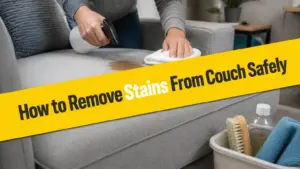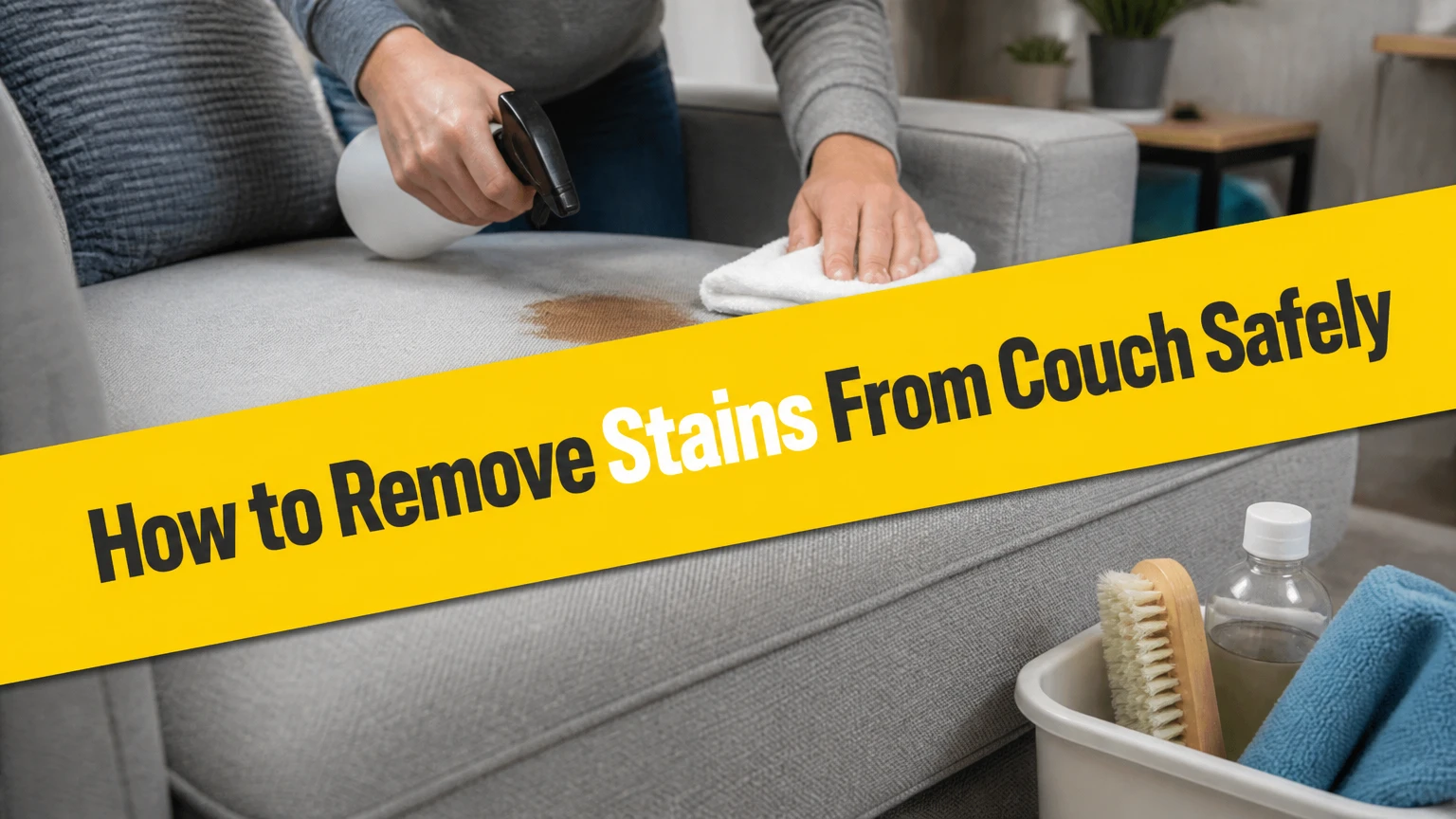
To remove stains from a couch, first identify the upholstery cleaning code, remove solids, blot excess liquid, and test a compatible cleaner on a hidden area. Apply a small amount from the stain’s edge inward, blot rather than scrub, remove residue, and dry the cushion quickly with airflow. The fabric code determines which method is safe.
Key Facts at a Glance
A W code permits a water-based upholstery cleaner, while S requires a solvent-based product.
An S/W or WS code permits either water-based or solvent-based cleaning, subject to the manufacturer’s instructions.
An X code permits vacuuming and gentle brushing only; liquid treatment can cause permanent damage.
Cold water is the safer choice for blood, milk, urine, and other protein-based stains because heat can set proteins.
A small stained area usually needs 1-2 teaspoons of solution, not a saturated cushion.
A couch cushion should dry fully, typically within 4-12 hours after damp cleaning, before anyone uses it.
What Is Couch Stain Removal?
Couch stain removal is the controlled process of separating foreign material from upholstery fibers, transferring the loosened material into a cloth or extraction machine, and drying the fabric without leaving residue or rings. Water-based cleaners suspend soil, solvents dissolve oily material, and enzyme products break down specific organic compounds.
A stain is usually a combination of a soil type, a liquid carrier, and a fabric surface. Coffee may contain water, tannins, sugar, and milk fat. A pet accident may contain urine salts, proteins, pigments, and contamination inside the foam. Treating only the visible color can leave the odor source below the cover.
Cleaning products work through different mechanisms:
- Surfactants: Dish soap and upholstery detergents reduce surface tension, surround oily particles, and help suspend soil.
- Solvents: Isopropyl alcohol and upholstery dry-cleaning solvents dissolve some inks, oils, and adhesive residues.
- Enzymes: Protease, amylase, and lipase target proteins, starches, and fats. An enzyme cleaner cannot remove every type of stain.
- Absorbents: Baking soda, cornstarch, and some commercial powders absorb surface oil, but they do not extract a deep stain.
- Extraction: A wet vacuum or upholstery machine removes suspended soil and moisture from the fabric and, to a limited extent, the cushion.
The American Cleaning Institute recommends following a product label and testing cleaning solutions on an inconspicuous area first. That rule matters because dye stability, backing material, and foam construction vary between sofas that appear to use the same fabric.
How Do You Read a Couch Cleaning Code?
Find the care label beneath a removable cushion, along the platform deck, or under the sofa frame. A tag marked W, S, WS, SW, or X describes the manufacturer’s recommended cleaning method, but the complete furniture-care label takes priority over a generic code chart.
| Code | Permitted method | Typical safe products | Main risk |
|---|---|---|---|
| W | Water-based cleaning | Upholstery shampoo, diluted detergent, enzyme cleaner | Water rings, dye bleed, over-wetting |
| S | Solvent-based cleaning | Upholstery solvent, dry-cleaning fluid | Fire risk, solvent marks, color loss |
| WS or SW | Water or solvent | Label-approved water or solvent cleaner | Testing failure, uneven drying |
| X | Vacuum and brushing only | Upholstery vacuum attachment, soft brush | Permanent rings, shrinkage, texture damage |
If the tag is missing, treat the couch as unknown, not automatically as W. Check the manufacturer’s website or model documentation, then test a hidden seam with the least aggressive compatible method. Silk, rayon, viscose, wool, antique textiles, and printed fabrics deserve professional assessment because moisture and friction can alter their texture or color permanently.
Do not infer a code from the fabric’s appearance. Polyester may tolerate water while a similar-looking viscose blend may develop distortion or watermarking.
What Is the Safest First Response?
The safest first response is to remove solid material, blot liquid with a white absorbent cloth, and stop the stain from spreading before choosing a chemical. Quick blotting reduces the amount that reaches the cushion foam, but pressure must remain controlled because aggressive rubbing pushes material sideways and downward.
Before You Start
| Requirement | Typical specification |
|---|---|
| Working time | 10-20 minutes for a fresh spot |
| Drying time | 4-12 hours for a damp-cleaned cushion |
| Basic cost | $3-$12 for cloths and mild detergent |
| Tools | 4 white microfiber cloths, spoon, bowl, fan, vacuum |
| Cleaner quantity | 1 teaspoon detergent in 2 cups water for W fabric |
| Safety check | Hidden-area test for 10 minutes, then inspect when dry |
Remove the cushion cover only if the care label says it can be machine-washed. Do not unzip a cover and wash it merely because the zipper is visible. Cover shrinkage can make reinstallation impossible.
Place a folded white towel beneath a removable cover or behind a thin stain when practical. The backing towel catches transferred color and prevents the stain from moving into another layer.
How to Remove Stains From Couch Upholstery
Use the seven-step method below for most fresh stains on W or WS upholstery. The process takes about 15-30 minutes of active work, while the cushion may need 4-12 hours to dry; the care code and the stain’s depth determine the result more than the brand of cleaner.
Step 1: Remove Solids and Blot Liquid
Scoop food, mud, vomit, or other solids with a spoon or dull card. Hold a folded white towel against liquid for 10-15 seconds, lift it, rotate to a dry section, and repeat until little moisture transfers.
Do not scrub in circles. Do not use colored paper towels, because dyes can transfer into damp upholstery.
Success checkpoint: The towel picks up only a faint mark after several presses.
Common mistake: Rubbing a wet stain outward and doubling its diameter.
Step 2: Identify the Stain and Fabric
Classify the material before applying a cleaner. Protein stains need cold treatment and often enzymes; greasy stains need a surfactant or compatible solvent; ink needs controlled alcohol testing; red wine and coffee need careful pigment removal.
Confirm the W, S, WS, or X code. For leather, velvet, suede, and faux leather, use the material-specific guidance below rather than the standard fabric recipe.
Success checkpoint: You can name both the stain family and the permitted cleaning method.
Common mistake: Applying a household product because it worked on clothing or carpet.
Step 3: Test the Cleaner on a Hidden Area
Apply 2-3 drops or a pea-sized amount of the selected product to an unseen seam. Blot with white cloth, wait at least 10 minutes, and inspect both wet and dry results for dye transfer, lightening, rings, stiffness, or texture change.
A test that looks safe while wet can still reveal a pale mark after drying. Solvents also require ventilation and no flame, cigarette, heater, or spark nearby.
Success checkpoint: No visible color change or texture change appears after drying.
Common mistake: Testing on the back of a cushion, then treating the visible side with a much larger amount.
Step 4: Apply a Small Amount of Cleaner
For W fabric, mix 1 teaspoon of clear, dye-free dish detergent with 2 cups of cool water. Dampen a white cloth rather than pouring the mixture onto the couch, then dab from the outside edge toward the center.
For S fabric, use a product specifically labeled for solvent-cleanable upholstery. Never substitute acetone, nail-polish remover, paint thinner, or gasoline.
Success checkpoint: The fabric is damp at the surface, not wet through to the foam.
Common mistake: Flooding the cushion in an attempt to dilute the mark.
Step 5: Allow the Cleaner to Dwell
Let a mild detergent solution sit for 3-5 minutes. Allow a labeled enzyme product to dwell for the time on its label, commonly 10-15 minutes. Keep the area damp during enzyme dwell, because dried enzymes stop working.
Do not use enzyme products on every stain. They are intended for biological soils, and some formulas can affect delicate fibers or finishes.
Success checkpoint: The stain begins transferring to the cloth with light pressure.
Common mistake: Leaving a solvent or detergent on the fabric for an unspecified extended period.
Step 6: Blot and Remove Residue
Press a clean white towel onto the treated area, hold for 10 seconds, and lift vertically. Repeat with fresh towel sections until color stops transferring. On W or WS fabric, use a separate cloth dampened with plain cool water to remove detergent residue, then blot again.
Residual soap attracts airborne dust and can leave a stiff or crunchy hand after drying. Rinsing does not mean saturating the cushion; two or three lightly damp passes are often enough.
Success checkpoint: The cloth lifts little color and the fabric no longer feels slippery.
Common mistake: Reusing the original dirty towel and redistributing the stain.
Step 7: Dry the Cushion Completely
Stand removable cushions on their edge, open windows if outdoor humidity is low, and direct a fan across the surface. Avoid high heat from hair dryers, radiators, and steam tools, which can set protein stains, shrink some textiles, or damage adhesives.
Inspect the fabric only after it is fully dry. A temporary dark patch is normal during evaporation; a hard ring, odor, or returning mark indicates a separate problem.
Success checkpoint: The cushion feels dry at the seams and has no cool, damp center.
Common mistake: Replacing the cushion while its foam is still wet.
Which Cleaner Should You Use?
The best couch stain cleaner is the least aggressive product that matches both the stain chemistry and the upholstery code. A mild detergent is suitable for many fresh food and dirt marks on W fabric, while solvent products suit some S fabrics and enzyme products suit biological contamination.
| Cleaner or method | Suitable material | Typical amount or time | Best use | Main limitation |
|---|---|---|---|---|
| Clear dish detergent and water | W, some WS fabrics | 1 tsp in 2 cups water, 3-5 minutes | Food, mud, light soil | Can leave residue |
| Enzyme upholstery cleaner | W, some WS fabrics | Label dose, 10-15 minutes | Urine, milk, vomit, organic residue | Not a universal stain remover |
| Upholstery solvent | S, some WS fabrics | Label dose, 2-5 minutes | Grease, oil, some ink | Flammable and color-sensitive |
| Isopropyl alcohol | Tested microfiber or compatible S fabric | 70-91%, small drops | Ballpoint ink, some dye transfer | Can spread color or affect backing |
| Hydrogen peroxide | Tested light, colorfast W fabric | 3% solution, short contact | Some organic or pigment marks | Can lighten dyed upholstery |
| Baking soda or cornstarch | Dry, compatible fabric | 30-60 minutes before vacuuming | Surface oil and odor | Does not remove deep contamination |
Avoid mixing vinegar, peroxide, bleach, ammonia, and commercial cleaners. Chemical combinations can create irritating vapors or make a fabric damage problem harder to diagnose. A vinegar-and-baking-soda mixture mostly produces fizz and diluted salts; it is not a stronger upholstery cleaner.
How Do You Treat Protein Stains?
Treat blood, milk, urine, and vomit with cool water and a compatible enzyme cleaner, because heat can bind protein residue more firmly to fibers. Blot first, apply the enzyme product at its label concentration, allow 10-15 minutes of dwell, then rinse lightly and dry with strong airflow.
For blood, use cold water only and work from the perimeter inward. For milk or vomit, remove solids and use an enzyme product that addresses both protein and odor. For urine, surface cleaning is insufficient when liquid has reached foam, batting, or the floor beneath the couch.
Pet urine requires an important distinction: an enzymatic spray can reduce odor at the surface, but it may not reach the full contaminated volume. If odor returns after complete drying, professional subsurface extraction or cushion-core replacement may be more effective than repeated spraying.
Never combine an enzyme cleaner with disinfectant, bleach, or a hot steam treatment. Heat can reduce enzyme activity and may set protein residue before the cleaner has worked.
How Do You Remove Oil and Grease?
Remove couch grease by lifting excess oil with a dry absorbent, then using a code-compatible detergent or solvent. Sprinkle a thin layer of baking soda or cornstarch over fresh surface oil for 30-60 minutes, vacuum it gently, and treat the remaining film without grinding powder into the weave.
On W fabric, place one drop of clear dish detergent on a damp white cloth and dab the mark. Work in small sections, because detergent can create a larger halo than the original grease if applied heavily.
On S fabric, use an upholstery solvent after testing. Apply solvent to the cloth, not directly to the couch, unless the product label specifically permits direct application. Keep changing cloth sections so dissolved oil is transferred away rather than redeposited.
Body oil on a headrest may require cleaning the entire cushion panel from seam to seam. Spot-treating only the darkest center can leave a clean island surrounded by a broader soil shadow.
How Do You Remove Coffee, Wine, and Juice?
Remove coffee, red wine, and juice by blotting immediately, then using a tested water-based upholstery cleaner on W or WS fabric. Plain water may remove the liquid carrier, but sugar, milk fat, tannins, and dyes can remain after the surface appears clean.
For coffee with milk, treat it as both a pigment and protein stain. Cool water and a mild detergent are safer than hot water. For red wine or berry juice, avoid pouring salt, club soda, or large volumes of water onto the cushion; these may spread the liquid and create a ring without removing the dye.
A 3% hydrogen peroxide product can lighten some stains on pale, colorfast W upholstery, but test it first and use a short contact time. Peroxide is an oxidizer, not a universal remedy, and it can permanently lighten colored fabric.
Do not use peroxide on dark or unstable dyes without a successful dry test. If pigment remains after two controlled treatments, stop escalating household chemistry.
How Do You Remove Ink?
Remove fresh ballpoint ink from tested microfiber or solvent-compatible upholstery with small applications of 70-91% isopropyl alcohol. Place an absorbent white towel beneath the fabric where possible, touch alcohol to the ink with a cotton swab or dropper, and blot immediately as the ink transfers.
Repeat with clean towel sections rather than rubbing the mark. Alcohol can dissolve the ink carrier, but it can also mobilize upholstery dye, soften some coatings, or carry ink into the backing.
Do not use alcohol on acetate, silk, untested printed fabric, or leather finishes. Permanent marker may require a professional solvent system because repeated home treatment can create a larger pale or glossy patch.
Ventilate the room and keep alcohol away from candles, gas flames, heaters, and electrical sparks. The treated area should dry rapidly, but rapid drying does not correct color loss.
How Do Material-Specific Methods Differ?
Material-specific couch cleaning differs more than stain-specific advice. Fabric upholstery tolerates some controlled moisture, leather needs finish-safe wiping and conditioning, and velvet or viscose can change pile direction or develop permanent marks from pressure.
| Couch material | First-line method | Avoid | Typical drying or recovery |
|---|---|---|---|
| Polyester fabric | Code-approved detergent or solvent | High heat and aggressive scrubbing | 4-8 hours |
| Microfiber | Tested alcohol or mild water method | Excess water and circular rubbing | 1-4 hours |
| Cotton or linen blend | W-code cleaner with low moisture | Over-wetting and bleach | 6-12 hours |
| Velvet | Vacuum and professional spot treatment | Saturation, brushing against pile | 12-24 hours if damp |
| Leather | Distilled-water-damp cloth, leather cleaner | Dish soap, peroxide, alcohol | 30-90 minutes |
| Faux leather | Manufacturer-approved cleaner | Solvent, acetone, abrasive powder | 30-120 minutes |
| Viscose, rayon, silk, wool | Professional evaluation | DIY wet cleaning and heat | Variable, often 12-24 hours |
For finished leather, remove liquid promptly with a dry cloth, then use a cleaner made for the specific finish. Aniline leather, nubuck, and suede need different products; a general leather wipe can darken porous leather.
For velvet, blot without flattening the pile and avoid steam unless the manufacturer permits it. Faux suede often shows nap marks, so restore the direction with a soft brush only after the area is dry and the care label allows brushing.
Should You Use Steam or an Extractor?
Use an upholstery extractor only on compatible W or WS furniture when you can control moisture and provide adequate drying. Steam and hot-water extraction can clean embedded soil, but neither method is automatically safe, and neither guarantees sanitization throughout foam.
| Method | Equipment cost, typical | Active time | Drying time | Appropriate use |
|---|---|---|---|---|
| Hand spot cleaning | $3-$15 | 15-30 minutes | 4-12 hours | One or two small stains |
| Rental extractor | $30-$80 per day | 1-3 hours | 6-12 hours | Several W-code cushions |
| Home upholstery machine | $100-$300 purchase | 1-3 hours | 6-12 hours | Recurring fabric maintenance |
| Low-moisture professional clean | $100-$250 per sofa | 1-2 hours | 2-6 hours | Moderate soil and delicate construction |
| Full professional extraction | $150-$400 per sofa | 2-4 hours | 8-24 hours | Deep contamination or many cushions |
The common claim that steam always sanitizes a couch is too broad. The result depends on delivered temperature, contact time, soil load, penetration, and whether the heat reaches the contaminated material without damaging the textile.
Do not steam blood, milk, or other protein stains before treating them. Do not use an extractor on X-code upholstery, loose-weave fabric, unsealed leather, or material with known dye instability.
What Does Couch Stain Removal Cost?
Typical couch stain-removal costs range from $3-$15 for a small DIY spot treatment, $30-$80 for a rental machine, and $100-$400 for professional service. The final price depends on sofa size, location, number of cushions, access, fabric risk, odor contamination, and whether foam extraction is needed.
| Service or supply | Typical cost | Typical duration | Best financial choice |
|---|---|---|---|
| White microfiber cloth pack | $5-$15 | Reusable for months | Basic emergency kit |
| Mild detergent solution | Under $3 | 15-30 minutes | Fresh W-code food marks |
| Enzyme upholstery spray | $8-$25 | 20-40 minutes | Pet and biological stains |
| Upholstery solvent | $10-$30 | 15-30 minutes | Tested S-code stains |
| Rental extractor | $30-$80 per day | 1-3 hours | Multiple removable cushions |
| Professional upholstery cleaning | $100-$400 per sofa | 2-4 hours | Deep, delicate, or recurring stains |
A professional quote should state whether it includes deodorizing, cushion interiors, travel, stain-spotting, and drying instructions. The cheapest quote may cover only surface cleaning and may not address urine in foam or dye migration.
How Do You Fix Wicking and Water Rings?
Fix a water ring by cleaning the entire affected cushion panel evenly, while fixing wicking requires drawing contamination back out of the fabric and foam. A dark edge often represents displaced soil, whereas a stain that reappears after drying usually indicates material rising from below.
For a W or WS cushion with a ring, lightly dampen the full panel from seam to seam with the same compatible solution, then extract or blot evenly. Treating only the outline usually creates another boundary.
For wicking, re-clean the surface with minimal moisture, place thick white towels over the area, and apply light, even weight for several hours. Replace damp towels as needed. This can pull moisture and dissolved soil upward into the towel instead of allowing it to dry at the surface.
For a stiff or crunchy feel, remove detergent residue with a barely damp plain-water cloth, then blot and dry. If the smell returns, the contamination likely remains in foam or batting rather than on the cover.
Common Mistakes and How to Fix Them
- Using hot water on blood or milk: Stop heating, blot with cool water, and use a tested enzyme product. Set protein may need professional treatment.
- Scrubbing back and forth: Stop before fibers become fuzzy. Trim no fibers, and let a professional assess texture damage.
- Over-wetting the cushion: Remove the cover only when washable, increase airflow, and dry the foam completely before reuse.
- Using bleach or peroxide on dark fabric: Rinse only if the code permits water, then assess whether color loss is permanent.
- Applying solvent to an open flame area: Ventilate immediately, remove ignition sources, and follow the product safety label.
- Mixing several cleaners: Stop adding chemicals. Blot with the code-approved method and contact the product manufacturer if irritation or strong fumes occur.
One practitioner rule prevents many failures: the amount of liquid should match the depth of the problem. A surface coffee drop needs controlled dampening; urine that reached foam needs extraction, not repeated surface spraying.
When Is Professional Cleaning Safer?
Professional upholstery cleaning is safer when the sofa has an X code, delicate fiber, antique construction, severe dye transfer, extensive urine, mold odor, or a stain larger than one cushion. A certified cleaner can identify fiber behavior, select low-moisture or solvent methods, and extract contamination that household towels cannot reach.
Hire help when any of these conditions apply:
- The care label prohibits liquid and the stain is liquid-based.
- Viscose, rayon, silk, wool, suede, or aniline leather is involved.
- The stain covers more than 25% of a cushion.
- Odor returns after the fabric has dried completely.
- A rental extractor leaves the cushion wet after 12 hours.
- The couch has a manufacturer warranty that DIY chemicals could void.
- The mark is caused by unknown chemical exposure, paint, or bodily contamination.
Photograph the stain before treatment, record products used, and tell the cleaner whether the cushion was already wet-cleaned. That information helps distinguish original staining from detergent residue, dye bleed, or wicking.
How Can You Prevent Couch Stains?
Prevent couch stains by removing food and liquid quickly, vacuuming weekly, and using a washable barrier on high-use seats. Fabric protector sprays can improve liquid resistance, but they do not make upholstery stain-proof and must match the manufacturer’s finish requirements.
A practical maintenance schedule includes:
- Vacuum seats, crevices, and under cushions every 1-2 weeks.
- Rotate reversible cushions monthly to distribute body oil and wear.
- Clean high-contact arms and headrests every 2-3 months.
- Treat spills within 5 minutes whenever possible.
- Keep pet accidents off the couch until the cover and foam are completely dry.
- Store white cloths, a spoon, cool water, and a code-approved cleaner nearby.
Avoid applying protector spray over an unremoved stain. The coating can make later professional treatment more difficult and may lock odor or discoloration beneath the finish.
FAQ
Can I Use Vinegar to Remove a Couch Stain?
Use diluted vinegar only when the upholstery manufacturer permits it and a hidden test shows no color or texture change. Vinegar may reduce some odors and mineral residue, but it is not a reliable solvent for grease, ink, or deep urine. Never mix vinegar with bleach, peroxide, or ammonia.
How Long Should a Couch Take to Dry?
A lightly damp spot often dries in 1-4 hours, while a cleaned cotton blend cushion commonly needs 6-12 hours. High humidity, thick foam, dense fabric, and over-wetting can extend drying beyond 24 hours. Use fans and do not close or stack cushions while the center remains cool or damp.
Can Baking Soda Remove Old Couch Stains?
Baking soda can absorb some surface oil and reduce odor after 30-60 minutes, but it cannot extract a deep or chemically bonded stain by itself. Vacuum it gently, then use the upholstery-code method. Old stains may require repeated controlled treatment or professional extraction.
How Do I Clean a Couch Without a Care Label?
Contact the furniture maker first and inspect an unseen seam with the least aggressive method. If the fiber is unknown, avoid soaking, bleach, peroxide, and strong solvents. A professional cleaner is the safer option for vintage upholstery, viscose, silk, wool, and fabrics that show dye transfer during testing.
Why Did My Couch Stain Get Bigger After Cleaning?
A stain gets bigger when moisture dissolves soil and carries it beyond the original mark, or when scrubbing spreads the material through the weave. Stop applying liquid, allow the area to dry, then clean the full cushion panel evenly with a compatible low-moisture method.
Is It Better to Replace a Stained Cushion?
Replace a cushion insert when urine, mold, or persistent odor remains inside the foam after proper extraction, or when the cover has irreversible bleach or dye damage. Surface discoloration alone does not justify replacement if the fabric remains structurally sound and the stain responds to code-approved cleaning.
The Bottom Line
To remove stains from couch upholstery safely, match the cleaner to the care code, identify the stain chemistry, use minimal moisture, blot in controlled passes, and dry the cushion fully. Water-based detergent suits many W-code marks, enzymes suit biological residue, solvents suit tested S-code fabric, and X-code or delicate upholstery usually needs a professional.