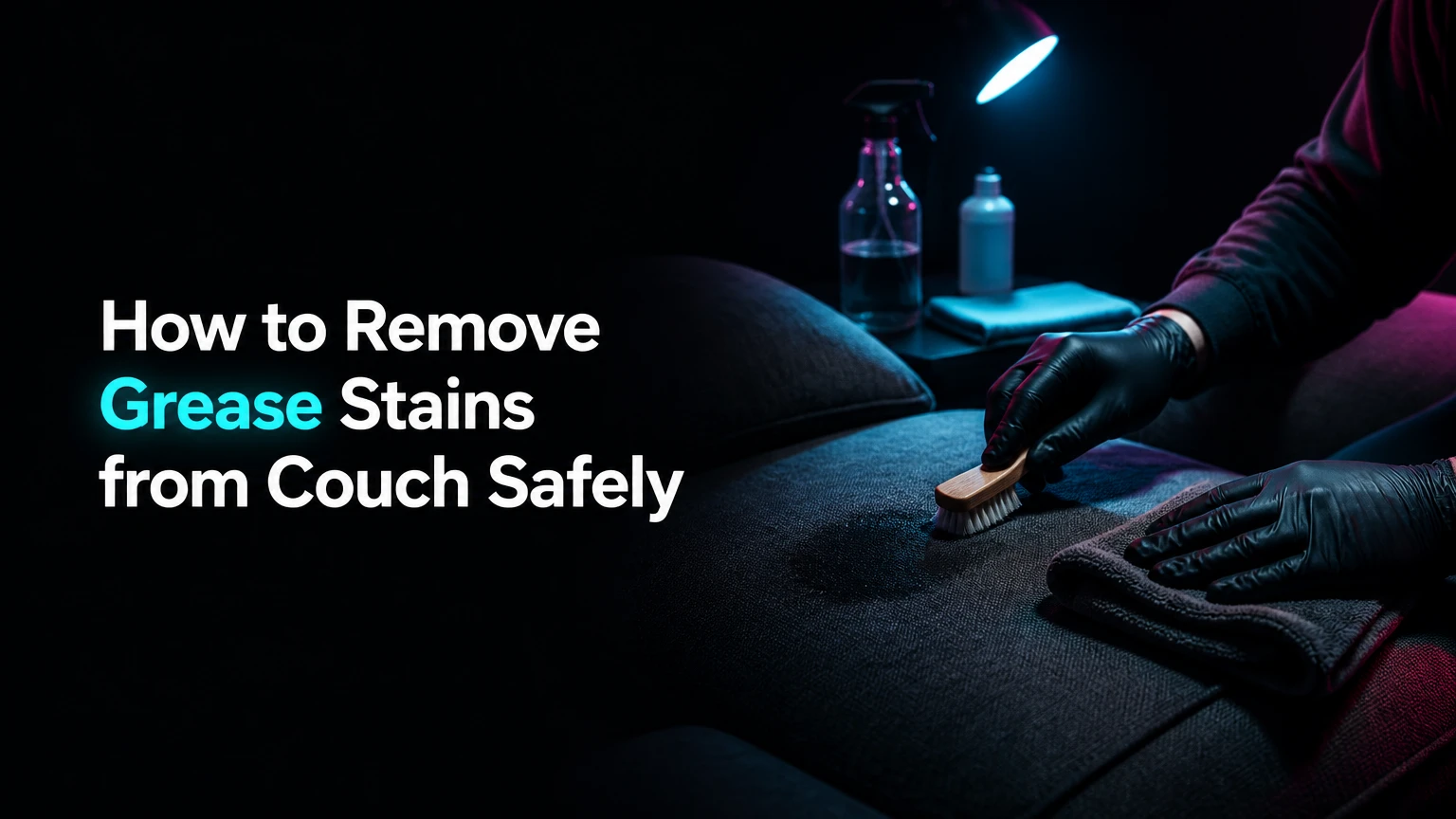
To remove grease stains from a couch, first check the upholstery cleaning code, then absorb surface oil with an approved powder before using a compatible cleaner. Use diluted dish soap only on W or S-W fabrics, a water-free solvent on S fabrics, and vacuum-only care on X fabrics. Fresh grease usually responds within 30-60 minutes; dried grease may require several treatments.
Key Facts at a Glance
Upholstery code W permits water-based cleaning, S requires a water-free solvent, S-W permits either, and X permits vacuuming only.
Powder absorbs surface oil but cannot reliably remove grease that has penetrated foam or aged inside fabric.
A practical dish-soap dilution for W or S-W upholstery is 1 teaspoon in 2 cups of lukewarm water.
White cloths, minimal moisture, and air drying reduce dye transfer, water rings, and fabric distortion.
Never scrub, iron, steam, or apply a solvent directly to a cushion without testing the hidden fabric first.
Professional cleaning is the safest next step for X-code upholstery, luxury fibers, extensive stains, and grease that reaches the cushion interior.
What Should You Do Before Cleaning Couch Grease?
Before cleaning couch grease, identify the upholstery code, remove loose debris, and test every product on a concealed area. The care tag usually appears beneath a removable cushion, under the sofa platform, or along the frame. If the tag is missing, treat the fabric as unverified rather than assuming water is safe.
Before You Start
| Requirement | Typical specification | Why it matters |
|---|---|---|
| Working time | 30-60 minutes | Covers absorption, treatment, rinsing, and initial drying |
| Heavy dried stain | 2-4 treatment cycles | One application rarely removes aged grease completely |
| Dish soap | 1 teaspoon in 2 cups water | Limits residue and over-wetting |
| Absorbent powder | 2-4 tablespoons per 10 cm stain | Creates full, opaque coverage |
| Cloths | 3-4 white microfiber cloths | Separates cleaning, rinsing, and drying |
| Vacuum | Upholstery or brush attachment | Removes loose powder without grinding it in |
| Ventilation | Open window plus fan | Helps water and solvent evaporate safely |
| Patch test | 10 cm hidden area, 15 minutes | Checks color transfer, texture, and finish change |
Read the manufacturer’s instructions as well as the code. A code describes the permitted cleaning chemistry, but it does not guarantee that every dish soap, solvent, brush, or extraction machine is suitable for the fabric’s dye, coating, backing, or finish.
Do not remove a cushion cover unless the care label specifically permits machine washing or dry cleaning. Grease can migrate through the cover into batting and foam, so washing only the outer cover can leave a shadow or create shrinkage around seams.
Which Upholstery Code Controls the Cleaning Method?
The upholstery code determines whether water, solvent, both, or neither can contact the couch fabric. Code labels are care instructions, not stain-removal guarantees, so a compatible cleaner still requires a hidden-area test and controlled application.
| Code | Permitted approach | Avoid | Appropriate grease strategy |
|---|---|---|---|
| W | Water-based upholstery cleaner, limited water, diluted dish soap | Saturation, harsh solvents, hot steam | Powder first, then low-moisture emulsification |
| S | Water-free upholstery solvent | Water, wet extraction, ordinary soap solution | Powder first, then solvent blotting |
| S-W | Water-based or solvent-based cleaner | Excess liquid, untested chemicals | Choose the lower-risk method for the fiber |
| X | Vacuuming only unless manufacturer says otherwise | Water, soap, solvent, powder residue | Vacuum loose material and call a professional |
| No code | Manufacturer-approved method only | Assuming W or S | Contact the maker or use a professional |
Code W does not mean the couch can be soaked. Water-safe upholstery can still develop rings, backing separation, dye bleed, or slow-drying odors when too much liquid reaches the cushion.
Code S does not mean every household solvent is safe. Use a product labeled for upholstery, follow its label, ventilate the room, and keep solvents away from flames, pilot lights, children, and pets.
Code X is the most restrictive category. The safest interpretation is dry vacuuming only, because even a supposedly harmless powder can lodge in the weave or interact with a protective finish.
Why Does Grease Need More Than Water?
Grease needs absorption or surfactant action because oil and water have different molecular behavior. Water is polar, while common cooking oils and fats are largely nonpolar, so plain water cannot carry grease away from upholstery fibers without an additional cleaning mechanism.
Three mechanisms matter:
- Absorption: Cornstarch or another fine absorbent captures liquid oil near the surface. Vacuuming then removes the powder and some oil together.
- Emulsification: Dish soap contains surfactants that surround oil droplets and help suspend them in water, allowing a cloth to lift the mixture.
- Dissolution: An upholstery solvent dissolves certain oil-based soils without introducing water to a water-sensitive textile.
Powder is a first step, not a complete chemical solution. It works best on a fresh spill that remains near the surface. A yellowed or translucent patch after vacuuming indicates that grease remains, not that the powder has failed entirely.
An important practitioner distinction is stain type. Butter, cooking oil, mayonnaise, and salad dressing are food fats. Body oil is a slower, darker buildup that often covers a larger panel. Petroleum grease, bicycle lubricant, and automotive products may contain dyes or additives that require professional solvent treatment.
How Do You Remove Fresh Grease from a W or S-W Couch?
To remove fresh grease from a W or S-W couch, lift solids, blot liquid oil, cover the spot with absorbent powder, vacuum it, and follow with a small amount of diluted dish soap if a shadow remains. Keep the wet area smaller than a hand and prevent liquid from reaching the cushion core.
Step 1: Lift Solids Without Spreading the Oil
Use the edge of a spoon or a blunt plastic card to lift butter, food, or congealed fat. Hold the tool nearly flat and work from the outside toward the center. Do not drag a solid lump across clean fabric.
Place a white paper towel or dry microfiber cloth over the remaining grease and press vertically for 5-10 seconds. Replace the cloth as soon as it becomes translucent.
Success checkpoint: The cloth picks up less oil after two or three presses.
Common mistake: Rubbing in circles spreads the stain and pushes grease below the surface.
Step 2: Apply an Absorbent Powder
Cover the spot completely with a 3-5 mm layer of cornstarch or baking soda. Cornstarch is usually easier to remove from a dense weave; baking soda is useful when odor accompanies the spill. Avoid talc where inhalation exposure is a concern, and do not use loose powder on an X-code couch unless the manufacturer permits it.
Leave the powder for 30 minutes for a small fresh spill. Leave it for 4-8 hours when the grease is thick, or when the powder becomes visibly yellow or clumped.
Success checkpoint: The powder has changed color, formed small clumps, or no longer looks bright white.
Common mistake: Applying a thin dusting that cannot contact the entire oily surface.
Step 3: Vacuum the Powder
Use a clean upholstery or brush attachment at low suction if the fabric has a raised nap. Make two slow passes in different directions, keeping the nozzle moving. Do not press a bare vacuum hose onto velvet, chenille, or loose-loop upholstery.
Repeat the powder treatment once if the area still looks glossy. Repeated powder cycles are safer than adding water immediately, especially on S-code fabric.
Success checkpoint: The fabric no longer feels greasy when touched with a clean fingertip through a white cloth.
Common mistake: Leaving powder in the weave, where moisture can later turn it into residue.
Step 4: Emulsify Residue on W or S-W Fabric
Mix 1 teaspoon of grease-cutting dish soap with 2 cups of lukewarm water. Dip a white microfiber cloth into the solution and wring it until damp, not wet. Test the solution on a hidden area for 15 minutes, then blot the stain from its outside edge toward the center.
Use one clean section of cloth per pass. Stop after 2-3 passes rather than repeatedly wetting the fabric.
Success checkpoint: The oily sheen decreases without a spreading wet halo.
Common mistake: Pouring the solution onto the couch, which drives grease into foam and creates a large drying boundary.
Step 5: Rinse and Dry the Area
Dampen a second white cloth with plain water and wring it firmly. Blot the cleaned area to remove soap, then press a dry towel over the spot for 30-60 seconds. Leave the cushion uncovered with a fan moving room-temperature air across it.
Drying can take 2-6 hours, depending on fabric density, humidity, and how much water entered the backing.
Success checkpoint: The fabric feels dry and flexible, with no slippery or sticky residue.
Common mistake: Using a hair dryer on high heat, which can set oil, distort synthetic fibers, or create a visible drying boundary.
How Do You Remove Dried Grease from Upholstery?
To remove dried grease from upholstery, soften the surface deposit with repeated absorption, then use the code-approved cleaner in small blotting cycles. Dried grease is harder because oxidation and fabric penetration reduce the effectiveness of one-step treatments, so patience is safer than stronger chemicals.
First vacuum the area to remove dust. Dust mixed with dish soap can form a gray paste, and that paste can spread farther than the original grease.
Apply cornstarch for 4-8 hours, vacuum thoroughly, and inspect under side lighting. If the patch remains dark or glossy, perform a second powder cycle before selecting a wet or solvent method.
For W or S-W fabric, use the diluted dish-soap method above, but allow 5 minutes of contact time after the first blotting pass. Do not let the solution dry as a concentrated soap film. Rinse with a barely damp cloth after each small cycle.
For S or S-W fabric, use an upholstery dry-cleaning solvent. Apply solvent to a white cloth, never directly to the cushion, and blot from the perimeter inward. Allow the solvent to evaporate completely before deciding whether another pass is needed.
Dried grease may have reached batting or foam. A surface treatment can remove the visible mark while leaving a faint odor or shadow, which is a sign that professional extraction or cushion disassembly may be necessary.
Which Grease-Removal Method Is Best for Your Couch?
The best grease-removal method depends on the upholstery code, stain age, and whether the oil remains at the surface. Powder is the lowest-risk first step, dish soap is effective on W and S-W fabric, and solvent is the correct category for S fabric.
| Method | Compatible code | Typical cost | Working time | Main limitation |
|---|---|---|---|---|
| Cornstarch absorption | W, S, S-W, with label approval | $1-$5 | 30 minutes-8 hours | Does not remove deeply penetrated grease |
| Diluted dish soap | W, S-W | $1-$8 | 20-45 minutes | Can leave rings or soap residue |
| Upholstery dry solvent | S, S-W | $8-$25 | 15-40 minutes | Fumes and finish damage if misused |
| Commercial upholstery cleaner | Product-specific W or S-W | $8-$20 | 20-60 minutes | Formula may bleach or over-wet fabric |
| Professional cleaning | All, subject to technician assessment | $100-$300 typical | 1-4 hours onsite | Higher cost and appointment required |
A commercial enzyme spray is not automatically the best choice for grease. Enzymes target particular organic compounds and may help with food or biological residues, but cooking oil removal still depends heavily on surfactants, solvent compatibility, and physical extraction. Follow the product label rather than combining an enzyme product with dish soap or solvent.
What Is the Best Order of Operations?
Use the least aggressive effective sequence: dry blotting, approved powder, vacuuming, code-compatible cleaner, controlled rinsing, and room-temperature drying. This sequence removes loose oil before liquid treatment and limits the amount of chemistry that reaches the fabric backing.
The sequence changes for S fabric because water is excluded. The sequence also stops at vacuuming for X fabric. A professional may use specialized equipment or chemistry that is unavailable to a homeowner.
How Do You Use Solvent on S-Code Couch Fabric?
To use solvent on S-code couch fabric, apply a small amount of upholstery-labeled water-free solvent to a white cloth, test a hidden area, and blot the grease without saturating the cushion. Ventilation and evaporation are part of the procedure, not optional finishing steps.
Step 1: Prepare the Room
Open a window, switch off candles and gas appliances, and keep pets and children away. Check the solvent label for ventilation, glove, and flammability instructions.
Vacuum and powder-treat the stain first. Solvent works more predictably when it is not immediately diluted by loose food particles or a thick surface layer of oil.
Step 2: Patch-Test the Finish
Apply solvent to a concealed section using a cotton swab or white cloth. Wait 15 minutes, then inspect for dye transfer, a lighter patch, sticky coating, rough texture, or altered nap.
If the finish changes, stop. A solvent reaction can be permanent even when the grease disappears.
Step 3: Blot in Small Sections
Put a teaspoon or less of solvent on the cloth, not on the couch. Press and lift repeatedly over a 5-8 cm section, moving to a clean area of cloth as oil transfers. Work from the outer edge toward the center.
Do not scrub velvet, silk, wool, or microfiber with a stiff brush. Friction can permanently change the direction or sheen of the pile.
Step 4: Evaporate and Reassess
Allow the area to dry naturally for at least 30 minutes in moving air. The final appearance may change as the solvent evaporates, so do not add more product while the fabric still feels cool or damp.
Success checkpoint: The fabric has no oily sheen, solvent odor is declining, and the nap matches the surrounding area.
Common mistake: Pouring solvent into the cushion, where it can attack foam, adhesive, backing, or internal fire barriers.
How Do You Remove Grease from Microfiber, Velvet, or Leather?
Microfiber, velvet, and leather require material-specific care because surface texture, coatings, and dye systems react differently to moisture. A microfiber code still controls cleaner choice, velvet can show permanent nap changes, and leather needs a leather cleaner rather than fabric soap.
| Material | Typical risk | Safer first action | Stop and escalate when |
|---|---|---|---|
| Microfiber polyester | Water rings and dark nap marks | Check code, powder, then minimal approved cleaner | Nap remains dark after dry brushing |
| Velvet | Crushed pile, sheen change, tide marks | Dry blot and label-approved solvent or professional care | Pile direction or color changes |
| Wool | Felting, shrinkage, dye bleed | Professional or label-approved low-moisture cleaning | Stain is larger than 5 cm |
| Silk | Water marks, color loss, fiber weakness | Professional dry cleaning | Any visible dye transfer occurs |
| Suede or nubuck | Darkened nap and permanent water marks | Suede-specific dry method | Grease has penetrated the nap |
| Finished leather | Finish stripping and dark oil shadow | Blot, then leather-specific cleaner and conditioner | Leather becomes sticky, pale, or cracked |
For microfiber, brushing should happen only after the fabric is fully dry. Use a soft upholstery brush in the existing nap direction; aggressive brushing while damp can create a larger dark patch.
For leather, blot excess oil with a dry cloth and follow the manufacturer’s leather-care instructions. Do not use baking soda, dish soap, rubbing alcohol, acetone, or fabric solvent unless the leather manufacturer explicitly approves the product.
Which Products Should You Avoid?
Avoid bleach, vinegar, hydrogen peroxide, abrasive powders, concentrated dish soap, and general-purpose degreasers unless the upholstery manufacturer specifically approves them. These products can lighten dye, strip protective finishes, weaken fibers, or leave residues that attract more soil.
Avoid these common shortcuts:
- Hot water or steam: Heat and moisture can spread oil, set some residues, and drive liquid into foam.
- Hair dryers on high heat: Uneven drying creates rings and can distort synthetic upholstery.
- Colored towels: Red, blue, or dark dyes can transfer when the cloth becomes wet or solvent-laden.
- Ammonia and bleach mixtures: Combining cleaners can release hazardous gases.
- Laundry detergent: Detergent may contain brighteners, enzymes, or fragrances that are difficult to rinse from upholstery.
- Abrasive scrubbing: Friction damages pile and spreads grease beyond the treated zone.
- Direct solvent application: A wet spot can penetrate backing and foam before evaporation begins.
A grease stain is not a reason to clean the entire couch with an untested homemade mixture. Broad wet cleaning often creates a larger, less uniform problem than the original spot.
Why Did a Ring or Dark Patch Appear?
A water ring appears when dissolved soil, soap, or dye migrates to the edge of a wet area as the upholstery dries. The ring is usually a drying-boundary problem rather than proof that the grease became chemically worse.
For W or S-W fabric, lightly dampen a clean white cloth with plain water and blot across the entire fabric panel from seam to seam. The goal is uniform moisture, not saturation. Extract excess moisture with dry towels and dry the panel evenly with a fan.
Do not use this correction on S, X, silk, suede, or other water-sensitive materials. A professional technician can often clean the full panel with controlled moisture or solvent so the appearance remains uniform.
| Problem | Likely cause | Safe correction | Expected limit |
|---|---|---|---|
| Grease spread outward | Rubbing or excess liquid | Dry powder, vacuum, treat smaller sections | May need 2-3 cycles |
| White powder remains | Incomplete vacuuming | Vacuum with a soft brush attachment | Avoid dampening residue |
| Fabric feels stiff | Dried soap or powder | Rinse-blot with a barely damp cloth on W fabric | Do not rinse S or X fabric |
| Dark ring formed | Uneven drying or soil migration | Treat the full panel on compatible W fabric | Professional help for delicate fabric |
| Oily smell remains | Grease reached batting or foam | Stop repeated surface treatment | Professional extraction may be required |
| Color changed | Dye bleed or finish damage | Stop and let dry; photograph the area | Further chemicals can worsen damage |
When Should You Hire a Professional Upholstery Cleaner?
Hire a professional when the couch is X-code, the fabric is silk or antique velvet, the grease covers more than one cushion, the oil has reached foam, or two careful treatments have not improved the stain. Professional cleaning is also appropriate when the care label is missing and the sofa has high replacement value.
A technician should inspect the fiber, backing, dye stability, cushion construction, and stain chemistry before choosing water extraction, low-moisture cleaning, or solvent treatment. Ask whether the quoted service includes spot treatment, full-panel cleaning, drying equipment, and protection reapplication.
Professional cleaning is not guaranteed to erase an aged stain. Oxidized oil can permanently discolor fibers, and a dark patch may represent finish damage rather than removable grease. A competent cleaner should explain that limitation before treatment.
Typical household spot-cleaning costs range from $1-$25 for materials. Professional upholstery visits commonly fall around $100-$300, but local labor, couch size, fabric delicacy, travel, and stain severity can move the price outside that range.
FAQ About Removing Couch Grease
Can baking soda remove grease from a fabric couch?
Baking soda can absorb some fresh surface grease, but it cannot dissolve oil that has penetrated deeply into upholstery. Cover the stain, wait 30 minutes to 8 hours, vacuum thoroughly, and repeat once if needed. Use powder only when the care label permits dry treatment, especially on X-code upholstery.
Can I use Dawn dish soap on my couch?
Use dish soap only when the care label permits water, usually W or S-W upholstery. Dilute 1 teaspoon in 2 cups of lukewarm water, apply it to a wrung-out white cloth, blot lightly, rinse with a separate damp cloth, and dry with airflow. Never use this method on S or X fabric.
How do I remove old body-oil stains from a couch?
Old body-oil stains need repeated low-moisture treatment rather than one strong application. Vacuum first, use an approved absorbent powder, then apply the code-compatible cleaner to a small section. Body oil often covers an entire contact panel, so cleaning only the darkest center can create a visible halo.
Does vinegar remove grease stains from upholstery?
Vinegar is not a reliable grease solvent and can create odor, discoloration, or finish changes on some upholstery. Vinegar also does not replace the surfactant action of a properly diluted upholstery cleaner. Avoid it unless the couch manufacturer specifically lists vinegar as an approved product.
Can I remove grease from a couch cushion cover in the washing machine?
Machine-wash a cushion cover only when its care label explicitly permits machine washing. Check whether the cover is preshrunk, close all fasteners, use the stated temperature, and air-dry it before reinstalling. Washing an unapproved cover can shrink seams, distort the fit, or set an oil shadow.
How long does a couch take to dry after cleaning?
A lightly damp W-code spot usually dries in 2-6 hours with airflow, while a heavily wetted cushion can take 12-24 hours. Do not use the couch until the fabric and cushion edge feel completely dry. Persistent dampness indicates over-wetting, high humidity, or moisture trapped inside the cushion.
The Bottom Line
To remove grease stains from couch upholstery, begin with the care code, blot without rubbing, absorb fresh oil, and use only the chemistry that the fabric permits. W and S-W fabrics can receive a carefully diluted dish-soap treatment, S fabrics need an upholstery-safe water-free solvent, and X fabrics should be vacuumed or professionally assessed. The safest method for how to remove grease stains from couch upholstery is the least aggressive method that fully matches the material, stain age, and cushion construction.