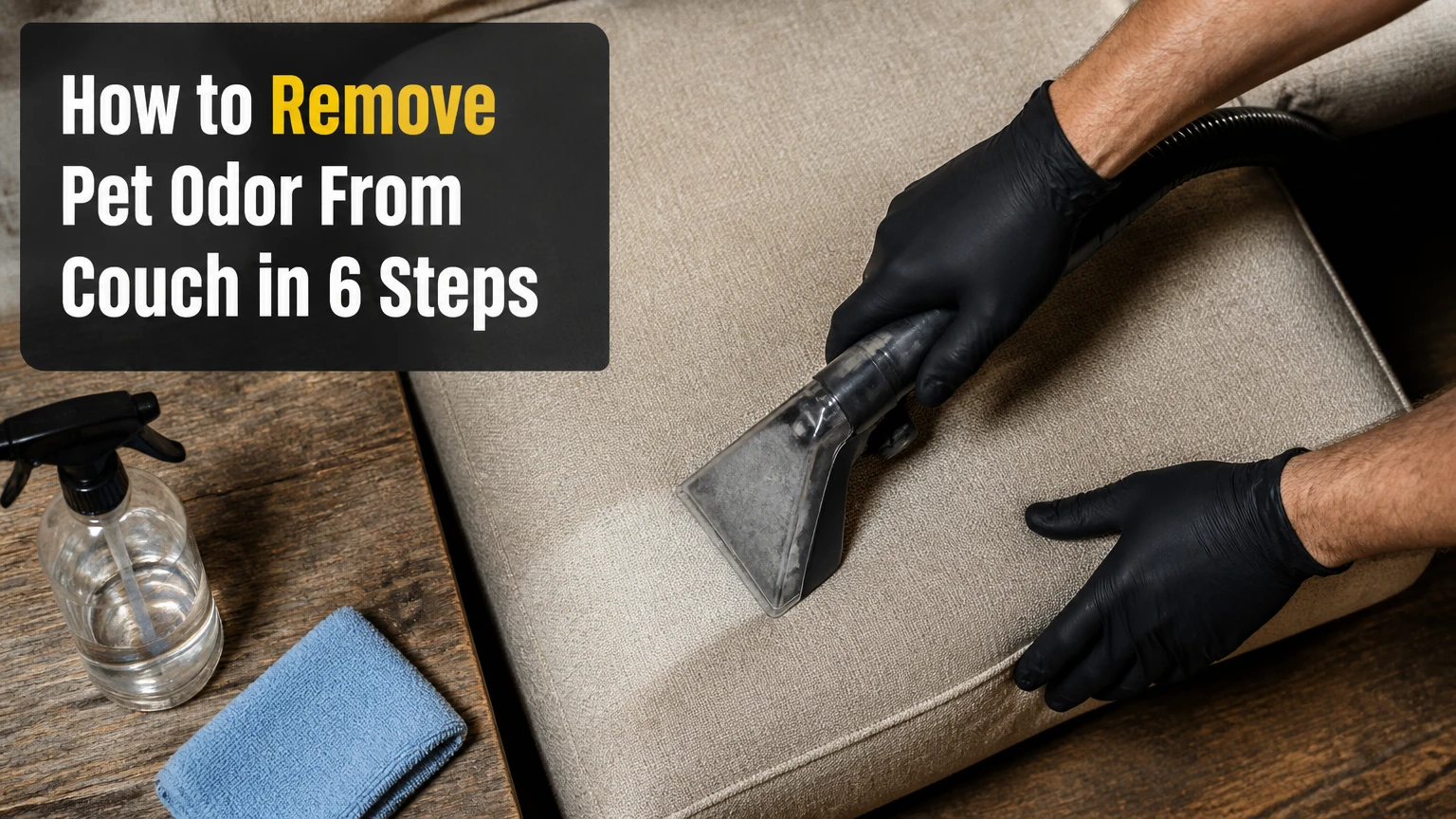
To remove pet odor from a couch, identify the upholstery code, vacuum loose debris, apply a compatible enzymatic cleaner deeply enough to reach the odor source, blot or extract the liquid, and dry the cushion completely. Fresh smells may improve within 6-24 hours; old urine embedded in foam often requires repeated treatment or professional extraction.
Key Facts at a Glance
Enzymatic upholstery cleaners are the most reliable DIY option for urine, vomit, feces, and organic pet residue on water-safe fabric.
A surface mist cannot remove odor trapped in cushion foam, batting, seams, or the couch deck.
Cleaning code W or WS generally permits water-based treatment, while code S requires solvent methods and code X prohibits liquid cleaning.
Never combine enzymatic cleaner, vinegar, hydrogen peroxide, bleach, or ammonia in one treatment.
Complete drying matters because damp upholstery can develop mildew odor and can make residual urine smell stronger.
If odor returns during humid weather, the contamination is usually deeper than the fabric surface.
Why Pet Odor Returns After Surface Cleaning
Pet odor returns when urine salts, body oils, saliva, dander, or decomposing food remain below the upholstery surface. Dog and cat urine can travel through fabric, batting, seams, and foam, while ordinary fragrance sprays only cover volatile odor molecules for a short time.
Urine presents the hardest case because urea breaks down into ammonia-like compounds, and dried urine leaves concentrated salts behind. Humidity rehydrates those residues, which explains why a couch can smell clean for days and then become noticeably sour or pungent during wet weather.
Body odor is usually shallower. Sebum from a dog’s coat binds to upholstery fibers, where a mild detergent and extraction can remove it. Vomit and feces require prompt removal because proteins, fats, and bacteria create both stain and odor risks.
The Institute of Inspection Cleaning and Restoration Certification defines cleaning as “the removal of unwanted matter.” That distinction matters here: deodorizing is not the same task as removing the material producing the odor.
How deep can pet odor penetrate?
A small accident can reach 2-5 centimeters into a loose cushion, depending on liquid volume, fabric absorbency, foam density, and how quickly someone blots it. A larger accident may reach the cushion underside, zipper seam, decking fabric, or hardwood frame.
Check the top, bottom, seams, and adjacent floor. For a removable cover, inspect the foam separately because laundering the cover alone can leave the primary odor source untreated.
Which Cleaner Works Best for Pet Odor?
An enzyme cleaner labeled for upholstery and compatible with the couch’s cleaning code is usually the best first choice for urine and other biological odors. Enzymes digest specific organic residues, but they cannot work through dried deposits unless the cleaner reaches the same depth and remains wet for the label’s stated dwell time.
Protease enzymes target protein residues, while lipase enzymes target fats and oils. Some pet products also contain surfactants that loosen oily soil, odor absorbers, or oxidizing agents. Product formulas differ, so follow the label rather than assuming every “pet odor remover” is enzymatic.
Baking soda can absorb some surface odor after the upholstery dries. Vinegar may reduce certain alkaline smells temporarily, but a 50/50 vinegar solution is not a dependable treatment for urine crystals and may damage natural fibers, dyes, or leather finishes.
| Treatment | Best use | Typical time and cost | Main limitation |
|---|---|---|---|
| Upholstery enzyme cleaner | Fresh or old urine, vomit, feces | $10-$30, 15 minutes-24 hours | Must reach the contaminated depth |
| Low-foam upholstery detergent | Dog body odor, sebum, dander | $8-$25, 10-20 minutes | Does not digest urine salts |
| Baking soda | Dry surface odor on W or WS fabric | $2-$8, 2-12 hours | Weak against embedded urine |
| White vinegar solution | Limited surface odor on some synthetic fabric | $2-$6, 10-15 minutes | Not a complete urine treatment |
| Hydrogen peroxide product | Selected colorfast synthetic upholstery | $5-$15, 5-15 minutes | Can bleach or alter dye |
| Professional extraction | Deep contamination and large cushions | $100-$300 per couch | Overwetting can create secondary damage |
Why vinegar is not a complete urine solution
Vinegar can change the pH of some odor compounds, but it does not reliably remove dried uric salts from cushion foam. Mixing vinegar with baking soda mostly creates carbon dioxide, water, and a short-lived fizz; after the reaction, little active cleaning chemistry remains.
Do not combine vinegar with hydrogen peroxide or chlorine bleach. Those combinations can produce irritating or hazardous chemicals. Use one product, rinse or extract according to its label, and allow the upholstery to dry before evaluating the result.
How Do You Remove Pet Odor From a Couch?
Remove pet odor from a couch in six controlled steps: identify the fabric, remove dry soil, test the product, treat the full contamination depth, extract excess liquid, and dry rapidly. A typical single-cushion treatment takes 30-60 minutes of active work plus 6-24 hours of drying.
Before You Start
| Requirement | Typical specification |
|---|---|
| Time | 30-60 minutes active work, 6-24 hours drying |
| Difficulty | Moderate for removable cushions, high for fixed foam |
| Cleaner | 250-750 milliliters of code-compatible enzyme product |
| Tools | Upholstery vacuum tool, 4-6 microfiber cloths, gloves, fan |
| Optional equipment | Wet-dry vacuum with upholstery nozzle |
| Prerequisite | Manufacturer tag showing W, WS, S, or X |
| Safety | Ventilation, colorfastness test, no mixed chemicals |
Step 1: Identify the Upholstery Code
Find the manufacturer’s cleaning tag beneath a cushion, behind a zipper, or under the couch frame. Code W permits water-based cleaning, code S requires a water-free solvent, code WS permits either method with testing, and code X permits vacuuming or brushing only.
| Code | Meaning | DIY odor method | Avoid |
|---|---|---|---|
| W | Water-based cleaner permitted | Enzyme spray or low-foam detergent | Unapproved solvent |
| WS or SW | Water or solvent permitted | Tested enzyme cleaner or solvent | Heavy saturation without testing |
| S | Solvent-based cleaner only | Upholstery dry-cleaning solvent | Water, steam, enzyme spray |
| X | Vacuum or professional-only care | Vacuum loose soil, call technician | Liquids, foam, steam |
| Leather | Finished leather surface | Leather cleaner, controlled wipe | Saturating seams or suede panels |
A code is not a guarantee of colorfastness. Test 1 teaspoon of cleaner on a hidden area, wait 10 minutes, blot with a white cloth, and inspect for dye transfer, stiffening, or a water ring.
Step 2: Remove Hair, Dander, and Dry Residue
Vacuum the entire couch with an upholstery attachment, including the front, back, creases, underside of removable cushions, and floor beneath the couch. Use a rubber glove or upholstery hair-removal tool for compacted fur that the vacuum leaves behind.
Dry debris interferes with wet cleaning because it absorbs product and forms a paste on the fabric. Vacuuming also reveals crusted urine, dark seams, and isolated areas that deserve separate inspection.
Success checkpoint: The fabric feels free of loose grit, and the vacuum can pass over the panel without collecting visible hair.
Common mistake: Do not spray first and vacuum afterward. Wet hair mats into the weave and makes extraction less effective.
Step 3: Locate the Odor Source
Use your nose at close range and inspect every cushion edge, seam, armrest, and nearby rug. A UV flashlight can reveal some dried urine deposits, but detergents, optical brighteners, and certain dyes also fluoresce, so treat UV marks as clues rather than proof.
For a strong unidentified smell, remove cushions and smell the foam, cover, decking, and floor independently. If the couch smells strongest underneath, surface treatment will not solve the problem.
Success checkpoint: You can identify a defined panel, cushion, seam, or foam area that receives treatment.
Common mistake: Do not clean only the visible stain. Urine often spreads horizontally beneath fabric and beyond the discolored center.
Step 4: Apply a Compatible Enzyme Cleaner
Apply enough enzyme cleaner to wet the contaminated upholstery without flooding the frame. For a localized area, start with 150-250 milliliters per square meter of fabric; for urine that reached foam, treatment may require 300-750 milliliters per cushion, depending on cushion size and product directions.
Keep the area wet for the label’s dwell time, commonly 15 minutes to 24 hours. Enzymes stop working when they dry, but excessive liquid can damage wood, adhesives, backing, or dense foam.
Treat removable covers on a protected surface if the manufacturer permits it. For fixed cushions, work in sections from seam to seam so the wet edge dries evenly.
Success checkpoint: The cleaner has reached the suspected depth, and the treated area remains damp for the required contact period.
Common mistake: A light surface mist is inadequate for a urine-soaked cushion. Match treatment depth to the original spill, not merely to the visible mark.
Step 5: Blot and Extract Excess Liquid
Press clean microfiber towels into the treated area, replacing each towel when it becomes damp. Do not scrub, because friction can spread dissolved soil, roughen nap, and push liquid farther into foam.
A wet-dry vacuum or upholstery extractor removes more contaminated liquid than towels alone. Make slow extraction passes, then make one or two dry passes without adding solution.
Success checkpoint: The cushion feels damp rather than saturated, and the extracted liquid becomes progressively clearer.
Common mistake: Do not use a household carpet machine with a large volume of water on fragile upholstery. Overwetting increases ring formation, slow drying, and foam odor.
Step 6: Dry the Couch Completely
Stand removable cushions on their edge, separate them from the frame, open windows when outdoor humidity is low, and aim a fan across the fabric rather than directly into one small spot. Allow 6-24 hours for typical drying, although thick foam may need 24-48 hours.
Press a dry white towel into the cushion center and underside. If the towel feels cool or damp, drying is incomplete even when the surface appears normal.
Success checkpoint: The cushion feels dry on both sides, has no cool damp core, and smells neutral after several hours in normal humidity.
Common mistake: Do not reinstall wet cushion covers. Trapped moisture can create mildew odor and conceal residual urine.
Which Method Should You Choose?
The right method depends on fabric code, contaminant, penetration depth, drying capacity, and whether the cushion can be removed. Enzyme treatment is the strongest DIY option for water-safe fabric, while solvent cleaning or professional service is safer for S, X, velvet, suede, and valuable upholstery.
| Situation | Recommended method | Typical quantity or duration | Expected result |
|---|---|---|---|
| Fresh urine on W fabric | Blot, enzyme treatment, extraction | 250-500 mL, 15-60 minutes | Often improved after one treatment |
| Old urine in removable foam | Deep enzyme treatment and extraction | 500-750 mL, up to 24 hours | May require 2-3 treatments |
| Dog body odor on WS fabric | Detergent wash and extraction | 250-500 mL, 10-20 minutes | Usually improves after one cleaning |
| S-code velvet | Professional solvent cleaning | $100-$300 per couch | Lower water-damage risk |
| X-code designer couch | Vacuum, then upholstery specialist | Inspection first | Avoids warranty or fiber damage |
| Finished leather | Leather cleaner and conditioner | 5-15 minutes per panel | Removes surface soil, not foam contamination |
What works for leather couches?
For finished leather, wipe the affected panel with a manufacturer-approved leather cleaner on a barely damp cloth, then dry and condition it if the leather-care instructions permit. Do not use a 50/50 vinegar mixture automatically, because acidic solutions can dull finishes, dry leather, or affect aniline surfaces.
If urine entered perforations, stitching, or a removable leather cushion, the odor source may be beneath the hide. A leather specialist should inspect the filling before any saturation treatment.
What works for suede and velvet?
Use the manufacturer’s instructions and a professional cleaner for suede, viscose velvet, silk blends, or crushed pile fabrics. Baking soda may be acceptable as a temporary dry deodorizer on some synthetic velvet, but it cannot remove deep urine and can lodge between fibers.
Never assume that “microfiber” has the same care requirement as suede. Microfiber may carry W, S, or WS coding, and the tag controls the method.
How Much Time and Money Will It Take?
A minor surface odor typically costs $10-$30 and takes 30-60 minutes of work plus overnight drying. Embedded urine, fixed cushions, and solvent-only fabrics raise the typical cost to $100-$300 for professional upholstery cleaning, with additional charges for severe contamination or multiple pieces.
| Cleaning approach | Typical US cost | Active time | Drying or dwell time |
|---|---|---|---|
| Baking soda deodorizing | $2-$8 | 10 minutes | 2-12 hours |
| Enzyme cleaner DIY | $10-$30 | 30-60 minutes | 6-24 hours |
| Rental extractor | $35-$75 per day | 1-2 hours | 12-48 hours |
| Professional upholstery extraction | $100-$300 | 1-3 hours | 6-24 hours |
| Specialist velvet, suede, or leather service | $150-$400 | 1-3 hours | 6-24 hours |
These are typical ranges, not fixed prices. Location, couch size, access, fabric risk, and the number of cushions change the quote. Ask whether the technician uses low-moisture upholstery equipment, performs a fabric test, and extracts rather than merely applying fragrance.
What Should You Avoid?
Avoid heat, ammonia, chlorine bleach, aggressive scrubbing, and repeated surface fragrance sprays when treating pet odor. These methods can set residues, damage fibers, encourage re-marking, or conceal a moisture problem without removing its source.
Using steam or hot water too early
Steam is risky on fresh urine and delicate upholstery because heat and moisture can drive contamination deeper, set some stains, distort backing, or damage adhesives. Professional hot-water extraction can work on suitable fabrics when the technician controls moisture and performs rapid extraction, but household steamers are not equivalent.
Using ammonia-based cleaner
Ammonia resembles part of urine’s odor profile and can leave a scent that encourages some pets to investigate or re-mark. Use a labeled pet enzyme product instead, and clean the surrounding floor or rug if the animal can still smell the original location.
Scrubbing the stain
Scrubbing spreads dissolved urine and can create a larger visible ring. Blotting and extraction remove liquid while reducing friction and fabric distortion.
Mixing cleaning chemicals
Never mix bleach with ammonia, vinegar, or other cleaners. Do not layer peroxide over an enzyme product unless the label explicitly permits it, because oxidation can deactivate enzymes and alter upholstery dye.
Leaving baking soda in the cushion
Excess powder can settle into foam and seams, where it becomes difficult to remove. Vacuum loose baking soda thoroughly, and use a controlled extraction method rather than repeatedly adding more powder.
What If the Smell Is Inside the Cushion?
If pet odor is inside couch foam, remove the cover when permitted, treat the foam itself, extract excess cleaner, and dry the foam on all sides. A cover-only wash cannot remove urine that migrated into polyurethane foam, batting, or the cushion zipper area.
For a removable cushion, place the foam on a clean plastic sheet or drying rack, apply the compatible product to the contaminated zone, and use a wet vacuum from both sides. Keep foam out of direct intense sunlight if the cover or foam can discolor or degrade.
Replacement becomes more practical when foam remains strongly odorous after two or three complete treatments, when the insert has begun to crumble, or when the odor has reached inaccessible frame padding. Compare the price of a replacement insert with professional restoration before discarding the couch.
How Do You Fix Persistent Odor and Water Rings?
Persistent odor requires finding the untreated source, while water rings require cleaning and drying the entire visible upholstery panel evenly. Repeating a small spot treatment often fails because dissolved residue migrates to the edge and dries into a new ring.
| Symptom | Likely cause | Corrective action |
|---|---|---|
| Smell returns when humid | Urine salts in foam or batting | Re-treat the full penetration depth |
| Sour smell after cleaning | Cushion remains damp | Separate cushion and fan-dry 24-48 hours |
| White powder remains | Excess baking soda or detergent | Vacuum, then extract with minimal clean water |
| Brown or dark water ring | Soil migration during uneven drying | Clean the entire panel seam to seam |
| Chemical fragrance remains | Deodorizer masking residue | Ventilate, then use extraction if fabric permits |
| Pet re-marks the spot | Residual odor remains nearby | Treat floor, rug, throw, and couch underside |
If a ring appears, do not wet only its center. Lightly clean the complete panel from seam to seam with the approved method, extract evenly, and dry with airflow across the whole area.
When should you hire a professional?
Hire an upholstery technician for X-code furniture, valuable antiques, non-removable cushions with deep urine, extensive contamination, mold-like odor, or upholstery that cannot dry within 24-48 hours. Professional service is also appropriate when the couch has a mixed-fiber construction and the care label is missing.
Ask for an inspection before treatment. A responsible technician should identify the fiber and backing, explain expected moisture exposure, state the drying plan, and disclose that severe urine damage may remain in foam or frame materials.
How Can You Prevent the Odor From Returning?
Prevent recurrence by removing odor from every connected surface and addressing the pet behavior that caused the accident. Wash nearby blankets, clean the floor beneath the couch, inspect rugs, and restrict access until the upholstery is fully dry and neutral.
Use a washable couch cover during training or illness. Keep pets off the couch after drinking, bathing, or outdoor activity until their coat is dry, and groom oily coats according to veterinary guidance.
Repeated urination can signal a medical or behavioral problem. A sudden change in a dog’s or cat’s elimination pattern warrants veterinary advice, especially when accidents occur alongside increased thirst, straining, pain, lethargy, or blood.
FAQ
Can I use Febreze or another air freshener on a smelly couch?
Air fresheners can reduce perceived odor temporarily, but they do not remove urine salts, sebum, or contaminated foam. Vacuum first, use a code-compatible cleaner, and reserve fragrance products for a fully dry couch after the source has been removed.
How long should enzyme cleaner sit on upholstery?
Follow the product label, because dwell times range from about 15 minutes to 24 hours. The treated area must remain wet during the stated period, but do not saturate upholstery beyond what the fabric, backing, and cushion can safely tolerate.
Will sunlight remove pet odor from couch cushions?
Sunlight can help dry removable cushions and reduce some odors, but it cannot reliably destroy urine residue inside foam. Strong direct sun may fade fabric or damage certain materials, so use airflow and indirect light unless the manufacturer permits sun exposure.
Can I wash a removable couch cover in a washing machine?
Wash a removable cover only when the manufacturer’s tag permits machine washing. Zip the cover closed, use the specified temperature and detergent, avoid high heat unless approved, and do not reinstall it until the cover and foam are completely dry.
Why does my couch smell worse after cleaning?
A couch may smell worse after cleaning because moisture has rehydrated dried urine salts, the foam remains damp, or the treatment dissolved residue without extracting it. Dry the cushion completely, then reassess at normal humidity before repeating a compatible deep treatment.
How do I remove cat urine smell without damaging upholstery?
Use an upholstery-safe enzyme cleaner on W or WS fabric, test first, and treat the foam if urine penetrated the cushion. For S, X, suede, velvet, or valuable leather, avoid water-based saturation and contact a qualified upholstery specialist.
The Bottom Line
To remove pet odor from couch upholstery, match the cleaner to the care code, remove dry soil, treat the full depth of contamination, extract excess liquid, and dry every cushion completely. Enzyme cleaner is the strongest DIY choice for water-safe fabric, while solvent-only, X-code, delicate, or deeply contaminated furniture requires professional care.ggja