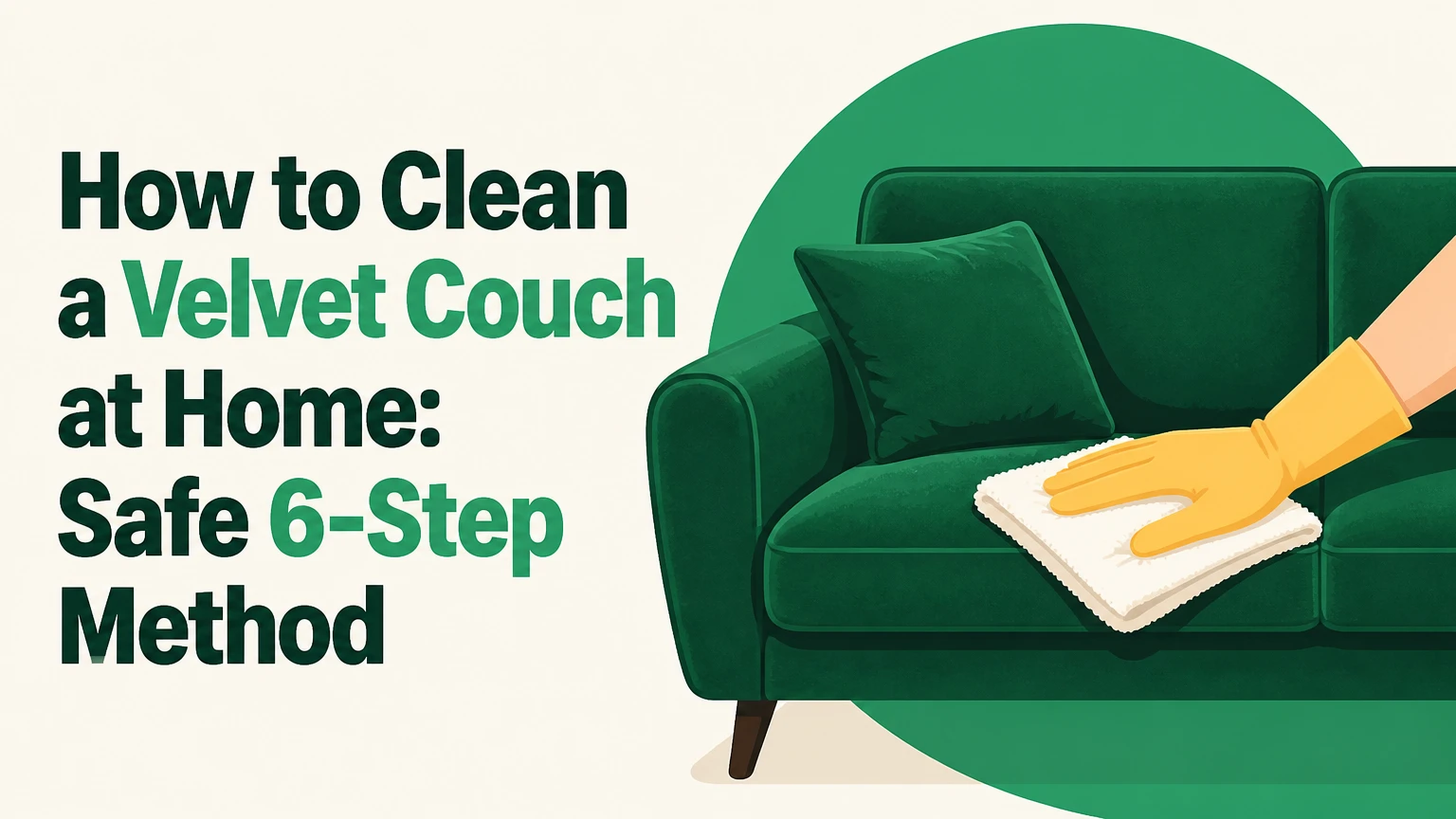
To clean a velvet couch, identify its upholstery care code, vacuum with the nap, spot-treat using the permitted cleaner, and dry the fabric quickly without saturation. A six-step process typically takes 30-60 minutes of active work plus 4-12 hours of drying, and the care label determines whether water, solvent, or no liquid is allowed.
Key facts at a glance
Upholstery code W permits water-based cleaning, while S permits water-free solvent cleaning.
Code W/S permits either method, but Code X permits vacuuming and brushing only.
Velvet should be blotted rather than scrubbed because friction can crush or twist the pile.
A wet velvet cushion should dry completely before use, usually within 4-12 hours with airflow.
Distilled water reduces mineral residue, but it does not make an unsuitable fabric safe to wet.
Steam, heat, baking soda, and stain removers can damage velvet when the manufacturer forbids them.
Why Velvet Needs a Different Cleaning Method
Velvet upholstery has a raised pile, or nap, that can trap dust, skin oils, pet hair, and liquid residue between its fibers. Cleaning must remove contamination while keeping the pile aligned, because rubbing, uneven moisture, and heat can create shiny patches, crushed areas, or visible water marks.
Flat-woven upholstery tolerates more mechanical agitation because its surface fibers are not vertically oriented in the same way. Velvet reacts differently: a vacuum head pushed against the nap can change how the surface reflects light, even when the fabric is technically clean.
The safest method is low-moisture cleaning. It uses suction, foam, or an approved solvent to loosen soil without soaking the backing, cushion foam, or adhesive layers. Professional upholstery cleaners often identify the fiber and backing before choosing between low-moisture foam, solvent treatment, or extraction.
What are pile, nap, and crushing?
The pile is the short raised fiber structure attached to the upholstery base. The nap is the direction in which those fibers naturally lie. Crushing occurs when pressure, moisture, heat, or friction forces the pile down or makes neighboring fibers stick together.
A velvet couch can show a darker or lighter patch after brushing because the pile reflects light in a different direction. That visual change is not always a stain. Compare the affected area with an untouched section under the same lighting before applying cleaner.
How to Read the Upholstery Care Code
The upholstery care code determines which cleaning chemistry is acceptable for a velvet couch. Find the tag beneath a removable cushion, along the platform deck, or under the frame, then follow the manufacturer’s instructions if they are more restrictive than the generic code.
| Code | Permitted method | Suitable home action | Main risk |
|---|---|---|---|
| W | Water-based cleaner | Foam or lightly damp cloth | Water rings and over-wetting |
| S | Water-free solvent | Approved upholstery solvent | Solvent marks or vapors |
| W/S | Water or solvent | Patch-tested low-moisture method | Product incompatibility |
| X | Vacuuming and brushing only | Dry maintenance | Permanent liquid damage |
Care symbols are widely used, but their exact interpretation can vary by manufacturer and market. A care label that says “professional clean only” overrides a general W or W/S assumption. If no label exists, contact the furniture maker with the model number and fabric composition.
Never infer the care code from appearance. Polyester velvet may tolerate a water-based method, while rayon, silk, cotton blends, or a glued synthetic backing may react badly to the same treatment.
Before You Start: Time, Tools, and Safety
A routine velvet couch clean requires 30-60 minutes of active work, 4-12 hours of drying, and roughly $10-$35 in supplies if you already own a vacuum. The decisive prerequisite is a successful patch test on an inconspicuous section that dries without color transfer, tide marks, stiffness, or pile distortion.
Prepare these items:
- Vacuum with a soft upholstery brush
- Crevice attachment
- Three white or colorfast microfiber cloths
- Distilled water for code W or W/S fabrics
- Mild, dye-free dish soap
- Approved upholstery solvent for code S fabrics
- Soft velvet or clothes brush
- Fan for air circulation
- White paper towels for fresh spills
- Nitrile gloves and open ventilation for solvent use
Keep the couch away from direct sunlight while it dries. Do not use a clothes iron, high-heat hair dryer, abrasive sponge, carpet shampoo, bleach, ammonia, or an unapproved fabric protector.
How to Clean a Velvet Couch in 6 Steps
Step 1: Remove cushions and dry debris
Take off loose cushions, pillows, throws, and removable covers. Check every cushion for separate care instructions, then vacuum the couch deck, seams, welt cords, underside, and cushion surfaces with the soft brush attachment.
Move the vacuum in short strokes with the nap rather than dragging the nozzle aggressively across the velvet. Use the crevice tool beside the frame, but keep its hard edge from contacting exposed pile.
You will know this step worked when loose crumbs, hair, and visible dust are gone without a new shiny stripe appearing. The common mistake is vacuuming against the nap with a stiff floor head, which can flatten the surface before wet cleaning begins.
Step 2: Identify and isolate the stain
Inspect the mark under neutral light and determine whether it is dry soil, a water-based spill, grease, ink, pet contamination, or a change in pile direction. Remove dry particles with a soft brush or vacuum before introducing liquid.
For a fresh spill, press a white paper towel onto the area for 10-15 seconds at a time. Replace the towel as it absorbs liquid. Do not circle the stain, spread it outward, or press hard enough to drive the spill into the cushion foam.
Photograph the mark before cleaning if you plan to use a professional service. A stain’s original color, edge, and size help distinguish residue from permanent dye loss or pile damage.
Step 3: Patch-test the permitted cleaner
Test the selected cleaner on a hidden area, such as the lower rear edge or the underside of a cushion. Apply the smallest practical amount, wait until the section is fully dry, then inspect for color transfer, water rings, odor, shrinkage, stiffness, and altered nap direction.
For code W, create foam with two drops of mild dish soap in 2 cups of distilled water. Use the foam rather than pouring the liquid onto the velvet. For code W/S, choose the lower-risk method recommended by the manufacturer, and for code S, use only a labeled upholstery solvent.
A successful patch test means the dried fabric looks and feels like the surrounding velvet. A failed test means stop. Enlarging a hidden failure across an entire cushion is a common and expensive error.
Step 4: Blot the stain with minimal moisture
Treat code W velvet by lifting foam with a clean microfiber cloth and pressing it onto the stain from the outside toward the center. Work in sections no larger than 2-3 inches, rotating to a clean part of the cloth as soil transfers.
Treat code S velvet only with a product labeled for upholstery and compatible with the manufacturer’s instructions. Apply solvent to the cloth, not directly to the couch, and use ventilation because many solvents release flammable or irritating vapors.
Treat grease carefully. Press with a dry white towel first, then use the code-approved method. Avoid talcum powder, cornstarch, and household degreasers unless the manufacturer specifically approves them, because powder can lodge in the pile and degreaser residues can leave a contrasting halo.
You will know the process is working when the stain lightens without a spreading wet edge. Stop after two or three light passes. Repeated wetting is more likely to damage velvet than a faint stain that a professional can later remove.
Step 5: Dry the upholstery evenly
After spot treatment, blot excess moisture with a dry towel and place a fan 2-4 feet away so air moves across the surface. Leave cushions standing on their edges only if the construction is stable and the manufacturer permits it; otherwise, keep them flat with airflow on both sides.
Typical drying times are 4-6 hours for lightly treated synthetic velvet and 6-12 hours for dense cotton blends or cool, humid rooms. Do not sit on the couch, replace cushions tightly, or cover the upholstery while any coolness or dampness remains.
The success checkpoint is a uniformly dry surface with no darker border around the treated area. The common mistake is using concentrated heat to shorten drying, which can distort synthetic fibers, dry adhesive unevenly, or set a stain.
Step 6: Reset the velvet pile
Brush completely dry velvet with a clean, soft-bristled clothes brush. First lift the pile gently across the affected area, then smooth it in the original nap direction using light, parallel strokes.
A soft toothbrush can handle a small seam or corner, but it is inefficient for a full cushion and may create a visibly different texture if used in circles. Compare the cleaned section from several angles because velvet’s appearance changes with light direction.
You will know the pile is reset when the surface has consistent shading and no stiff, crusty, or compressed patch. Brushing cannot restore fibers that have melted, broken, or permanently lost their dye.
Which Velvet Cleaner and Method Should You Use?
The best cleaning method depends on the care code, fiber, stain, and backing construction. Water-based foam is usually the practical option for labeled synthetic W velvet, while solvent treatment or professional care is safer for many S, silk, rayon, and antique pieces.
| Velvet type | Typical composition | Safer routine | Typical drying or service time |
|---|---|---|---|
| Polyester velvet | 100% polyester or blend | Vacuum and low-moisture foam if code W | 4-6 hours |
| Nylon velvet | Nylon pile with synthetic backing | Code-approved foam or solvent | 4-8 hours |
| Cotton velvet | Cotton pile and woven base | Low-moisture professional cleaning often preferred | 6-12 hours |
| Linen blend velvet | Linen mixed with cotton or polyester | Patch-tested foam or professional cleaning | 6-12 hours |
| Rayon velvet | Regenerated cellulose fiber | Dry maintenance and professional service | 12-24 hours |
| Silk velvet | Silk pile and delicate backing | Professional specialist only | 12-24 hours |
The table gives typical behavior, not a substitute for the label. Fiber content alone cannot predict whether a couch can be wetted because dyes, backing adhesives, and manufacturing finishes also affect stability.
Can you steam-clean a velvet couch?
Steam cleaning is not automatically safe for velvet, even when the fabric looks synthetic. Use steam only when the manufacturer specifically approves it for that fabric and code, keep the tool moving, and avoid saturating the backing.
Steam can relax a crushed pile, but it can also produce water marks, shrinkage, dye migration, or backing separation. A professional may use controlled vapor at a measured distance, while a household steamer held close to the surface can deliver excessive heat and moisture.
For a small crushed area on approved W or W/S upholstery, hold the steamer several inches away for one or two brief passes, then brush the pile while warm. Do not steam code S or X fabric without written manufacturer approval.
Should You Use Baking Soda on Velvet?
Baking soda can absorb some surface odor, but it is not a universal velvet deodorizer and should not be the default treatment for delicate, dark, silk, rayon, or heavily textured upholstery. Fine powder can lodge between pile fibers and may leave a pale residue that is difficult to remove completely.
If the manufacturer permits dry powder and a patch test succeeds, apply a very thin layer to a small area for 15-30 minutes, then vacuum slowly with the soft brush attachment. Do not leave it overnight, press it into the fabric, or use it to treat urine, milk, or other liquid contamination.
Persistent odor often comes from cushion foam, pet residue, mildew, or the backing rather than the visible surface. Baking soda cannot disinfect contaminated foam or correct moisture trapped beneath the upholstery.
Stain-Specific Velvet Treatment
Treat a velvet stain according to its chemistry and the fabric code, not according to color alone. Fresh liquid should be absorbed first, while dried stains and greasy marks require a controlled product test before treatment.
| Stain or problem | First action | Code W or W/S option | Code S, X, or delicate option |
|---|---|---|---|
| Water, juice, or wine | Blot for 1-2 minutes | Foam-blot small sections | Professional solvent service |
| Grease or oil | Press with dry towel | Approved upholstery cleaner | Approved solvent or specialist |
| Ink | Do not spread the mark | Professional advice preferred | Professional solvent service |
| Pet urine | Absorb immediately | Enzyme product only if label allows | Professional extraction |
| Gum or wax | Harden with wrapped ice | Lift gently with a blunt tool | Specialist cleaning if residue remains |
| Mud | Let dry completely | Vacuum, then patch-test | Vacuum only until serviced |
| Mildew odor | Isolate cushion | Do not saturate | Professional assessment |
Enzyme cleaners are not automatically suitable for velvet. Many are water-heavy and can create rings or affect dyes, so use them only when both the product and upholstery manufacturer approve the combination.
Ink, dye transfer, and bleach marks may represent permanent color loss rather than removable soil. More solvent or repeated blotting cannot replace missing dye and may enlarge the damaged area.
Common Mistakes and How to Fix Them
Over-wetting the cushion
Over-wetting drives cleaner into foam and can create slow-drying odors, tide marks, or backing damage. Blot with dry towels, increase airflow, and stop adding product; if the cushion remains damp after 12 hours, arrange professional drying or cleaning.
Scrubbing in circles
Circular scrubbing twists the pile and distributes the stain. Stop rubbing, allow the area to dry, then brush gently in the nap direction; a professional may be needed if the fibers have become permanently shiny.
Treating only the center of a visible ring
A narrow wet spot can dry with a distinct boundary. Do not automatically mist an entire cushion, because doing so can spread the problem and violate the care code. Use a professional if the manufacturer does not specify panel-level wet cleaning.
Applying a household solvent
Rubbing alcohol, acetone, nail-polish remover, and paint thinner can dissolve dyes, finishes, or synthetic fibers. Remove the product only if it is still wet and safe to blot, then contact the manufacturer or an upholstery specialist.
Using direct heat
A hair dryer on high heat can deform synthetic pile and dry the outer surface while the cushion remains wet inside. Use room-temperature airflow from a fan instead.
Brushing while damp
Damp fibers can stretch, clump, or settle into a new direction. Wait until the fabric is fully dry, then use a soft brush with light pressure.
How to Fix Water Rings, Stiffness, and Crushed Pile
A velvet water ring usually results from uneven wetting or dissolved soil moving to the edge as the area dries. A stiff patch usually contains dried cleaner residue or matted fibers, while a flat patch may be pressure-crushed rather than stained.
For a minor stiff area, vacuum away loose residue after complete drying and brush gently in several directions before smoothing with the nap. Do not add more water merely because the fabric feels hard.
For a water ring on code W or W/S fabric, stop spot treatment and consult the manufacturer’s instructions before attempting a larger, even cleaning pass. A professional can sometimes clean the entire cushion face uniformly, which is safer than repeatedly chasing the ring.
For crushed pile, use only manufacturer-approved low steam or professional pile restoration. Heat cannot repair melted polyester, broken fibers, or permanent abrasion.
DIY or Professional Cleaning: Which Is Safer?
DIY cleaning costs less and works well for dry debris, fresh blotting, and small marks on clearly labeled synthetic velvet. Professional cleaning is the better choice for large stains, unknown codes, luxury fibers, pet urine, mildew, dye transfer, or cushions that have already been over-wetted.
| Situation | DIY cost | Professional cost, typical | Typical turnaround | Recommended choice |
|---|---|---|---|---|
| Weekly dust and hair removal | $0-$10 | $75-$150 | Same day | DIY |
| One small fresh spill | $5-$20 | $100-$200 minimum | 1-3 days | DIY if code is clear |
| Full synthetic couch clean | $15-$35 | $150-$350 | 4-8 hours onsite | Depends on code |
| Cotton or linen velvet | $15-$40 | $200-$450 | 6-24 hours | Professional preferred |
| Silk, rayon, or antique velvet | $10-$25 | $250-$600+ | 1-3 days | Specialist |
| Pet urine or mildew | $20-$60 | $200-$500+ | 1-3 days | Professional |
Prices are typical North American ranges and vary with couch size, city, access, stain severity, and whether cushions are removable. A very low quote may exclude odor treatment, drying, or pile restoration, so ask what the service includes.
An honest limitation matters here: home spot cleaning cannot guarantee complete stain removal or invisible results. Velvet changes appearance with viewing angle, and a service provider may recommend replacement when dye loss, backing failure, or severe pile damage is permanent.
Velvet Maintenance That Prevents Deep Cleaning
Vacuum a velvet couch weekly in a pet household and every 1-2 weeks in a low-use room. Rotate reversible cushions every 1-2 months if the design allows, and keep direct sunlight from striking one section because ultraviolet exposure can fade dyes unevenly.
| Maintenance task | Frequency | Tool or condition | Practical result |
|---|---|---|---|
| Soft-brush vacuuming | Weekly with pets | Upholstery brush | Removes abrasive grit and hair |
| Seam and crevice vacuuming | Every 2 weeks | Crevice tool | Removes crumbs and dust |
| Cushion rotation | Every 1-2 months | Reversible design required | Reduces localized crushing |
| Spill blotting | Immediately | White paper towel | Limits liquid penetration |
| Care-label review | Every 6-12 months | Manufacturer tag | Prevents wrong chemistry |
| Professional inspection | Every 12-24 months | Upholstery specialist | Identifies backing and pile damage |
Do not apply fabric guard spray simply because the couch is polyester. Protection products can darken velvet, change its hand, or conflict with the manufacturer’s warranty. Patch-test any protector and retain the product label for future cleaning decisions.
FAQ
Can I wash velvet cushion covers in a washing machine?
Most velvet cushion covers should not enter a washing machine unless the manufacturer explicitly gives washing instructions. Machine agitation, spin force, heat, and shrinkage can distort the pile or make the cover impossible to refit. Check the cover label separately from the couch frame, and never assume removable means washable.
How often should I deep-clean a velvet couch?
A typical home should deep-clean velvet upholstery only when visible soil or a specific spill requires it, while weekly vacuuming handles routine dust. Professional cleaning every 12-24 months may suit a heavily used couch, but delicate silk or antique velvet needs a specialist assessment rather than a fixed schedule.
Can I use a carpet cleaner on velvet upholstery?
Do not use a carpet cleaner on velvet unless the couch manufacturer and machine instructions specifically approve the combination. Carpet machines often deliver more water and agitation than velvet can tolerate, increasing the risk of rings, slow drying, pile matting, and backing separation.
Why does my velvet couch look darker after brushing?
Brushing changes the nap direction, and velvet fibers reflect light differently when they point up, down, or sideways. A darker appearance does not automatically mean the fabric is dirty or wet. Compare the area after the couch is fully dry and smooth the pile consistently with a soft brush.
How do I remove pet hair from velvet?
Use a soft upholstery vacuum brush in the nap direction, then lift remaining hair with a dry rubber glove or a lint roller tested on a hidden area. Avoid aggressive scraping because adhesive rollers and stiff tools can pull fibers from loosely constructed velvet.
Is velvet a poor choice for homes with pets?
Synthetic polyester velvet is usually more practical for pets than silk, rayon, or cotton velvet because it often tolerates more routine cleaning, but no velvet is immune to claws, oils, or urine. Choose a clearly labeled, tightly constructed fabric and use washable throws on high-contact areas.
The Bottom Line
How to clean a velvet couch safely depends first on the upholstery code, then on controlled moisture, gentle blotting, rapid room-temperature drying, and careful pile restoration. Vacuum dry debris regularly, patch-test every cleaner, avoid unapproved steam and household solvents, and use a professional for delicate fibers, unknown labels, large stains, pet contamination, or permanent pile damage.