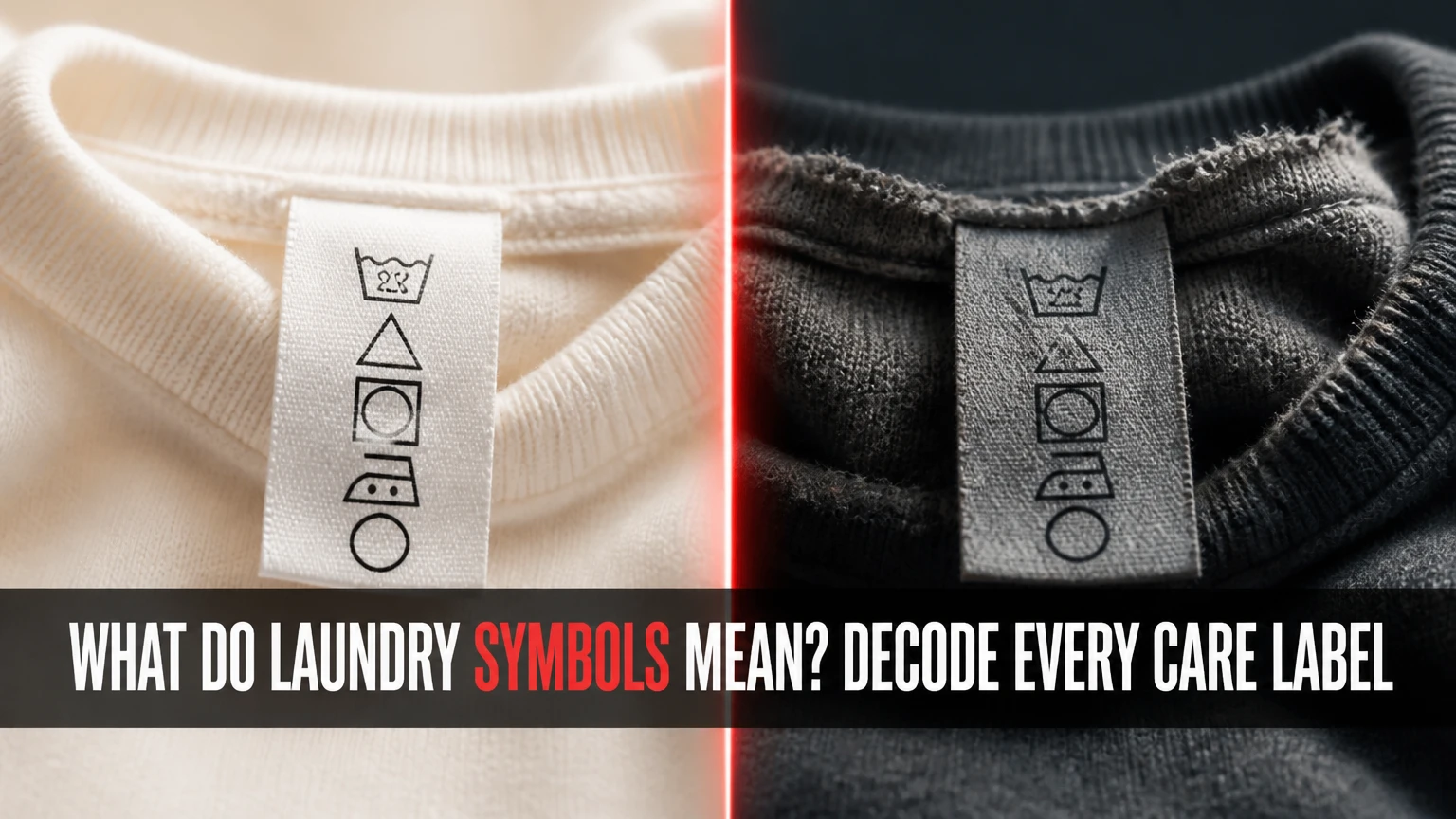
Laundry symbols are standardized care-label pictograms that tell you how to wash, bleach, dry, iron, or professionally clean a garment. Read them from left to right as washing, bleaching, drying, ironing, and professional care, while dots set heat, bars reduce mechanical action, and an X prohibits the pictured process.
Key Facts at a Glance
A washtub gives the maximum washing temperature and permitted washing method.
A triangle concerns bleach, not washing temperature or stain-removal strength.
A square describes natural drying; a square containing a circle describes tumble drying.
Dots generally indicate heat intensity, but exact temperatures depend on the symbol family and regional standard.
One or two bars under a symbol require gentler mechanical treatment than an unlined symbol.
A crossed symbol means do not use that process, even if another instruction appears convenient.
What Do the Five Main Laundry Symbols Mean?
The five core laundry symbols are the washtub for washing, triangle for bleaching, square for drying, iron for ironing, and circle for professional cleaning. Each shape identifies a care category before its modifiers add limits such as temperature, cycle intensity, shade, steam, or solvent type.
The system is associated with international care-label standards, including ISO 3758, while national rules determine how manufacturers present labels. The Federal Trade Commission states that its Care Labeling Rule requires manufacturers and importers to attach care instructions with a reasonable basis, but labels can differ between the United States, Canada, the United Kingdom, Australia, and Europe.
Read the Label in Its Intended Sequence
A complete label normally presents instructions in this order:
- Washing
- Bleaching
- Drying
- Ironing
- Professional textile care
The sequence is operational rather than decorative. A garment may be washable but not bleach-safe, tumble-dryable only at low heat, and ironable only at a low setting. Follow the strictest instruction in each category.
How Do Dots, Bars, and Crosses Change a Symbol?
Dots indicate heat, bars indicate gentler mechanical action, and an X means the pictured process is prohibited. These modifiers work across categories, although the number of dots and their exact temperature equivalents can vary by standard.
For example, one bar below a wash tub commonly indicates a permanent-press or reduced-action cycle, while two bars indicate a very gentle or delicate cycle. A crossed triangle means no bleach, and a crossed circle means no professional dry cleaning. Never infer that a missing symbol means permission; the label may simply omit a category.
What Does the Wash Tub Symbol Mean?
The wash tub tells you whether a garment can be machine washed, hand washed, or not washed, and it sets the maximum water temperature. A plain tub permits the standard machine cycle available for that label, while bars, a hand graphic, or a cross impose stricter limits.
The temperature is a ceiling, not a recommendation to use the hottest available setting. Washing below the labeled maximum usually reduces dye loss, fiber stress, and energy use, provided the detergent and hygiene requirements are appropriate.
| Wash symbol pattern | Maximum temperature or method | Mechanical instruction | Typical examples |
|---|---|---|---|
| Plain tub, 30°C | 30°C / 86°F | Normal machine cycle | Dark cotton, viscose blend |
| Tub with one bar | Label temperature, often 30-40°C | Permanent-press or reduced-spin cycle | Polyester shirt, easy-care blend |
| Tub with two bars | Label temperature, often 30°C | Delicate cycle, low agitation | Lace, silk blend, embellished top |
| Tub with hand | Usually 30°C-40°C | Hand wash, no standard machine cycle | Wool, cashmere, delicate knit |
| Tub with X | No water washing | Use another labeled method | Structured jacket, solvent-care item |
What Do Wash-Tub Dots and Numbers Mean?
A number inside the tub gives the maximum Celsius temperature, such as 30, 40, or 60. In many symbol systems, dots communicate heat, with one dot representing a cooler wash and additional dots allowing progressively warmer water, but number-based labels are more precise.
Common practical equivalents are one dot or 30°C for cool washing, two dots or 40°C for warm washing, and three dots or 50°C to 60°C for hotter washing. Do not treat these as universal conversions. Check the printed number, the country’s labeling convention, and the washing machine’s actual program.
When Should You Choose Hand Washing?
Choose hand washing when the label shows a hand in the tub, because the garment has not been labeled for ordinary machine agitation. Use cool or lukewarm water, a small amount of mild detergent, and gentle pressing rather than twisting or scrubbing.
Hand washing does not automatically mean a garment can tolerate soaking for hours. Wool fibers can felt through moisture, heat, alkalinity, and friction, so keep the process short and support the garment while it drains. Roll delicate items in a clean towel to remove water before drying them flat.
What Do Triangle Bleach Symbols Mean?
The triangle identifies bleach permission. An empty triangle permits any suitable bleach, a triangle with two diagonal lines permits non-chlorine oxygen bleach only, and a crossed triangle prohibits all bleach unless the manufacturer gives separate instructions.
Bleach compatibility is a chemical question, not a color question. A white garment may still contain elastane, optical brighteners, resin finishes, or coatings that chlorine bleach damages. Oxygen bleach is generally less aggressive than chlorine bleach, but the label and product directions still control.
| Triangle symbol | Bleach permission | Suitable product category | Main risk |
|---|---|---|---|
| Empty triangle | Any bleach permitted | Chlorine or oxygen bleach | Concentration damage if overdosed |
| Triangle with two diagonal lines | Non-chlorine bleach only | Oxygen bleach labeled color-safe | Color change from chlorine |
| Crossed triangle | No bleach | Detergent and stain pre-treatment only | Yellowing, weakening, discoloration |
| Missing triangle | No assumption | Check garment brand guidance | Unverified chemical damage |
Can You Use Chlorine Bleach on a Colored Garment?
Use chlorine bleach on a colored garment only when the empty triangle permits any bleach and the product label confirms safe dilution. A colorfast test on an inconspicuous seam can reveal dye reaction, but it does not prove long-term fiber compatibility.
Never pour concentrated bleach directly onto fabric. Mix it with water according to the product label, avoid mixing it with ammonia or acidic cleaners, and rinse thoroughly. A crossed or striped triangle is a clear reason to choose a non-bleach stain treatment instead.
What Do Square Drying Symbols Mean?
The square describes air drying, while a square containing a circle describes tumble drying. Dots inside the circle set dryer heat, and lines inside the plain square specify line drying, drip drying, flat drying, or drying in shade.
Drying often causes more irreversible garment damage than washing because heat accelerates shrinkage, adhesive failure, elastic deterioration, and print cracking. A garment labeled washable is not necessarily safe for a clothes dryer.
| Drying symbol pattern | Meaning | Practical setting | Garments at risk |
|---|---|---|---|
| Square with circle, no dot | Tumble dry permitted | Follow machine’s fabric setting | Stable cotton and linen |
| Square with circle, one dot | Low-heat tumble dry | Low temperature, short cycle | Polyester, elastane blends |
| Square with circle, two dots | Medium-heat tumble dry | Medium temperature | Towels, durable cotton |
| Square with circle, three dots | High-heat tumble dry | High temperature | Heat-tolerant heavy cotton |
| Square with X over circle | Do not tumble dry | Rack, line, or flat dry | Wool, molded garments, prints |
| Square with horizontal line | Dry flat | Support on a clean drying surface | Wool and heavy knits |
| Square with three vertical lines | Drip dry | Hang while saturated, do not wring | Shirts and washable synthetics |
| Square with diagonal corner lines | Dry in shade | Keep away from direct sun | Dark dyes and delicate colors |
Why Must Some Sweaters Dry Flat?
Sweaters should dry flat when the label shows a horizontal line because wet knit fabric becomes heavy and can stretch under its own weight. A hanger may create shoulder points, lengthen sleeves, or distort the neckline before the garment is dry.
Shape the sweater to its original measurements on a towel or mesh rack. Replace the towel if it becomes saturated, and keep airflow around the garment. Direct sunlight can fade dyes, while high heat can shrink wool and damage acrylic fibers.
What Does a Circle With a Letter Mean?
A circle with P or F identifies professional dry-cleaning solvent categories, while a circle with W identifies professional wet cleaning. A crossed circle means do not dry clean, and a crossed W, where used, indicates that professional wet cleaning is not permitted.
The letters are instructions for the cleaner, not home-care directions. “P” commonly identifies perchloroethylene and certain petroleum-based solvent systems, while “F” identifies hydrocarbon or other specialized solvent processes under applicable standards. Take the entire garment, including trims and lining, to a cleaner that understands the label.
What Do Iron Symbols and Steam Marks Mean?
The iron symbol gives the maximum ironing temperature through dots. One dot is low heat, two dots medium heat, and three dots high heat; a crossed iron prohibits ironing, while crossed steam marks prohibit steam.
Typical temperature ranges are approximately 110°C / 230°F for one dot, 150°C / 300°F for two dots, and 200°C / 390°F for three dots. These values are common care-label references, not permission to press directly on every surface. Use a pressing cloth on dark fabrics, prints, coated materials, and synthetic blends.
| Iron symbol | Typical maximum setting | Common material examples | Safer technique |
|---|---|---|---|
| One dot | 110°C / 230°F | Nylon, acrylic, acetate | Press briefly from the reverse |
| Two dots | 150°C / 300°F | Polyester, wool, silk blends | Use a pressing cloth |
| Three dots | 200°C / 390°F | Cotton, linen | Add steam only if permitted |
| Crossed iron | No ironing | Heat-sensitive coatings, technical finishes | Use hanging or professional care |
| Crossed steam marks | No steam | Certain synthetics and bonded fabrics | Dry press at permitted heat |
A cool iron can still leave shine on wool or melt a synthetic if the soleplate remains stationary. Keep the iron moving and test an inside seam first.
How Should You Sort Laundry by Care Label?
Sort laundry by the most restrictive care instruction, then separate by color, soil level, and fabric structure. A safe household workflow takes about 10 minutes before washing and prevents the common mistake of combining a delicate blouse with heavy denim.
- Read every label. Pull out hand-wash, dry-clean, flat-dry, and no-tumble items before filling the machine.
- Separate color groups. Keep dark, bright, white, and heavily dye-shedding garments apart, especially during the first two washes.
- Group by maximum temperature. Put 30°C items together rather than washing the entire load at 60°C.
- Group by cycle intensity. Keep two-bar delicates away from towels, jeans, zippers, and garments with hooks.
- Protect construction. Close zippers, fasten hooks, turn printed garments inside out, and place small delicate items in a mesh bag.
- Choose drying before washing. Remove garments that require flat, drip, shaded, or line drying before the wet load reaches the dryer.
A label does not replace ordinary sorting. Red dye can transfer at a permitted temperature, and a low-temperature cycle cannot make a lint-producing towel compatible with black knitwear.
Which Laundry Method Is Best for Each Garment?
Machine washing is usually the fastest and lowest-cost option for stable everyday fabrics, hand washing reduces mechanical stress on delicate textiles, and professional cleaning handles garments whose structure or solvent requirements exceed home equipment.
| Method | Typical active time | Typical total time | Typical direct cost | Best use |
|---|---|---|---|---|
| Machine wash and air dry | 10-15 minutes | 8-24 hours | $0.50-$1.50 per load | Everyday washable clothing |
| Machine wash and tumble dry | 10-15 minutes | 60-120 minutes | $1.00-$2.00 per load | Durable towels and basics |
| Hand wash and flat dry | 15-25 minutes | 12-24 hours | $0.25-$1.00 per item | Wool, lace, delicate knits |
| Professional dry cleaning | 5 minutes drop-off | 2-4 business days | $5-$15 per garment, typical | Suits, coats, structured pieces |
| Professional wet cleaning | 5 minutes drop-off | 1-3 business days | $5-$20 per garment, typical | Water-safe tailored garments |
Home-laundry costs vary with utility prices, machine capacity, detergent, and whether the load is washed at home or in a laundromat. Professional prices vary by city, garment weight, lining, stain treatment, and rush service, so these figures are planning ranges rather than universal prices.
Which Laundry Symbol Mistakes Cause the Most Damage?
The most damaging mistakes are using excessive heat, applying the wrong bleach, and exposing delicate construction to aggressive agitation. These errors can shrink fibers, strip dyes, distort shape, or destroy coatings before a second wash can correct the problem.
Mistake: Treating the Maximum Temperature as the Ideal Temperature
A 60°C label means the garment can tolerate up to that temperature under the defined care process. It does not mean every wash should use 60°C. Use the lowest temperature that removes the soil and meets the hygiene requirement.
Mistake: Confusing “Do Not Tumble Dry” With “Do Not Dry”
A crossed tumble-dryer symbol still permits another drying method unless the square itself is crossed or a separate instruction forbids drying. Lay-flat, drip-dry, line-dry, and shade-dry symbols tell you what to do instead.
Mistake: Hanging a Wet Knit
A wet wool or cotton knit can stretch several centimeters in length or width under its own weight. Support it horizontally until dry, and reshape the ribbing and seams while the fabric remains damp.
Mistake: Assuming Dry Cleaning Removes Every Stain
Dry cleaning is effective for many oil-soluble soils, but water-soluble stains, tannins, dye transfer, and aged protein stains may require specialized pre-treatment. Tell the cleaner what caused the stain and when it occurred; rubbing it first can set damage or spread the mark.
Mistake: Ignoring Trim and Construction
A care label may describe the garment’s main textile while buttons, sequins, faux leather, interfacing, foam, elastic, or glued decoration require stricter handling. For expensive or irreplaceable clothing, the least aggressive method is the prudent choice when label instructions conflict with visible construction.
Can a Shrunken Garment Be Recovered?
A mildly shrunken wool or cotton garment may regain some shape after soaking and careful blocking, but heat-fused fibers, felted wool, damaged elastane, and distorted bonded fabrics usually cannot be fully restored. Recovery is possible only when the fiber still has enough flexibility to reshape.
Use lukewarm water and a small amount of gentle detergent, soak for about 20-30 minutes, and press out water without wringing. Roll the garment in a towel, then reshape it flat to its original dimensions while damp. Baby shampoo is sometimes recommended for relaxing protein fibers, but it is not a guaranteed repair and cannot reverse severe felting.
For future loads, reduce heat first. Washing below the maximum label temperature and air drying usually prevent more damage than any post-shrinkage treatment can repair.
What Should You Do if Colors Run?
Remove the garment from the washer promptly, keep it wet, and rewash it separately using the hottest temperature the label permits. A commercial color-run remover may help colorfast washable fabrics, but test it first because it can alter the original dye.
Do not tumble-dry or iron the affected garment before treatment. Heat can fix transferred dye more permanently. Chlorine bleach is not a general solution, and the triangle symbol must permit its use before it is considered.
What If the Care Label Is Missing?
Use fiber content, construction, dye behavior, and garment value to choose a conservative routine when the label is missing. Wash unknown garments cold on a delicate cycle, test for color bleeding, avoid chlorine bleach, and air dry away from direct sunlight until you understand the fabric.
A silk blouse, wool coat, lined jacket, or garment with glued decoration deserves professional advice rather than trial and error. Fiber content alone is insufficient because finishing treatments and blended yarns can change the safe method.
Expert Rules for Reading Care Labels
- The strictest symbol controls the process. A cotton shirt with a 40°C wash and no-tumble instruction must be washed at or below 40°C and dried without a dryer.
- Mechanical action matters as much as temperature. Cold water on a normal cycle can damage lace, stretch knits, or loosen sequins through agitation and spin.
- Drying choice often determines lifespan. Air drying reduces thermal stress, but direct sun can fade dyes and prolonged dampness can create odor.
- A professional-care symbol is not a stain guarantee. Cleaner skill, stain age, fiber chemistry, and trim compatibility affect the result.
- When two instructions conflict, stop and verify. Contact the manufacturer or a cleaner rather than choosing the more convenient symbol.
Frequently Asked Questions
Are laundry symbols the same in every country?
The core shapes are internationally recognizable, but presentation and temperature conventions differ. ISO 3758 underpins much of the global system, while the United States commonly uses written instructions and number-based tubs, and European labels frequently use Celsius temperatures. Always interpret the actual marks on the garment.
What does a laundry symbol with two lines underneath mean?
Two lines usually require a very gentle or delicate process with reduced agitation and spin. The exact program name differs by washing machine, so select the gentlest cycle that matches the fiber, use a suitable detergent, and avoid overfilling the drum.
Does a crossed-out circle mean I cannot wash the garment?
No. A crossed-out circle means do not use professional dry cleaning. The garment may still permit hand washing, machine washing, or another process shown elsewhere on the label. Read the tub, bleach, drying, and iron symbols separately.
What does “wash separately” mean if there is no special symbol?
“Wash separately” is a written precaution for dye transfer, surface fibers, or contrasting panels. It means isolate the garment during washing, even when the tub symbol permits an ordinary cycle. The instruction does not by itself specify temperature or drying method.
Is cold water always safer for clothes?
Cold water reduces many forms of dye loss and heat shrinkage, but it does not eliminate damage from friction, overloading, detergent residue, or poor drying. Cold washing also may not remove heavy oils as effectively as a warmer permitted cycle, so soil level and label limits both matter.
Should you follow the fabric type or the laundry symbol?
Follow the care symbol first because the manufacturer has considered the garment’s construction, finish, and components. Fabric type provides a useful warning when the label is missing, but it cannot override a specific instruction such as hand wash, low heat, flat dry, or no steam.
The Bottom Line
Laundry symbols are a compact instruction system: the tub controls washing, the triangle controls bleach, the square controls drying, the iron controls pressing, and the circle controls professional care. Dots set heat, bars reduce mechanical action, and X marks prohibit a process. For what do laundry symbols mean, the safest answer is to read the complete sequence, obey the most restrictive instruction, and use the lowest effective heat.