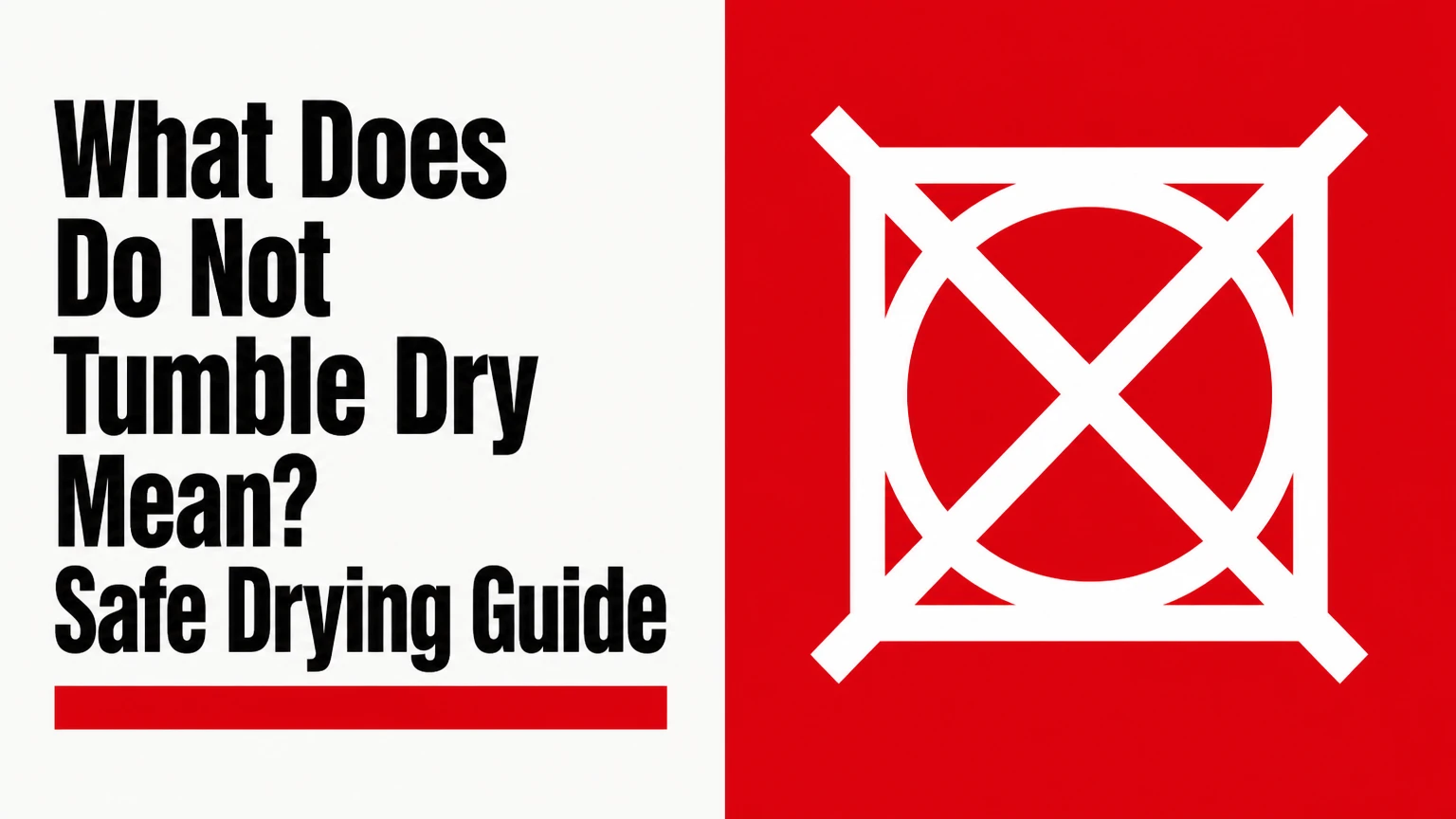
“Do not tumble dry” means a garment must not go into a rotating clothes dryer, including regular, timed, low-heat, and high-heat cycles. The instruction warns that tumbling, heat, and forced airflow may shrink, stretch, abrade, melt, distort, or weaken the item. Use the garment’s approved air-drying method instead.
Key Facts at a Glance
- A crossed-out square containing a circle means do not tumble dry.
- “Do not tumble dry” does not automatically mean “dry clean only.”
- A no-heat or air-fluff cycle can still damage garments through tumbling and friction.
- Heavy knits, wool, cashmere, silk, lace, structured clothing, and coated outerwear need special handling.
- Lay sweaters flat; hang sturdy woven garments only when their wet weight will not distort them.
- Drying indoors typically takes 8-48 hours, depending on fabric thickness, room humidity, airflow, and spin speed.
What Does Do Not Tumble Dry Mean?
The phrase means the garment should be dried without a mechanical tumble dryer. A tumble dryer repeatedly lifts, drops, rotates, and blows air through clothing, while many cycles also apply heat; that combination can alter dimensions, damage surface fibers, or deform trims and coatings.
The care instruction usually appears beside a drying symbol: a square with a circle indicates tumble drying, and a cross over that symbol means it is prohibited. The symbol is different from a square with one horizontal line, which commonly indicates dry flat, or a square with three vertical lines, which commonly indicates drip dry under the ISO 3758 care-symbol system.
Care labels communicate the manufacturer’s tested or intended limits for normal laundering. The label does not predict exactly how many minutes a garment might survive in a dryer. It gives a boundary: avoid the process because the risk is material, structural, or cosmetic.
Is low heat allowed when the label says do not tumble dry?
No. Low heat is not automatically safe when the label prohibits tumble drying. The low-heat symbol permits a reduced-temperature tumble cycle only when the label shows a tumble-dry symbol with the appropriate dot configuration; a crossed-out symbol prohibits the process itself.
A no-heat or air-fluff setting also deserves caution. Although the heater may be off, the drum still creates rotation, impact, friction, and airflow. Those forces can stretch wet knits, snag lace, damage bonded details, and roughen delicate surfaces.
How Does Tumble Drying Damage Clothing?
Tumble drying damages sensitive garments through four interacting forces: heat, drum movement, fiber friction, and rapid airflow. Heat can shrink natural fibers or soften synthetic components, while mechanical action can distort shape even when the heater is disabled.
Heat changes fiber dimensions and components
Cotton, linen, and rayon can contract when water-swollen fibers dry under heat and movement. Wool can felt when moisture, warmth, and agitation cause its scales to interlock. Elastane, polyurethane coatings, adhesive tapes, printed graphics, rubberized trims, and foam components can lose elasticity or adhesion.
Synthetic fibers do not all melt in an ordinary dryer. Polyester and nylon generally tolerate controlled temperatures better than polyurethane films or rubber trims, but a prohibited label indicates that the complete garment, not merely its main fiber, has not been cleared for that treatment.
Tumbling distorts shape
A wet garment is heavier than a dry garment because it holds water. Repeated lifting and dropping can pull shoulder seams, hems, waistbands, collars, and knitted stitches out of alignment. The risk rises when a garment has low stretch recovery, a loose knit, a long silhouette, or a heavy decorative panel.
Friction creates surface wear
Drum rotation rubs fabric against itself, other garments, and the drum. Repeated abrasion can produce pills on acrylic and wool blends, fuzz on brushed fabrics, frayed edges on lace, and premature wear on printed or coated surfaces.
Forced airflow dries unevenly
A dryer removes moisture quickly, but uneven evaporation can leave thick seams, pockets, cuffs, and waistbands at a different moisture level from the main fabric. Those sections may contract at different rates, producing puckering or twisting.
Which Drying Method Should You Use?
The correct alternative depends on the fabric, garment weight, construction, and drying symbol. Dry flat is the safest default for heavy or shape-sensitive knits, while drip drying suits items that must retain their full length and should not be wrung.
| Drying method | Suitable garments | Typical setup | Typical time |
|---|---|---|---|
| Dry flat | Wool sweater, cashmere cardigan, heavy knit | Towel or mesh rack, reshaped horizontally | 24-48 hours |
| Line dry | Woven cotton shirt, linen trousers, sturdy polyester | Clothesline or ventilated hanger | 4-24 hours |
| Drip dry | Rain shell, delicate synthetic, lace item | Tub or shower rod, no wringing | 8-36 hours |
| Shade dry | Dark cotton, silk blouse, dyed linen | Rack or line away from direct sun | 8-36 hours |
| Professional cleaning | Structured suit, tailored coat, lined formalwear | Cleaner following care label | 1-4 days |
How do you dry a garment flat?
Lay the garment horizontally on a clean, absorbent towel or mesh drying rack, then reshape the shoulders, sleeves, side seams, neckline, and hem before leaving it undisturbed. Replace a saturated towel after several hours if the garment remains wet.
Do not place a heavy sweater over a narrow rail. A rail creates a fold line and concentrates water weight at the shoulder or midpoint. A ventilated mesh rack improves airflow beneath the garment, but a solid plastic surface can trap moisture and extend drying time.
For faster drying, press the garment between two towels rather than wringing it. Roll the towel and garment together, apply gentle pressure with your hands, unroll the bundle, and then reshape the item flat.
When is hang drying safe?
Hang drying is generally suitable for lightweight woven garments and stable synthetic or cotton items whose wet weight will not deform the fabric. Shirts, blouses, polyester sportswear, and many linen garments can usually hang from a smooth hanger or line.
Hanging is less suitable for wool, cashmere, viscose, rayon, heavy cotton knits, and garments with a broad wet body. Water weight can create pointed shoulders, a stretched neckline, a longer hem, or diagonal side seams.
Use a wide contoured hanger for shirts and jackets. Use a padded hanger for delicate blouses. Avoid thin wire hangers because they create concentrated pressure and may rust if their coating is damaged.
What does drip dry mean?
Drip dry means allowing a garment to dry while excess water drains naturally, without wringing or pressing the item aggressively. The method is useful for rainwear, delicate synthetics, and garments whose shape may change if twisted.
Support the garment so that water does not pool in a hood, pocket, waistband, or folded hem. A shower rod, broad plastic hanger, or bathtub drying area can work, provided the garment has airflow around its surfaces and does not remain bunched.
Drip drying is not the same as leaving clothing in a sealed bathroom. High humidity slows evaporation and increases odor risk. Open the door, run an exhaust fan, or move the item to a room with lower humidity once dripping has reduced.
How Should Different Fabrics Be Dried?
Fabric content provides a starting point, but garment construction can override fiber-level assumptions. A polyester shell with a heat-sensitive waterproof membrane needs more conservative treatment than an unlined polyester shirt.
| Fabric or garment | Preferred method | Main risk | Practical rule |
|---|---|---|---|
| Wool or cashmere knit | Dry flat | Felting and stretching | Press in towels, reshape, never wring |
| Silk blouse | Dry flat or shade hang | Water marks and UV fading | Use low spin and shade |
| Viscose or rayon | Dry flat | Lengthwise distortion | Support while wet, avoid hanger drying |
| Linen shirt | Shade line dry | Creasing and color fading | Smooth seams before hanging |
| Cotton T-shirt | Line dry or flat dry | Shrinkage and graphic wear | Avoid heat, turn printed side inward |
| Nylon rain shell | Drip dry or label-approved method | Coating and seam-tape damage | Follow the brand’s technical-care instructions |
| Lace or embellished item | Dry flat | Snags and trim separation | Place in a mesh support layer |
| Tailored coat | Professional cleaning or label method | Interfacing and lining distortion | Do not improvise with a dryer |
Wool requires special care because heat and agitation can produce felting, which is often permanent. Viscose and rayon can look acceptable while wet but become misshapen during drying because their strength and dimensional stability change substantially when saturated.
Silk may tolerate air drying but can develop water rings, color shifts, or sun damage. Dry silk away from windows and radiators. For technical outerwear, the garment manufacturer’s instructions take priority because membrane, seam tape, DWR finish, insulation, and adhesive components vary by product.
Air Drying Versus Tumble Drying: Which Is Safer?
Air drying is safer for garments labeled do not tumble dry because it removes drum agitation and usually avoids high heat. Tumble drying is faster and more compact, but the convenience comes with higher risk for shrinkage, abrasion, shape loss, and damage to trims.
| Decision factor | Air drying | Tumble drying |
|---|---|---|
| Typical lightweight garment time | 4-12 hours | 30-60 minutes |
| Typical heavy sweater time | 24-48 hours | 40-70 minutes, if permitted |
| Mechanical friction | Low, if supported correctly | Continuous drum contact |
| Heat exposure | Ambient, commonly 15-30°C | Commonly 40-80°C, cycle-dependent |
| Operating energy | Usually no appliance energy | Often about 1-4 kWh per load |
| Space requirement | Rack, line, or tub area | One enclosed appliance |
| Main failure mode | Odor from slow drying | Shrinkage or mechanical wear |
Air drying is not risk-free. Poor support stretches knits, direct sun fades dyes, and inadequate ventilation can create a musty smell. Tumble drying can be acceptable for garments with a permitted symbol and appropriate temperature, but a permitted setting for one item does not make the setting safe for every item in the load.
Can You Use the Washing Machine’s Spin Cycle?
A washing-machine spin cycle can reduce air-drying time, but high-speed spinning may stress delicate fabrics, trims, and loose knits. Select the lowest effective spin speed allowed by the garment label, and use a short, gentle spin for silk, wool, lace, and shape-sensitive items.
Typical spin speeds range from 400 to 1,600 revolutions per minute. Lower speeds leave more water in the garment, but they also reduce centrifugal stress. A towel press after washing often removes water more safely than twisting the item by hand.
Separate heavy denim or towels from delicate clothing before spinning. A heavy mixed load can compress lightweight garments and create sharp folds that become difficult to remove during air drying.
What Should You Do Before Air Drying?
Remove the garment from the washer promptly, inspect the care label, and choose a support method before moving the item. The most important preparation steps are controlling residual water, restoring the original shape, and creating airflow around the fabric.
- Read the complete care label. Check washing, bleaching, drying, ironing, and professional-cleaning instructions. “Do not tumble dry” addresses drying only.
- Select a suitable spin speed. Use a gentle or moderate spin when the fabric is delicate or loosely knitted.
- Remove excess water safely. Press between towels for wool, silk, rayon, and lace. Do not wring or twist.
- Reshape immediately. Align seams, cuffs, neckline, waistband, and hem while the garment is still damp.
- Choose flat, line, drip, or shade drying. Match the method to the garment’s weight and construction.
- Improve ventilation. Leave space between items, use an exhaust fan, or operate a dehumidifier in a closed room.
- Check the thickest section. A waistband, pocket, collar, or seam must be fully dry before storage.
You will know the process worked when the garment is evenly dry, its seams lie flat, its measurements remain consistent, and no sour odor develops. A garment that feels dry on the surface can retain moisture inside cuffs, linings, and folded areas.
What Does Professional Dry Cleaning Have to Do With the Label?
Professional dry cleaning is required only when the care label says dry clean only or when the garment’s construction makes home washing unsafe. A do-not-tumble-dry instruction alone usually means the item may be washed according to its washing instructions and then air dried.
A tailored jacket may need professional cleaning because water can distort the chest piece, shoulder padding, lining, or fusible interfacing. A washable wool sweater may need only careful washing and flat drying. The two garments can share the same drying prohibition while requiring different complete care routines.
Never assume that “dry clean” means the item cannot contact water under every circumstance. Some labels list dry clean as a recommendation, while others prohibit home washing. Follow the exact wording and symbols rather than using the drying symbol as a substitute for the full label.
How Long Does Air Drying Take?
Air drying typically takes 4-12 hours for lightweight clothing and 24-48 hours for heavy wool or cashmere, but room humidity, air movement, fabric thickness, and washing-machine spin speed can change those ranges substantially.
| Item | Typical indoor time at 20-24°C | Faster-drying condition | Slow-drying condition |
|---|---|---|---|
| Polyester shirt | 4-8 hours | 40-55% relative humidity | 70% humidity or less airflow |
| Cotton T-shirt | 6-12 hours | Moderate fan airflow | Dense rack spacing |
| Linen trousers | 8-18 hours | Hanger and open window | Cool, damp room |
| Silk blouse | 6-14 hours | Towel press before hanging | Dripping wet and folded |
| Wool sweater | 24-48 hours | Mesh rack and fan | Thick towel underneath |
| Rain shell | 8-24 hours | Drip dry with ventilation | Hood or pockets holding water |
Typical household drying-rack prices range from $15-$45 for a basic mesh or folding model. A dehumidifier may shorten drying time, but electricity costs vary by model and local tariff, so no universal operating-cost figure is reliable.
Common Air-Drying Mistakes and Fixes
Hanging a heavy knit
A wet sweater can stretch at the shoulders and neckline when suspended from a hanger. Rewash or dampen the sweater, press out excess water, reshape it flat, and allow it to dry on a mesh surface.
Leaving clothes in direct sunlight
Ultraviolet exposure can fade dyes and weaken some fibers, especially silk, elastane, and dark-colored textiles. Use shade drying outdoors or place the rack away from direct window light indoors.
Drying in a closed, humid room
Slow evaporation can produce a sour odor and encourage mildew on both clothing and surrounding surfaces. Increase ventilation, separate garments by several centimeters, and rewash any item that still smells after it becomes dry.
Wringing silk, wool, or lace
Twisting creates localized stress and can permanently alter the weave or shape. Use a towel-roll press instead, applying downward pressure rather than rotational force.
Placing fabric over a rusty or narrow hanger
Rust can leave difficult stains, while a narrow hanger can create shoulder points or crease marks. Choose smooth, wide plastic, wood, or padded hangers that match the garment’s shape.
What If You Accidentally Tumble-Dried the Garment?
Stop the dryer, remove the garment while it is still warm or damp, and inspect its measurements, seams, elastic, prints, and surface texture. A mildly stretched or shrunken natural-fiber garment may respond to controlled rewetting and reshaping, but heat-damaged synthetics, melted coatings, and distorted bonded trims usually cannot be restored fully.
For wool or cotton, soak the garment in lukewarm water with a small amount of mild detergent for approximately 15-30 minutes. Press out water without twisting, lay the item flat, and ease it gradually toward its original measurements; aggressive pulling can create uneven distortion.
Baby shampoo and conditioner are sometimes suggested for relaxing fibers, but results are inconsistent and residues can affect dye or surface feel. Do not apply heat during attempted recovery. If the garment contains elastane, polyurethane, seam tape, foam, or a waterproof membrane, consult the manufacturer before using any treatment.
Expert Rules That Prevent Most Damage
- Treat the entire garment, not its dominant fiber. A cotton shirt with elastane, a printed film, and glued trim has more failure points than its fiber label suggests.
- A fast spin is usually safer than a dryer, but not always safest. For delicate clothing, towel pressing removes water without exposing the item to drum heat and repeated impact.
- Measure valuable knits before washing. Record chest width, body length, sleeve length, and shoulder width; the measurements provide a practical check after drying.
- Dry thick areas first. Turn pockets outward, open collars, separate cuffs, and avoid folded hems because trapped moisture causes odor before visible mildew appears.
- Do not use fabric softener as a repair strategy. Softener can reduce absorbency and may interfere with the performance finish on towels, sportswear, and technical garments.
FAQ
Does do not tumble dry mean I cannot wash the garment?
No. The instruction limits the drying method, not necessarily the washing method. Read the washing symbol separately, then wash at the stated temperature and cycle before choosing flat, line, drip, or shade drying. A garment labeled hand wash and do not tumble dry needs gentler treatment than a washable cotton shirt with the same drying prohibition.
Can I dry a do-not-tumble-dry garment with a fan?
Yes, a fan can accelerate evaporation without tumbling the garment, provided the item remains supported in its approved position. Keep the fan several feet away, maintain airflow across the fabric, and avoid placing delicate clothing directly against a heater. Air movement shortens drying time; it does not authorize heat or mechanical drying.
Can I put the garment in a dryer for five minutes?
A short dryer period is still a prohibited process when the label says do not tumble dry. Five minutes may be enough to create shrinkage, transfer a print, stretch a knit, or damage a coating, particularly when the item enters the drum wet and heavy.
Why does air-dried clothing feel stiff?
Stiffness commonly results from detergent residue, mineral deposits, rapid surface drying, or insufficient fabric movement during drying. Use the recommended detergent quantity, avoid overloading the washer, shake or smooth sturdy garments before hanging, and run an appropriate rinse if residue remains.
Can I iron a garment that says do not tumble dry?
Possibly, because ironing and tumble drying are separate care instructions. Check the iron symbol and its dot count, then use the permitted temperature with a pressing cloth when the fabric has a print, delicate surface, or synthetic component. Never infer ironing permission from the drying symbol.
What does a crossed-out dryer symbol look like?
The symbol is a square containing a circle with a cross through it. The circle identifies a tumble dryer, and the cross indicates that the garment should not enter one. Dots inside an uncrossed circle indicate permitted temperature levels, but dots do not override the cross.
The Bottom Line
Do not tumble dry means the garment must avoid a rotating mechanical dryer, including low-heat and no-heat cycles unless the manufacturer specifically gives a different instruction. Choose dry flat for heavy knits, shade or line dry suitable woven garments, drip dry items that should not be wrung, and use professional cleaning only when the full care label requires it. Understanding what does do not tumble dry mean prevents avoidable shrinkage, stretching, abrasion, odor, and coating failure.