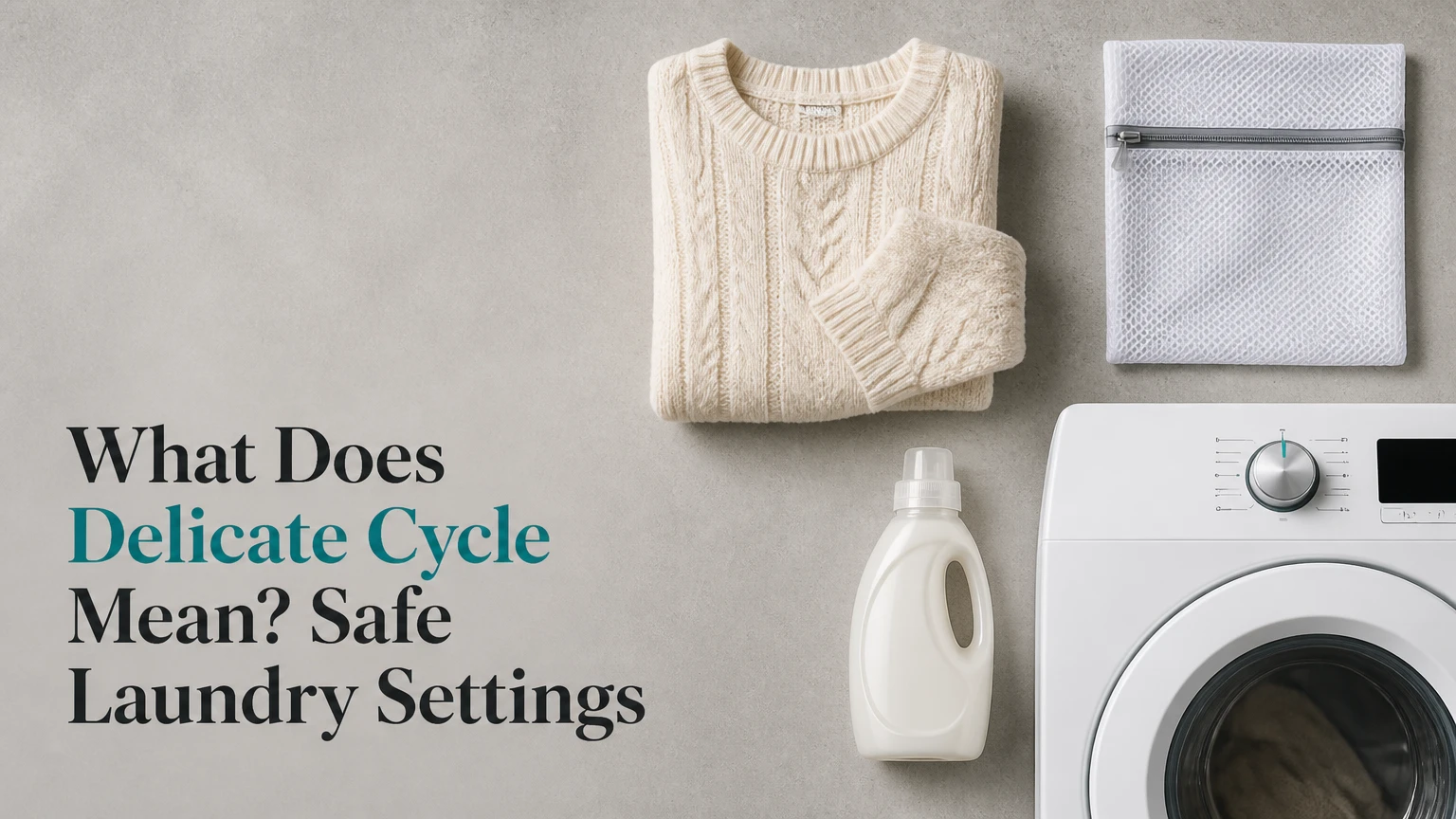
The delicate cycle is a washing-machine program that cleans fragile or lightweight garments with less mechanical action than a normal cycle. It usually combines gentler drum movement, a shorter or interrupted wash period, and a slower final spin, helping reduce stretching, snagging, pilling, and abrasion.
Key Facts at a Glance
A delicate cycle reduces mechanical stress; it does not guarantee that every fragile garment is machine-safe.
“Delicate,” “gentle,” and “hand wash” are related labels, but their motion and spin settings vary by manufacturer.
The garment care label takes priority over the name of the washing-machine program.
Typical delicate cycles run for 25-45 minutes at cold or cool temperatures, but exact settings differ by model.
A small load, mild detergent, and mesh bag usually protect fragile garments better than a full drum.
Delicate washing does not make high heat safe; tumble-drying can damage an item after a gentle wash.
What Does the Delicate Cycle Mean on a Washing Machine?
The delicate cycle means a lower-stress wash intended for garments that may be damaged by vigorous agitation, high-speed spinning, heat, or rough contact with heavier laundry. The setting is commonly used for lingerie, lace, lightweight synthetics, silk-like fabrics, knitwear, and clothing with decorative details.
The word “delicate” is not a universal performance specification. A Whirlpool front-loader, a Maytag top-loader, and an LG washer may use different water levels, drum movements, pauses, and spin speeds under the same label. Some machines call the program “Gentle,” “Delicates,” “Hand Wash,” or “Silks.”
The cycle reduces risk, rather than eliminating it. A beaded evening dress, tailored jacket, leather-trimmed garment, or item marked “dry clean only” may still be unsuitable for a delicate machine wash.
What the Cycle Changes
A normal cotton cycle relies on stronger movement and faster extraction because towels, sheets, denim, and cotton garments tolerate more force. A delicate program normally changes several variables:
- Mechanical movement: slower tumbling, rocking, or intermittent agitation.
- Wash time: often shorter, with longer pauses between movements.
- Spin speed: lower extraction speed, which leaves more water in the fabric.
- Temperature: commonly cold or cool, although some models allow warm water.
- Load size: often smaller than the washer’s maximum rated capacity.
The exact combination matters more than the program name. A machine with a central agitator may still twist garments more aggressively than a front-loader using a slow tumble pattern.
How Does a Delicate Wash Cycle Work?
A delicate wash cycle works by reducing the forces that create fabric abrasion, stretching, snagging, and distortion. Water, detergent, and controlled movement loosen ordinary body soil, while pauses and a slower spin limit repeated rubbing and sudden tension on fibers.
The Typical Wash Sequence
The following sequence describes a common pattern, not a guaranteed specification for every machine.
- Fill: The washer adds cold or cool water. Some older top-loaders use a high water level so garments move more freely; many high-efficiency machines use sensors and add only the water required for the load.
- Wash: The drum, wash plate, or agitator moves gently for short intervals. Pauses allow detergent solution to work without continuous friction.
- Drain: Used water leaves the tub. Drain speed and timing depend on the washer’s pump and control software.
- Rinse: Fresh water removes suspended soil and detergent. An extra rinse can help when skin sensitivity or heavy detergent residue is a concern.
- Final spin: The washer extracts water at a reduced speed compared with a normal cotton program. Garments usually leave the machine wetter.
High water is not an automatic feature of every delicate program. The American Cleaning Institute explains that modern high-efficiency washers regulate water according to load sensing, so users should not assume that manually selecting a maximum fill is safer.
Typical Settings and Ranges
| Attribute | Delicate cycle, typical range | Normal cotton cycle, typical range | Why it matters |
|---|---|---|---|
| Water temperature | Cold to 30°C, 60-86°F | Cold to 60°C, 60-140°F | Lower heat reduces shrinkage and dye stress |
| Total duration | 25-45 minutes | 45-90 minutes | Delicate programs often shorten active washing |
| Final spin | 400-800 RPM | 800-1,400 RPM | Lower speed reduces tension but leaves garments wetter |
| Load size | 25-50% of drum capacity | 70-100% of rated capacity | Space reduces crushing and tangling |
| Agitation pattern | Intermittent, rocking, or slow tumble | Continuous or stronger tumble | Less movement lowers abrasion |
| Detergent amount | About 50-75% of normal dose | Label dose for soil and load size | Excess detergent is harder to rinse from fragile fibers |
These figures are practical ranges, not promises. The owner’s manual is the authoritative source for a particular washer, especially when the machine offers adjustable temperature, soil level, spin, or water-plus options.
Which Fabrics Belong in the Delicate Cycle?
The delicate cycle suits washable garments whose care labels permit machine washing and whose construction can tolerate controlled water movement. Fabric fiber alone is not enough; seams, trims, coatings, dyes, and shape retention also determine suitability.
| Item or material | Delicate-cycle suitability | Recommended conditions | Avoid or use instead |
|---|---|---|---|
| Nylon or polyester lingerie | Usually suitable | Cold water, mesh bag, low spin | High heat and rough zippers |
| Lace underwear | Often suitable | Small load, mild detergent, mesh bag | Normal cycle and loose hooks |
| Silk blouse | Model and label dependent | Cold water, shortest gentle setting | Hand washing or dry cleaning if labeled |
| Merino wool sweater | Only if label permits | Wool or hand-wash program preferred | Regular delicate if the manual warns against it |
| Viscose or rayon dress | High risk of distortion | Cold water, minimal handling, reshape wet | Dry cleaning when labeled |
| Elastane leggings | Usually suitable | Cold water, low spin, no chlorine bleach | Hot water and high-heat drying |
| Sequined top | Construction dependent | Inside out, zipped mesh bag, cold water | Machine washing if sequins are glued |
| Structured blazer | Usually unsuitable | Follow dry-cleaning or specialist instructions | Delicate cycle unless explicitly washable |
Fabrics That Need Extra Caution
Wool: Wool can felt, shrink, or lose shape when heat, moisture, and friction combine. A machine’s dedicated wool cycle is generally preferable to a generic delicate cycle because it may use lower movement and a gentler spin.
Silk: Silk fibers tolerate water differently depending on dye, finish, and garment construction. Color bleeding, water marks, and loss of sheen remain possible even with cold delicate washing.
Viscose and rayon: These fibers can weaken when wet and may stretch or become misshapen. A delicate program reduces force but cannot prevent distortion caused by the fiber’s wet strength.
Lace and elastane: Lace can snag, while elastane can degrade under heat, chlorine, oils, and repeated high-temperature drying. A mesh bag protects lace from hooks and drum perforations.
Decorative garments: Beads, sequins, embroidery, foil prints, and glued appliqué can catch or detach. Turning a garment inside out reduces contact with the drum, but it does not repair weakly attached decoration.
The care label remains decisive. The Federal Trade Commission’s Care Labeling Rule requires manufacturers and importers in the United States to provide reliable care instructions, so “hand wash” or “dry clean only” should not be overridden merely because a washer has a delicate button.
How Should You Use the Delicate Cycle?
Use the delicate cycle with a small, sorted load, cold or cool water, a mild detergent, and protective bags for items with straps, lace, hooks, or small detachable parts. The most reliable result comes from matching the load to the care label rather than placing every lightweight garment together.
Step 1: Read Each Care Label
Separate machine-washable items from hand-wash and dry-clean-only garments. Check the maximum temperature, bleach warning, spin restriction, and drying symbol before loading the washer.
Step 2: Sort by Weight and Color
Wash lightweight garments together. Do not combine lace underwear with denim, towels, hooded sweatshirts, metal zippers, or garments with Velcro because heavier items can press, snag, or abrade fragile fabric.
Step 3: Protect the Garments
Close hooks, fasten zippers, remove brooches, and turn printed or embellished items inside out. Place bras, hosiery, lace, and small delicate pieces in zippered mesh bags, leaving enough room for water to pass through.
Step 4: Choose the Settings
Select delicate, gentle, hand wash, or wool according to the care label and the machine manual. Choose cold water unless the label specifies another temperature, and select the lowest practical spin speed.
Step 5: Add Detergent Carefully
Use a liquid detergent designed for delicate fabrics, or use a small amount of ordinary liquid detergent when the label permits it. A practical starting point is 50-75% of the normal dose for a small, lightly soiled load.
Avoid assuming that every “delicate wash” product is suitable for silk or wool. Enzymes, alkaline builders, bleach, and fragrance additives may affect particular fibers or dyes, so follow both the garment and detergent instructions.
Step 6: Load the Drum Loosely
Fill the drum to roughly one-quarter to one-half of its visible capacity. Garments should have room to move and should not form a tightly compressed bundle.
Step 7: Remove Laundry Promptly
Take garments out immediately after the program finishes. Gently unfold them, press out excess water without twisting, and reshape knits on a flat towel when the care label calls for flat drying.
Can Delicate Clothes Go in the Dryer?
Delicate clothes can go in a dryer only when the garment label permits tumble-drying at the specified heat level. A gentle wash does not protect silk, wool, elastic, rayon, lace, or glued decoration from heat, tumbling, or overdrying.
| Garment type | Safer drying method | Typical drying time | Main risk |
|---|---|---|---|
| Silk blouse | Flat dry or hang if label permits | 2-6 hours | Water marks, stretching, heat damage |
| Wool sweater | Reshape and dry flat | 8-24 hours | Shrinkage and loss of shape |
| Nylon lingerie | Drip dry or low-heat tumble if labeled | 2-5 hours | Elastic fatigue and snags |
| Elastane leggings | Air dry away from direct heat | 4-10 hours | Loss of stretch and odor retention |
| Polyester blouse | Low-heat tumble or hang dry | 1-3 hours | Wrinkles and trim damage |
| Lace garment | Flat or hang dry inside out | 3-8 hours | Distortion and snagging |
A towel-press method removes water without adding high mechanical stress. Place the wet garment on a clean towel, roll the towel loosely, and press along the roll. Do not wring silk, wool, lace, or viscose.
Delicate Versus Hand Wash, Wool, and Permanent Press
The delicate cycle is the broadest gentle option, but a specialized program may be safer when the washer has one. Hand-wash and wool programs typically use more controlled movement, while permanent press balances wrinkle reduction with more cleaning action.
| Program | Typical movement | Typical spin | Best use | Main limitation |
|---|---|---|---|---|
| Delicate | Slow tumble or intermittent agitation | 400-800 RPM | Lingerie, lace, lightweight synthetics | Not safe for every hand-wash item |
| Hand wash | Very slow rocking or brief movement | 0-600 RPM | Labels marked hand wash, model permitting | Poorer soil removal |
| Wool | Minimal movement and controlled temperature | 400-800 RPM | Machine-washable wool | Not intended for ordinary heavy soil |
| Permanent press | Moderate movement with wrinkle control | 600-1,000 RPM | Polyester, blended shirts, rayon blends | Too forceful for fragile lace |
| Normal cotton | Strong tumble or agitation | 800-1,400 RPM | Towels, sheets, denim, cotton basics | Higher abrasion and stretching risk |
Is Hand Wash Gentler Than Delicate?
Hand-wash programs are often gentler than generic delicate programs, but the comparison depends on the washer’s programming. A hand-wash label still does not mean that machine washing is automatically approved; some manufacturers use the term to describe a cycle that imitates hand movement, not a guarantee of garment safety.
Is Wool the Same as Delicate?
Wool is not exactly the same as delicate. A wool cycle is calibrated for wool’s tendency to felt and shrink, while a delicate cycle may focus more generally on reducing abrasion and spin force. Choose wool when the label permits machine washing and the washer provides that dedicated program.
Delicate Versus Normal and Permanent Press
Delicate is the safer choice for fragile, lightweight, or decorative washable garments, while normal is better for durable cotton and heavily soiled laundry. Permanent press fits moderately durable synthetic or blended clothing that needs wrinkle control but does not require the lowest mechanical action.
| Decision factor | Delicate | Permanent press | Normal cotton |
|---|---|---|---|
| Typical water temperature | Cold-30°C | Cold-40°C | Cold-60°C |
| Typical load soil | Light | Light to medium | Medium to heavy |
| Suitable examples | Lace, lingerie, silk-like tops | Polyester shirts, blends | Towels, denim, sheets |
| Fabric stress | Low | Medium | High |
| Stain-removal ability | Low to moderate | Moderate | Moderate to high |
| Residual water after spin | High | Medium | Low to medium |
| Typical duration | 25-45 minutes | 40-70 minutes | 45-90 minutes |
Delicate is a poor choice for towels, bedding, work uniforms covered in grease, cloth diapers requiring a validated hygiene routine, and muddy sportswear. The cycle’s lower friction helps fabric longevity but limits soil removal.
Does the Delicate Cycle Use More Water or Energy?
Water and energy consumption depend more on washer design and selected temperature than on the word “delicate.” Older top-loaders may use more water for gentle fabric movement, whereas high-efficiency front-loaders and impeller machines may use less water but rely on load sensing and intermittent tumbling.
Cold-water washing generally uses less energy than heated washing because the machine does not need to raise the incoming water temperature. The U.S. Department of Energy identifies water heating as the largest energy use associated with household laundry, although the exact savings depend on the appliance, household water temperature, and utility rates.
Typical household resource patterns are:
- Water: approximately 15-30 gallons for many high-efficiency machines and 25-45 gallons for some conventional top-loaders.
- Electricity: usually lower than a warm or hot cycle, especially in a cold-water program.
- Time: commonly 25-45 minutes, with some machines exceeding 60 minutes because of sensing or extra rinses.
- Drying energy: unchanged by the wash label and often higher when garments leave the washer wetter.
A low-spin delicate cycle may save wash energy but shift energy use to a longer dryer run. Air-drying can remove that trade-off, provided the garment can be safely air-dried.
What Common Mistakes Damage Delicate Laundry?
The most damaging mistakes are overloading the machine, mixing fragile items with heavy garments, using excessive detergent, and applying heat after a gentle wash. Each mistake adds a different form of stress, so selecting the delicate program alone cannot correct poor loading or drying practices.
Overloading the Drum
A packed drum prevents garments from moving through water and increases fabric-on-fabric pressure. Small loads clean more evenly and reduce tangling.
Mixing Heavy and Light Items
A towel can wrap around a lace camisole, while a metal zipper can catch knitwear. Sort by both color and physical weight.
Using Too Much Detergent
Excess detergent can remain in dense seams and elastic, causing stiffness, odor, or skin irritation. More detergent does not compensate for the delicate cycle’s lower agitation.
Selecting High Heat
Hot water can shrink wool, weaken elastane, fade dyes, and set some stains. Choose the lowest temperature allowed by the label.
Ignoring the Dryer Symbol
Tumble drying can cause more damage than the wash cycle. Flat-dry wool, protect silk from heat, and air-dry elastic garments when possible.
Leaving Clothes in a Wet Bundle
Wet garments develop deep creases and may smell musty. Remove the load promptly, separate pieces, and dry them according to their construction.
Why Are Clothes Dripping Wet After Delicate Washing?
Clothes are often wetter after a delicate cycle because the washer uses a lower final spin speed to reduce stretching and deformation. A 400-800 RPM extraction removes less water than a 1,000-1,400 RPM cotton cycle, so damp garments are expected.
Do not automatically run a high-speed spin afterward. For sturdy items that the care label permits, a separate moderate spin may be acceptable, but silk, wool, lace, viscose, and embellished garments are safer when towel-pressed or air-dried.
Why Are Stains Still Present?
Delicate cycles provide limited stain removal because low mechanical action cannot break up ground-in oil, mud, protein, or pigment as effectively as a normal cycle. Pretreat the mark before washing by testing a small hidden area, applying suitable detergent, and gently blotting rather than scrubbing.
Professional cleaning may be safer for solvent-sensitive dyes, oil-based stains on silk, tailoring, and garments labeled dry clean only. Never use chlorine bleach on silk, wool, elastane, or unknown fibers.
Why Did a Garment Stretch?
Stretching can result from wet-fiber weakness, excessive load weight, twisting around an agitator, or hanging a heavy wet knit. Reshape knitwear while damp and dry it flat; use a mesh bag for small pieces and avoid pulling garments from a tightly tangled load.
Situational Recommendations
Baby Clothes
Machine-washable baby clothes can usually use a delicate cycle when they are lightly soiled and made from fragile bamboo, rayon, or thin cotton. For diapers, spit-up stains, or hygiene-sensitive loads, follow the product manufacturer’s wash protocol instead of relying on a gentle program.
An extra rinse can reduce detergent residue. Fragrance-free detergent is a separate choice from cycle selection and may be preferable for sensitive skin.
Vintage Clothing
Vintage garments require inspection before washing. Weak seams, aged elastic, color instability, metal trim, and undocumented fabric blends make a delicate machine cycle risky even when the garment feels lightweight.
Test colorfastness in an inconspicuous area, photograph the construction, and hand wash or consult a textile conservator when the item has historical or financial value.
Bras and Hosiery
Fasten bra hooks, place each item in a separate mesh bag, and avoid combining bras with towels or garments containing Velcro. Use cold water and air-dry because heat accelerates elastic deterioration.
Athletic Clothing
Polyester and nylon activewear often tolerate delicate washing, but a normal synthetic or sportswear cycle may remove body oils more effectively when the care label permits it. Skip fabric softener because it can coat moisture-wicking fibers and reduce absorbency.
The Bottom Line
The delicate cycle means a lower-stress washing program for washable garments vulnerable to abrasion, stretching, snagging, or high-speed extraction. Use cold or cool water, a small sorted load, mild detergent, and mesh bags, then follow the garment’s care label for washing and drying. The setting reduces damage risk, but it cannot make every fragile garment machine-safe.
Frequently Asked Questions
Does the Delicate Cycle Prevent Shrinkage?
The delicate cycle can reduce shrinkage risk by using cooler water and less mechanical action, but it cannot prevent shrinkage caused by heat-sensitive fibers. Wool, cotton, rayon, and some blends may still change size. Check the care label, avoid hot water, and air-dry garments when tumble-drying is not approved.
Can I Wash Jeans on the Delicate Cycle?
You can wash lightweight jeans on delicate when the care label permits machine washing, but the cycle may not remove heavy soil effectively. Wash denim separately or with similarly durable dark clothing, turn it inside out, use cold water, and choose a normal or denim program when stronger cleaning is needed.
How Full Should a Delicate Load Be?
A delicate load should usually fill about one-quarter to one-half of the visible drum, leaving garments loose enough to move through the water. A crowded load increases tangling and abrasion, while a single small item may receive excessive movement against the drum.
Should I Use Fabric Softener on Delicate Clothes?
Fabric softener is not required for delicate clothes and can reduce absorbency, coat performance fabrics, or affect elastane and moisture-wicking finishes. Use a small amount only when the garment and product instructions permit it. Avoid softener on athletic wear, microfiber, and many towels.
Can I Wash Dry-Clean-Only Clothes on Delicate?
Do not machine-wash a dry-clean-only garment merely because the washer has a delicate setting. The label indicates that water, agitation, dye behavior, construction, or solvent requirements may make home washing unsafe. Use professional cleaning or follow a specialist’s instructions for valuable garments.
Why Does My Washer Take Longer on Delicate?
A delicate program may take longer because the washer pauses between movements, senses the load, balances garments before spinning, or adds a low-speed rinse and drain sequence. A displayed time is often an estimate, so an extended duration does not necessarily indicate a malfunction.