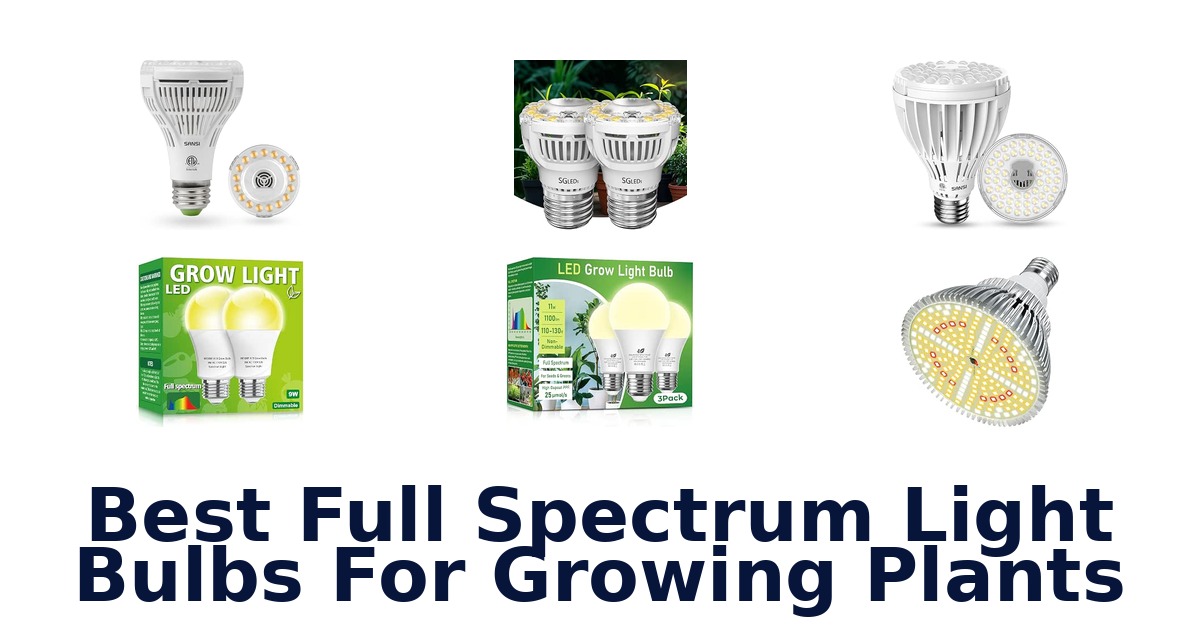
A strong full-spectrum grow bulb delivers plant-suitable light in a fixture your space can accommodate, making it useful for indoor herbs, houseplants, or fruiting plants that need supplemental light. These ten options range from compact 7-watt A15 bulbs to 32-watt models, with listed color temperatures from 4000K to 5000K and different levels of output detail. SANSI’s 30-watt PAR25 stands out for its stated PPFD of 336 μmol/s/m2 at one foot and supplemental 660nm red light; lower-wattage SANSI bulbs offer published PPF or PPFD figures too.
Other choices include ordinary A19 shapes and a larger PAR38 bulb. Match the bulb’s base and shape to your fixture, then consider distance and coverage before choosing wattage.
SANSI PAR25 30W is the strongest listed all-around option because it combines a full spectrum spanning 380–780nm with supplemental 660nm red light and a stated PPFD of 336 μmol/s/m2 at one foot. Its 30-watt draw and E26 base suit buyers seeking a higher-output bulb for supplemental indoor growing. Choose a lower-wattage bulb if your fixture or growing area calls for less output, and confirm the bulb’s physical shape fits before buying.
Our Top Picks
 Best Overall
The 30W bulb lists PPFD of 336 μmol/s/m2 at one foot, a 380–780nm spectrum, supplemental 660nm red light, and an E26 base.
View on Amazon High-Wattage Pick
Its 32W output and 350W incandescent equivalent suit buyers seeking a stronger bulb; it also lists 4000K daylight, CRI 95, and a five-year warranty.
View on Amazon A19 Output Pick
This familiar A19 bulb lists 15W, PPF of 27 μmol/s, PPFD of 152.83 at one foot, and a five-year warranty.
View on Amazon- Compact PAR Format SANSI PAR20 10W
- Lowest Wattage SGLEDs A15 7W
Compare the grow bulbs by format, output, and use
| # | Product | Wattage | Incandescent Equivalent Wattage | Voltage | Buy |
|---|---|---|---|---|---|
| 1 | 1. SANSI PAR25 30WBest Overall | 30 W | 300 W | 120 V | View on Amazon |
| 2 | 2. SANSI PAR25 32WHigh-Wattage Pick | 32 W | 350 W | 120 V AC | View on Amazon |
| 3 | 3. SANSI A19 15WA19 Output Pick | 15 W | 200 W | 110 V | View on Amazon |
| 4 |  4. SANSI PAR20 10WCompact PAR Format | 10 W | 150 W | 120 V | View on Amazon |
| 5 |  5. Lonwon PAR38 30WHigh-wattage PAR38 plant bulb | 30 W | 320 W | 120 V AC | View on Amazon |
| 6 |  6. Briignite A19 11WNatural-looking A19 for herbs | 11 W | 100 W | 120 V | View on Amazon |
| 7 |  7. SGLEDs A15 7WLowest Wattage | 7 W | 60 W | 120 V | View on Amazon |
| 8 |  8. mfxmf A19 9WTwo-bulb red-blue spectrum set | 9 W | 100 W | 110 V | View on Amazon |
| 9 |  9. Nzkwrv A19 11WFlicker-free natural-white A19 | 11 W | 100 W | 110 V | View on Amazon |
| 10 |  10. Flaspar A19 11WInstant-on full-spectrum A19 | 11 W | 100 W | 120 V | View on Amazon |
Detailed Reviews: Best Full Spectrum Light Bulbs For Growing Plants
#1 · Best Overall
1. SANSI PAR25 30W
- Wattage: 30 W
- Incandescent Equivalent Wattage: 300 W
- Voltage: 120 V
Best for: Flowering and fruiting PAR25.
Why it ranks #1: The 30W bulb lists PPFD of 336 μmol/s/m2 at one foot, a 380–780nm spectrum, supplemental 660nm red light, and an E26 base.
SANSI’s 30-watt PAR25 adds 660nm red supplementary light to a 5000K full spectrum, giving growers a bulb specifically described for flowering and fruiting support. Its listed PPFD of 336 μmol/s/m2 at one foot supplies a concrete close-range measurement for planning placement.
The 380–780nm visible-spectrum coverage pairs with the added 660nm red light, which SANSI says helps flowering and fruiting and prolongs flowering. That makes the spectrum especially relevant to growers focused on those stages rather than only a general white-light appearance. The 30-watt draw, 300-watt incandescent equivalent, E26 base, and 120-volt specification help buyers assess power and fixture compatibility before installation.
- 5000K daylight-white appearance
- Additional 660nm red supplementary light
- PPFD of 336 μmol/s/m2 at one foot
- E26 base and 120-volt specification
- The stated PPFD measurement is for one foot and does not specify other distances.
Skip it if you need two lower-wattage bulbs for separate fixtures; SANSI's PAR20 10W listing includes a two-bulb pack.
This PAR25 suits indoor growers focused on flowering or fruiting who can use its E26 base and 30-watt draw. Treat the published PPFD as a one-foot measurement when planning plant placement.
Full product details
| Brand | SANSI |
|---|---|
| Accepted Voltage Frequency | 100 to 120 Volts and 60 Hertz |
| Color | White |
| Color Rendering Index | 80 |
| Color Temperature | 5000 Kelvin |
| Incandescent Equivalent Wattage | 300 watts |
| Included Components | 1* SANSI PAR25 30W LED Grow Bulb |
| Item Dimensions W x H | 3.07"W x 4.48"H |
| Item Weight | 0.32 kg |
| Light Color | 5000K Daylight White |
| Light Source Wattage | 30 watts |
| Manufacturer | SANSI |
| Part Number | 01-03-001-043001 |
| Manufacturer Warranty Description | 5-year warranty. |
| Material | Aluminum, Ceramic |
| Model | SANSI Full Spectrum LED Grow Light Bulb |
| Model Number | PAR25 30W |
| Voltage | 120 volts |
| Wattage | 30 watts |
Listed on Amazon as: SANSI 300W Equiv. Full Spectrum LED Grow Light Bulb 5000K+660nm E26 Base
View on Amazon#2 · High-Wattage Pick
2. SANSI PAR25 32W
- Wattage: 32 W
- Incandescent Equivalent Wattage: 350 W
- Voltage: 120 V AC
Best for: Ceramic 32-watt grow bulb.
Why it ranks #2: Its 32W output and 350W incandescent equivalent suit buyers seeking a stronger bulb; it also lists 4000K daylight, CRI 95, and a five-year warranty.
SANSI’s 32-watt ceramic bulb lists a 350-watt incandescent equivalent and 4000K daylight, giving growers a higher-wattage option with a familiar white appearance. Its ceramic body and stated low infrared radiation are relevant for setups where bulb material and heat radiation are part of plant-light selection.
The 32-watt draw and 350-watt equivalent provide a clear comparison point for choosing a fixture, while the 4000K daylight color temperature describes the visible light. SANSI lists a ceramic body, reinforced insulation, and a V0 flame-retardant grade, connecting its construction details with safety considerations. The low-IR description notes reduced heat radiation, and the bulb’s listed 120-volt supply sets an electrical boundary.
- 32 watts with 350-watt incandescent equivalent
- 4000K daylight appearance
- Ceramic body with V0 flame-retardant grade
- Low-IR description indicates less heat radiation
- At 32 watts, it draws more power than the listed 30-watt SANSI PAR25.
Skip it if you prefer a 30-watt bulb with extra 660nm red light; SANSI's PAR25 30W listing specifies that supplement.
Consider this SANSI bulb for growers seeking a ceramic 32-watt option with daylight appearance and stated low-IR output. Its 120-volt supply and 32-watt draw are relevant fixture and operating considerations.
Full product details
| Brand | SANSI |
|---|---|
| Accepted Voltage Frequency | 100 to 120 Volts and 60 Hertz |
| Bulb Shape Size | A21 |
| Color | Full Spectrum |
| Color Rendering Index | 95 |
| Color Temperature | 4000 Kelvin |
| Incandescent Equivalent Wattage | 350 watts |
| Included Components | PAR25 32W Grow Bulb |
| Item Dimensions W x H | 3.27"W x 5.63"H |
| Light Color | Daylight |
| Light Source Wattage | 32 watts |
| Manufacturer Warranty Description | 5 years warranty. |
| Material | Ceramic |
| Model | PAR25 32W LED Grow Light |
| Model Number | 01-03-001-013201 |
| Special Feature | AC 120V, LED Full Spectrum, 4000K Natural Light, High PPFD, 5-year warranty, ETL Listed |
| Voltage | 120 volts_of_alternating_current |
| Wattage | 32 watts |
Listed on Amazon as: SANSI 350W-Eq. Grow Light Bulbs for Indoor Plants Full Spectrum 32W LED E26
View on Amazon#3 · A19 Output Pick
3. SANSI A19 15W
- Wattage: 15 W
- Incandescent Equivalent Wattage: 200 W
- Voltage: 110 V
Best for: Higher-output daylight A19.
Why it ranks #3: This familiar A19 bulb lists 15W, PPF of 27 μmol/s, PPFD of 152.83 at one foot, and a five-year warranty.
SANSI’s 15-watt A19 lists a PPFD of 152.83 μmol/s/m2 at one foot, giving growers a specific close-range output reference. Its 4000K daylight full spectrum covers the visible range and is presented for every plant growth cycle, combining measured output with a natural-looking white light.
The listed PPF of 27 μmol/s and one-foot PPFD measurement help buyers compare placement options against the 10-watt SANSI PAR20, which lists lower figures. Its A19 shape and 110-volt specification clarify fixture and supply requirements before installation. SANSI also describes a hollow structure that transfers working heat to the air through natural convection, a design intended to support heat dissipation during operation.
- 15-watt A19 format
- PPF of 27 μmol/s listed
- PPFD of 152.83 μmol/s/m2 at one foot
- Hollow structure supports natural-convection heat transfer
- The specified voltage is 110 volts, so it is not a universal-voltage bulb.
Skip it if you need a bulb specified for 120 volts; Briignite's A19 5000K bulb lists 120 volts.
A fit for indoor growers seeking an A19 daylight bulb with stated close-range output and a described heat-transfer structure. Check the 110-volt specification against the intended fixture supply before choosing it.
Full product details
| Brand | SANSI |
|---|---|
| Accepted Voltage Frequency | 100 to 120 Volts and 60 Hertz |
| Bulb Shape Size | A19 |
| Color | White |
| Color Rendering Index | 95 |
| Color Temperature | 4000 Kelvin |
| Incandescent Equivalent Wattage | 200 watts |
| Included Components | Bulb |
| Item Dimensions W x H | 3.39"W x 3.9"H |
| Light Color | White |
| Light Source Wattage | 15 watts |
| Manufacturer | SANSI |
| Part Number | 01-03-001-010317 |
| Manufacturer Warranty Description | 5 years warranty. |
| Material | Ceramic |
| Model Number | C21GL-DE26-15W |
| Style Name | Garden |
| Voltage | 110 volts |
| Wattage | 15 watts |
Listed on Amazon as: SANSI Grow Lights for Indoor Plants, 15W Full Spectrum A19 Grow Light Bulb
View on Amazon#4 · Compact PAR Format
4. SANSI PAR20 10W
- Wattage: 10 W
- Incandescent Equivalent Wattage: 150 W
- Voltage: 120 V
Best for: Measured-light PAR20 setup.
Why it ranks #4: The two-bulb PAR20 set lists PPF of 16.8 μmol/s, PPFD of 97.91 at one foot, 4000K daylight, and CRI 95.
SANSI’s PAR20 bulb pairs a 4000K daylight appearance with listed PPF and PPFD measurements, giving growers more quantified light output to consider when positioning plants. Its full-spectrum range covers 400–780nm, and the daylight specification suits buyers seeking visible light closer to a natural appearance.
The listed PPF of 16.8 μmol/s and PPFD of 97.91 μmol/s/m2 at one foot give a reference point for arranging plants near the bulb. A secondary optical design works through a lens, connecting the bulb’s optical setup with its stated output measurements. Its 10-watt draw and PAR20 shape help identify the fixture and electrical requirements, while the two-pack supports lighting a pair of plant locations.
- 4000K daylight appearance
- 400–780nm visible-spectrum coverage
- PPF and PPFD figures supplied
- Two bulbs included
- Its listed PPFD is measured at one foot, so the figure does not describe other distances.
Skip it if you want a higher listed PPFD at one foot; SANSI's 15W A19 lists 152.83 μmol/s/m2 at that distance.
This two-bulb PAR20 set suits growers who want published light-output figures for close positioning decisions. Use its one-foot PPFD as the reference point, not as a claim about performance at every plant distance.
Full product details
| Brand | SANSI |
|---|---|
| Accepted Voltage Frequency | 100 to 120 Volts and 60 Hertz |
| Bulb Shape Size | PAR20 |
| Color | Full Spectrum 4000k |
| Color Rendering Index | 95 |
| Color Temperature | 4000 Kelvin |
| Incandescent Equivalent Wattage | 150 watts |
| Item Dimensions W x H | 3.07"W x 3.86"H |
| Item Weight | 7 ounces |
| Light Color | 4000K Daylight |
| Light Source Wattage | 10 watts |
| Manufacturer | SANSI |
| Part Number | 01-03-001-041032 |
| Material | Ceramic |
| Model | PAR20 10W Grow Light Bulb 2 Pack |
| Model Number | 01-03-001-041032 |
| Style Name | 2_Count (Pack of 1) |
| Voltage | 120 volts |
| Wattage | 10 watts |
Listed on Amazon as: SANSI LED Grow Light Bulbs 2-Pack, 10W Full Spectrum, E26 Base, 4000K
View on Amazon#5
5. Lonwon PAR38 30W
- Wattage: 30 W
- Incandescent Equivalent Wattage: 320 W
- Voltage: 120 V AC
Best for: High-wattage PAR38 plant bulb.
Why it ranks #5: Its 30W PAR38 form and 320W incandescent equivalent provide a higher-output alternative, with a 4000K appearance and standard E26 base.
Lonwon’s 30-watt PAR38 lists a 320-watt incandescent equivalent, giving growers a higher-wattage bulb for a compatible plant-light setup. Its 4000K appearance combines white-looking illumination with a targeted red-and-blue spectrum, intended for tomatoes, peppers, leafy greens, herbs, and other plants across growth stages.
The E26 base allows this bulb to fit a range of regular lamps, including listed floor, ceiling, wall, and clamp fixtures; the clamp option calls for at least a six-inch shade. Its 30-watt draw and 320-watt equivalent provide a reference for choosing a fixture and electrical setup. The 4.7-inch PAR38 format is notably larger than a conventional A19, so fixture clearance matters before installation.
- 30 watts with 320-watt incandescent equivalent
- 4000K white appearance with targeted red-blue spectrum
- E26 base fits listed regular lamp types
- Specified for plants at all growth stages
- The 4.7-inch PAR38 bulb requires more fixture clearance than an A19.
Skip it if you need a smaller A19 bulb for a tight fixture; Flaspar's A19 full-spectrum bulb offers that shape.
This Lonwon bulb fits growers using a compatible E26 lamp who want the PAR38 format and higher stated wattage. Check the fixture’s clearance for its 4.7-inch size, especially in compact shades.
Full product details
| Brand | Lonwon |
|---|---|
| Accepted Voltage Frequency | 100 to 240 Volts and 50 Hertz to 60 Hertz |
| Bulb Shape Size | PAR38 |
| Color Rendering Index | 95 |
| Color Temperature | 4000 Kelvin |
| Incandescent Equivalent Wattage | 320 watts |
| Included Components | Bulb |
| Item Dimensions W x H | 4"W x 4"H |
| Item Weight | 6.08 ounces |
| Light Color | 4000K |
| Light Source Wattage | 30 watts |
| Manufacturer | Lonwon |
| Part Number | GLB240304 |
| Manufacturer Warranty Description | 2 |
| Material | Acrylonitrile Butadiene Styrene (ABS), Aluminum |
| Model | GLB240304 |
| Model Number | GLB240304 |
| Voltage | 120 volts_of_alternating_current |
| Wattage | 30 watts |
Listed on Amazon as: LED Grow Light Bulb, 30W, E26 Base, 4000K Full Spectrum, 1-Pack
View on Amazon#6
6. Briignite A19 11W
- Wattage: 11 W
- Incandescent Equivalent Wattage: 100 W
- Voltage: 120 V
Best for: Natural-looking A19 for herbs.
Why it ranks #6: This three-bulb A19 set uses 11W per bulb and lists 1000 lumens, 5000K light, and a 180-degree output.
The Briignite A19 pairs a 5000K white appearance with a red-and-blue spectrum, giving plant growers a more natural-looking light for tomatoes, peppers, leafy greens, and herbs. Its stated suitability across all growth stages makes it a straightforward option for one bulb serving a mixed indoor planting routine.
The 180-degree output spreads light broadly, while the 1,000-lumen rating gives a concrete brightness reference for positioning the bulb over plants. It draws 11 watts and is listed as equivalent to a 100-watt traditional bulb, so it can provide that stated equivalent with lower power consumption. The A19 shape and 120-volt specification make it suited to compatible household bulb fixtures; the three-bulb inclusion can outfit more than one planting spot.
- 5000K white appearance with red-and-blue spectrum
- 180-degree light output
- 1,000 lumens at 11 watts
- Three bulbs included
- The listed voltage is 120 volts, limiting use to compatible electrical supplies.
Skip it if you need a specified PPFD reading to plan light intensity; SANSI's 10W PAR20 listing provides PPF and PPFD figures.
Choose this three-bulb set for household growers who want broad A19 lighting and a white-looking full spectrum for herbs or vegetables. Its 120-volt specification is the key electrical boundary to check.
Full product details
| Brand | Briignite |
|---|---|
| Bulb Shape Size | A19 |
| Color | White |
| Color Rendering Index | 85 |
| Color Temperature | 5000 Kelvin |
| Incandescent Equivalent Wattage | 100 watts |
| Included Components | 3 Bulbs included |
| Item Dimensions W x H | 2.36"W x 4.65"H |
| Item Weight | 3.52 ounces |
| Light Color | Cool White |
| Light Source Wattage | 11 watts |
| Manufacturer | Briignite |
| Part Number | 11W-A19-5000K-Grow Light Bulb |
| Material | Aluminum, Plastic |
| Model | 9W-A19-5000K-Grow Light Bulb |
| Model Number | foco de crecimiento 9W-A19-5000K |
| Style Name | Grow Bulb 3 Pack |
| Voltage | 120 volts |
| Wattage | 11 watts |
Listed on Amazon as: Grow Light Bulbs, 5000K Full Spectrum Grow Light, LED Grow Bulb
View on Amazon#7 · Lowest Wattage
7. SGLEDs A15 7W
- Wattage: 7 W
- Incandescent Equivalent Wattage: 60 W
- Voltage: 120 V
Best for: Compact A15 two-bulb set.
Why it ranks #7: The 7W A15 bulbs are the lowest-wattage listed option; their 4000K light and two-bulb pack suit smaller supplemental-light setups.
SGLEDs pairs a compact A15 shape with a 4000K white appearance and red-blue spectrum, giving growers two smaller bulbs for compatible indoor fixtures. The stated spectrum is intended for tomatoes, peppers, leafy greens, and herbs at all growth stages, while ceramic heat-sink technology distinguishes its construction.
Each bulb draws 7 watts and carries a 60-watt incandescent-equivalent rating, making its listed power and output references easy to weigh for small plant setups. The A15 format is smaller than an A19, which can help where fixture space is limited. SGLEDs says its ceramic heat sink replaces a traditional aluminum substrate and directly supports the LED chip; the two-pack can serve separate locations.
- Compact A15 shape
- Two bulbs included
- 4000K white appearance with red-blue spectrum
- Ceramic heat-sink technology
- At 7 watts, it has less listed power than the 11-watt A19 options.
Skip it if you want a higher-wattage bulb; Nzkwrv's 11W A19 lists 1,000 lumens and full spectrum.
A practical option for growers with compact fixtures seeking two small bulbs for herbs or leafy greens. Its 7-watt rating suits buyers who prioritize the A15 format over the higher wattage of larger bulbs.
Full product details
| Brand | SGLEDs |
|---|---|
| Bulb Shape Size | A15 |
| Color | A15-7w |
| Color Temperature | 4000 Kelvin |
| Incandescent Equivalent Wattage | 60 watts |
| Light Color | White |
| Light Source Wattage | 7 watts |
| Manufacturer | SGLEDs |
| Part Number | C23ZW019-V0007A27 |
| Manufacturer Warranty Description | 2 year. |
| Material | Ceramic, Plastic |
| Model | C23ZW019-V0007A27 |
| Model Number | C23ZW019-V0007A27 |
| Special Feature | Eye-Friendly, Flicker-Free, Full Spectrum |
| Voltage | 120 volts |
| Wattage | 7 watts |
Listed on Amazon as: A15 7W Full Spectrum Grow Light Bulbs, E26, 2 Pack
View on Amazon#8
8. mfxmf A19 9W
- Wattage: 9 W
- Incandescent Equivalent Wattage: 100 W
- Voltage: 110 V
Best for: Two-bulb red-blue spectrum set.
Why it ranks #8: This two-bulb A19 set uses 9W per bulb and claims a 400–740nm spectrum for all growth stages, though listed color is red/blue.
The mfxmf pair specifies a 400–740nm full spectrum for all plant growth stages, giving growers two A19 bulbs for indoor planting areas. Its listed 150-degree output offers a broad beam, while the recommended lamp-to-plant distance of 2–4.05 feet provides a practical starting point for setup.
Each bulb draws 9 watts and is listed as replacing a 100-watt traditional bulb, connecting its lower stated power use with a familiar incandescent-equivalent reference. The 150-degree light output can cover a wider area than a narrow beam, and the stated 2–4.05-foot distance helps guide initial placement. Its A19 shape and 110-volt rating identify the fixture format and electrical requirement for installation.
- Two A19 bulbs included
- 400–740nm spectrum for all growth stages
- 150-degree light output
- Recommended lamp-to-plant distance is 2–4.05 feet
- The listed 110-volt rating limits use to fixtures supplied at that voltage.
Skip it if you need a white-looking 5000K bulb; Briignite's A19 grow bulb has that stated appearance and lists 120 volts.
Consider this pair for indoor growers who want a broad-output A19 bulb and a stated placement range. Its red-blue light color and 110-volt specification are important considerations for the room and fixture.
Full product details
| Brand | mfxmf |
|---|---|
| Bulb Shape Size | A19 |
| Color | Full Spectrum |
| Color Rendering Index | 85 |
| Incandescent Equivalent Wattage | 100 watts |
| Item Dimensions W x H | 2.36"W x 4.56"H |
| Item Weight | 2.88 ounces |
| Light Color | Red/Blue |
| Light Source Wattage | 9 watts |
| Manufacturer | mfxmf |
| Part Number | ZP007 |
| Material | Plastic |
| Model | ZP007 |
| Model Number | ZP007 |
| Voltage | 110 volts |
| Wattage | 9 watts |
Listed on Amazon as: 2 Pack LED Grow Light Bulbs,Full Spectrum Plant Light Bulb, 9W Replace 100W
View on Amazon#9
9. Nzkwrv A19 11W
- Wattage: 11 W
- Incandescent Equivalent Wattage: 100 W
- Voltage: 110 V
Best for: Flicker-free natural-white A19.
Why it ranks #9: The 11W A19 bulb lists 1000 lumens, 4000K natural white, and full-spectrum use for herbs, vegetables, and houseplants.
Nzkwrv’s A19 combines a 4000K natural-white appearance with a red-and-blue full spectrum, giving indoor growers a more conventional-looking bulb for vegetative and flowering stages. Its listed flicker-free and eye-friendly features may suit a home growing area where the light is also visible to people.
The bulb produces 1,000 lumens while drawing 11 watts, giving buyers a brightness figure alongside its stated power use. Its A19 shape and 110-volt rating help establish fixture and supply requirements, while the 4000K color temperature describes the visible light appearance. The listed full-spectrum output is presented for herbs, vegetables, and houseplants, so the same bulb can serve a variety of indoor plant types.
- 4000K natural-white appearance
- Full spectrum covering red and blue wavelengths
- 1,000 lumens at 11 watts
- Listed as flicker-free and eye-friendly
- The 110-volt specification limits compatibility to fixtures supplied at that voltage.
Skip it if you need a stated PPFD measurement for positioning; SANSI's 10W PAR20 bulb lists PPFD at one foot.
This bulb suits home growers who want a natural-white A19 for herbs, vegetables, or houseplants across vegetative and flowering stages. Its 110-volt rating is the main fixture-supply boundary.
Full product details
| Brand | Nzkwrv |
|---|---|
| Bulb Shape Size | A19 |
| Color | White |
| Color Rendering Index | 85 |
| Color Temperature | 4000 Kelvin |
| Incandescent Equivalent Wattage | 100 watts |
| Light Color | Natural White |
| Light Source Wattage | 11 watts |
| Manufacturer | Nzkwrv |
| Part Number | RF-GR-4000K |
| Material | Aluminum, Plastic |
| Model | RF-GR-4000K |
| Model Number | RF-GR-4000K |
| Special Feature | Energy Efficient, Eye-Friendly, Flicker-Free, Full Spectrum, Long Lasting |
| Voltage | 110 volts |
| Wattage | 11 watts |
Listed on Amazon as: Grow Light Bulbs, 11W LED Full Spectrum Plant Light Bulbs for Indoor Plants
View on Amazon#10
10. Flaspar A19 11W
- Wattage: 11 W
- Incandescent Equivalent Wattage: 100 W
- Voltage: 120 V
Best for: Instant-on full-spectrum A19.
Why it ranks #10: Its 11W A19 bulb is described as full spectrum across 380–780nm, but the supplied specifications provide no output, color temperature, or photometric figures.
Flaspar lists instant-on operation alongside a natural-white full spectrum spanning 380–780nm, giving indoor growers a bulb that reaches light immediately and is specified for plants at all growth stages. Its A19 form keeps the setup familiar for compatible fixtures while avoiding an explicitly red-blue-looking appearance.
The 11-watt draw and 100-watt incandescent equivalent offer a direct power and familiar-output reference for planning a household grow-light setup. Its A19 shape and stated E26 base identify the fitting, while the 120-volt specification and accepted 100–120-volt, 60-hertz range clarify electrical compatibility. Flaspar describes the light as non-glaring and natural in color, a useful consideration when the growing area shares indoor space.
- Instant-on operation
- 380–780nm full-spectrum range
- 11 watts with 100-watt incandescent equivalent
- E26 base and 120-volt specification
- No lumen or PPFD measurement is supplied for comparing light output.
Skip it if you require published PPFD figures to guide placement; SANSI's 10W PAR20 bulb lists PPFD at one foot.
Choose Flaspar for a compatible E26 fixture where immediate, natural-white light and a stated full-spectrum range matter. Growers who need quantified brightness or PPFD will find those figures absent from its supplied specifications.
Full product details
| Brand | Flaspar |
|---|---|
| Accepted Voltage Frequency | 100 to 120 Volts and 60 Hertz |
| Bulb Shape Size | A19 |
| Color | White |
| Incandescent Equivalent Wattage | 100 watts |
| Light Color | white |
| Light Source Wattage | 11 watts |
| Manufacturer | Flaspar |
| Material | Aluminum, Plastic |
| Special Feature | Energy Efficient, Eye-Friendly, Full Spectrum, Instant On, LED Grow Light Bulb A19 Bulb Full Spectrum Grow Light Bulb Plant Light Bulbs See more |
| Style Name | Modern |
| Voltage | 120 volts |
| Wattage | 11 watts |
Listed on Amazon as: A19 11W LED Grow Bulbs E26 Base Full Spectrum Plant Light Bulb for Indoor
View on AmazonWhy bulb-to-plant distance can change the result
A bulb’s output figures are tied to distance, so a strong-looking wattage alone does not tell you how much light reaches leaves. SANSI lists its 10W PAR20 at PPFD 97.91 μmol/s/m2 at one foot and its 15W A19 at 152.83 at one foot; the 30W SANSI PAR25 lists 336 at one foot. These figures are useful comparisons at the stated distance, not guarantees of coverage across a whole shelf.
The mfxmf listing gives a recommended distance of 2–4.05 feet, but the other products do not provide an equivalent placement instruction in the supplied data. Avoid assuming that distance guidance transfers between bulb models: output and beam shape differ, and PAR20, A19, and PAR25 are not the same format.
Position the bulb according to its own instructions and monitor plant response.
Check fixture fit before choosing a higher-wattage bulb
A grow bulb can be unsuitable even when its base fits, because shape and clearance also matter. Many entries are A19 bulbs, but the set also includes A15, PAR20, PAR25, and a 4-inch-wide PAR38. The Lonwon PAR38 listing specifically suggests a clamp lamp with at least a 6-inch shade, among other fixture types.
That makes it a poor assumption that every bulb will sit comfortably in a small desk lamp or enclosed shade. Check the fixture’s E26 socket where applicable, the bulb’s dimensions, and any manufacturer restrictions on enclosure or dimming; the supplied listings do not establish universal compatibility with enclosed or dimmable fixtures.
Higher-wattage options such as the 30W and 32W bulbs may be more appropriate for a suitable open fixture, while a compact A15 or A19 can be easier to accommodate. Physical fit is a practical purchase check, not a proxy for plant coverage.
How to Choose a Full-Spectrum Grow Bulb
Output and plant-light data
Look for stated plant-light output when you need to compare bulbs for a particular growing distance. The listings range from 7W for SGLEDs A15 7W to 32W for SANSI PAR25 32W, but wattage alone is not a measure of light delivered to leaves. SANSI PAR20 10W lists PPFD of 97.91 μmol/s/m2 at one foot, SANSI A19 15W lists 152.83, and SANSI PAR25 30W lists 336 at one foot.
Choose a bulb with published output figures when you want a more direct comparison; lower-wattage bulbs may suit a small plant or modest supplemental setup. Confirm the stated measurement distance before applying any figure to your own placement.
Bulb shape and fixture fit
Choose a shape and size that your lamp can safely accommodate, not just a base that screws in. The options include A15, A19, PAR20, PAR25, and PAR38, with the Lonwon PAR38 measuring about four inches wide and the Briignite A19 measuring 2.36 inches wide. Several products specify an E26 base, while others’ supplied specification details do not list one, so check the product’s own socket information before ordering.
A compact bulb may suit a small fixture or tight shelf; PAR formats can be more appropriate where the fixture has room for their larger form. If using a shade or enclosed fitting, verify its clearance and the maker’s fixture guidance rather than assuming all LED grow bulbs work in every lamp.
Color appearance and spectrum details
Consider how the light will look in your room as well as whether its listing describes a full spectrum. Several bulbs present white light to the eye: Briignite A19 11W is 5000K, while SANSI A19 15W, SANSI PAR20 10W, SGLEDs A15 7W, and Lonwon PAR38 30W list 4000K. SANSI A19 15W and PAR20 10W list CRI 95; Briignite lists CRI 85.
SANSI PAR25 30W adds 660nm red light to a stated 380–780nm spectrum. Prefer a listed white color temperature if you want a less conspicuous grow light in a living space; look at spectrum details and plant-light output if your priority is supplemental growing rather than room appearance.
Which grow bulb should I choose?
For the strongest documented output, choose SANSI PAR25 30W: it lists PPFD of 336 μmol/s/m2 at one foot, full-spectrum light, and supplemental 660nm red. If you want a familiar A19 shape with published plant-light figures, SANSI A19 15W lists PPF and PPFD and includes a five-year warranty. For two smaller PAR bulbs with listed output data, choose SANSI PAR20 10W.
If your priority is a lower-wattage compact format, SGLEDs A15 7W is the smallest listed option. Choose Briignite A19 11W when a three-bulb set and 1000-lumen specification matter.
For a larger PAR38 format, consider Lonwon PAR38 30W, but check shade clearance. Confirm socket, dimensions, and placement instructions before selecting any bulb.
Frequently Asked Questions
How far should a full-spectrum grow bulb sit from my plants?
Start with the placement guidance supplied for the specific bulb, since the right distance depends on its output, the fixture, and the plants. If no distance is stated, begin cautiously and watch for signs of stress or weak growth. Adjust gradually, keeping the bulb securely installed and away from foliage that could touch it.
How many hours a day should I run a grow light bulb?
Use the bulb’s instructions and your plants’ light needs to set a daily schedule; there is no single duration that suits every plant. A timer can help keep the schedule consistent. Observe how plants respond, and avoid assuming that leaving the light on continuously is better than providing a regular dark period.
Can I use a grow bulb in an enclosed or dimmable fixture?
Only use it in an enclosed or dimmable fixture if the bulb’s product information explicitly says that use is supported. The titles here do not establish either compatibility. Check the bulb’s instructions and fixture requirements before installing it; otherwise, choose a suitable open, non-dimmable fixture and confirm the socket and physical clearance.
How do I know whether a bulb will fit my fixture?
Check the socket type and the bulb’s physical dimensions against your fixture before buying. An E26 base appears in several listed titles, but that alone does not confirm that every bulb will fit a particular shade or enclosure. Also allow for the bulb’s shape and clearance, especially with larger PAR-style formats.
What does a published PPFD figure tell me?
PPFD describes the amount of photosynthetically active light reaching a surface at a stated distance, so the distance matters when comparing figures. For example, the article identifies a listed PPFD of 336 μmol/s/m2 at one foot for the SANSI PAR25 30W. Compare figures only when their measurement conditions are clear.
Final Words
For the strongest documented output, choose SANSI PAR25 30W: it lists PPFD of 336 μmol/s/m2 at one foot, full-spectrum light, and supplemental 660nm red. SANSI A19 15W is a practical pick for a familiar A19 shape with published plant-light figures and a five-year warranty; SANSI PAR20 10W offers two smaller PAR bulbs with listed output data. For compact lower-wattage use, consider SGLEDs A15 7W.
Check fit, socket, and placement instructions before choosing.