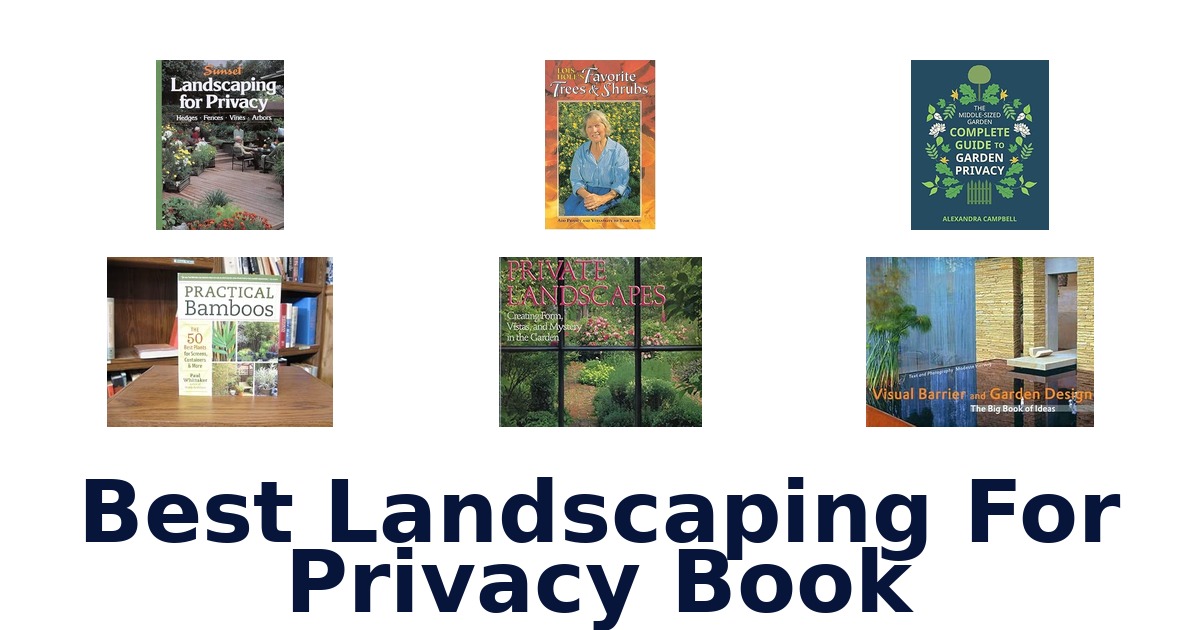
A strong landscaping-for-privacy book connects garden design with practical ways to screen a yard, making it useful for homeowners planning a more secluded outdoor space. This selection includes books explicitly titled around landscaping or garden privacy, alongside narrower references on trees and shrubs, bamboo screens, and visual barriers. The leading choice is Marty Wingate’s Landscaping for Privacy, whose subtitle frames the book around turning an outdoor space into a peaceful retreat.
Other options suit readers seeking a different angle, such as a hardcover format, a plant-specific focus, or a design-oriented book with listed full-color photographs. The product information identifies formats and titles, but not dimensions, publication details, or the depth of each book’s instructions, so compare the stated focus with the kind of privacy project you have in mind.
Marty Wingate Landscaping for Privacy leads because its title directly addresses landscaping for privacy and its subtitle describes turning an outdoor space into a peaceful retreat. It is listed as a paperback and is a close match for readers seeking a broad privacy-focused garden guide. Readers wanting a narrower plant reference can consider Practical Bamboos or Lois Hole’s Favorite Trees and Shrubs, while Private Landscapes lists 400 full-color photographs for a more visual design angle.
Our Top Picks
 Best Overall
Marty Wingate Landscaping for Privacy
Its title directly targets landscaping for privacy, and the subtitle describes turning an outdoor space into a peaceful retreat; paperback format is listed.
View on Amazon Direct-Topic Alternative
Sunset Books Landscaping for Privacy
The title exactly names landscaping for privacy, making it closely matched to the search, and it is listed as a paperback.
View on Amazon Hardcover Format
Creating Privacy in the Garden directly addresses garden privacy, and its listed hardcover format distinguishes it from the paperback options.
View on Amazon- Visual Design Focus Seebohm and Sykes Private Landscapes
- Tree and Shrub Focus Lois Hole's Trees and Shrubs
Compare these privacy-garden books
| # | Product | Buy |
|---|---|---|
| 1 | 1. Marty Wingate Landscaping for PrivacyBest Overall | View on Amazon |
| 2 | 2. Sunset Books Landscaping for PrivacyDirect-Topic Alternative | View on Amazon |
| 3 | 3. Julia Fogg Creating PrivacyHardcover Format | View on Amazon |
| 4 |  4. Alexandra Campbell Garden PrivacyBroad garden-privacy readers | View on Amazon |
| 5 |  5. Seebohm and Sykes Private LandscapesVisual Design Focus | View on Amazon |
| 6 |  6. Modeste Herwig Visual Barrier DesignGarden-design idea seekers | View on Amazon |
| 7 |  7. Lois Hole's Trees and ShrubsTree and Shrub Focus | View on Amazon |
| 8 |  8. Paul Whittaker Practical BamboosBamboo-screening planners | View on Amazon |
| 9 |  9. Linora Bellcroft PaperbackReaders checking an incomplete listing | View on Amazon |
Detailed Reviews: Best Landscaping For Privacy Book
#1 · Best Overall
1. Marty Wingate Landscaping for Privacy
Best for: Retreat-minded outdoor planners.
Why it ranks #1: Its title directly targets landscaping for privacy, and the subtitle describes turning an outdoor space into a peaceful retreat; paperback format is listed.
Its focus on turning outdoor space into a peaceful retreat gives this book a clear angle on privacy: the goal is not only screening, but shaping a more secluded-feeling place to spend time. Marty Wingate’s title also emphasizes innovative ways, making it a fit for readers seeking ideas beyond a basic barrier.
The title links privacy with a peaceful retreat, so readers can consider screening as part of the experience of an outdoor space rather than an isolated task. Its emphasis on innovative ways and landscaping points toward ideas for shaping the yard with plants and other landscape choices. The book is a paperback by Marty Wingate; the supplied listing does not specify particular plants, project steps, or regional guidance, so readers who need those details should check the book’s contents before choosing it.
- Explicitly focuses on landscaping for privacy
- Connects privacy with a peaceful outdoor retreat
- Promises innovative ways to shape outdoor space
- Written by Marty Wingate
- The supplied listing gives no specific plant recommendations or project details.
Skip it if you need confirmed species lists or step-by-step plans before buying; the supplied listing does not describe those contents.
A reader looking for fresh ways to make an outdoor area feel more secluded may appreciate its retreat-centered approach. Choose it with the understanding that the listing does not identify specific plants, installation instructions, or regional advice.
Listed on Amazon as: Landscaping for Privacy: Innovative Ways to Turn Your Outdoor Space into a Peaceful Retreat
View on Amazon#2 · Direct-Topic Alternative
2. Sunset Books Landscaping for Privacy
Best for: Straightforward privacy-landscaping readers.
Why it ranks #2: The title exactly names landscaping for privacy, making it closely matched to the search, and it is listed as a paperback.
The concise title, Landscaping for Privacy, makes this Sunset Books paperback a direct match for readers seeking a book centered on screening an outdoor space. Its broad landscaping focus leaves room for multiple approaches, though the supplied listing does not identify particular plants, layouts, or instructions.
Sunset Books presents the subject broadly as landscaping for privacy, which makes the book relevant to readers who want to approach screening through the yard as a whole. The paperback format is a practical fit for readers who prefer a physical book to consult while considering their landscape. However, the supplied product information offers no named techniques, plant lists, or project examples, so buyers looking for a particular method should verify that the contents meet their needs.
- Privacy is the central subject
- Frames screening as a landscaping topic
- Published under the Sunset Books name
- Available in paperback
- The supplied listing does not identify specific techniques, plants, or project examples.
Skip it if you want documented plant lists or detailed project instructions; none are described in the supplied product information.
This is a plausible fit for readers wanting a paperback specifically titled around privacy landscaping. It is a broad-topic choice, so readers who need a named plant selection or a defined project method should seek confirmed contents first.
Listed on Amazon as: Landscaping for Privacy
View on Amazon#3 · Hardcover Format
3. Julia Fogg Creating Privacy
Best for: Garden-focused privacy seekers.
Why it ranks #3: Creating Privacy in the Garden directly addresses garden privacy, and its listed hardcover format distinguishes it from the paperback options.
Its garden-specific framing distinguishes Creating Privacy in the Garden from broader yard-planning titles, making it a natural subject match for readers focused on secluded outdoor planting spaces. Julia Fogg is the named author, and the book is listed as a hardcover; the supplied details do not specify its methods.
The title’s emphasis on creating privacy in the garden puts the reader’s goal and setting together, which can help narrow a search to garden-oriented screening rather than general landscape design. Its hardcover format offers a physical reference for planning. The listing does not name plant varieties, design examples, or step-by-step guidance, however, so buyers who need a particular solution should look for confirmation in the book’s contents rather than infer those features from the title.
- Focuses on creating privacy
- Specifically centers the garden setting
- Written by Julia Fogg
- Listed in hardcover format
- The supplied listing does not specify plants, design examples, or instructions.
Skip it if you need a verified species list or a stated step-by-step design method; the supplied listing provides neither.
Gardeners seeking a book whose title directly addresses privacy in garden spaces may find this a relevant starting point. Its hardcover format is clear, but the available listing leaves the specific advice and planting scope unspecified.
Listed on Amazon as: Creating Privacy in the Garden
View on Amazon#4
4. Alexandra Campbell Garden Privacy
Best for: Broad garden-privacy readers.
Why it ranks #4: The Complete Guide to Garden Privacy is explicitly focused on the category, though its title does not specify landscaping; paperback format is listed.
The title’s promise of a complete guide to garden privacy makes this paperback a direct fit for readers seeking a broad treatment of the subject. Alexandra Campbell is the named author, but the supplied listing does not spell out the guide’s sections, techniques, or plant recommendations.
Calling itself a complete guide places garden privacy at the center and suggests a broader scope than a title limited to one plant category. That framing may suit readers who want to explore the topic as a whole before settling on a screening approach. The paperback is by Alexandra Campbell; because the supplied information does not list chapters, examples, or specific methods, buyers who require a particular kind of guidance should confirm the contents before relying on that breadth.
- Explicitly covers garden privacy
- Presents itself as a complete guide
- Written by Alexandra Campbell
- Available in paperback
- The supplied listing does not describe the guide’s methods or contents.
Skip it if you need a confirmed chapter list, named plants, or a specific installation method; the supplied listing does not provide them.
This title suits readers who want a broad garden-privacy reference rather than a book identified with one plant type. Its scope is conveyed by the title, but the listing leaves the actual techniques and examples unspecified.
Listed on Amazon as: The Complete Guide to Garden Privacy
View on Amazon#5 · Visual Design Focus
5. Seebohm and Sykes Private Landscapes
Best for: Visual garden-design browsers.
Why it ranks #5: Private Landscapes covers form, vistas, and mystery in the garden, and its listing specifies 400 full-color photographs for visual reference.
The title combines form, vistas, and mystery with private landscapes, and it specifies 400 full-color photographs. That visual emphasis gives readers a concrete reason to consider this book when exploring garden design ideas, especially if images help them think through the character and layout of a space.
The stated subjects—form, vistas, and mystery—frame privacy as part of how a garden is experienced, not only as a screen between properties. Its 400 full-color photographs offer a visual reference for readers comparing landscape ideas, while the title’s “private landscapes” focus keeps the subject relevant to seclusion. The listing does not identify specific plants or construction instructions, so use it for visual design inspiration rather than assuming it supplies a planting manual.
- Addresses private landscapes
- Covers form, vistas, and mystery
- Specifies 400 full-color photographs
- Written by Caroline Seebohm and Christopher Simon Sykes
- The supplied listing does not specify plant selections or construction instructions.
Skip it if you need a plant-by-plant guide or explicit installation instructions; the listing emphasizes design themes and photographs instead.
Readers who develop garden ideas visually may value the stated photograph count and emphasis on form and vistas. It is a better subject match for design exploration than for buyers seeking confirmed plant lists or installation steps.
Listed on Amazon as: Private Landscapes: Creating Form, Vistas, and Mystery in the Garden (includes 400 full-color photographes)
View on Amazon#6
6. Modeste Herwig Visual Barrier Design
Best for: Garden-design idea seekers.
Why it ranks #6: Visual Barrier & Garden Design: The Big Book of Ideas connects screening with garden design, and the listing identifies a hardcover format.
The Big Book of Ideas subtitle gives this hardcover a visual, inspiration-oriented angle on visual barriers and garden design. Modeste Herwig is the named author, and the title directly connects barrier planning with broader garden ideas, a useful framing for readers considering privacy as part of a designed space.
By pairing visual barriers with garden design, the title links privacy screening to the overall look and organization of a garden. Its “Big Book of Ideas” framing suggests an idea-focused reference, while the hardcover format provides a physical book for browsing. The supplied listing does not name specific barrier types, plants, or installation methods, so readers seeking technical direction should check the contents rather than assume the book offers detailed project instructions.
- Explicitly covers visual barriers
- Connects barriers with garden design
- Presents itself as a book of ideas
- Written by Modeste Herwig
- The supplied listing does not specify barrier types, plants, or installation methods.
Skip it if you need verified plant choices or technical barrier instructions; the supplied listing does not describe either.
Gardeners looking for ideas that connect privacy barriers with garden design may find this title relevant. Its idea-led framing is a fit for visual planning, but readers requiring technical installation guidance should confirm that the book provides it.
Listed on Amazon as: Visual Barrier & Garden Design: The Big Book of Ideas
View on Amazon#7 · Tree and Shrub Focus
7. Lois Hole's Trees and Shrubs
Best for: Tree-and-shrub privacy planners.
Why it ranks #7: Its subtitle specifically links trees and shrubs with adding privacy and versatility to a yard, but the title centers on plant types.
The title names trees and shrubs as the subject and explicitly links them with adding privacy and versatility to a yard. That makes Lois Hole’s book especially relevant to readers considering woody plants for screening, while its title also signals interest in more than one yard function.
The focus on favorite trees and shrubs gives plant-minded readers a defined starting point for thinking about privacy, rather than treating screening as an unspecified landscape feature. The title’s mention of versatility also signals that the plants are considered for more than privacy alone. Lois Hole is the author and Lee Craig the editor; the paperback listing does not provide species names, growing conditions, or regional guidance, so those details should be checked in the book.
- Focuses on trees and shrubs
- Explicitly connects plant selection with privacy
- Signals versatility in yard use
- Lists Lois Hole as author and Lee Craig as editor
- The supplied listing does not name species or provide growing-condition details.
Skip it if you need confirmed regional plant choices or growing requirements before selecting trees and shrubs; those details are not listed.
Readers weighing trees and shrubs as privacy features may value the book’s specific plant focus and stated interest in versatility. Check its contents if your decision depends on species, climate suitability, or care requirements.
Listed on Amazon as: Lois Hole's Favorite Trees and Shrubs: Add Privacy and Versatility To Your Yard
View on Amazon#8
8. Paul Whittaker Practical Bamboos
Best for: Bamboo-screening planners.
Why it ranks #8: The title identifies 50 bamboo plants for screens, containers, and more, offering a focused screening option rather than a broad privacy guide.
Its title identifies 50 bamboos for screens, containers, and more, giving readers a defined plant group and several stated uses to explore. Paul Whittaker’s paperback is particularly relevant to gardeners considering bamboo for privacy screens, while the title also points beyond in-ground screening.
The named set of 50 bamboos gives the book a more focused plant scope than a general privacy title, helping readers concentrate their research on bamboo choices. Its stated uses include screens and containers, which gives container gardeners a reason to consider it alongside readers planning a screen. The title also says “and more,” without specifying those additional uses, so readers should consult the contents for plant requirements and practical selection guidance.
- Covers 50 bamboos
- Specifically includes plants for screens
- Names containers as an intended use
- Written by Paul Whittaker
- The supplied listing does not specify bamboo varieties or their growing requirements.
Skip it if you need verified growing conditions for a particular bamboo; the supplied listing does not identify varieties or their requirements.
Gardeners specifically exploring bamboo for screening or containers have a clear reason to consider this focused paperback. It is less directly matched to readers seeking a broad survey of all privacy-plant options, and plant suitability details are not listed.
Listed on Amazon as: Practical Bamboos: The 50 Best Plants for Screens, Containers and More
View on Amazon#9
9. Linora Bellcroft Paperback
Best for: Readers checking an incomplete listing.
Why it ranks #9: The listing provides an author and paperback format but no title or subject details, so its relevance to landscaping for privacy cannot be established.
The listing identifies Linora Bellcroft as the author and paperback as the format, but supplies no title. That limited information makes this entry difficult to assess as a privacy-landscaping resource; its clearest use is for readers willing to verify the book’s identity and contents before deciding.
With no supplied title, description, or subject details, readers cannot tell from this listing whether the book addresses garden privacy, landscaping, or another topic. The named author is Linora Bellcroft, and the listed format is paperback, but neither detail establishes the book’s subject or advice. That makes checking a fuller catalog record especially important before purchase, particularly for readers choosing among books on a defined landscaping need.
- Names Linora Bellcroft as author
- Lists paperback as the format
- Provides an author attribution
- Identifies a physical book format
- The supplied listing has no title or subject description.
Skip it if you need a clearly identified landscaping-for-privacy book; this listing supplies no title or subject description.
Readers willing to investigate an incomplete catalog entry may use the author and format as identification clues. Anyone selecting specifically for garden privacy should first confirm the title and contents, since neither is supplied here.
View on AmazonAvoid treating a screen as a complete design
A privacy screen can block a view yet still leave the garden feeling closed off, so screening and overall garden composition are not identical goals. The titles in this selection point to different approaches: Practical Bamboos focuses on plants for screens, while Private Landscapes names form, vistas, and mystery as design concerns. That contrast matters when the problem is not just a direct sightline but how the yard feels from several viewpoints.
A plant-specific screen reference may help narrow a material choice, but it should not be assumed to cover the layout or visual effect of a whole garden. Conversely, a design-oriented title may offer a broader visual perspective without being a dedicated plant-care manual.
Match the book’s stated focus to the actual task, and check its contents before relying on it for detailed planting instructions.
Check mature size and boundary constraints separately
A book title alone cannot tell you whether a recommended screen will fit your yard or suit its boundary conditions. This list ranges from broad privacy guides to plant-focused titles, including Lois Hole’s Favorite Trees and Shrubs and Practical Bamboos, but the supplied listings give no mature heights, spread, spacing, or root behavior. Those missing details can become a practical trap: a plant that looks suitable in a general screening discussion may outgrow the available strip or conflict with nearby features.
Use a privacy book to develop candidate approaches, then verify the specific plant’s mature dimensions and suitability for your location through reliable plant information. The distinction is especially important when comparing a tree or shrub screen with a bamboo-focused option; the product titles indicate different plant emphases, not interchangeable growth habits or guaranteed fit.
How to Choose a Garden Privacy Book
Breadth of privacy coverage
Choose a book whose stated scope matches whether you need an overall privacy plan or a focused reference. This set includes broad titles such as Landscaping for Privacy and The Complete Guide to Garden Privacy, as well as narrower options like Practical Bamboos, which names 50 plants for screens, containers, and more. Lois Hole’s Favorite Trees and Shrubs concentrates on those plant types and explicitly mentions adding privacy and versatility to a yard.
A reader starting with a whole-yard privacy problem may prefer a broad title; someone already considering bamboo or woody plants may find the focused title more relevant. The listings do not provide chapter contents, so treat titles as indicators of scope rather than proof of specific coverage.
Format preference
Consider whether you prefer a paperback or hardcover, since the listings identify both formats. Marty Wingate’s Landscaping for Privacy, Sunset Books’ Landscaping for Privacy, Creating Privacy in the Garden, The Complete Guide to Garden Privacy, Practical Bamboos, and Lois Hole’s Favorite Trees and Shrubs are listed as paperbacks. Creating Privacy in the Garden and Visual Barrier & Garden Design are listed as hardcovers, giving readers a choice beyond the paperback majority.
The listing for Private Landscapes does not specify a format in the supplied data, so do not infer one. A paperback may suit someone who prioritizes the listed format of several close-topic guides; a hardcover-preferring buyer can start with the two explicitly identified hardcover books.
Text-led or visual design emphasis
Look for a stated visual component if you want design inspiration, rather than assuming every garden guide offers the same kind of reference. Private Landscapes explicitly lists 400 full-color photographs and addresses form, vistas, and mystery in the garden. Visual Barrier & Garden Design is also framed as a big book of ideas, although no photograph count or other visual details are supplied.
Other titles emphasize privacy, plant types, or screens without listing image details. The reader seeking visual examples has the clearest stated signal in Private Landscapes; a reader focused on the topic of privacy or a particular plant group may instead choose a directly titled guide.
The product data does not establish how much instruction, illustration, or plant detail any book contains beyond these descriptions.
Which Privacy Landscaping Book Should You Choose?
For a broadly framed guide directly about landscaping for privacy, choose Marty Wingate Landscaping for Privacy, the top-ranked match with a subtitle about creating a peaceful outdoor retreat. Sunset Books Landscaping for Privacy is another direct-topic paperback. If you prefer a hardcover explicitly centered on garden privacy, consider Julia Fogg Creating Privacy.
Choose Alexandra Campbell Garden Privacy for a title that calls itself a complete guide, while recognizing that contents are not specified here. For design inspiration with a stated visual component, Seebohm and Sykes Private Landscapes lists 400 full-color photographs.
If your project centers on a plant group, Lois Hole’s Trees and Shrubs addresses trees and shrubs for yard privacy, and Paul Whittaker Practical Bamboos focuses on 50 plants for screens and more. Modeste Herwig Visual Barrier Design suits interest in barrier and garden design. The Linora Bellcroft listing lacks a title, so its fit is unclear.
Frequently Asked Questions
How do I choose plants that will screen my yard year-round?
Choose plants according to the screening you need in each season. For year-round coverage, consider whether evergreen foliage suits your climate and site; for a layered look, combine plants with different forms or seasonal interest. Check local growing conditions and mature dimensions before choosing, since a plant reference may focus on a particular group, such as bamboos, trees, or shrubs.
What should I consider before using a hedge or bamboo screen near a boundary?
Check boundary rules and local guidance before planting, then consider how the hedge or bamboo may spread, grow, and affect neighboring space. Confirm the mature width and height, and plan for maintenance and access. Because bamboo varieties differ, use a focused reference such as Practical Bamboos when evaluating bamboo options for screens.
How can I estimate the mature size and spacing needed for a privacy planting?
Use the expected mature height and spread of each plant, not its size at purchase, to plan spacing. Measure the area and allow room for growth, upkeep, and access. Confirm spacing for the specific plants you select; a trees-and-shrubs reference may help when those are the main plants in your plan.
Which book suits a broad privacy-focused garden project?
Marty Wingate’s Landscaping for Privacy is the closest match for a broad project: its title directly addresses privacy landscaping, and its subtitle describes creating a peaceful outdoor retreat. Sunset Books’ Landscaping for Privacy is another direct-topic paperback. For a garden-privacy hardcover, consider Julia Fogg’s Creating Privacy in the Garden.
Which book is best for visual design inspiration or a specific plant group?
For a stated visual component, Private Landscapes lists 400 full-color photographs. For a plant-group focus, Lois Hole’s Favorite Trees and Shrubs addresses trees and shrubs for yard privacy, while Practical Bamboos focuses on plants for screens and more. Choose based on whether you need visual inspiration or a narrower plant reference.
Final Words
For a broadly framed guide directly about privacy landscaping, choose Marty Wingate’s Landscaping for Privacy, the top-ranked match with a subtitle about creating a peaceful outdoor retreat. Sunset Books is another direct-topic option; Julia Fogg suits readers seeking a garden-privacy hardcover. For a narrower project, consider the trees-and-shrubs or bamboo titles, or choose Private Landscapes for its stated photographs.
Match the book to your project before deciding.