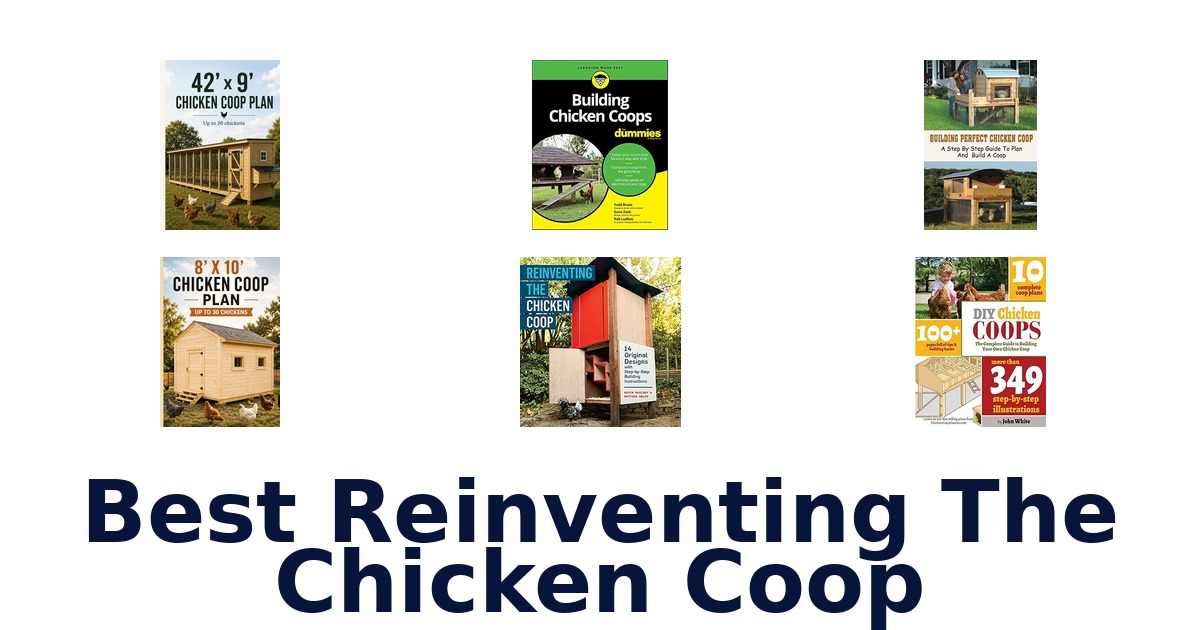
A strong choice for reinventing a chicken coop offers practical building guidance or fresh design ideas suited to your flock, space, and preferred project style. The closest match is Reinventing the Chicken Coop, a paperback with 14 original designs and step-by-step building instructions. This roundup also includes broad DIY guides, a book of innovative projects, and plans with specified footprints and flock capacities.
Those options serve different needs: some emphasize a range of ideas, while others describe a particular coop or housing approach. Compare the stated design counts, dimensions, capacity claims, and formats before choosing.
The product details do not establish construction difficulty, material lists, or local-code suitability, so treat those as questions to resolve before starting a build.
Reinventing the Chicken Coop is the leading choice because its title and stated contents directly match this search: it offers 14 original designs with step-by-step building instructions in paperback. That combination makes it the clearest fit for someone seeking ideas alongside build guidance, rather than a single fixed-size plan or a specialized open-front housing guide. For a broader collection of coop and run blueprints, consider Backyard Chicken Coop Ideas and Plans instead.
Our Top Picks
 Best Overall
Its 14 original designs and step-by-step building instructions directly match the search for ways to reinvent a chicken coop.
View on Amazon Innovative Projects
The book presents 21 innovative projects for a hassle-free chicken habitat, making it a strong fit for readers seeking fresh coop ideas.
View on Amazon Broadest Design Range
Backyard Chicken Coop Ideas and Plans
Its listing promises blueprints and step-by-step instructions for 30+ coops and runs, with designs intended to fit any space.
View on Amazon- Open-Front Specialist Fresh-Air Poultry Houses
- Largest Stated Flock 8' x 10' Chicken Coop Plan
Compare These Chicken Coop Books and Plans
| # | Product | Buy |
|---|---|---|
| 1 | 1. Reinventing the Chicken CoopBest Overall | View on Amazon |
| 2 | 2. HentopiaInnovative Projects | View on Amazon |
| 3 | 3. Backyard Chicken Coop Ideas and PlansBroadest Design Range | View on Amazon |
| 4 |  4. Building Chicken Coops For DummiesFirst-time coop-building learners | View on Amazon |
| 5 |  5. DIY Chicken CoopsDIY coop-building beginners | View on Amazon |
| 6 |  6. Building Perfect Chicken CoopStep-by-step coop and run builders | View on Amazon |
| 7 |  7. Reinventing the Chicken CoopPaperback edition seekers | View on Amazon |
| 8 |  8. Fresh-Air Poultry HousesOpen-Front Specialist | View on Amazon |
| 9 |  9. 8' x 10' Chicken Coop PlanLargest Stated Flock | View on Amazon |
| 10 |  10. 42' × 9' Chicken Coop PlanWalk-in coop and run planners | View on Amazon |
Detailed Reviews: Best Reinventing The Chicken Coop
#1 · Best Overall
1. Reinventing the Chicken Coop
Best for: Readers comparing original coop designs.
Why it ranks #1: Its 14 original designs and step-by-step building instructions directly match the search for ways to reinvent a chicken coop.
Fourteen original designs paired with step-by-step building instructions give this paperback a clear role: helping readers compare distinct coop concepts while following a construction-oriented guide. Kevin McElroy and Matthew Wolpe are the named authors, and the title makes the range of designs its central distinction for people planning a coop project.
The combination of 14 designs and step-by-step instructions supports two parts of the planning process: choosing among multiple concepts and having an ordered guide for building. That makes the book a fit for readers who want more than a single coop plan, while keeping the subject focused on coop construction. The supplied title does not state flock capacity or identify particular design dimensions, so buyers should treat it as a design-and-instruction book rather than a specified-size plan.
- Includes 14 original designs
- Pairs designs with step-by-step building instructions
- Focuses specifically on chicken coops
- Names Kevin McElroy and Matthew Wolpe as authors
- The supplied title gives no flock-capacity figure for matching a plan to a specific flock.
Skip it if you need a stated capacity for up to 30 chickens; Mostafa Daoudi’s 8' x 10' Chicken Coop Plan names that limit.
Readers choosing among several coop concepts and wanting step-by-step building instructions will find the scope relevant. If your decision depends on a specified footprint or flock capacity, this title’s supplied details do not provide either.
Listed on Amazon as: Reinventing the Chicken Coop: 14 Original Designs with Step-by-Step Building Instructions
View on Amazon#2 · Innovative Projects
2. Hentopia
Best for: Creative chicken-habitat project readers.
Why it ranks #2: The book presents 21 innovative projects for a hassle-free chicken habitat, making it a strong fit for readers seeking fresh coop ideas.
Twenty-one innovative projects give Hentopia a project-centered angle on creating a hassle-free habitat for chickens. Frank Hyman’s paperback is framed around the habitat as a whole, rather than a single dimensioned coop plan. That makes it relevant to readers interested in multiple ways to shape their chicken-keeping setup.
The 21-project count offers several project ideas to explore, while the title’s emphasis on a hassle-free habitat gives those projects a broader chicken-keeping context. Readers looking beyond one fixed coop layout may find that combination useful for considering different improvements to a habitat. The supplied facts do not identify the projects, building steps, dimensions, or flock capacities, so buyers cannot use this listing alone to select a project by size or construction requirements.
- Includes 21 projects
- Frames the subject as a chicken habitat
- Emphasizes a hassle-free setup
- Names Frank Hyman as author
- The supplied title does not specify project dimensions or flock capacities.
Skip it if you need a stated 8' x 10' coop plan for up to 30 chickens; Mostafa Daoudi’s 8' x 10' Chicken Coop Plan gives those figures.
Readers interested in a collection of habitat projects rather than a single specified coop size may find Hentopia relevant. If dimensions, capacities, or step-by-step build details determine your choice, they are not stated in the supplied listing.
Listed on Amazon as: Hentopia: Create a Hassle-Free Habitat for Happy Chickens; 21 Innovative Projects
View on Amazon#3 · Broadest Design Range
3. Backyard Chicken Coop Ideas and Plans
Best for: Flexible-space coop planners.
Why it ranks #3: Its listing promises blueprints and step-by-step instructions for 30+ coops and runs, with designs intended to fit any space.
More than 30 coops and runs, with plans described as fitting any space, make this Kindle guide the broadest stated design collection in this group. Graham F. Gardener’s title also emphasizes stylish, secure, and practical chicken housing, pairing complete blueprints with step-by-step instructions for readers comparing possible builds.
The 30-plus coop and run ideas give readers multiple configurations to consider, while the “fit any space” framing makes space flexibility a central part of the title’s promise. Complete blueprints and step-by-step instructions connect that choice stage to construction guidance. The listed subject includes both coops and runs, which may help people considering housing as a combined setup; no individual dimensions or flock-capacity figures are supplied in the title.
- Lists 30+ coop and run ideas
- Describes plans as fitting any space
- Promises complete blueprints and step-by-step instructions
- Covers stylish, secure, and practical chicken housing
- The supplied title does not give individual plan dimensions or flock capacities.
Skip it if you need a named 42' × 9' footprint and capacity for up to 20 chickens; Mostafa Daoudi’s 42' × 9' Chicken Coop Plan specifies them.
This Kindle guide fits planners who want a broad selection of coop-and-run ideas with blueprints and instructions. If you need to choose by a precise footprint or stated flock capacity, the supplied title does not provide those figures.
View on Amazon#4
4. Building Chicken Coops For Dummies
Best for: First-time coop-building learners.
Why it ranks #4: The Dummies description emphasizes making intimidating topics easier to understand, a useful approach for readers who want accessible coop-building guidance.
Its Dummies approach to making intimidating topics easier to understand is the clearest differentiator, giving readers a confidence-oriented entry point to chicken-coop building. Todd Brock, David Zook, and Robert T. Ludlow are the listed authors. The supplied information emphasizes accessible explanation and learning, rather than a particular coop footprint or capacity.
For someone approaching coop construction as an unfamiliar subject, the stated aim of making intimidating topics easier to understand can help make the learning process feel more approachable. The accompanying promise of helping readers apply what they know and discover what they do not supports a guide for building knowledge, not just following a fixed plan. The supplied facts do not identify dimensions, flock capacity, or a count of plans, so it is best judged as an accessible introduction.
- Dummies format is presented as making intimidating topics easy to understand
- Aims to help readers feel more confident applying existing knowledge
- Encourages readers to discover what they do not know
- Lists three authors: Todd Brock, David Zook, and Robert T. Ludlow
- The supplied facts do not specify a coop footprint or flock capacity.
Skip it if you need a named coop size and capacity in the plan; Mostafa Daoudi’s 8' x 10' Chicken Coop Plan specifies both.
This is a sensible match for readers who want an accessible introduction to chicken-coop building and help identifying knowledge gaps. Choose a different guide if your project requires a named footprint, capacity, or defined set of construction plans.
Listed on Amazon as: Building Chicken Coops For Dummies
View on Amazon#5
5. DIY Chicken Coops
Best for: DIY coop-building beginners.
Why it ranks #5: This paperback is presented as a complete guide to building your own chicken coop, matching the practical construction side of the search.
A complete guide centered on building your own chicken coop makes this paperback a direct fit for readers who want a DIY-focused resource rather than a general poultry title. John White is the named author. Its title signals a broad construction guide, but the supplied details do not identify a particular coop design, size, or flock limit.
The emphasis on building your own coop connects the book to a hands-on project, while the phrase “complete guide” positions it as a resource for the overall task rather than one isolated design. That broad framing can suit readers who want a single title focused on DIY coop construction. However, the supplied information does not state the number of plans, construction sequence, dimensions, or intended flock capacity, so those needs cannot be matched from the listing facts.
- Focuses on building a chicken coop yourself
- Identifies itself as a complete guide
- Keeps its subject specifically on chicken-coop construction
- Lists Mr John White as author
- The supplied title does not state dimensions or flock capacity.
Skip it if you want multiple named concepts with step-by-step instructions; Kevin McElroy and Matthew Wolpe’s Reinventing the Chicken Coop lists 14 original designs.
DIY-minded readers seeking a chicken-coop-focused guide may appreciate its broad project scope. If your plans depend on comparing a stated number of designs or selecting a coop by dimensions and flock capacity, the supplied listing does not establish those details.
Listed on Amazon as: DIY Chicken Coops: The Complete Guide To Building Your Own Chicken Coop
View on Amazon#6
6. Building Perfect Chicken Coop
Best for: Step-by-step coop and run builders.
Why it ranks #6: Its title describes a step-by-step guide to planning and building a coop, including attention to building a better chicken run.
Planning and building a coop are both explicit parts of this guide’s title, which also calls out building a better chicken run. Tessie Mishoe’s paperback is therefore aimed at readers who want a construction-oriented resource covering the coop project and its run, rather than a guide limited to habitat concepts.
The step-by-step framing connects planning with the work of building, giving readers a process-oriented starting point for a coop project. The separate mention of a chicken run broadens the title’s scope beyond the coop itself, which may suit buyers considering both parts of their setup. No footprint, flock capacity, plan count, or particular run configuration is stated in the supplied details, so project sizing remains a decision point outside this listing’s facts.
- Covers planning a chicken coop
- Covers building a coop step by step
- Specifically mentions building a chicken run
- Paperback by Tessie Mishoe
- The supplied title gives no footprint or flock-capacity figure.
Skip it if you need a specified walk-in layout and covered run for up to 20 chickens; Mostafa Daoudi’s 42' × 9' Chicken Coop Plan names those details.
This guide suits DIY readers seeking a step-by-step framing for planning and building a coop, with the chicken run included in its stated scope. If you need dimensions or a flock-size limit, the supplied listing does not provide them.
Listed on Amazon as: Building Perfect Chicken Coop: A Step By Step Guide To Plan And Build A Coop: Building A Better Chicken Run
View on Amazon#7
7. Reinventing the Chicken Coop
Best for: Paperback edition seekers.
Why it ranks #7: This paperback listing repeats the exact Reinventing the Chicken Coop title, but supplies no design count or building-instruction details.
This listing identifies a paperback edition of Reinventing the Chicken Coop, tying it to Matthew Wolpe and the same title’s coop-design subject. Its distinguishing supplied detail is the edition and format information; the listing does not independently describe the number of designs or building steps, so buyers should assess it on the facts shown here.
The paperback format makes this a physical-book option for readers who prefer a print edition while exploring a chicken-coop title. Matthew Wolpe is named in the listing, and the title points to coop reinvention as its subject. Because this listing supplies no separate features, plan count, dimensions, or capacity, it is difficult to judge its construction detail from this record alone; use the edition information as the supported basis for choosing it.
- Listed as a paperback edition
- Names Matthew Wolpe in the title
- The title identifies chicken-coop design as its subject
- Provides a distinct product listing for this edition
- This listing supplies no plan count or construction-step details.
Skip it if you need the listing to specify 14 designs and step-by-step building instructions; Kevin McElroy and Matthew Wolpe’s other Reinventing the Chicken Coop listing states those features.
Readers seeking the paperback edition of a chicken-coop title associated with Matthew Wolpe may find this listing relevant. If you need verified details about plan count, construction steps, or capacity, this record does not supply them.
Full product details
| Brand | Middle English Edition by unknown author (Author) Format: Paperback |
|---|
Listed on Amazon as: Reinventing the Chicken Coop by Matthew Wolpe (30-Jan-2013) Paperback
View on Amazon#8 · Open-Front Specialist
8. Fresh-Air Poultry Houses
Best for: Open-front coop researchers.
Why it ranks #8: Its focus is open-front chicken coops and healthier poultry, making it relevant to buyers specifically considering that housing approach.
Its focus on open-front poultry houses sets this classic guide apart, giving readers a resource centered on a particular coop approach and its stated goal of healthier poultry. Prince T. Woods is the named author. The paperback title does not identify a modern step-by-step build plan or a specific coop size.
The open-front format gives the book a clearly bounded subject for readers exploring that style of poultry housing, while its subtitle connects the approach with healthier poultry. That focus may help buyers investigate a specific housing concept rather than compare many unrelated coop designs. The supplied listing does not state dimensions, flock capacity, or construction steps, so it should not be treated as a size-matched building blueprint based on the facts provided.
- Focuses on open-front poultry houses
- Presents itself as a classic guide
- Connects its subject with healthier poultry
- Names Prince T. Woods as author
- The supplied title does not specify dimensions or a step-by-step construction plan.
Skip it if you need step-by-step DIY instructions for a stated 8' x 10' coop; Mostafa Daoudi’s 8' x 10' Chicken Coop Plan provides that scope.
Readers specifically researching open-front poultry houses may value this focused subject and its stated health-oriented framing. If you need a dimensioned blueprint, capacity figure, or explicit building sequence, those details are not established by this listing.
Listed on Amazon as: Fresh-Air Poultry Houses: The Classic Guide to Open-Front Chicken Coops for Healthier Poultry
View on Amazon#9 · Largest Stated Flock
9. 8' x 10' Chicken Coop Plan
Best for: Large-flock plan planners.
Why it ranks #9: The plan specifies an 8' x 10' footprint and capacity for up to 30 chickens, but centers on one particular coop size.
An 8' x 10' footprint and stated capacity of up to 30 chickens give this plan a concrete scale for buyers planning a larger flock. Mostafa Daoudi’s paperback presents the coop as a step-by-step DIY building guide, connecting those size details to an instructional project rather than leaving the dimensions on their own.
The named 8' x 10' dimensions help buyers assess whether the plan suits their available building area, while the stated capacity of up to 30 chickens gives a specific flock-size reference. Step-by-step DIY guidance supports readers who want construction instructions alongside those planning figures. The title describes a chicken coop plan, but does not specify a covered run or walk-in layout, so buyers seeking those particular features should not assume they are included.
- Specifies an 8' x 10' coop footprint
- States capacity of up to 30 chickens
- Presented as a step-by-step DIY building guide
- Paperback by Mostafa Daoudi
- The title does not specify a covered run or walk-in layout.
Skip it if you need a stated walk-in coop and covered run; Mostafa Daoudi’s 42' × 9' Chicken Coop Plan names both features.
This plan suits DIY builders who need a stated 8' x 10' footprint and capacity reference for up to 30 chickens. It is a less clear fit if a walk-in layout or covered run is central to your project.
Listed on Amazon as: 8' x 10' Chicken Coop Plan: Step-by-Step DIY Building Guide for Up to 30 Chickens
View on Amazon#10
10. 42' × 9' Chicken Coop Plan
Best for: Walk-in coop and run planners.
Why it ranks #10: This plan specifies a spacious walk-in coop and covered run for up to 20 chickens, a narrow fit for shoppers seeking varied designs.
A 42' × 9' footprint, walk-in coop, and covered run give this plan a clearly specified large-layout focus. Mostafa Daoudi’s paperback states capacity for up to 20 chickens and presents the project as a step-by-step DIY guide, helping buyers evaluate scale and layout before choosing a build.
The 42' × 9' dimensions let builders compare the plan with their available site, while the walk-in layout and covered run identify two features of the proposed setup. A stated capacity of up to 20 chickens adds a flock-size reference, and the step-by-step DIY framing connects those specifications to construction guidance. This is a substantial stated footprint, so it suits buyers with room for the listed dimensions rather than those seeking a compact coop.
- Specifies a 42' × 9' footprint
- Describes a walk-in coop
- Includes a covered run in the plan title
- States capacity for up to 20 chickens
- Its stated 42' × 9' footprint calls for substantial site space.
Skip it if you need an 8' x 10' coop plan for up to 30 chickens; Mostafa Daoudi’s 8' x 10' Chicken Coop Plan states that smaller footprint and larger capacity.
Choose this plan if a walk-in coop and covered run suit your project and you can accommodate its stated 42' × 9' footprint. Its up-to-20-chicken capacity is the relevant boundary for flock planning.
Listed on Amazon as: 42' × 9' Chicken Coop Plan: Step-by-Step DIY Building Guide for a Spacious Walk-In Coop and Covered Run for Up to 20 Chickens
View on AmazonAvoid choosing a plan by flock capacity alone
A stated chicken capacity does not by itself tell you whether a plan will fit your property or daily routine. The 8′ x 10′ Chicken Coop Plan claims space for up to 30 chickens, while the 42′ × 9′ Chicken Coop Plan describes a walk-in coop and covered run for up to 20; the different footprints and features make the capacity figures unsuitable as a simple ranking of space efficiency. The listings do not specify usable floor area, run area separately, or how capacity was calculated.
Before choosing a fixed plan, verify the dimensions against your site and check what the stated capacity includes. Readers who have not settled on a footprint may prefer a guide offering multiple designs, such as Reinventing the Chicken Coop or Backyard Chicken Coop Ideas and Plans, rather than committing immediately to one specified layout.
Treat specialized housing as a design trade-off
An open-front coop is a particular housing approach, not a universal substitute for comparing designs. Fresh-Air Poultry Houses focuses on open-front chicken coops and presents them in relation to healthier poultry, while the other listings range from general building guides to multiple coop and run plans. That specialization may help a reader already interested in open-front housing, but the listing does not establish how the design performs in a specific climate, against local predators, or under local building rules.
Likewise, titles promising a broad range of plans do not establish that every blueprint suits every site. Check ventilation, protection, and local requirements against your own conditions before building.
If you are still exploring concepts, a book with multiple designs or projects can offer a wider starting point than a guide centered on one housing style.
How to Choose a Chicken Coop Book or Plan
Range of designs and projects
Look for a stated variety of designs if you are still exploring what to build. Reinventing the Chicken Coop lists 14 original designs, Hentopia has 21 innovative projects, and Backyard Chicken Coop Ideas and Plans describes 30+ coops and runs. By contrast, the listed 8′ x 10′ and 42′ × 9′ plans focus on a particular footprint and layout.
A broad collection suits buyers comparing different concepts or adapting an idea to their property; a single-size plan may better suit someone who has already chosen a layout and wants to follow a defined project. The counts describe the listed designs or projects, not how much construction detail each one provides, so check the product description for the guidance you need.
Footprint and stated flock capacity
Check stated dimensions and capacity when selecting a plan for a particular site or flock. The 8′ x 10′ Chicken Coop Plan lists capacity for up to 30 chickens, while the 42′ × 9′ Chicken Coop Plan describes a walk-in coop and covered run for up to These are concrete starting points, but the listings do not explain the capacity calculations or separate coop and run areas.
A buyer prioritizing the stated maximum may investigate the 8′ x 10′ plan; someone seeking a specifically described walk-in layout with a covered run may prefer the 42′ × 9′ plan. Confirm that the footprint fits your property and that the plan’s actual layout meets your needs before committing.
Guidance style and format
Choose a guidance style that matches whether you need broad instruction, project steps, or a specialized design focus. Reinventing the Chicken Coop states that it includes step-by-step building instructions, while Building Chicken Coops For Dummies is described as making intimidating topics easier to understand. Fresh-Air Poultry Houses focuses on open-front coops, and Backyard Chicken Coop Ideas and Plans lists blueprints and step-by-step instructions for 30+ coops and runs.
The products include paperbacks and a Kindle edition, so format also varies. Readers who want a physical book can choose among the listed paperbacks; someone who prefers the listed digital option can consider the Kindle edition.
A title or format alone does not confirm the level of detail, so review the description for the type of instruction you want.
Which chicken coop book or plan should you choose?
Choose Reinventing the Chicken Coop if you want the closest match to the search: 14 original designs and step-by-step building instructions. If you want a wide set of coop and run blueprints, Backyard Chicken Coop Ideas and Plans lists 30+ options; for a project-focused alternative, Hentopia includes 21 innovative projects. Readers seeking an accessible general introduction can consider Building Chicken Coops For Dummies, while Fresh-Air Poultry Houses suits buyers specifically exploring open-front coops.
If you have already settled on a footprint, compare the 8′ x 10′ Chicken Coop Plan, which states a capacity of up to 30 chickens, with the 42′ × 9′ Chicken Coop Plan, which describes a walk-in coop and covered run for up to Verify dimensions and suitability before building.
Related Buying Guides
Frequently Asked Questions
How much coop space does each chicken need, including outdoor run space?
Plan for enough indoor and outdoor room for your flock to move comfortably, and check applicable animal-welfare guidance for specific space recommendations. The listed plans describe different capacities and footprints, but those figures alone do not establish what will suit your birds, setup, or local requirements. Verify dimensions and suitability before building.
Which coop design is best for my climate and predator risks?
Choose a design only after considering your local weather, ventilation needs, and predator exposure. The listed titles identify options such as open-front housing and a covered run, but do not establish that either suits every location. Review the complete plans, materials, and security details, then adapt the design to your conditions.
What permits or local rules apply before building a backyard chicken coop?
Check with your local planning office and relevant animal-control authority before building; requirements vary by location. Ask about flock limits, coop placement, setbacks, permits, and any restrictions on structures or poultry. The listed books and plans do not establish which rules apply to your property, so confirm locally before choosing a design.
Should I choose a book of designs or a single coop plan?
Choose a collection if you are still comparing layouts, and a single plan if you have settled on a footprint. Reinventing the Chicken Coop offers 14 designs with step-by-step building instructions; Backyard Chicken Coop Ideas and Plans lists 30+ coop and run options. The individual plans state specific dimensions and capacities to verify.
What should I check before committing to a specific plan?
Confirm that the stated footprint and capacity fit your site, flock, and intended use. The 8′ x 10′ plan states a capacity of up to 30 chickens, while the 42′ × 9′ plan describes a walk-in coop and covered run for up to Verify dimensions and suitability before building.
Final Words
For the closest match to a search for reinventing a chicken coop, choose Reinventing the Chicken Coop: its 14 original designs and step-by-step instructions combine ideas with build guidance. If you want a broader set of layouts, consider Backyard Chicken Coop Ideas and Plans. For a fixed footprint, compare the two dimensioned plans, checking capacity, site fit, and local rules before building.