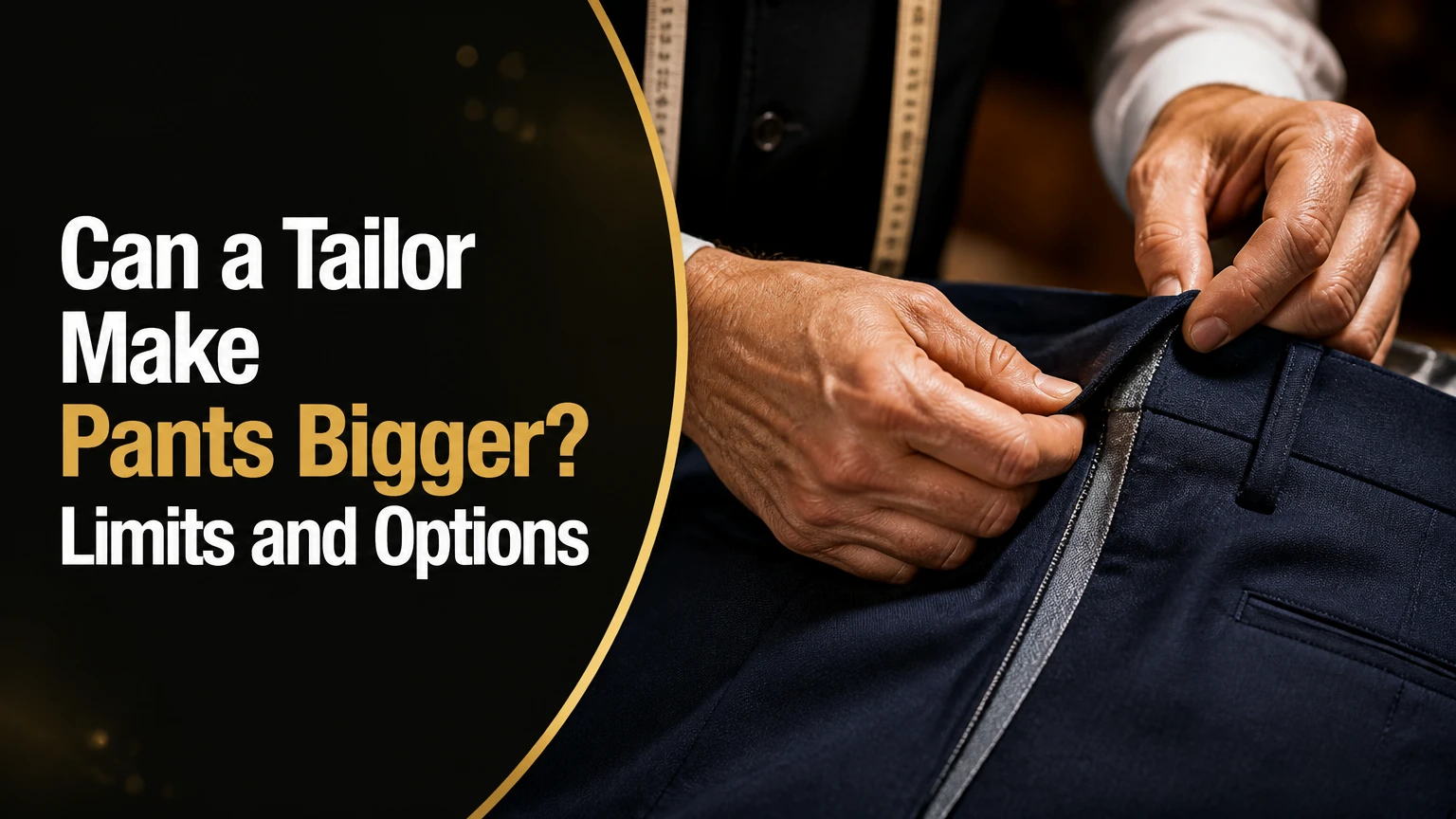
Yes, a tailor can make pants bigger when the garment contains usable seam allowance, especially at the center-back waistband and seat seam. A tailor may also add fabric panels, gussets, or waistband inserts when no hidden allowance remains, but those methods can change the appearance, comfort, and resale value of the pants.
Key Facts at a Glance
- Waist enlargement depends on hidden fabric, not the marked size or the fabric’s stretch alone.
- Formal wool trousers commonly offer the best chance of a clean adjustment because their center-back seams are often constructed for alteration.
- A typical waist let-out is about 0.5-2 inches around the circumference, although construction determines the actual limit.
- Thigh and seat expansion usually requires reshaping several seams, so it costs more and can affect pockets, creases, and drape.
- Pants can often be lengthened by 1-2 inches when sufficient hem allowance remains and the original hemline has not been permanently distressed.
- A tailor should inspect the exact garment before promising a result, because seam width, fabric condition, lining, topstitching, and fading all matter.
Can a Tailor Make Pants Bigger at the Waist?
A tailor can enlarge a trouser waistband if extra cloth remains inside the waistband seam, center-back seam, or side seams. The tailor releases the existing stitching, moves the seam outward, reshapes the transition into the seat, and rebuilds the waistband so the added room does not create a sharp bulge below the waist.
The most favorable example is a pair of wool suit trousers with a center-back seam and a visible internal allowance. A simple let-out may preserve the waistband, belt loops, back pockets, and pressed crease. The result is usually cleaner than adding a contrasting strip of fabric.
A waistband that feels tight can have several different causes. The waist may be too small, the rise may be too short, the seat may be too narrow, or the thighs may need additional room. Increasing only the waistband does not solve a short rise, and forcing a waist alteration over a restrictive seat can produce diagonal strain lines.
A practical tailor measures the wearer and the garment together. The relevant number is the required increase in finished circumference, not merely the difference between two flat measurements. For example, a 1-inch increase measured across the front of a flat pair generally represents about 2 inches around the full waist, assuming the measurement was taken correctly.
Where Should You Inspect for Extra Fabric?
Turn the pants inside out and inspect the center-back seam, waistband joins, side seams, and hem. Extra fabric appears as a folded strip beyond the line of stitching, but a wide-looking seam does not always mean the fabric can be released without disturbing a pocket, lining, or structural edge.
Check these locations:
- Center-back seam: Follow the seam from the waistband into the seat. This is often the most useful expansion point on tailored trousers.
- Waistband seam: Look inside the folded waistband for a separate extension or a seam that can be repositioned.
- Side seams: Inspect the hip and upper leg, especially on unlined trousers without welt pockets near the seam.
- Back pockets: Confirm that the pocket bags and welt openings will remain correctly positioned after the adjustment.
- Hem: Look for folded cloth below the existing stitching, particularly on unfinished suit trousers.
Do not cut or unpick the seam at home before an inspection. Once a tailor removes original stitches, the old needle holes and pressing marks may remain visible.
How Much Larger Can Trousers Become?
Most trousers can be enlarged by approximately 0.5-2 inches around the waist when adequate seam allowance exists, while a well-constructed suit may permit more in exceptional cases. No universal “two-size” rule applies because the usable allowance, body shape, pocket position, fabric condition, and desired silhouette set the limit.
The following figures are typical working ranges, not guarantees:
| Alteration area | Typical increase | Most suitable garments | Main limitation |
|---|---|---|---|
| Waist and seat | 0.5-2 in around | Wool trousers, suit pants, formal slacks | Limited by center-back allowance |
| Upper thigh | 0.25-1 in around | Unlined trousers, bespoke trousers | Requires a smooth transition into the crotch |
| Leg opening | 0.5-1.5 in around | Straight-leg trousers, wide hems | Changes the trouser silhouette |
| Inseam length | 1-2 in | Unfinished dress trousers, cuffed trousers | Limited by hem allowance and crease |
| Structural panel | 2-4+ in | Workwear, cargo pants, casual denim | Added material remains visible |
| Waistband insert | 1-3 in | Casual trousers, maternity adaptations | Insert may look less formal |
The circumference and location matter more than the headline number. Adding 1 inch at the waist does not automatically add 1 inch through the hips or thighs. A tailor may divide the change between the center back and side seams to preserve balance.
A second sizing issue is proportionality. If trousers are expanded too far, the back pockets can move closer together, belt loops can lose their intended spacing, and the front pleats or crease can shift relative to the body. A technically larger waist can therefore produce a visibly incorrect garment.
Can Suit Pants Be Let Out More Than Casual Pants?
Suit pants often offer a better alteration base than casual pants because wool tailoring uses seam structures, separate waistbands, and hem reserves that are easier to reconstruct. Casual garments frequently use felled seams, dense topstitching, rivets, narrow seam allowances, and washed finishes that make enlargement more visible.
| Trouser type | Likely waist method | Typical clean capacity | Visual risk |
|---|---|---|---|
| Wool suit trousers | Center-back let-out | 0.5-2 in | Low to medium |
| Unlined wool slacks | Center back or side seams | 0.5-1.5 in | Low |
| Cotton chinos | Waistband or side seams | 0-1 in | Medium |
| Stretch trousers | Seam release or insert | 0.5-1.5 in | Medium |
| Standard jeans | Waistband, seat, or panel | 0-1 in cleanly | High |
| Lined formal trousers | Outer seam plus lining adjustment | 0.5-1 in | Medium to high |
| Cargo pants | Gusset or side panel | 1-4 in | Medium |
A premium garment is not automatically alterable. Some designer trousers use narrow allowances to reduce bulk, while an inexpensive pair may have a useful center-back seam. Construction decides the outcome.
Can a Tailor Expand the Seat or Thighs?
A tailor can expand the seat or thighs when the relevant seams contain allowance or when additional fabric can be inserted. Seat expansion is more complex than a waist let-out because the alteration must follow the curve from the waistband through the hip and into the crotch without creating drag lines.
The tailor first identifies the source of tightness. Horizontal wrinkles under the seat can indicate insufficient seat room, while diagonal wrinkles from the crotch toward the outer hip may indicate a tight thigh or an incompatible rise. Releasing only the center-back seam may make the waist larger while leaving the thigh unchanged.
For modest changes, the tailor may open the inseam, outseam, or seat seam and establish a new stitching line. A larger change may need a gusset or a matching panel. The panel can be hidden along the inner leg, placed at the seat, or integrated into the waistband, depending on the garment.
Pocket design complicates the work. Side pockets can gape when the hip seam moves, and welt pockets can become visually off-center when the back seat is expanded. A tailor should pin the trousers on the wearer before deciding which seam will carry the adjustment.
Can a Tailor Make Pants Longer?
A tailor can lengthen pants when fabric remains inside the hem, although the finished increase usually falls between 1 and 2 inches. Dress trousers with an unfinished hem provide the most flexibility, while jeans with a distressed or chain-stitched hem are difficult to lengthen invisibly.
Lengthening requires more than unfolding the bottom edge. The tailor must establish the correct break over the intended shoes, preserve the leg opening, and recreate the hem finish. A cuffed trouser may have more material available, but lowering the cuff changes its proportion and can expose a crease or fading line.
Bring the shoes normally worn with the trousers. Dress shoes, boots, sneakers, and heels create different positions at the front break and back hem. A fitting performed in socks can produce an inaccurate result.
| Hem construction | Typical lengthening potential | Best solution | Common visible issue |
|---|---|---|---|
| Unfinished wool hem | 1-2 in | Recut and finish new hem | Old crease may need pressing |
| Plain folded trouser hem | 0.5-1.5 in | Release internal fold | Needle marks or faint line |
| Deep cuff | 1-2 in | Reduce cuff depth | Cuff proportion changes |
| Original jeans hem | 0-0.5 in | Preserve hem with seam method | Fade band remains |
| Frayed hem | 0 in cleanly | Add a new lower section | Contrast and uneven texture |
| Blind-stitched formal hem | 0.5-1.5 in | Reposition blind stitch | Pressing imprint |
What Does the Alteration Process Involve?
A professional trouser enlargement usually takes six stages: body measurement, garment inspection, seam opening, new seam placement, machine stitching, and pressing. The highest-value stage is the initial diagnosis because a tailor must distinguish a small waist problem from a broader issue involving rise, seat, thighs, or fabric damage.
The usual workflow is:
- Measure the wearer: The tailor records the waist, seat, rise, thigh, and preferred hem position.
- Map the garment: The tailor examines seam allowances, pocket bags, linings, belt loops, facings, and original pressing.
- Open selected seams: Original stitching is removed carefully, often around the waistband and center back.
- Mark the new shape: The new seam line is chalked so the expanded section tapers gradually into the unchanged garment.
- Pin and test: The wearer tries on the pinned trousers while standing, sitting, and walking.
- Stitch and reinforce: The tailor sews the new seam, trims excess cloth only after approval, and secures stress points.
- Rebuild the waistband: The waistband, lining, belt loops, and any center-back stay are reattached.
- Press the garment: Steam and pressure settle the new seam and restore the crease.
A good transition is gradual. An abrupt change that ends near the crotch can create puckering, bubbling, or a sharp ridge under the seat. Pressing may soften minor impressions, but it cannot erase worn fabric, permanent dye contrast, or weakened fibers.
How Much Does the Alteration Cost?
Typical trouser enlargement costs about $20-$60 for a straightforward waist adjustment and $50-$150 or more for a gusset, panel, or complex lined reconstruction. Local labor rates, garment construction, fabric matching, pressing requirements, and rush service create larger price differences than the nominal trouser size.
| Service | Typical price range | Typical turnaround | Main price driver |
|---|---|---|---|
| Waist let-out | $20-$45 | 3-7 days | Waistband and center-back construction |
| Seat adjustment | $30-$65 | 3-7 days | Pocket and crotch shaping |
| Thigh expansion | $35-$75 | 5-10 days | Inseam, lining, and taper |
| Inseam lengthening | $15-$35 | 3-5 days | Hem style and original crease |
| Waistband insert | $25-$60 | 3-7 days | Insert material and finishing |
| Gusset or side panel | $50-$150+ | 7-14 days | Matching fabric and reconstruction |
| Lined suit trouser rebuild | $60-$150+ | 7-14 days | Lining and hand-finishing |
These are typical North American alteration ranges, not a universal price list. A tailor may charge a minimum service fee even when the actual sewing takes less than an hour. Dry-cleaning, stain treatment, fabric sourcing, and delivery can appear as separate charges.
Ask whether the quoted price includes pressing and whether the shop guarantees the fit after the first try-on. A low quote may exclude waistband reconstruction or belt-loop reattachment.
Can Jeans, Chinos, and Dress Pants Be Enlarged?
Jeans, chinos, and dress pants can all be enlarged, but dress trousers usually produce the most discreet result. Denim and casual cotton garments often lack spare fabric at the center back, contain strong topstitching, or show a permanent contrast where an old seam was released.
Jeans
Standard jeans may be enlarged through a waistband extension, center-back insert, seat gusset, or side-seam panel. Matching denim is difficult because factory washing creates a unique pattern of fading, whiskering, abrasion, and color variation. A new dark strip can look obvious against worn indigo.
Stretch denim provides limited comfort but does not guarantee a successful alteration. Elastane can lose recovery with age, and a fabric that stretches temporarily may still have insufficient pattern width. A tailor should assess the jeans while seated, not only while standing.
Chinos
Chinos may accept a small waistband adjustment, particularly when the waistband has a center seam or separate extension. Side pockets, belt loops, and flat-felled seams can restrict the available room. A discreet elastic insert may work for everyday wear, but it is rarely appropriate for formal trousers.
Dress trousers
Wool dress trousers are often the strongest candidates for a clean let-out. The tailor can usually work with the center-back seam, waistband lining, and seat shaping, provided the cloth has not become shiny, brittle, or threadbare.
What Alternatives Exist When No Seam Allowance Remains?
When no usable seam allowance exists, a tailor can add a gusset, matching panel, elastic insert, or new waistband section. These alternatives increase physical room, but none can recreate the exact original construction when the added fabric, dye, texture, or topstitching does not match.
Choose the method according to the garment and the amount needed:
- Waistband extension: Best for a small waist increase when the seat still fits. The extension may sit at the center back or near a side seam.
- Elastic insert: Useful for casual pants and fluctuating measurements. The insert improves comfort but changes the waistband’s appearance and support.
- Gusset: Adds substantial room through a seam, often at the center back, inner thigh, or side. The gusset is practical for workwear but usually visible.
- Matching fabric panel: Works when the owner accepts a design detail or when a similar fabric can be sourced from cuffs, an inside facing, or another garment.
- Size-up replacement: Often the best value when the waist, seat, thighs, and rise are all too small.
A hidden insert is not always the best answer. It can create extra bulk, alter pocket placement, or pull the waistband unevenly when the wearer sits.
Should You Alter Pants or Buy a Larger Size?
Buy a larger pair when the trousers are tight through several body areas or need more than about 2 inches of additional waist circumference. Alter the existing pair when the fabric is valuable, the required adjustment is modest, and the garment has enough allowance to preserve its original proportions.
| Situation | Better choice | Reason | Expected compromise |
|---|---|---|---|
| Wool suit, waist needs 1 in | Alter existing trousers | Center-back let-out may be discreet | Possible old seam impression |
| Jeans, waist needs 3 in | Buy larger size | Panel work can look obvious | New pair may need waist reduction |
| Chinos, waist needs 0.5 in | Alter existing trousers | Small adjustment is usually manageable | Pocket balance must be checked |
| Waist and thighs both tight | Buy larger size | One seam cannot solve every restriction | Tailor may reshape the new pair |
| Expensive vintage trousers | Inspect before deciding | Fabric and construction justify diagnosis | Old cloth may fail during sewing |
| Weight fluctuates regularly | Add planned adjustability | Split waistband or insert can accommodate change | More complex initial alteration |
Buying a size up and tailoring down is usually easier than making a small garment much larger. Taking fabric away permits reshaping, while adding room requires material that may no longer exist.
An exception is a high-quality suit with generous allowances. Replacing a costly pair may be less sensible than commissioning a careful let-out, particularly when the jacket and trousers form a matched set.
What Can Go Wrong After Enlargement?
The most common post-alteration problems are puckering below the waistband, visible old seam lines, uneven pocket spacing, and a waist that fits while the seat remains tight. Each problem points to a different cause, so pressing alone should not be treated as a universal repair.
Puckering Below the Waistband
Puckering usually means the new seam tapers too abruptly into the original seat or crotch line. The corrective action is to reopen the affected section and create a longer, smoother transition, followed by careful pressing.
Visible Ghost Lines
Ghost lines are old needle holes, faded seam channels, shine, or dye differences left after the original seam moves. Wool may respond to steam and a damp pressing cloth, but worn or permanently faded cloth may retain the mark.
Pocket Distortion
Back pockets can move closer together after a center-back let-out, while side pockets may gape after an outseam alteration. The tailor should check pocket position on the body before final stitching, especially when the requested increase exceeds 1 inch.
Weak or Rotten Fabric
Vintage garments can contain brittle fibers, weakened thread, or dry-rotted interlinings. A seam ripper may damage cloth that looks sound from the outside. A responsible tailor may refuse the job or recommend a visible reconstruction rather than risk destroying the garment.
Loss of Original Crease
Expanding a seat or leg can shift the pressed crease relative to the new grain. The tailor may restore the crease with steam and pressure, but a crease permanently polished into the old position can remain visible.
How Should You Prepare for a Tailor Appointment?
Bring the shoes, belt, shirt, and undergarments normally worn with the pants, then explain whether the priority is standing comfort, sitting comfort, appearance, or future adjustability. A tailor needs the intended use because a formal fit and a workwear fit tolerate different seam and waistband solutions.
Before the appointment:
- Wear the pants for several minutes so tight areas become clear.
- Mark whether the problem is the waist, rise, seat, thigh, hem, or more than one area.
- Bring matching fabric if the garment needs a panel.
- Do not wash or aggressively press vintage trousers immediately before inspection.
- Ask for the maximum discreet increase, not merely the largest technically possible increase.
- Request a try-on before permanent trimming.
- Confirm the price, completion date, and whether pressing is included.
Use precise language. Ask, “Can you let out the center-back seam by 1 inch around the waist while keeping the seat balanced?” That question gives the tailor a measurable target without assuming the method.
Is a Split Waistband Worth Requesting?
A split waistband can be worthwhile for trousers that will need future waist adjustments because the construction leaves a controlled alteration point at the center back. The feature does not create unlimited capacity, but it can make later tightening or loosening cleaner and faster.
A split waistband is especially useful for formal trousers, weight fluctuation, and growing teenagers. It is less valuable on low-cost jeans where fading, topstitching, and limited allowance already determine the outcome.
A tailor may also leave the extra cloth untrimmed after a let-out. That reserve can support a later adjustment, although repeated alterations can weaken the seam and leave cumulative needle marks. Ask the shop to preserve the allowance when doing so does not create bulk.
What Is the Bottom Line on Can a Tailor Make Pants Bigger?
Can a tailor make pants bigger? Yes, when the garment contains usable seam allowance or can accept a carefully chosen insert, panel, or gusset. The cleanest results usually come from modest waist adjustments on wool trousers, while jeans, lined pants, and garments needing several inches of extra room carry greater visual and structural risk.
Inspect the center-back seam first, but do not judge the job from seam width alone. Have a professional assess the waist, seat, rise, thighs, pockets, fabric condition, and hem together before you approve the alteration. A larger replacement pair is often the better decision when multiple areas are tight.
Frequently Asked Questions
Can a tailor make pants bigger without adding fabric?
A tailor can enlarge pants without adding fabric only when unused cloth exists inside the original seams or hem. Stretch fabric may provide temporary comfort, but stretch does not replace missing pattern width. If the seams have no reserve, the tailor must use an insert, gusset, elastic section, or a different pair.
Can pants be made two sizes bigger?
Pants can occasionally be made two marked sizes larger, but the phrase “two sizes” has no consistent measurement across brands. A tailor must calculate the actual increase in waist, seat, thigh, and rise. A modest increase in one area may work, while a two-size expansion throughout the garment usually requires reconstruction.
Can a tailor make the waistband bigger but keep the legs unchanged?
A tailor can enlarge the waistband while leaving most of the legs unchanged when the waist is the only tight area. The new waistband seam must taper smoothly into the original seat, or the trousers may bubble directly below the waist. The tailor should also check belt-loop spacing and back-pocket alignment.
Can a tailor make tight pants more comfortable if they technically fit?
A tailor may improve comfort by releasing the waistband, adding a small elastic insert, reshaping the seat, or adjusting the rise. Tightness caused by a short rise or narrow crotch cannot be solved reliably through a simple waist alteration. Sitting and walking tests reveal these problems better than standing still.
Are alterations cheaper than replacing pants?
A simple waist or hem adjustment is often cheaper than replacing high-quality trousers, while a gusset or multi-area reconstruction may approach or exceed the price of a new mid-range pair. Compare the alteration quote with the garment’s replacement cost, fabric quality, fit, and sentimental value.
Can I make pants bigger at home?
A home alteration is practical for a simple elastic waistband insert or a visible casual gusset, but professional work is safer for lined trousers, suit pants, welt pockets, and expensive fabric. Cutting before confirming the required circumference can permanently remove the only usable seam allowance.