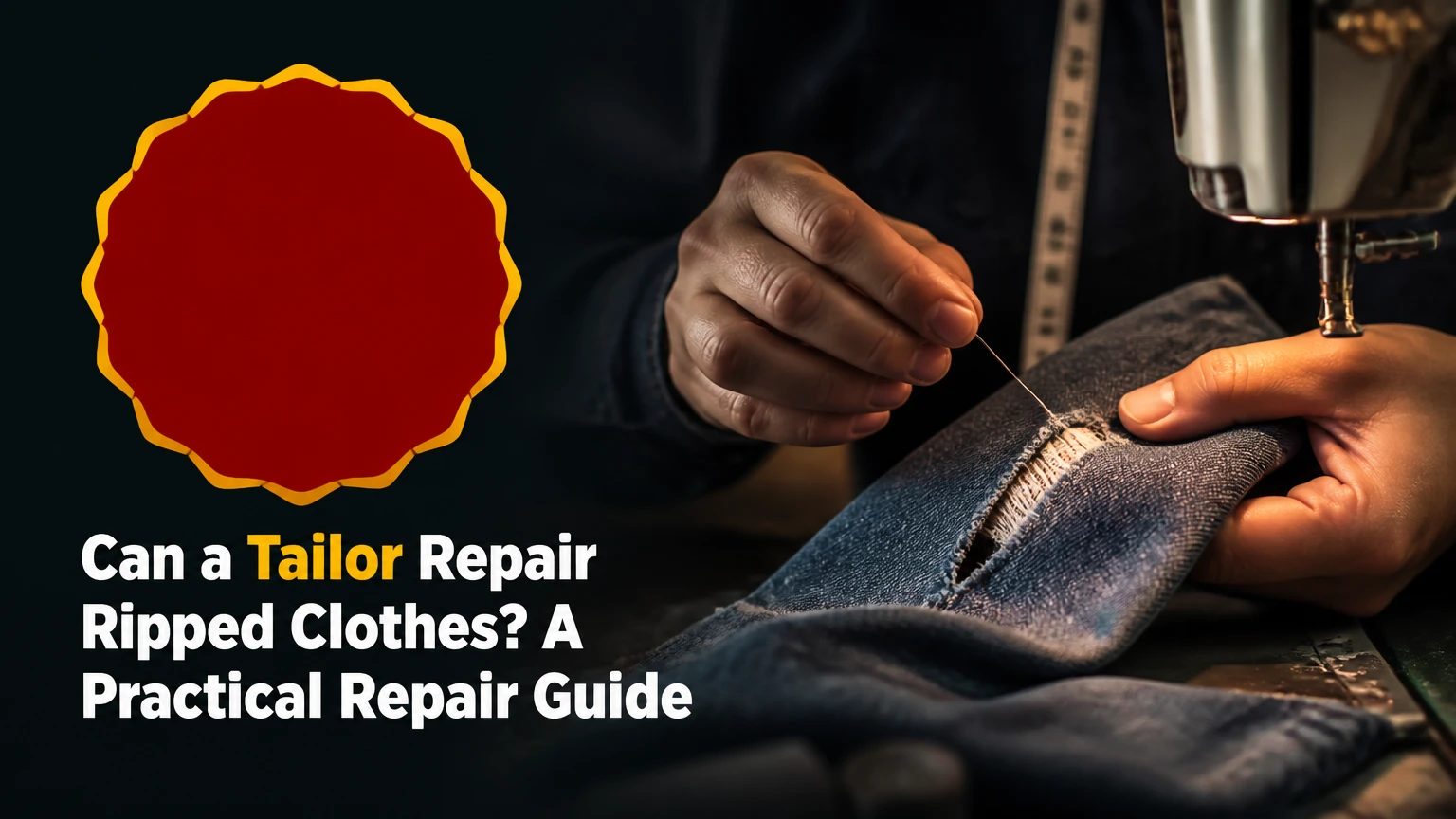
Yes, a tailor can repair most ripped clothes, including split seams, torn trousers, damaged jeans, coat tears, holes, and some knitwear. The correct method depends on whether the garment fabric is intact, how much material is missing, the fabric’s stretch and age, and whether the repair must be invisible or simply durable.
Key Facts at a Glance
- A clean split seam is usually the least expensive repair because the original fabric remains available for restitching.
- Typical clothing-repair prices range from $10-$20 for a simple seam to $60-$150 or more per inch for professional reweaving.
- Machine darning suits denim and sturdy cotton, while hand reweaving suits valuable wool garments where appearance matters most.
- A tailor can stabilize a tear with backing fabric, interfacing, or an internal patch before stitching the damaged area.
- Silk weakened by age, severely thinned spandex, and large smooth-fabric burn holes may not accept a durable invisible repair.
- Do not apply superglue, iron-on tape, or fabric adhesive before assessment because residue can interfere with stitches and permanently alter the fabric.
Can a Tailor Repair Ripped Clothes?
A tailor can repair ripped clothes when enough sound fabric remains to support new stitches or a patch. Tailors repair seam failures, tears across fabric, holes, worn elbows, blown-out trouser crotches, pocket openings, jacket linings, and selected knitwear damage.
The word “ripped” covers several different failures. A thread may have broken while the fabric remains strong, or the cloth itself may have torn and lost fibers. Those cases require different techniques, prices, and expectations.
A tailor may provide the service directly, or may refer luxury garments and fragile knitwear to a reweaver or knitwear specialist. A dry cleaner may accept basic repairs, but cleaning and tailoring are separate skills, so a complex tear deserves a professional who examines construction and fabric condition before promising an outcome.
What Damage Can a Tailor Repair?
Tailors can repair most localized damage when the surrounding material is stable. A professional first identifies the failure type, because stitching a hole closed without reinforcing weak fabric often moves the stress to the edge of the new repair.
| Damage type | Typical method | Typical price | Typical time |
|---|---|---|---|
| Split side seam or inseam | Restitch original seam | $10-$20 | 1-3 days |
| Small fabric tear | Hand or machine reinforcement | $15-$35 | 2-5 days |
| Jeans crotch wear | Machine darning or under-patch | $20-$40 | 3-5 days |
| Coat or lined jacket tear | Internal patch and lining access | $30-$60 | 5-7 days |
| Moth hole in knitwear | Hand repair or knit reweaving | $20-$40 per hole | 5-7 days |
| Broken zipper beside a tear | Zipper replacement and seam repair | $25-$50 | 3-5 days |
| Luxury wool tear | French reweaving or inweaving | $60-$150+ per inch | 2-4 weeks |
These figures are typical practitioner ranges in the United States, not universal prices. A lined cashmere coat, patterned silk dress, or waterproof technical jacket usually costs more because the tailor must disassemble and restore additional layers.
A Seam Split Is Different From a Fabric Tear
A seam split occurs when thread fails along a construction line, while a fabric tear breaks the cloth itself. Seam repairs are often straightforward because the tailor can reopen the area, align the original edges, and sew through undamaged fabric.
A fabric tear is more complex when its edges are frayed, stretched, or surrounded by thinning fibers. The tailor may need to add an under-patch, trim only unstable material, or widen access through a lining to distribute tension.
What Happens at the Tailor?
A clothing repair usually follows assessment, preparation, stabilization, reconstruction, and finishing. The appointment may take 5-15 minutes, but the actual workshop time depends on fabric, lining, stitch density, and whether the garment requires pressing or disassembly.
1. The Tailor Assesses the Damage
The tailor examines the tear’s direction, fabric weave, fiber content, seam construction, lining, and nearby stress. The professional may gently pull the surrounding area to determine whether the cloth is sound or likely to fail again.
A tailor also checks color, pattern repeat, nap, garment age, and care-label instructions. On a striped jacket or checked trouser, matching the pattern can require more time than closing the tear itself.
2. The Garment Is Prepared
Loose debris and unstable threads are identified before repair. The garment may be cleaned first if oil, perspiration, food, or mildew would prevent accurate inspection, although the owner should ask before laundering a fragile or color-unstable item.
Pressing flattens distorted edges and reveals the original grain. Tailors generally avoid casually cutting away frayed fibers because those fibers can show how the weave failed and where reinforcement should begin.
3. The Weak Area Is Stabilized
Stabilization prevents a new line of stitching from concentrating stress on already weak fabric. Depending on the garment, a tailor may use lightweight fusible interfacing, a silk organza support, a matching cloth under-patch, or a narrow seam reinforcement.
The backing must suit the fabric. Heavy interfacing under fine silk can create a visible stiff spot, while insufficient support under denim may allow a crotch repair to fail after repeated bending.
4. The Tear Is Reconstructed
The repair may use a lockstitch machine, overlock machine, hand needle, darning foot, or specialized reweaving technique. The tailor aligns the grain and edges before securing the area, rather than simply pulling the opening shut.
Machine stitching is efficient and durable for many casual garments. Handwork gives greater control on fine wool, patterned cloth, knitwear, and areas where a visible machine grid would be distracting.
5. The Repair Is Pressed and Inspected
Steam and pressing help the repaired area settle into the garment’s original shape. The tailor checks stitch security, puckering, thread color, lining movement, and the garment’s hang before returning it.
A good repair should not create a tight ridge that changes how trousers sit or how a jacket sleeve bends. Pressing cannot hide a mismatch in fabric texture, so the final result depends primarily on method selection and the condition of the original cloth.
Which Repair Method Fits the Damage?
The best method depends on fabric loss, garment use, appearance requirements, and available donor material. Darning reinforces a hole with thread, patching adds cloth, seam repair reconnects existing edges, and reweaving replaces missing structure thread by thread.
| Repair method | Material added | Best fabrics | Appearance | Structural result |
|---|---|---|---|---|
| Seam restitching | Matching thread | Cotton, wool, polyester | Usually low visibility | Strong when fabric is intact |
| Machine darning | Dense thread grid | Denim, canvas, work cotton | Visible on close inspection | Durable but slightly stiff |
| Hand darning | Hand-laid thread | Wool, socks, knits | Visible or blended | Flexible when matched correctly |
| Under-patching | Matching backing cloth | Jeans, coats, uniforms | Low to medium visibility | Strong across larger tears |
| Over-patching | Exterior patch cloth | Canvas, denim, workwear | Deliberately visible | Very strong and easy to inspect |
| French reweaving | Replacement warp and weft | Fine wool, luxury suiting | Potentially nearly invisible | Preserves original drape best |
Seam Restitching
Seam restitching is appropriate when the original seam allowance remains intact. The tailor may use a lockstitch, chainstitch, or overlock finish that matches the garment’s construction and thread weight.
A simple split in a shirt side seam may cost $10-$20. If the seam has pulled out because the garment is too tight, restitching alone may fail, and the tailor may recommend releasing the seam, altering the fit, or adding reinforcement.
Darning
Darning fills a hole or worn section with closely spaced threads that cross the damaged area. The repair can follow the original weave direction, which makes it especially useful for denim knees, trouser crotches, sweater elbows, socks, and work clothing.
Machine darning is usually faster and less expensive than hand darning. It may leave a denser, slightly firmer patch, so it is a poor choice for a fluid silk blouse or a garment that needs unrestricted stretch.
Patching
An under-patch sits behind the tear, allowing the tailor to secure frayed edges onto a stable support. An over-patch sits on the outside and becomes part of the garment’s visible design.
A combined repair can use a hidden under-patch plus decorative topstitching. That approach often outlasts a thin exterior patch alone on children’s knees, backpack contact points, and workwear exposed to abrasion.
Reweaving
French reweaving, also called inweaving, replaces missing threads individually and follows the original warp, weft, color, and pattern. A specialist may take donor threads from a hidden hem or use a closely matched textile.
Reweaving is most appropriate for fine wool suits, tuxedo trousers, cashmere coats, and heirloom garments. It is expensive because the work is slow and highly skilled, and a perfectly invisible result is not guaranteed when the fabric is faded or the tear has distorted the weave.
Can Jeans, Suits, and Coats Be Repaired?
Jeans, suits, and coats can usually be repaired, but each garment needs a different balance between strength, bulk, and visual discretion. Denim tolerates visible reinforcement, suiting favors low-profile work, and coats may require lining, insulation, or waterproofing to be restored separately.
| Garment | Common damage | Preferred repair | Main limitation |
|---|---|---|---|
| Jeans | Crotch blowout, knee hole, pocket tear | Darning or under-patch | Repair may feel firmer |
| Wool suit trousers | Seat, pocket, or thigh tear | Matching reweave or internal support | Heat and shine risk during pressing |
| Suit jacket | Elbow, side seam, lining split | Reweave, patch, or lining repair | Pattern and drape must remain aligned |
| Winter coat | Shell tear, lining failure | Technical patch or replacement lining | Water resistance may not return fully |
| T-shirt | Side seam, thin jersey hole | Stretch stitch or knit repair | Severely thin jersey keeps failing |
| Sweater | Moth hole, snag, unraveling | Hand darning or knit reweaving | Yarn color and tension are difficult to match |
Denim and Workwear
Denim is one of the most repairable fabrics because cotton fibers can accept dense stitching and patches. A tailor often places matching or contrasting fabric behind a worn area, then uses a darning foot to build a thread bridge across the opening.
Ask for reinforcement beyond the visible hole. If the tailor stitches only the opening, the next failure may occur immediately outside the repair where the denim has already thinned.
Suits and Formalwear
A suit tear deserves an alteration tailor or reweaving specialist rather than an automatic machine patch. The professional must preserve the garment’s drape, lining movement, canvassing, pattern alignment, and surface finish.
For dark worsted wool, a visible repair can catch light even when thread color appears correct. Reweaving may be justified when the suit is bespoke, expensive, difficult to replace, or made from a fabric no longer available.
Coats and Technical Outerwear
A tailor can repair many coats, but a sewn repair may affect waterproofing, insulation, or seam sealing. Down jackets, laminated membranes, coated nylon, and taped seams require a specialist familiar with technical outerwear.
A patch can restore function without restoring the original appearance. On a rain shell, an exterior technical patch may be more reliable than an invisible stitched repair because every needle hole can become a path for water.
Which Fabrics Are Difficult to Repair?
Silk, highly elastic synthetics, fragile vintage cloth, and laminated technical fabrics are difficult when their fibers have degraded rather than simply separated. A tailor can sometimes make a serviceable repair, but the professional may recommend a visible patch, partial reconstruction, or replacement.
| Fabric condition | Why repair is difficult | Likely recommendation | Repair outlook |
|---|---|---|---|
| Dry-rotted silk | Fibers break beside new stitches | Stabilized patch or replacement panel | Low for invisible repair |
| Thin jersey knit | Stretch concentrates at stitch holes | Stretch-compatible knit repair | Moderate if damage is small |
| Shredded spandex | Elastic fibers have lost recovery | Replace panel or garment | Low for lasting repair |
| Burned polyester | Melted fibers cannot re-form | Exterior patch or panel replacement | Moderate with visible work |
| Laminated nylon | Needle holes may leak | Technical adhesive patch | Good for small tears |
| Antique cotton | Oxidation and brittleness | Conservation-led support | Variable, avoid aggressive sewing |
When Should You Stop Expecting an Invisible Repair?
An invisible repair becomes unrealistic when fabric loss is broad, the surrounding cloth is brittle, the color is sun-faded, or the pattern cannot be recreated. The tailor should explain the expected visibility before work begins, preferably by showing a sample or marking the proposed repair area.
A visible repair is often the more honest and durable choice. It can preserve wearability without pretending that damaged material has returned to its original condition.
How Much Does a Tailor Charge?
A tailor typically charges $10-$20 for a simple seam repair, $20-$60 for common holes and lined-garment tears, and $60-$150 or more per inch for specialist reweaving. Local labor rates, garment construction, fabric value, urgency, and repair visibility determine the final quotation.
| Service level | Example garment | Typical price | Typical turnaround |
|---|---|---|---|
| Basic repair | Shirt seam or pocket opening | $10-$20 | 1-3 days |
| Standard reinforcement | Jeans crotch or small hole | $20-$40 | 3-5 days |
| Complex alteration repair | Lined jacket or coat | $30-$60 | 5-7 days |
| Specialist knitwear | Moth hole in cashmere | $20-$40 per hole | 5-7 days |
| Hardware plus fabric repair | Zipper and surrounding tear | $25-$50 | 3-5 days |
| Luxury restoration | Fine wool reweaving | $60-$150+ per inch | 2-4 weeks |
A $15 seam repair can become a $50 reconstruction if the owner continues wearing the garment and enlarges the failure. Typical rush fees add 25%-100%, although a tailor may refuse urgent work when pressing, lining removal, or hand reweaving cannot be compressed safely.
How Long Will the Repair Take?
Simple repairs commonly take 1-3 days, standard darning takes 3-7 days, and hand reweaving often takes 2-4 weeks. The calendar time includes queueing, cleaning or pressing, approval of a patch, disassembly, sewing, inspection, and collection.
A tailor may finish a basic seam in 15-30 minutes of bench work but still quote several days because the shop groups jobs and schedules fittings. Ask whether the quoted time means working time or collection date.
Complex repairs take longer when the garment has a lining, interlining, pockets, insulation, decorative topstitching, or a repeating pattern. Photograph the damage before leaving the item if the garment has sentimental or insurance value.
What Should You Do Before the Appointment?
Leave the garment intact, dry, and free from homemade adhesive, then bring any matching spare fabric or thread you have. Do not trim frayed edges, pull loose yarns, iron over the tear, or wash a delicate garment solely to prepare it.
Use this preparation checklist:
- Photograph the outside and inside of the damage.
- Check the care label and record the fiber content.
- Note when the tear occurred and whether it followed snagging, friction, or a tight fit.
- Bring a spare button, matching fabric, or removable hem offcut.
- Tell the tailor whether appearance, strength, water resistance, or low cost matters most.
- Ask for the method, price range, visibility, and completion date before approving work.
Why Are Adhesives and Trimming Risky?
Superglue, fusible tape, and fabric glue can stiffen fibers, leave residue, and block a needle from forming a clean stitch. Cutting away frayed edges can remove useful information and reduce the fabric available for a stable repair.
If adhesive is already present, disclose it. A professional may need to remove the residue, place a larger patch, or explain that the repair will remain visible.
Is a Tailor Better Than a Dry Cleaner or Specialist?
A tailor is usually best for fit-related seam failures and ordinary garment construction, while a dry cleaner may handle basic repairs and a reweaver or conservator is better for luxury, antique, or technically complex textiles. The right provider depends on the garment’s value and failure mode.
| Provider | Best assignment | Typical equipment or skill | Avoid assigning |
|---|---|---|---|
| Alteration tailor | Seams, hems, patches, linings | Industrial sewing machines | Fragile conservation pieces |
| Dry cleaner with repairs | Basic seams, buttons, zippers | Cleaning and routine repair workflow | Complex invisible reweaving |
| Denim repair specialist | Crotches, knees, heavy wear | Darning machine and denim stock | Fine silk or formal suiting |
| Reweaver | Luxury wool and cashmere tears | Hand reweaving and donor-thread work | Waterproof membrane repairs |
| Knitwear specialist | Sweaters, socks, unraveling | Loop reconstruction and yarn matching | Heavy canvas abrasion |
| Textile conservator | Antique, museum, heirloom textiles | Conservation supports and documentation | Routine low-cost alterations |
Search terms such as “clothing repair tailor,” “denim darning,” “French reweaving,” or “knitwear repair” produce more relevant results than searching only for “alterations.” Ask to see comparable completed work, especially if the repair will be visible on a suit or coat.
When Is Repair Worthwhile?
Repair is usually worthwhile when the garment fits well, replaces an expensive item, has sentimental value, or can be restored for less than a comparable replacement. Repair is less attractive when the fabric is failing across a broad area, the garment is uncomfortable, or the quotation approaches replacement cost.
Use four questions:
- Is the damage localized, or is the surrounding fabric also thin?
- Will the garment receive regular use after repair?
- Does the repair preserve a useful fit and construction?
- Is the expected service life longer than the repair’s cost justifies?
A $35 repair on well-fitting jeans worn weekly may provide years of use. A $60 repair on a brittle fast-fashion blouse may only postpone disposal for a few washes.
What Happens When a Repair Fails?
A repair can fail because the underlying fabric was weaker than it appeared, the garment remains too tight, the wrong thread or stitch was used, or the repaired area receives repeated abrasion. Failure beside the stitches usually indicates surrounding fabric weakness rather than an ordinary loose thread.
Return promptly if the seam opens, the patch lifts, or puckering changes the garment’s fit. Keep the receipt and ask what remedy the shop offers, but recognize that a tailor cannot guarantee original strength when fibers have aged or melted.
A responsible tailor should identify limits before starting. For valuable pieces, request written notes about the proposed method, expected visibility, and whether the repair is intended for wear, display, or conservation.
FAQ
Can I repair a rip at home instead of visiting a tailor?
You can repair a short, clean seam split at home with a matching needle and thread, but holes, stretch fabrics, lined garments, and high-value clothing require better assessment. A home repair is most suitable when low visibility is unimportant and the surrounding fabric remains strong.
Should I repair a small rip immediately?
Repair a small rip as soon as practical, especially at a crotch, pocket, elbow, or side seam. Continued movement enlarges the opening and stresses nearby fibers, turning a simple restitch into a patch or reconstruction.
Can a tailor repair a zipper tear?
A tailor can replace a broken zipper and repair fabric pulled away from the zipper tape. If the surrounding fabric is shredded, the professional may need to install a larger backing piece or replace part of the garment panel.
Can a tailor fix a hole in a sweater?
A tailor or knitwear specialist can repair a small sweater hole by darning, duplicate stitching, or reconstructing lost loops. Matching yarn weight, color, tension, and knit direction determines whether the repair blends in or remains visible.
Can a tailor repair ripped stretchy workout clothes?
A tailor can repair a small seam failure in stretchwear with a compatible stretch stitch and thread. Severely thinned spandex or fabric damaged by friction usually cannot support a lasting repair, so panel replacement or garment replacement may be more practical.
How do I ask for an invisible repair?
Describe the garment, location, fabric, tear size, and visibility requirement, then ask whether the tailor recommends reweaving, darning, or an under-patch. Request an honest estimate of close-range visibility because “invisible” often means unobtrusive at normal wearing distance, not undetectable under inspection.
The Bottom Line
Can a tailor repair ripped clothes? Yes, in most cases, provided the surrounding fabric still has structural strength. Choose seam restitching for a clean split, darning or an under-patch for denim and worn areas, visible patching for maximum durability, and specialist reweaving for valuable fine wool.
Bring the garment before washing or trimming it, avoid adhesives, and ask for the method, price, timing, and expected visibility in advance. Typical repairs cost $10-$60 and take 1-7 days, while luxury reweaving may cost $60-$150 or more per inch and require 2-4 weeks.