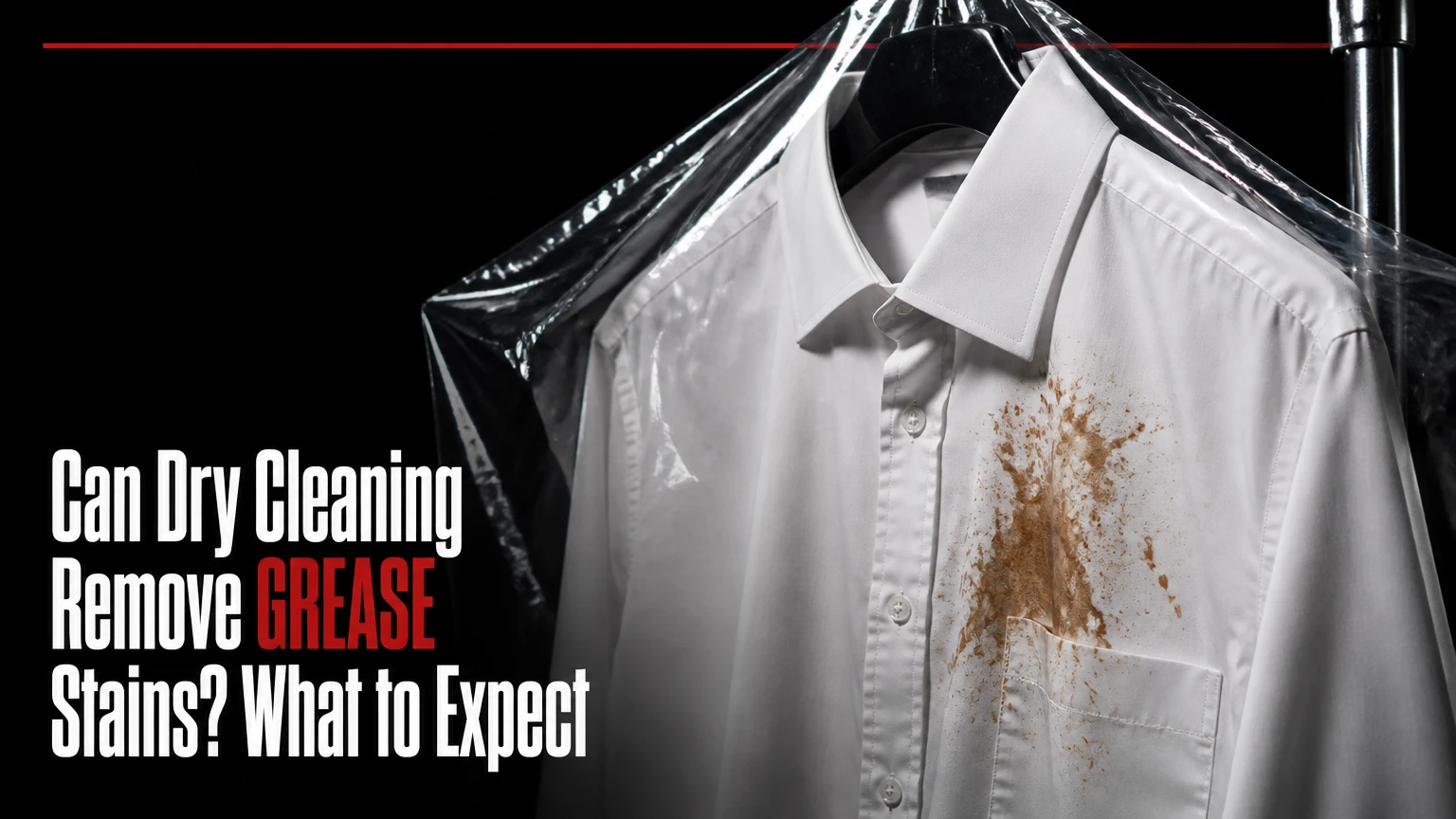
Yes, dry cleaning can remove many grease stains, especially fresh cooking oil, butter, cosmetics, body oil, and petroleum-based marks. Professional dry cleaners use oil-compatible solvents plus localized stain treatment, but removal is not guaranteed: heat-set stains, dyes, fabric damage, and unidentified mixed stains can remain.
Key Facts / At a Glance
- Dry cleaning is usually effective for oil-based stains because its solvents dissolve oily soil more readily than water alone.
- A dryer, iron, or hot press can make an untreated grease stain substantially harder to remove.
- Typical retail treatment costs about $7-$20 for many garments, while coats, silk, leather-trimmed items, and specialty pieces cost more.
- Typical turnaround is 2-3 business days, although stain complexity and local service capacity can extend the time.
- Do not add water, detergent, or heat to a dry-clean-only garment before professional inspection.
- No responsible cleaner can promise complete removal without seeing the fabric, dye, stain age, and garment construction.
Why Can Dry Cleaning Remove Grease Stains?
Dry cleaning can remove grease because professional cleaning solvents are generally better at carrying nonpolar oily soils than water alone. Grease does not simply disappear during the machine cycle; the solvent loosens and dissolves part of the oily deposit, while agitation, filtration, extraction, and targeted spotting transfer the soil away from the textile.
The common phrase “like dissolves like” is useful but simplified. Oil and grease do not need their chemical bonds broken apart for cleaning to work. A compatible solvent surrounds and disperses oily molecules, reducing their attachment to fibers so the liquid can carry them away.
Water is polar, but the claim that water categorically repels every oil is too broad. Water-based detergents can remove grease from washable fabrics because surfactants surround oil in micelles. Dry-cleaning solvents take a different route and can be particularly useful when water would shrink, distort, bleed, or ring the garment.
A grease mark may contain more than grease. Restaurant stains can include protein, starch, sugar, pigments, and salt; motor oil can contain carbon, metal particles, additives, and road soil. A solvent cycle may remove the oily fraction while leaving a colored or particulate shadow that requires separate treatment.
Which Grease Stains Respond Best?
Fresh cooking oil, salad dressing, butter, lipstick oil, sunscreen, and body sebum usually respond better than old stains exposed to heat. Dry cleaning is also appropriate for oily marks on wool suits, silk blouses, rayon dresses, and structured garments that should not be aggressively washed at home.
| Stain type | Typical response | Main complication | Best first action |
|---|---|---|---|
| Olive or vegetable oil | High on untreated fabric | Added pigment, herbs, or sauce | Blot and identify the food |
| Butter or cream sauce | Moderate to high | Protein and dairy residue | Scrape solids, avoid water |
| Lipstick or foundation | Moderate to high | Wax, pigment, and silicone | Tell the cleaner the product |
| Sunscreen | Moderate | Mineral filters and yellowing | Keep away from heat |
| Motor oil | Moderate | Carbon, additives, and grit | Use an industrial-experienced cleaner |
| Chain grease | Low to moderate | Thick lubricant and embedded dust | Do not brush aggressively |
| Melted candle wax | Variable | Wax may transfer during heat | Scrape only when cool |
| Cooking oil after dryer use | Reduced | Heat-driven fiber penetration | Disclose the dryer exposure |
A practitioner rule matters here: describe the source, not merely the appearance. “Black grease” could mean motor oil, bicycle lubricant, mascara, axle grease, or food pigment, and each may need a different spotting agent.
What Happens to a Greasy Garment at a Dry Cleaner?
A professional dry cleaner normally inspects, pre-treats, cleans, reinspects, and finishes the garment. The stain spotter’s diagnosis is often more important than the machine cycle because a solvent wash cannot reliably remove a heavily concentrated deposit that was never loosened first.
1. Inspection identifies the risk
The cleaner checks the care label, fiber content, dye stability, lining, interfacing, buttons, sequins, coatings, and trim. The technician also looks for a tide line, fabric abrasion, color loss, and evidence that the stain has already been ironed or tumble-dried.
The customer should identify the stain’s source and age. A description such as “two drops of canola oil yesterday, no washing” gives the cleaner more useful information than “old dark spot.”
2. Pre-spotting loosens concentrated grease
A spotter applies a product designed for paint, oil, and grease, often called a POG agent, or uses a suitable solvent and surfactant system. The technician works from the reverse side or toward the center when appropriate, using controlled air, vacuum, steam, or gentle mechanical action.
Aggressive rubbing is not professional stain removal. Rubbing can fuzz wool, abrade silk, spread a ring, and force soil deeper into a dense weave.
3. The solvent cycle removes dispersed soil
The garment enters a closed-loop machine containing a liquid solvent. The machine washes, extracts, and dries the item under controlled conditions, then filters or distills the solvent for reuse.
Modern cleaners may use several solvent families. Perchloroethylene, commonly called perc, remains effective but is regulated in many jurisdictions. Hydrocarbon solvents are petroleum-derived alternatives, while siloxane-based systems such as GreenEarth use a silicone solvent. “Green” does not mean every stain disappears without pretreatment.
4. Post-spotting addresses residual shadows
After cleaning, the garment is inspected under strong light. Remaining grease, pigment, or particulate matter may receive a second localized treatment, but repeated treatment can increase the risk of dye change, texture change, or weakening.
5. Finishing restores presentation
Pressing, steaming, shaping, and inspection complete the service. Finishing can improve the garment’s appearance, but pressing cannot remove grease. Heat should be applied only after the cleaner has decided that remaining oily soil will not be baked into the fibers.
Which Dry-Cleaning Solvent Is Best for Grease?
No solvent is universally best for every grease stain. Perc can provide strong oil-cleaning performance, hydrocarbon systems can be gentler in some applications, and siloxane systems may need careful pretreatment for heavy or aged deposits.
| Solvent system | Typical strength | Fabric or trim consideration | Grease limitation |
|---|---|---|---|
| Perchloroethylene, perc | Strong solvent action and mature spotting protocols | Environmental and regulatory controls apply | May still leave pigment or heat-set residue |
| Hydrocarbon | Effective on many oils with a relatively gentle process | Longer cycles may be used | Heavy industrial soil may need extra treatment |
| Siloxane, including GreenEarth | Low-water process with compatibility for selected delicate items | Cleaner skill and formulation matter | Dense automotive grease may require repeated spotting |
| Wet cleaning with water and detergents | Strong on water-soluble food components | Requires controlled shrinkage and dye management | Not the same as conventional dry cleaning |
Solvent choice is only one variable. Machine filtration, detergent formulation, spotting experience, temperature, extraction quality, and the cleaner’s willingness to reinspect often determine the outcome.
The U.S. Environmental Protection Agency regulates perc use and has established requirements for dry-cleaning facilities; local rules and phaseout schedules can differ. Ask a cleaner which process the specific garment will receive rather than assuming every store uses the same chemistry.
How Much Does Grease-Stain Dry Cleaning Cost?
Typical retail dry-cleaning treatment costs about $7-$20 for many shirts, trousers, skirts, and comparable garments. A coat, silk dress, tuxedo, wedding garment, leather-trimmed item, or piece needing specialty restoration may cost $20-$100 or more depending on the market and work required.
| Garment or service | Typical price range | Typical turnaround | Cost driver |
|---|---|---|---|
| Shirt or blouse | $7-$15 | 2-3 business days | Fiber, trim, and local pricing |
| Trousers or skirt | $8-$18 | 2-3 business days | Lining and stain complexity |
| Wool suit, two pieces | $18-$40 | 2-4 business days | Pressing and construction |
| Coat or formal dress | $20-$60 | 3-7 business days | Size, fabric, and finishing |
| Specialty or industrial item | $25-$100+ | 3-10 business days | Heavy soil and specialty handling |
These are typical planning ranges, not a universal price list. Rush service may add a fee, and a cleaner may quote separately for extensive stain restoration. A low-cost standard cleaning and a specialist’s treatment for embedded automotive grease are different services.
How Long Does Grease Removal Take?
Standard dry-cleaning service commonly takes 2-3 business days, while specialty grease treatment may take 3-10 days. A 24-hour rush service is possible at some cleaners, but speed can reduce the opportunity for repeated spotting and controlled reinspection.
The stain itself may need only minutes of treatment. The total time includes queueing, solvent-cycle scheduling, drying, finishing, and quality control. Ask whether the quoted date includes stain inspection or only routine cleaning.
Should You Try a Home Treatment First?
Home treatment is reasonable for fresh grease on a machine-washable cotton, polyester, or denim item, but professional cleaning is safer for dry-clean-only, tailored, lined, dyed, embellished, or visibly damaged garments. The care label and garment construction matter more than the grease alone.
Safe home method for washable fabrics
- Remove solids. Lift butter, sauce, or thick lubricant with the edge of a spoon. Do not scrape hard enough to roughen the weave.
- Blot excess oil. Press a white paper towel against both sides of the fabric. Replace the towel as it absorbs oil.
- Apply dishwashing liquid. Use about 1 teaspoon of liquid dish detergent for a coin-sized stain. Test an inside seam first.
- Wait 5-10 minutes. Keep the garment flat and prevent the detergent from drying completely.
- Rinse and wash. Use the warmest cycle permitted by the care label, not an automatically hot cycle.
- Inspect before drying. Repeat the treatment if a translucent or dark ring remains. Air-dry until the stain is gone.
You will know the treatment worked when the fabric looks uniform under angled light and no oily translucency appears after rinsing. The common mistake is using the dryer because the garment looks clean while damp.
Baking soda can absorb surface oil, but it is not a solvent and cannot replace detergent for most textile stains. Cornstarch or talc may help with a fresh, heavy deposit, yet powders can leave residue and do not solve the problem of heat or dye instability.
Dry Cleaning Versus Home Washing for Grease
Professional dry cleaning offers the lower fabric risk for delicate or structured clothing, while home washing costs less and can work well on washable everyday fabrics. The best choice depends on the care label, stain composition, previous heat exposure, and consequences of damage.
| Decision factor | Professional dry cleaning | Home treatment and washing |
|---|---|---|
| Typical direct cost | $7-$20 per ordinary garment | About $0.10-$1.00 in supplies |
| Best fabric range | Wool, silk, rayon, tailored garments | Cotton, denim, polyester, washable blends |
| Main cleaning action | Solvent plus localized spotting | Detergent, water, agitation |
| Typical time | 2-3 business days | 30-120 minutes plus drying |
| Main failure risk | Residual shadow or dye sensitivity | Shrinkage, bleeding, abrasion, heat setting |
| Best stain condition | Fresh or moderately aged oil | Fresh food oil on colorfast fabric |
Professional cleaning is not automatically safer for every textile. A cleaner may decline an item with a fragile coating, unstable dye, degraded adhesive, or an already weakened fiber. Conversely, home detergent can damage silk, wool, acetate, and structured tailoring even when the grease comes out.
Why Does the Dryer Make Grease Stains Harder to Remove?
A dryer can make grease stains harder to remove because heat drives the oily material farther into the fiber structure and may oxidize or polymerize some residues. Heat can also set a ring, alter a dye, or make a previously invisible mark appear yellow or brown.
The phrase “permanent” needs precision. Dryer exposure does not guarantee that a stain can never be reduced, but it lowers the probability of complete removal and raises the risk of fabric damage during stronger treatment.
Do not iron a suspected grease stain. Do not tumble-dry a garment until inspection confirms that the oily mark has disappeared in dry light.
Can a Cleaner Remove Motor Oil and Automotive Grease?
A dry cleaner may remove motor oil, but heavy automotive grease often requires a cleaner experienced with uniforms, mechanics’ clothing, or industrial laundry. Motor oil contains hydrocarbon lubricant, additives, carbon, and abrasive road particles, so a standard retail cycle may remove the oil while leaving a gray particulate shadow.
Tell the cleaner whether the garment touched engine oil, bearing grease, chain lubricant, hydraulic fluid, or a food oil. Also disclose whether the item has been washed, dried, ironed, or treated with a household product.
| Automotive soil | Likely challenge | Cleaner to seek | Customer instruction |
|---|---|---|---|
| Fresh engine oil | Oily film and dark pigment | Cleaner handling workwear | Keep item away from heat |
| Bearing grease | Thick, waxy deposit | Industrial garment specialist | Do not spread the deposit |
| Bicycle chain lubricant | Oil plus metal dust | Cleaner familiar with technical fabrics | Remove loose grit gently |
| Hydraulic fluid | Thin oil and possible dye | Professional spotter | Identify the fluid brand if known |
A solvent that is gentle on a silk blouse may not be the best choice for a heavily contaminated canvas uniform. Industrial laundries may use water-based emulsification, specialized detergents, or different safety controls rather than conventional retail dry cleaning.
Which Fabrics Need Professional Handling?
Silk, wool, rayon, acetate, velvet, lined tailoring, pleated garments, and embellished clothing deserve professional inspection before grease treatment. These materials can suffer from water rings, shrinkage, dye bleeding, nap damage, adhesive failure, or distortion when treated with household detergent.
| Fabric or construction | Main home-treatment risk | Recommended approach | Inspection priority |
|---|---|---|---|
| Silk charmeuse | Water rings and dye disturbance | Professional cleaner | High |
| Wool suiting | Felting, shrinkage, abrasion | Professional cleaner | High |
| Rayon or viscose | Swelling and distortion | Professional cleaner | High |
| Cotton T-shirt | Color loss or residual ring | Home treatment if washable | Moderate |
| Denim jeans | Fading and localized lightening | Home treatment after testing | Moderate |
| Sequined or bonded item | Adhesive or trim damage | Specialist cleaner | Very high |
“Dry-clean only” is a strong warning against improvisation, not a guarantee that dry cleaning will remove every mark. The label describes the manufacturer’s safest care method, while stain removal still depends on the chemistry and history of the stain.
What Should You Do Before Taking the Garment In?
Blot fresh grease, remove thick solids without rubbing, keep the garment dry, and tell the cleaner exactly what caused the mark. Do not apply water, bleach, alcohol, acetone, laundry detergent, or a commercial stain stick to a delicate garment unless its care instructions specifically permit that treatment.
Use this handoff checklist:
- Mark the stain location with a removable note, not a safety pin through delicate fabric.
- Record the approximate time and substance.
- State whether the item went through a washer, dryer, iron, or steamer.
- Mention any home product already applied.
- Point out nearby trim, lining, print, coating, or contrasting dye.
- Ask whether the cleaner will pre-spot and reinspect the item.
Paper towels are preferable to colored napkins because dyes can transfer. A small amount of pressure is useful; scrubbing is not.
What If the Grease Stain Remains?
If the stain remains after cleaning, ask for immediate reinspection and explain the original substance and treatment history. A reputable cleaner can often reprocess or post-spot a suitable item, but repeated chemical treatment cannot restore dye loss, abrasion, discoloration, or fibers permanently altered by heat.
Check the garment before leaving the counter, especially under bright or angled light. Request the senior spotter or manager if the first result is unsatisfactory, and ask what part of the mark remains: oil, pigment, particulate soil, a water ring, or fabric damage.
A second treatment is most useful when removable residue remains. It is less useful when the “stain” is actually a lighter patch caused by bleaching, friction, or dye transfer from another object.
How Should You Choose a Local Cleaner?
Choose a cleaner based on relevant stain experience, not solvent marketing alone. Ask whether the shop handles silk and wool, identifies grease by source, performs pre-spotting, accepts motor-oil work, and offers a reinspection policy.
Use these questions by phone or at drop-off:
- Do you treat cooking oil and automotive grease in-house?
- Which solvent or wet-cleaning system will you use for this fabric?
- Will the stain be pre-spotted before the machine cycle?
- Do you inspect the garment before pressing?
- What happens if the grease remains?
- Will you note existing damage or color instability before treatment?
- What is the estimated price and completion date?
A cleaner who promises 100% removal without examining the item is giving an unreliable answer. Experienced operators can estimate risk, but they cannot control the stain’s age, dye chemistry, or prior heat exposure.
Frequently Asked Questions
Can dry cleaning remove old grease stains?
Dry cleaning can reduce some old grease stains, but aged marks are less predictable than fresh ones. Oxidation, repeated wear, detergent residue, and dryer heat may change the oil or damage the dye. Tell the cleaner how long the stain has been present and whether the garment has already been washed or pressed.
Does dry cleaning remove grease from a white shirt?
Dry cleaning can remove oily residue from a white shirt, but yellow or gray discoloration may remain if the stain contains pigment, oxidized oil, or detergent residue. A washable white cotton shirt may respond better to a tested detergent treatment and oxygen bleach permitted by its care label.
Can I use rubbing alcohol on a grease stain?
Rubbing alcohol is not a universal grease remover and can affect dyes, finishes, prints, adhesives, or acetate fibers. Avoid it on dry-clean-only clothing unless a textile professional approves it. For washable cotton, test any solvent on an inconspicuous area before applying it to the visible fabric.
Does dry cleaning remove food stains as well as grease?
Dry cleaning often removes the oily portion of a food stain effectively, but water-soluble sugar, salt, protein, and colored sauce may require separate wet-side spotting. Tell the cleaner whether the food included cream, tomato, wine, coffee, spices, or dye because a single solvent treatment may not address every component.
Can grease stains disappear after washing but return later?
A grease stain can appear gone when wet and reappear after drying because oil remains inside the fibers and refracts light differently once the fabric is dry. Inspect the garment under bright light before using a dryer, and repeat a safe treatment or seek professional advice when a translucent ring returns.
Is dry cleaning worth it for an inexpensive garment?
Dry cleaning is usually worth considering when the garment is delicate, tailored, sentimental, or difficult to replace. For a low-cost, washable cotton shirt, home treatment is often more economical. Compare the garment’s replacement cost with a typical $7-$20 professional cleaning charge and the risk of damaging it yourself.
The Bottom Line
Dry cleaning can remove many grease stains, particularly fresh cooking oil, cosmetics, body oil, and petroleum residue on fabrics that should not be washed at home. The best outcome comes from prompt drop-off, accurate stain identification, professional pre-spotting, and no dryer or iron exposure. For a washable cotton or denim garment, a small amount of dish detergent may be a practical alternative, but inspect it before drying. For silk, wool, rayon, tailoring, embellishments, or motor oil, professional assessment is the safer decision. The answer to “can dry cleaning remove grease stains” is yes, with the important qualification that stain age, heat, dye condition, and grease composition determine whether removal is complete.