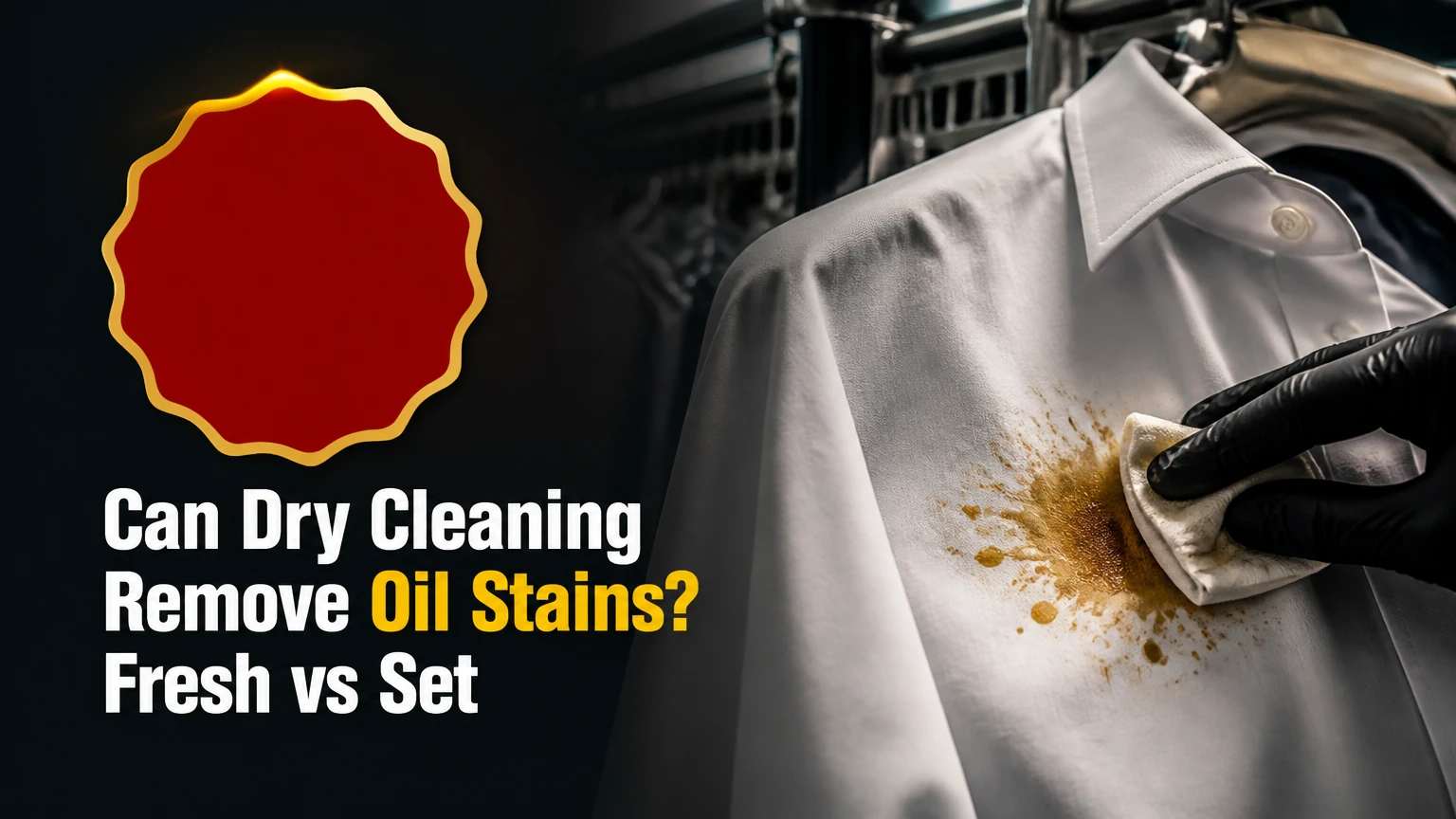
Yes, professional dry cleaning can remove many oil stains because dry-cleaning solvents dissolve oily, water-repellent compounds more effectively than water alone. Results depend on the oil type, fabric, stain age, dye, and whether heat has set the mark. Tell the cleaner exactly what caused the stain and avoid ironing or machine-drying it first.
Key facts at a glance
- Dry-cleaning solvent is usually more effective than water alone against cooking oil, body oil, cosmetics, and many lubricants.
- Professional oil-stain treatment normally begins with inspection and localized pre-spotting before the garment enters the machine.
- A fresh, untreated oil mark has a better outlook than one exposed to an iron, clothes dryer, or prolonged storage.
- “Dry clean only” means the garment should follow the care label, not that every stain is guaranteed to disappear.
- Do not rub an oil stain aggressively or cover it with water-based products on silk, wool, suede, or structured garments.
- Dry-cleaning prices commonly range from about $5-$12 for a shirt or pair of trousers and $15-$35 for a dress or suit, depending on location and service.
Can Dry Cleaning Remove Oil Stains?
Professional dry cleaning can remove fresh and moderately aged oil stains from many garments, particularly marks caused by food, skin oils, lotion, makeup, and petroleum-based grease. The process works because the cleaning liquid is an organic solvent rather than a water-based wash solution.
A cleaner cannot promise complete removal in every case. Heat can oxidize or permanently alter the oil, while synthetic fibers may absorb oily compounds and retain a shadow after treatment. Some marks that appear to be oil are actually dye transfer, adhesive, rust, or a combination of grease and colored food residue, so correct identification affects the treatment.
The best first action is simple: blot excess oil with a white absorbent cloth, leave the garment otherwise untreated, and identify the stain when you bring it in. A cleaner can select a spotting agent and process based on the fiber, dye, construction, and contamination.
Why Does Dry Cleaning Work on Oil?
Dry cleaning works on oil because many dry-cleaning solvents have chemical properties that interact with nonpolar oily substances, whereas water is polar and does not dissolve grease efficiently by itself. Solvent action loosens the oil, and mechanical movement, filtration, and extraction remove the dissolved residue from the garment.
“Like dissolves like” is a useful simplification, not a complete description of modern cleaning. Professional formulations also use detergents, moisture, controlled heat, and spotting agents. Those additives help suspend soil and prevent redeposition, while the solvent carries away compounds that water alone would leave behind.
Water-based laundry can still remove oil from washable cotton or polyester when a detergent contains surfactants. Surfactants surround oily soil and help disperse it into the wash water. The distinction is that a professional cleaner can choose a solvent or wet-cleaning formula while controlling agitation, moisture, temperature, and finishing pressure.
Dry cleaning is not a magic solvent bath. Heavy grease may require repeated local treatment, and a yellow-brown mark may indicate oxidation or fiber damage rather than removable surface oil.
What kinds of oil respond best?
Cooking oil, salad dressing, butterfat, body oil, hair products, foundation, and many light lubricants commonly respond well to professional cleaning. Motor oil, chain grease, cutting oil, and dark industrial lubricants can also respond, but they may contain pigments, metal particles, resins, or additives that leave a residual color.
Tell the cleaner whether the substance was olive oil, engine oil, massage oil, silicone lubricant, sunscreen, or makeup. “Oil” is not one chemical category in practical stain treatment, and the distinction determines which pre-spotter is appropriate.
What Happens at a Professional Cleaner?
A professional oil-stain treatment normally follows seven stages: garment inspection, stain identification, localized pre-spotting, solvent or wet cleaning, solvent recovery, post-spotting, and pressing. The most important stage is often pre-spotting because the technician can target the exact residue before the general cleaning cycle.
1. Inspection and identification
The cleaner checks the care label, fiber content, colorfastness, lining, trim, coating, buttons, pleats, and construction. The technician records visible damage and marks the stain location, because a faint oil halo can be difficult to see after the garment is placed among other items.
Point out every affected area. A receipt or intake ticket may record “front right hem” or “collar, body oil,” which gives the finishing team a defined inspection target.
2. Pre-spotting the oil
The technician applies a compatible spotting agent to the oil mark and works it gently with a spatula, brush, air, steam, or vacuum equipment. The goal is to loosen the soil without spreading it, stripping the dye, flattening the nap, or damaging the finish.
A good cleaner tests an inconspicuous area when the fabric or dye is vulnerable. Silk, acetate, rayon, coated synthetics, and dark garments deserve more restraint than a plain white cotton shirt.
3. Cleaning in solvent or water
The garment enters a closed machine using a selected solvent, or it goes through professional wet cleaning when the label and construction allow water. The machine controls the cleaning liquid, drum movement, temperature, filtration, and drying conditions.
Dry-cleaning machines recover and reuse solvent through filtration and distillation systems. The exact cycle varies by machine, solvent, garment load, and cleaner’s process, so a public-facing “one standard temperature” does not apply to every shop.
4. Extraction and drying
High-speed extraction removes most liquid from the textile, followed by controlled airflow that evaporates remaining solvent. Excessive heat is avoided when the fabric, dye, elastane, adhesive, or coating could shrink, distort, or discolor.
5. Post-spotting and finishing
If a shadow remains, the technician may treat the garment again on a spotting board. The garment is then steamed or pressed, inspected, folded or hung, and packaged.
Finishing can improve the appearance without removing the chemical residue. Inspect the garment under bright light before accepting it, especially when the stain was the reason for the service.
Which Cleaning Method Removes Oil Best?
No single cleaning method is best for every oil stain. A professional cleaner chooses among solvent dry cleaning, hydrocarbon cleaning, silicone-based cleaning, and controlled wet cleaning according to the fiber, dye, soil, and care label.
| Method | Typical oil performance | Best-fit garments | Main limitation |
|---|---|---|---|
| Perchloroethylene dry cleaning | Strong on petroleum grease and heavy oily soil | Wool suits, structured tailoring, robust dry-clean-only garments | Environmental and occupational controls apply |
| Hydrocarbon solvent | Good on food oil, cosmetics, and body oil | Delicate garments needing a lower-aggression solvent | Heavy or aged grease may need extra spotting |
| Silicone-based solvent | Moderate on light oil and routine soil | Delicate items where gentle handling matters | Dark industrial grease can require repeat treatment |
| Professional wet cleaning | High when detergent and emulsifier are correctly selected | Water-compatible wool, cotton, linen, and some synthetics | Water can cause shrinkage, dye migration, or distortion |
| Home machine washing | Variable, high only with suitable detergent and fabric | Washable cotton, linen, and durable synthetics | Unsafe for many dry-clean-only garments |
Perchloroethylene, often called perc, remains effective, but “strongest” does not mean universally safest. The U.S. Environmental Protection Agency has treated perc as a regulated hazardous air pollutant, and cleaners must manage exposure, equipment, waste, and ventilation. Ask what process the shop uses rather than demanding one chemical.
GreenEarth is a trade name associated with a silicone-based cleaning solvent, while hydrocarbon systems use petroleum-derived solvents. Their suitability depends on machine settings and spotting skill, not merely the label on the solvent.
How Much Does Oil-Stain Cleaning Cost?
Typical U.S. retail pricing is about $5-$10 for a shirt or blouse, $7-$12 for trousers, and $15-$35 for a dress or suit. A cleaner may add roughly $5-$15 for extensive post-spotting, restoration, or industrial contamination, although local price structures vary substantially.
| Garment or service | Typical base price | Possible extra charge | Typical turnaround |
|---|---|---|---|
| Shirt or blouse | $5-$10 | $0-$8 | 2-3 business days |
| Trousers or skirt | $7-$15 | $0-$10 | 2-3 business days |
| Dress | $15-$35 | $5-$15 | 3-5 business days |
| Suit, two-piece | $18-$40 | $5-$15 | 3-5 business days |
| Heavy grease treatment | $10-$25 added | $5-$15 repeat service | 3-7 business days |
| Same-day service | Base price plus 20%-50% | $5-$20 rush fee | 4-8 hours |
These figures are typical planning ranges, not universal rates. Designer clothing, wedding garments, leather, suede, drapes, and items requiring repair or dye testing can cost more. Ask whether stain treatment is included before authorizing service.
How long does dry cleaning take?
Standard oil-stain cleaning usually takes 2-3 business days, while a same-day service may take 4-8 hours if the shop accepts the risk and has capacity. Repeat spotting, odor, drying time, a delicate fabric, or a weekend drop-off can extend the schedule.
A quick turnaround does not improve stain chemistry. It only reduces queue time, so a cleaner should not skip inspection or post-cleaning evaluation to meet a rush deadline.
Should You Try Home Removal First?
Home treatment is reasonable for a fresh oil stain on a washable cotton, linen, or durable synthetic garment, but it is a poor first choice for silk, wool tailoring, suede, leather, rayon with unstable dye, or any item labeled “dry clean only.” The care label and garment construction matter as much as the oil.
For washable garments
- Blot excess oil. Use a white paper towel or clean white cloth. Press vertically instead of rubbing outward.
- Apply a small amount of liquid laundry detergent. A grease-cutting dish detergent can work on some durable washable fabrics, but test an inside seam first.
- Wait 5-10 minutes. Do not allow the product to dry on the fabric.
- Rinse and wash according to the care label. Use the warmest permitted setting, not automatically the hottest setting.
- Air-dry the garment. Inspect the mark before using a dryer, iron, or steamer.
The quantity should be small enough to rinse completely. Excess dish soap can create residue, discoloration, or excessive suds in a washing machine.
For dry-clean-only garments
Blot the stain, remove loose food solids with the edge of a spoon, and take the garment to a cleaner promptly. Do not add baking soda, cornstarch, water, stain spray, detergent, or rubbing alcohol unless the cleaner specifically advises it.
Home dry-cleaning kits do not replicate professional spotting boards, solvent filtration, garment inspection, or finishing equipment. They may freshen a garment, but they are a weak substitute for targeted treatment of a visible oil mark.
What Can Make an Oil Stain Permanent?
An oil stain becomes harder to remove when heat, oxidation, dye change, or fiber damage transforms the original residue. A dryer or iron can drive oil deeper into a textile and accelerate chemical changes, while months of storage can turn a pale mark yellow or brown.
| Condition | Typical effect | Best response | Outlook |
|---|---|---|---|
| Fresh oil, no heat | Surface residue remains mobile | Blot and clean promptly | Often favorable |
| Washed, then air-dried | Detergent may remove part of the oil | Re-treat before any heat | Variable |
| Tumble-dried once | Heat drives residue into fibers | Tell cleaner about dryer exposure | Reduced |
| Ironed directly | High heat can bake and spread the mark | Stop heating and seek professional treatment | Reduced |
| Aged yellow-brown mark | Oxidation or polymerization may have occurred | Ask about controlled restoration treatment | Uncertain |
| Dye stripped by rubbing | Visible light patch is fiber or color damage | Do not keep scrubbing | Cleaning cannot restore lost dye |
Oil oxidation is especially relevant to vegetable oils, cooking fats, and some cosmetic products. A cleaner may be able to reduce the residue, but no solvent can reliably restore dye that has already changed or fibers that have been abraded.
Why does rubbing make the problem worse?
Rubbing pushes oil sideways and deeper into the weave while abrading fibers at the surface. On wool, velvet, brushed synthetics, and silk, the resulting nap or shine change can remain visible even after the oil has been removed.
Use pressure and lifting, not friction. A white cloth also prevents colored paper or towels from transferring dye to the garment.
Does Fabric Type Change the Result?
Fabric type changes the acceptable moisture, agitation, heat, and chemical exposure, so the same oil stain can have different outcomes on cotton, silk, wool, polyester, and acetate. A cleaner evaluates both the fiber and the garment’s finish before selecting a process.
| Fabric | Oil-stain concern | Safer initial action | Common risk |
|---|---|---|---|
| Cotton | Absorbs cooking oil but tolerates washing | Blot, pre-treat if label allows | Heat setting and color loss |
| Linen | Absorbs oil and wrinkles easily | Follow washable label carefully | Shrinkage and uneven pressing |
| Polyester | Holds oily body soil strongly | Use detergent if washable | Persistent gray or yellow shadow |
| Silk | Sensitive to water rings and spot halos | Blot only, then professional cleaner | Dye bleed, rings, texture change |
| Wool | Sensitive to friction and excess moisture | Blot and follow dry-clean label | Felting, shrinkage, distortion |
| Rayon or viscose | Can weaken when wet | Avoid home water treatment | Water marks and shape loss |
| Acetate | Vulnerable to some solvents and heat | Professional inspection | Dissolution, fusing, or finish damage |
| Suede or leather | Requires material-specific treatment | Keep dry and use a specialist | Permanent darkening or tide marks |
Care labels describe the manufacturer’s tested cleaning pathway, but they do not guarantee stain removal. A “dry clean” instruction addresses garment care, not the chemistry of every contaminant.
What Should You Tell the Cleaner?
Tell the cleaner what the substance was, when it spilled, whether the garment was washed, and whether it encountered heat. Those details are more useful than simply pointing at a dark spot because detergent, dryer heat, and stain age can change the treatment plan.
Use this intake checklist:
- Name the oil: olive oil, butter, sunscreen, foundation, motor oil, or another product.
- Give the approximate age: 20 minutes, two days, or six months.
- Report heat: dryer, iron, hair dryer, radiator, or hot car.
- Report previous products: detergent, dish soap, powder, solvent, or stain remover.
- Identify all locations: front, lining, cuff, pocket, collar, or trim.
- Mention the garment’s value and any nonfabric components.
- Ask whether the shop performs post-spotting and re-cleaning if the mark remains.
Do not conceal a previous attempt. A cleaner who knows that a product was applied can test for residue, discoloration, or a water ring before choosing another treatment.
How Do You Compare Dry Cleaning With Home Treatment?
Professional cleaning is the safer decision for delicate or dry-clean-only clothing, while home treatment is cheaper and often effective for fresh oil on washable fabric. The correct choice depends on the care label, fiber, stain age, and consequences of damage.
| Decision factor | Professional dry cleaning | Home treatment |
|---|---|---|
| Upfront cost | About $5-$40 per garment | About $0.10-$1.00 in detergent |
| Typical time | 2-3 business days | 30-90 minutes plus drying |
| Best fabric range | Silk, wool, tailoring, structured garments | Cotton, linen, durable synthetics |
| Equipment | Solvent machine, spotting board, press | Cloth, detergent, sink or washer |
| Main strength | Targeted solvent and controlled finishing | Immediate action on washable fabric |
| Main risk | Cost and incomplete removal | Shrinkage, dye damage, heat setting |
| Heat control | Professional drying and finishing | User-controlled, often inconsistent |
| Best use case | Motor grease or valuable clothing | Fresh cooking oil on a care-label-approved item |
Professional dry cleaning is not automatically better for every textile. A skilled wet cleaner may produce a better result on a washable cotton shirt, while a solvent process may be appropriate for a wool suit or silk blouse.
What If the Stain Remains After Cleaning?
If an oil mark remains after dry cleaning, return the garment promptly and ask the cleaner to inspect whether the residue, oxidation, dye change, or fiber damage is responsible. Do not apply another household product before the cleaner evaluates the first process.
A useful follow-up sequence is:
- Compare the mark before and after cleaning. A smaller, paler mark indicates partial removal; an unchanged mark may indicate misidentified soil.
- Ask what solvent and spotting process were used. The answer helps determine whether another compatible treatment is possible.
- Request post-spotting or reprocessing. Reputable cleaners commonly inspect a missed stain when notified soon after pickup.
- Ask about oxidation treatment. A yellow-brown mark may need a carefully controlled bleaching or restoration procedure, not simply another solvent cycle.
- Accept the limit if dye or fiber is damaged. A lighter patch, sheen, or texture change cannot be cleaned back into its original state.
A second treatment has its own risks. Repeated spotting can weaken fabric, alter color, or damage a coating, so the cleaner should explain the likely benefit before proceeding.
When should you use a specialist?
Use a specialist for leather, suede, fur, beaded clothing, vintage textiles, wedding gowns, heavily contaminated workwear, or garments with visible finish damage. Automotive grease may contain metal particles and dark pigments that require more than ordinary household stain treatment.
For valuable garments, request a written estimate and ask whether the business sends the item to an outside restoration specialist. Ordinary neighborhood dry cleaning and textile restoration are different services.
Expert Rules for Better Results
Experienced cleaners tend to follow rules that are easy for home users to overlook:
- Heat is the irreversible checkpoint. Inspect after washing and before drying because a dryer can convert a potentially removable stain into a restoration problem.
- The stain story is diagnostic evidence. Knowing whether a mark came from olive oil or chain lubricant narrows the possible residues and prevents random product testing.
- A visible shadow is not always remaining oil. On polyester, a change in surface reflectance or dye can look like grease after the residue has largely gone.
- More chemical is not more effective. Excess product increases spread, residue, and color risk; targeted application usually outperforms saturation.
- The garment’s weakest component sets the limit. A solvent-safe wool body may still contain acetate lining, glued trim, fragile interfacing, or unstable buttons.
These rules explain why a professional may decline a guaranteed outcome. Honest stain removal includes the possibility that cleaning can expose pre-existing damage or that complete removal would risk the garment.
Frequently Asked Questions
Can dry cleaning remove old oil stains from clothes?
Dry cleaning can reduce or remove some old oil stains, but age lowers the probability of complete removal. Storage can oxidize vegetable oils and cosmetics into yellow or brown compounds, while previous ironing or tumble-drying can set the residue. Tell the cleaner the stain’s age and every treatment it has received.
Can dry cleaning remove motor oil from a suit?
Professional dry cleaning may remove motor oil from a suit, especially when the stain is fresh and the cleaner knows its source. Motor oil can contain soot, metal particles, resins, and additives that leave pigment after the oily carrier is removed. Heavy contamination may require specialist work and repeat treatment.
Will dry cleaning remove grease from polyester?
Dry cleaning can remove grease from polyester, but polyester often retains oily body soil more strongly than absorbent natural fibers. A fresh mark usually has a better outlook than a heat-dried one. A cleaner may use solvent pre-spotting, while a washable polyester garment may respond to detergent and air-drying at home.
Can I use dish soap on a dry-clean-only garment?
Do not use dish soap on a dry-clean-only garment unless a textile professional specifically directs you. Water and detergent can create rings, dye migration, texture changes, or residue that complicates professional treatment. Blot excess oil, avoid heat, and take the garment to a cleaner with the stain details.
Does dry cleaning remove body oil from collars?
Dry cleaning commonly reduces body oil on collars, cuffs, and shirt fronts, although old buildup can leave yellowing or a gray shadow. Point out the affected areas because collar soil may be difficult to distinguish from normal fabric discoloration. Repeated buildup may need laundering, wet cleaning, or specialized shirt service.
How soon should an oil-stained garment go to the cleaner?
Take a dry-clean-only garment to a cleaner as soon as practical, preferably within one or two days, after blotting excess oil and avoiding heat. Immediate professional attention does not guarantee removal, but it reduces the time available for oxidation, spreading, and fiber absorption.
The Bottom Line
Can dry cleaning remove oil stains? Usually, yes, particularly when the oil is fresh, the garment is processed according to its care label, and the cleaner receives accurate information about the substance and previous heat exposure. Dry cleaning cannot guarantee removal of oxidized oil, dye damage, or a stain baked into synthetic fibers.
For washable cotton, linen, or durable polyester, careful detergent treatment followed by air-drying may be the least expensive first step. For silk, wool, rayon, acetate, tailoring, suede, leather, or valuable clothing, blot the mark and use a qualified professional cleaner instead. Never iron or machine-dry an untreated oil stain.