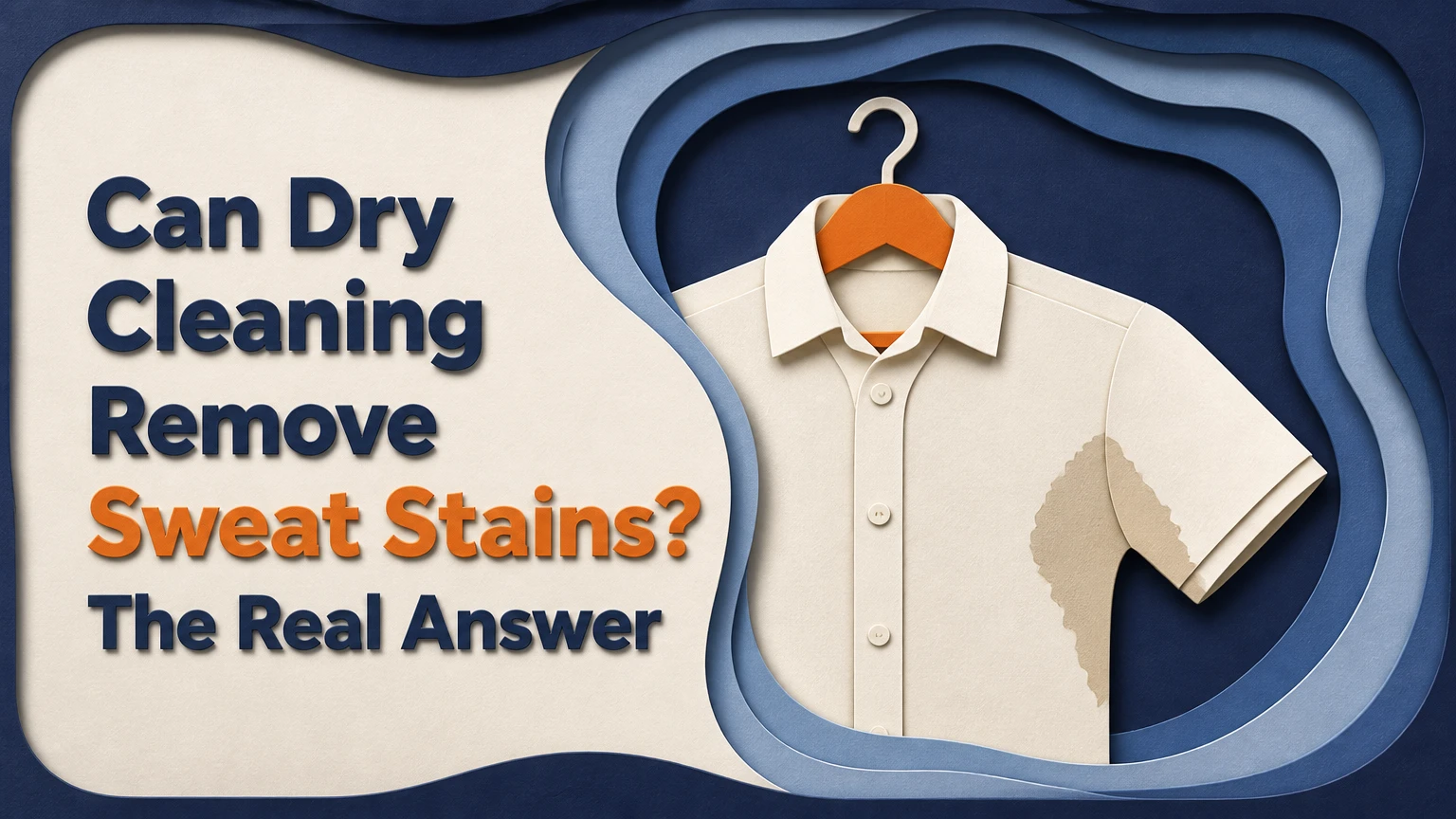
Yes, professional dry cleaning can remove many sweat stains, but the dry-cleaning solvent alone is not enough. Sweat contains water-soluble salts and proteins, while body oil and antiperspirant buildup contain oil-soluble compounds. Successful removal usually requires fabric testing, wet-side pre-spotting, and sometimes oxygen-based treatment before or after the solvent-cleaning cycle.
Key Facts at a Glance
- Dry-cleaning solvent removes body oils and waxy antiperspirant residue better than raw sweat salts.
- Professional pre-spotting is the step that targets water-based sweat residue.
- A dryer or iron can permanently set discoloration and make removal less predictable.
- Cotton and linen often respond better to professional wet cleaning than solvent cleaning.
- Silk, wool, rayon, acetate, and tailored garments require conservative testing before stain treatment.
- No cleaner can guarantee removal when sweat has weakened fibers or permanently changed the garment’s dye.
What Kind of Stain Is a Sweat Stain?
A sweat stain is usually a mixed stain containing perspiration salts, proteins, skin oils, deodorant ingredients, and sometimes dye that has chemically changed. Fresh perspiration may dry as a nearly invisible residue, while repeated wear creates a stiff yellow or gray underarm deposit.
Human sweat is primarily water, but the visible mark is rarely only sweat. Sebum contributes oil, antiperspirants may contribute aluminum salts and waxes, and skin bacteria can contribute odor compounds. The yellowing often develops during storage, oxidation, or exposure to heat.
The garment’s color also matters. A white shirt can show yellow oxidation clearly, while a dark garment may show a pale ring, altered dye, or shiny residue instead. A stiff underarm area suggests accumulated solids rather than a simple surface mark.
Why does sweat turn yellow?
Sweat turns yellow when residue oxidizes and interacts with body oils, antiperspirant ingredients, and fabric dyes. Heat accelerates the process, and repeated drying can bond the residue more tightly to fibers.
Yellowing does not prove that the fabric is dirty in the ordinary sense. Acidic perspiration can damage some dyes and fibers, particularly when residue remains for months. In those cases, cleaning may remove the deposit while leaving a lighter or darker area caused by chemical damage.
Laundry-care guidance commonly warns against heat before stain inspection. Maytag, for example, advises checking that a stain has disappeared before machine drying because dryer heat can set remaining residue. That principle applies to professional treatment as well.
Why Can Dry Cleaning Remove Some Sweat Stains but Not Others?
Dry cleaning works best on the oily part of a sweat stain because its solvent dissolves grease, sebum, and many antiperspirant residues. Standard solvent cleaning is less effective against water-soluble salts and protein residue, which require a separate spotting process.
A professional cleaner may use a spotting board, steam, vacuum extraction, detergent-based agents, protein digesters, mild acids, or controlled oxygen products. The exact sequence depends on the care label, fiber, colorfastness, finish, and condition of the garment.
The phrase “dry cleaning” describes the main cleaning system, not every treatment performed in a plant. A garment can receive solvent cleaning plus hand spotting, or it may be routed to professional wet cleaning when water is the safer and more effective medium.
The Federal Trade Commission’s Care Labeling Rule requires a label to disclose “at least one safe cleaning method.” That instruction identifies a safe method, not a guarantee that every stain will disappear. A cleaner must still assess the stain and garment before choosing chemistry.
What does pre-spotting do?
Pre-spotting separates the stain into components and treats each component with a compatible product. A cleaner first identifies whether the residue is primarily oily, protein-based, tannin-like, dye-related, or mineral-based, then applies the least aggressive effective treatment.
A typical professional sequence includes:
- Inspection: The cleaner examines underarms, collars, seams, lining, and weakened areas under strong light.
- Care-label review: Fiber content, finish, embellishment, and manufacturer restrictions determine available treatments.
- Colorfastness testing: A hidden area is tested for dye bleeding, fading, or transfer.
- Spot treatment: The technician applies a targeted agent and gently works from the outside toward the center.
- Flushing or extraction: Steam, water, vacuum, or controlled mechanical action removes loosened residue.
- Main cleaning cycle: Solvent or water-based cleaning addresses remaining soil.
- Final inspection: Persistent discoloration is assessed before pressing, packaging, and release.
A cleaner may repeat spotting after the main cycle because the first treatment can expose residue hidden beneath oil or antiperspirant film. Pressing should occur only after the garment has been checked.
Which Cleaning Method Works Best for Sweat Stains?
Professional wet cleaning is generally the strongest option for washable cotton and linen because water dissolves sweat salts directly. Solvent dry cleaning is often the safer choice for structured wool, silk, acetate, and garments whose shape or finish could be harmed by immersion.
| Method | Main medium | Sweat-residue performance | Best garment examples | Typical US price |
|---|---|---|---|---|
| Solvent dry cleaning | Petroleum, hydrocarbon, silicone, or other solvent | Strong on oils; requires wet-side spotting for salts | Wool blazer, suit, silk jacket | $8-$35 |
| Professional wet cleaning | Water, controlled detergent, specialized finishing | Strong on salts and washable protein residue | Cotton shirt, linen blouse | $6-$25 |
| Household laundering | Water and consumer detergent | Good on fresh washable stains; variable on old yellowing | Cotton T-shirt, polyester shirt | $0.25-$2 per load |
| Hand restoration | Targeted water or solvent chemistry | Used for fragile, valuable, or heavily damaged pieces | Vintage silk, couture, archival textile | $30-$150+ |
Prices are typical US estimates, not a universal rate card. City, garment construction, stain complexity, rush service, and cleaner expertise can change the total substantially.
Is dry cleaning or washing better for a cotton shirt?
Washing or professional wet cleaning is usually better for a cotton shirt with sweat salts because water reaches and dissolves the residue. A solvent-only cycle may remove the oily deodorant film while leaving yellowing or stiffness behind.
A cotton shirt marked machine washable can usually be pretreated and washed according to its care label. A shirt with bonded interfacing, delicate trim, unusual dye, or a “dry clean only” instruction should go to a cleaner instead.
Cotton can tolerate more moisture than silk, but cotton is not immune to damage. Aggressive brushing, high-temperature bleaching, and repeated alkaline treatments can weaken fibers or alter color.
Is dry cleaning safe for wool, silk, and rayon?
Dry cleaning is often safer for wool, silk, and rayon than home experimentation, but stain removal must be conservative. These fibers can shrink, bleed, stretch, water-mark, or lose surface finish when exposed to unsuitable moisture, heat, pH, or friction.
| Fabric | Main risk | Preferred first option | Home-treatment position |
|---|---|---|---|
| Wool | Felting, shrinkage, distortion | Experienced solvent cleaner with spot testing | Avoid peroxide and scrubbing |
| Silk | Dye bleeding, water marks, fiber weakening | Specialist cleaner, low-moisture treatment | Do not soak unless label permits |
| Rayon or viscose | Swelling, distortion, rings | Cleaner inspection before treatment | Avoid rubbing and saturation |
| Acetate | Solvent damage, melting from heat | Cleaner familiar with acetate | Avoid acetone and high heat |
| Polyester | Heat setting, dye transfer | Washing if label permits; wet cleaning for severe stains | Patch test first |
| Linen | Shrinkage, crease setting | Washing or wet cleaning if labeled washable | Air-dry and avoid chlorine |
A “dry clean only” label is especially important when the garment has shoulder pads, fused panels, lining, pleats, beads, sequins, or a structured silhouette. The stain may be removable, but the garment may not tolerate the treatment needed to remove it.
How Old Can a Sweat Stain Be Before Treatment Becomes Difficult?
Fresh sweat residue is easier to remove than yellowed residue that has been repeatedly heated, but no universal percentage predicts success. Stain age, dryer exposure, fiber condition, colorfastness, antiperspirant chemistry, and prior treatments matter more than a simple calendar cutoff.
| Stain condition | Likely treatment difficulty | Appropriate next action | Heat risk |
|---|---|---|---|
| Fresh, unwarmed residue | Low to moderate | Rinse or report promptly | Low |
| Several wears, air-dried | Moderate | Pre-spot and clean soon | Moderate |
| Several months old | Moderate to high | Request stain analysis and test treatment | High |
| Repeatedly machine-dried | High | Ask about restoration limits | Very high |
| Ironed underarm area | High | Stop heat and seek professional assessment | Very high |
| Brittle, thinning, torn fabric | Permanent-damage risk | Prioritize preservation over whitening | Severe |
The often-repeated claim that fresh stains have a 95%-100% removal rate and old stains have a 50%-75% rate is not a dependable industry standard. Cleaners generally do not publish controlled success rates across fabrics, stain chemistries, and treatment histories, so those figures should not be presented as guarantees.
Can a dryer permanently set a sweat stain?
A dryer can permanently set or intensify sweat discoloration by accelerating oxidation and bonding residue to fibers. Dryer heat also reveals damage that was initially invisible, including dye change, fiber brittleness, and yellowed protein residue.
Do not iron or tumble-dry a garment while the underarm mark remains visible. Air-drying is safer because it leaves an opportunity for inspection and another treatment cycle.
Heat does not always make removal impossible. A skilled cleaner may reduce the mark, but the remaining shadow could represent altered dye rather than removable soil. That distinction should be explained before aggressive treatment.
What Should You Tell the Dry Cleaner?
Tell the cleaner exactly where the sweat stain is, when it appeared, and whether the garment has been washed, dried, ironed, bleached, or treated with a home remedy. Specific information helps the technician select chemistry and reduces the chance that an underarm mark is overlooked during intake.
Use a direct drop-off request: “The yellowing is from sweat and antiperspirant at both underarms. It has or has not been through a dryer. Please inspect it for pre-spotting and tell me whether wet cleaning is safe.”
Ask these questions before leaving the garment:
- Will the underarms receive manual pre-spotting?
- Is the discoloration residue, dye change, or fiber damage?
- Would professional wet cleaning be safer for this care-label-approved garment?
- Will the cleaner test colorfastness before oxygen treatment?
- Is intensive stain treatment included in the quoted price?
- What result is realistic if the garment has been heated?
- Will the cleaner call before using a stronger treatment?
A cleaner who promises complete removal without examining the garment is giving an unreliable answer. Stain removal is a controlled risk decision, not a guaranteed machine setting.
How Much Does Sweat-Stain Treatment Cost and How Long Does It Take?
Typical turnaround is 2-4 days for ordinary cleaning and about 5-7 days when the garment needs repeated spotting, controlled whitening, drying, or specialist review. Typical US pricing ranges from roughly $6 for a shirt to more than $45 for a formal or fragile garment.
| Garment or service | Standard cleaning estimate | Intensive stain-treatment estimate | Typical turnaround |
|---|---|---|---|
| Cotton dress shirt | $6-$15 | $3-$10 extra | 2-4 days |
| Blouse or silk shirt | $8-$20 | $5-$20 extra | 3-7 days |
| Wool blazer | $10-$25 | $5-$15 extra | 3-5 days |
| Two-piece suit | $18-$40 | $5-$20 extra | 3-7 days |
| Formal or beaded dress | $25-$75+ | $15-$60+ extra | 5-14 days |
Local pricing varies widely, and some cleaners include ordinary spotting while others charge separately for restoration work. Rush service may reduce inspection time and increase cost, so it is not always the best choice for an old yellow stain.
What determines the final price?
The final price depends on garment type, fabric risk, stain age, number of treatment cycles, embellishment, and whether the cleaner must perform color correction. A white cotton shirt with fresh residue is cheaper to treat than a lined silk dress with months-old yellowing.
Ask for a treatment estimate before authorizing oxygen bleach, dye correction, or specialist restoration. The cleaner should explain whether the extra charge covers labor, materials, repeated cycles, or risk assessment.
Can You Remove Sweat Stains at Home?
Home treatment is reasonable for a care-label-approved washable cotton, linen, or polyester garment that has not been heat-set. Fragile, structured, dyed, vintage, or dry-clean-only garments should be assessed by a professional before moisture or bleaching products are applied.
For a washable garment:
- Rinse the affected area with cool water from the reverse side.
- Apply a small amount of liquid laundry detergent to the residue.
- Let the detergent work for 10-15 minutes.
- Wash at the care-label temperature.
- Inspect the underarms before drying.
- Air-dry until the stain is confirmed gone.
A commonly used home mixture combines detergent with 3% hydrogen peroxide, but hydrogen peroxide can lighten dyes and weaken some fibers. Patch-test an inside seam, avoid mixing peroxide with chlorine bleach or ammonia, and do not use the mixture on silk, wool, leather, or uncertain dyes.
Baking soda can provide mild alkalinity and absorb odor, but it is not a universal stain remover. Scrubbing with a toothbrush can abrade fibers and create a visible fuzzy patch, especially on fine knits.
Should you use chlorine bleach on yellow underarms?
Chlorine bleach is usually a poor first choice for sweat stains because it can worsen yellowing, weaken fibers, and damage garment dyes. Chlorine bleach is especially risky when the residue contains proteins, elastane, colored stitching, or unknown antiperspirant ingredients.
For a white, bleach-safe cotton item, follow the product label and garment-care instructions rather than guessing a concentration. Oxygen-based products are often gentler, but “color-safe” does not mean risk-free, and prolonged soaking can still alter dyes or finishes.
What If Dry Cleaning Does Not Remove the Stain?
If dry cleaning leaves a mark, first determine whether the remaining area is residue, permanent dye alteration, or fiber degradation. Ask the cleaner to identify the failure mode before authorizing another chemical treatment.
A second treatment may help when oily antiperspirant film remains. Professional wet cleaning may help a washable cotton or linen garment when salts or protein residue survived the solvent cycle. Neither option can reliably restore dye that sweat or bleach has chemically changed.
Do not immediately apply a home remedy after professional cleaning. The garment may contain residual chemicals, weakened fibers, or an altered finish that reacts unpredictably with peroxide, acids, alkalis, or heat.
A useful escalation sequence is:
- Photograph the remaining mark in natural light.
- Ask whether the cleaner documented “stain,” “color loss,” or “fiber damage.”
- Request the treatment history and care-label assessment.
- Obtain a second opinion for valuable silk, wool, vintage, or formalwear.
- Stop treatment if the fabric becomes thin, shiny, brittle, or distorted.
A receipt notation such as “stain may not completely remove” is not proof that the cleaner performed poor work. It may indicate a pre-existing dye or fiber problem, but the cleaner should still explain the observation clearly.
How Can You Prevent Underarm Sweat Stains?
Prompt washing, complete drying before storage, and reduced antiperspirant transfer prevent most underarm buildup. Let antiperspirant dry before dressing, avoid storing sweat-damp clothing, and clean frequently worn shirts before residue oxidizes.
Practical prevention rules include:
- Allow liquid or roll-on antiperspirant to dry fully before dressing.
- Wear a washable undershirt under dry-clean-only jackets and blouses.
- Rinse sweat-heavy washable garments before placing them in a hamper.
- Do not store a worn suit or silk blouse in a sealed plastic bag.
- Inspect underarms before pressing or drying.
- Tell the cleaner about invisible sweat exposure even when no mark is visible.
Invisible residue can oxidize later in storage. A garment that looks clean at drop-off may develop yellowing after pressing or months in a closet, particularly when body oils and antiperspirant remain in the fibers.
Which garments should go to a specialist?
Valuable silk, vintage clothing, beaded formalwear, tailored wool, rayon, acetate, and garments with visible fiber thinning should go to a cleaner experienced with restoration. Ordinary neighborhood dry cleaning may be adequate for routine maintenance but not for chemically altered or historically significant textiles.
Specialist restoration costs more because the objective changes from ordinary cleaning to controlled preservation. The technician may accept a faint shadow rather than risk tearing, bleeding, shrinkage, or permanent texture change.
Frequently Asked Questions
Does dry cleaning remove deodorant stains?
Dry cleaning usually removes oily and waxy deodorant buildup effectively because solvent dissolves many oil-soluble ingredients. White antiperspirant marks can also contain water-soluble salts and mineral deposits, so the cleaner may need pre-spotting or professional wet cleaning for complete removal.
Can dry cleaning remove sweat odor?
Dry cleaning can reduce odor by removing body oils and residue, but odor may persist when bacteria-related compounds remain in the fibers or lining. Proper pre-spotting, ventilation, and sometimes professional wet cleaning are more useful than adding fragrance, which masks rather than removes the source.
Can old yellow armpit stains be removed from a white shirt?
Old yellow underarm stains can sometimes be reduced or removed from a white shirt, especially when the shirt is washable and the fibers remain strong. Repeated dryer heat, chlorine bleach, dye alteration, and fabric thinning reduce the chance of complete restoration.
Should I wash a dry-clean-only shirt with sweat stains?
Do not wash a dry-clean-only shirt solely because sweat stains respond well to water. Washing can shrink the garment, distort lining, release dyes, or damage fused construction; take the shirt to a cleaner and disclose the stain history instead.
How soon should sweaty clothes be cleaned?
Clean or rinse sweat-soaked washable clothing within 24-48 hours when possible, and send dry-clean-only garments for inspection soon after heavy wear. Prompt treatment limits oxidation, odor development, and antiperspirant buildup before heat or storage makes the mark harder to remove.
The Bottom Line
Professional dry cleaning can remove sweat stains when the cleaner treats the entire residue, not just the garment in solvent. Dry cleaning is strongest against body oils and antiperspirant film, while professional wet cleaning often performs better on washable cotton and linen because water dissolves sweat salts directly.
For the best chance of success, identify the underarm area at drop-off, disclose dryer or iron exposure, and request pre-spotting with colorfastness testing. Avoid chlorine bleach and heat until the mark is gone. If treatment fails, determine whether the remaining shadow is removable residue or permanent dye and fiber damage before trying again. That is the practical answer to “can dry cleaning remove sweat stains”: often yes, but the result depends on chemistry, fabric, time, and treatment history.