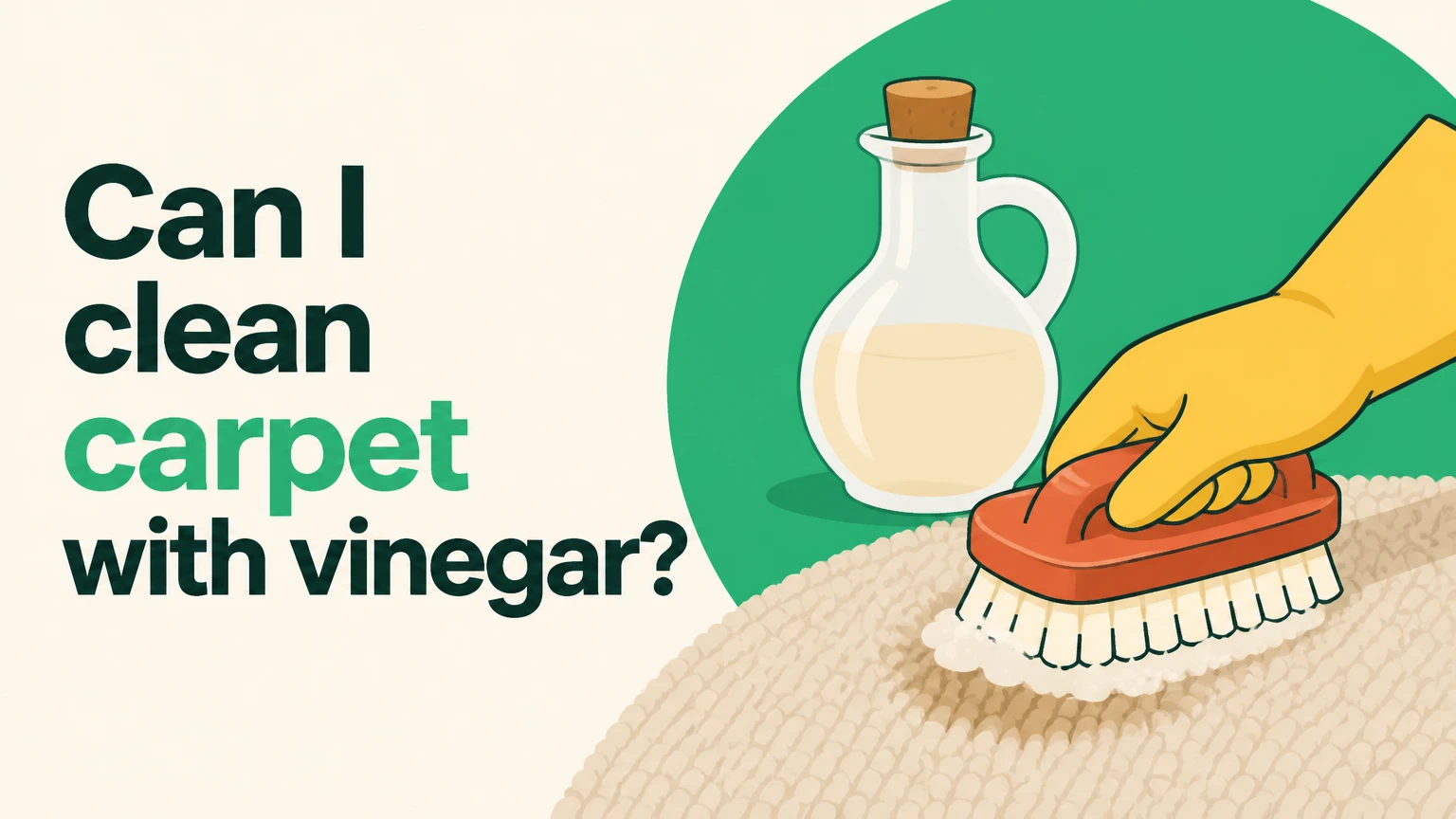
Yes, you can clean some carpets with diluted white distilled vinegar, especially for small, fresh spills, light residue, and mild odors. Vinegar is not a universal carpet cleaner or disinfectant, and it can damage wool, silk, viscose, unstable dyes, carpet backing, or machine components when used incorrectly.
Key facts at a glance
- Use clear white distilled vinegar, not apple cider vinegar, balsamic vinegar, or red wine vinegar.
- For a synthetic-fiber spot, start with 1 part vinegar to 2-3 parts water rather than saturating the carpet with a 1:1 mixture.
- Always test a hidden area for color transfer, fading, texture change, and backing damage before treating the visible stain.
- Never scrub a carpet stain. The Carpet and Rug Institute’s spot-cleaning guidance is simple: “Never rub a spot.”
- Vinegar may reduce some odors, but enzyme cleaners are more appropriate for urine because they target odor-producing organic residues.
- Do not add vinegar to a carpet-cleaning machine unless the machine and chemical manufacturer specifically permit it.
What does vinegar do to carpet?
White distilled vinegar is typically a 5% acetic-acid solution in water. Its acidity can loosen some alkaline or mineral residues and reduce the smell of certain alkaline odors, but vinegar does not dissolve every stain and does not extract soil from the carpet backing.
Vinegar works best as a mild acid rinse or spot-treatment ingredient. It can help with water-soluble residues from beverages, hard-water deposits, and some light food spills. It is less suitable for oily grease, wax, paint, permanent dye, and deeply embedded soil, because those problems require solvents, detergents, enzymes, or mechanical extraction.
The acidic liquid also creates risk. Carpet colorants, wool fibers, cellulose fibers, latex backing, and adhesive layers do not all respond the same way to low-pH solutions. A carpet’s fiber label and manufacturer warranty therefore matter more than the fact that vinegar is inexpensive or commonly used in kitchens.
Vinegar is also not equivalent to a registered disinfectant. The U.S. Environmental Protection Agency registers products for specific antimicrobial claims, contact times, and surfaces. Ordinary household vinegar does not provide that standardized disinfection label.
Which carpets can safely receive vinegar?
Synthetic nylon, polyester, and polypropylene carpets generally tolerate a small amount of diluted white vinegar better than wool, silk, viscose, or jute. Even synthetic carpet can bleed, develop a water ring, or suffer backing damage if the solution remains wet too long.
| Carpet material | Vinegar suitability | Main risk | Safer approach |
|---|---|---|---|
| Nylon | Usually acceptable for small spots | Dye bleeding, overwetting | Test first; use 1:2 or 1:3 vinegar-to-water |
| Polyester | Usually acceptable for light residue | Water rings, oily stain spreading | Blot, use mild detergent for grease |
| Polypropylene | Often tolerant of diluted solutions | Backing moisture, texture change | Use minimal liquid and dry rapidly |
| Wool | Avoid routine vinegar treatment | Fiber damage, dye bleed, felting | Use wool-approved cleaner or specialist |
| Viscose or rayon | Avoid household experimentation | Browning, distortion, permanent water marks | Professional cleaning recommended |
| Silk, jute, sisal | Do not use vinegar without specialist advice | Fiber weakening and dye instability | Follow the rug or carpet manufacturer’s method |
A patch test must include the carpet backing, not only the face fibers. Apply a drop to a hidden edge, press a white cloth over it after five minutes, and inspect the cloth for transferred color. Let the test area dry completely because browning, stiffness, and watermarking may appear only after evaporation.
When should you avoid vinegar completely?
Avoid vinegar when the carpet is wool, silk, viscose, antique, hand-dyed, heavily soiled, structurally loose, or attached to a backing that is already separating. Avoid it on stains with unknown chemical composition, because an acid can spread or set some dyes and can react unpredictably with previous cleaning products.
Do not use vinegar after applying bleach, ammonia, or an unknown commercial chemical. Rinse the area with clean water, remove as much residue as possible, and allow it to dry before choosing another treatment. Mixing acids with chlorine bleach can release hazardous chlorine gas.
What vinegar mixture should you use?
For a small stain on a colorfast synthetic carpet, mix 1 part white distilled vinegar with 2-3 parts cool or lukewarm water. A 1:1 mixture is stronger, but stronger is not automatically safer or more effective; use it only when the carpet manufacturer permits it and a patch test passes.
| Situation | Vinegar | Water | Typical contact time | Maximum area |
|---|---|---|---|---|
| Light deodorizing mist | 1 cup | 3 cups | 5-10 minutes | 10-20 square feet |
| Fresh beverage spot | 1 cup | 2 cups | 3-5 minutes | 1 square foot |
| Dried alkaline residue | 1 cup | 1 cup | 5 minutes | 1 square foot |
| Wool or viscose carpet | 0 cups | 0 cups | 0 minutes | Use approved cleaner |
| Machine tank | Only if approved | Follow label | Follow machine label | Manufacturer-defined |
Use a spray bottle only for a fine mist. Do not pour the mixture directly onto carpet, because liquid can travel through the pile into the jute, latex, foam, or wood subfloor.
How do you clean a carpet stain with vinegar?
A small synthetic-carpet stain usually takes 10-20 minutes to treat, followed by 4-12 hours of drying. The decisive factor is moisture control: remove the spill quickly, use a limited amount of solution, blot repeatedly, and dry the carpet down to its backing.
Before you start
- Time: 10-20 minutes of work, plus drying
- Difficulty: Low for a small surface spot
- Cost: Approximately $0.05-$0.30 of vinegar per spot
- Materials: White distilled vinegar, water, spray bottle, white microfiber cloths, spoon or dull scraper, dry towel, fan
- Prerequisite: Confirm the fiber type and complete a hidden patch test
Step 1: Remove solid material
Lift food, mud, or pet waste with a spoon or dull edge. Work from the outside of the mark toward the center so the contamination does not spread across clean fibers.
You will know this step worked when no loose material remains above the pile. A common mistake is dragging a solid stain sideways, which enlarges the affected area before liquid treatment begins.
Step 2: Blot the liquid spill
Press a dry white towel onto a fresh spill for 10-20 seconds, lift it, and repeat with a clean section. Do not rub, twist, or brush the pile while it is wet.
You will know this step worked when the towel absorbs less liquid after several presses. Colored towels can transfer dye, while vigorous rubbing can abrade the fiber and force the spill deeper.
Step 3: Apply a diluted vinegar solution
For a colorfast synthetic carpet, mist enough 1:2 or 1:3 vinegar solution to dampen the stained fibers without wetting the backing. Apply from the outer edge inward, and keep the treated area close to the original stain.
You will know the solution is controlled when the carpet feels damp at the surface but no liquid reaches the floor underneath. Flooding the spot is the most common cause of wicking and slow drying.
Step 4: Allow limited dwell time
Leave the diluted vinegar on the spot for 3-5 minutes. Do not leave a wet vinegar solution for 15 minutes by default, especially on colored carpet or carpet with an unknown backing.
You will know the dwell period is sufficient when the residue looks softened and transfers more readily to a towel. A long dwell time adds chemical exposure without guaranteeing better stain removal.
Step 5: Blot the loosened residue
Press a clean white microfiber cloth into the area, moving to a dry section after each press. Continue until the cloth shows little or no further transfer.
You will know the stain is lifting when the towel becomes marked while the carpet becomes visibly lighter. Scrubbing at this stage can roughen the pile and create a permanently different sheen.
Step 6: Rinse lightly with water
Mist a small amount of plain water over the treated fibers, then blot again. Rinsing removes loosened vinegar and soil; it also reduces the chance of a visible ring caused by uneven drying.
You will know the rinse is adequate when the carpet no longer smells strongly acidic after blotting. Do not pour water onto the spot, because rinsing must remove residue without creating a second saturation problem.
Step 7: Dry the carpet completely
Place a dry towel over the spot and press it with a flat, stable object for 15-30 minutes. Remove the weight, then run a fan across the area and keep foot traffic away until the pile and backing are dry.
You will know the job is complete when the carpet feels normal, the stain has not returned, and no cool dampness remains at the base of the fibers. Typical drying takes 4-12 hours indoors, depending on humidity, ventilation, pile height, and padding.
Can you put vinegar in a carpet-cleaning machine?
Do not put vinegar in a carpet extractor unless the equipment manufacturer and carpet-care instructions explicitly approve it. Vinegar can affect seals, hoses, metal parts, detergent chemistry, warranty terms, and the machine’s intended extraction performance.
A carpet machine depends on a formulated cleaning solution with controlled foaming, surfactants, rinsability, and compatibility with the pump and recovery system. Household vinegar mainly supplies acidity and water. It does not provide the soil-suspension system needed for greasy, embedded traffic soil.
| Cleaning method | Typical product amount | Typical drying time | Best use | Main limitation |
|---|---|---|---|---|
| Vinegar spot treatment | 30-90 ml per spot | 4-12 hours | Fresh, small residue | Limited soil extraction |
| Manufacturer-approved machine detergent | Label dose, often 30-120 ml per tank | 6-24 hours | Whole-room cleaning | Requires equipment and rinsing |
| Hot-water extraction service | Technician-controlled | 6-24 hours | Embedded soil and large areas | Typical cost $100-$300 per room |
| Low-moisture encapsulation | Product-specific | 1-4 hours | Faster re-entry | May not remove deep contamination |
A manufacturer-approved carpet detergent is the safer choice for full-room cleaning. If a machine manual says to use water only, use water only; if the carpet warranty specifies hot-water extraction or a particular chemistry, follow that requirement.
Does vinegar remove pet urine and carpet odors?
Vinegar may temporarily reduce the smell of a mild, surface-level alkaline odor, but vinegar does not reliably remove pet urine from carpet padding. Urine can penetrate below the pile, and dried uric-acid residues can remain after the surface appears clean.
Use an enzyme-based pet-urine product labeled for carpet when the odor source is urine, vomit, or another biological residue. Enzymatic products are designed to break down specific organic compounds, while vinegar primarily changes pH and may mask odor temporarily.
For a recent accident, blot as much liquid as possible, identify the affected area with ultraviolet light if necessary, and follow the enzyme product’s saturation and dwell instructions. Unlike a small vinegar spot treatment, enzyme treatment may require controlled contact with the contaminated backing, followed by thorough drying.
Professional treatment is appropriate when urine has reached the pad, subfloor, tack strip, or multiple rooms. A lingering odor after two home treatments indicates that the odor source is deeper than the visible carpet fibers.
Is vinegar better than carpet shampoo or enzyme cleaner?
Vinegar is cheaper and simpler for a small, mild residue, but formulated carpet detergent cleans embedded soil more effectively and enzyme cleaner is better for biological odors. No single product is safest for every fiber, stain type, or depth of contamination.
| Problem | Diluted vinegar | Carpet detergent | Enzyme cleaner | Professional extraction |
|---|---|---|---|---|
| Fresh water-based spill | Effective in some cases | Effective | Usually unnecessary | Excessive for one spot |
| Grease or cooking oil | Weak | Usually better | Not designed for oil | Effective with proper pretreatment |
| Pet urine odor | Temporary surface benefit | May leave odor source | Usually best first option | Best for pad or subfloor contamination |
| Whole-room soil | Limited | Better with extraction | Not a general soil cleaner | Strongest deep-clean option |
| Wool carpet | Higher risk | Use wool-approved formula | Product-specific | Safest for valuable rugs |
| Typical small-spot cost | $0.05-$0.30 | $0.25-$2 | $1-$5 | Service minimum often $75-$150 |
Vinegar wins on low cost and ingredient simplicity. Manufacturer-approved detergent wins for ordinary whole-room soil, while enzyme chemistry wins for biological contamination.
Why do vinegar and baking soda create problems?
Vinegar and baking soda react immediately, producing carbon dioxide, water, and sodium acetate. The visible fizz can loosen superficial debris mechanically, but the acid and alkaline ingredients largely neutralize each other instead of delivering their separate cleaning effects.
Sprinkling dry baking soda first can also create powder trapped in dense carpet. Adding vinegar afterward makes a wet paste that is difficult to extract and may leave the carpet stiff or gritty. Baking soda can help absorb a light odor when applied sparingly to a fully dry carpet, followed by thorough vacuuming, but it is not a substitute for urine treatment.
Never combine vinegar with chlorine bleach, ammonia, or commercial cleaners unless the label explicitly states compatibility. Chemical residues can react, create irritating vapors, or produce a new stain.
What are the most common vinegar-cleaning mistakes?
The most damaging mistakes are over-wetting, treating the wrong fiber, rubbing the stain, skipping the rinse, and using vinegar as a disinfectant or urine destroyer. Each mistake changes the risk profile more than the vinegar’s low purchase price changes the cleaning cost.
- Over-saturating the pile: Excess liquid reaches padding and subfloor, increasing drying time and mildew risk. Extract or blot immediately, then use fans.
- Skipping the colorfastness test: Unstable dyes can bleed into surrounding fibers. Stop if a white cloth picks up color.
- Using colored or flavored vinegar: Apple cider, balsamic, and red wine vinegar contain pigments and residues that can stain.
- Rubbing aggressively: Friction distorts pile direction and can spread oily or colored material. Press and lift instead.
- Leaving residue behind: Vinegar smell and dissolved soil remain if the area is never lightly rinsed and dried.
- Treating a recurring stain repeatedly: Recurrence often indicates wicking or contamination in the pad. More surface vinegar does not solve a deep source.
A counterintuitive practitioner rule is that less liquid usually produces a cleaner-looking result. Controlled dampening keeps dissolved soil near the surface, where a towel can remove it, instead of transporting the stain into the backing.
How long does vinegar smell or wet carpet last?
A vinegar smell commonly weakens as the solution evaporates, but the time varies from 1-4 hours for a small, well-ventilated spot to 12-24 hours for a damp room. Carpet that remains wet beyond 24 hours needs immediate drying and inspection.
| Condition | Typical drying range | Recommended action |
|---|---|---|
| Small spot, low-pile nylon, open window | 2-6 hours | Blot and use a fan |
| Medium spot with padding | 6-12 hours | Press with towels and ventilate |
| Humid room above 60% relative humidity | 12-24 hours | Use a dehumidifier and fan |
| Full-room wet cleaning | 6-24 hours | Keep furniture and traffic off carpet |
| Wet carpet after 24 hours | Abnormal | Extract moisture and investigate padding |
Increase air movement across the carpet rather than merely heating the room. A fan, open windows when outdoor humidity permits, and a dehumidifier remove moisture more efficiently than fragrance sprays, which only conceal odor.
What if the carpet stain comes back?
A stain that reappears after drying is usually wicking, meaning dissolved material moved from the backing or padding back into the carpet tips. Vinegar did not necessarily fail chemically; the treatment may have mobilized a deeper deposit without removing enough of it.
Re-blot the area with minimal plain water, place a dry towel over it, and apply weight for 15-30 minutes. Replace the towel when damp, then dry the area with strong airflow. Do not keep adding vinegar to a repeatedly returning mark.
If the stain returns a second time, use an extractor with appropriate cleaning solution or contact a carpet professional. Brown discoloration can also indicate jute or cellulose backing browning, which requires a different treatment from ordinary surface staining.
How much does vinegar carpet cleaning cost?
A typical vinegar spot treatment costs about $0.05-$0.30 in materials, while a gallon of white distilled vinegar commonly costs approximately $3-$8 in U.S. retail stores. Whole-room cleaning usually costs more because equipment, approved detergent, labor, extraction, and drying control matter more than the liquid ingredient.
| Service or approach | Typical material or service cost | Labor time | Typical result |
|---|---|---|---|
| One vinegar spot | $0.05-$0.30 | 10-20 minutes | Surface residue reduction |
| DIY approved detergent spotter | $0.25-$2 | 10-25 minutes | Better targeted soil removal |
| Rental extractor | $30-$60 per day | 2-5 hours | Whole-room cleaning |
| Professional single room | $75-$150 minimum | 1-2 hours on site | Deeper extraction |
| Professional multi-room visit | $150-$300 typical | 2-4 hours on site | Broader soil and odor treatment |
These are typical U.S. consumer ranges, not fixed prices. Wool rugs, urine contamination, furniture moving, stairs, and severe staining can raise professional costs substantially.
When should you hire a carpet professional?
Hire a professional for wool, silk, viscose, antique, hand-dyed, heavily contaminated, or repeatedly wet carpet. Professional help is also appropriate when urine reaches padding, when a stain covers more than a few square feet, or when the carpet warranty requires approved extraction.
Ask the technician which method will be used, what chemistry is approved for the fiber, how moisture will be removed, and whether the company guarantees odor treatment or only surface cleaning. A credible provider should inspect the fiber and backing before applying solution.
Home vinegar treatment is reasonable for a small, recent spot on colorfast synthetic carpet when the owner accepts the limitations. It is not a substitute for fiber identification, extraction, or professional restoration.
FAQ
Can vinegar remove coffee stains from carpet?
Diluted white vinegar may help after fresh coffee has been blotted, especially when milk, sugar, or alkaline residue remains. Vinegar will not reliably remove coffee pigment from every carpet, and coffee with cream can leave oily protein residue that responds better to a carpet detergent. Patch-test first and rinse lightly.
Is vinegar safe for pets after carpet cleaning?
A small amount of diluted vinegar is generally less concerning than many fragranced products, but pets should stay off damp carpet until it is fully dry. Vinegar is not a pet-urine disinfectant or odor cure, and animals can ingest residue by licking fibers. Use ventilation and an appropriate enzyme cleaner for urine.
Can vinegar remove old carpet stains?
Vinegar can loosen some old water-soluble residues, but old stains may be chemically altered, oxidized, or embedded in the backing. Test a hidden area, use minimal solution, and stop if color transfers. Permanent dye, paint, rust, and set grease usually require specialized chemistry or professional treatment.
How often can I spray vinegar on carpet?
Do not use vinegar as a routine whole-carpet spray. Repeated misting adds moisture and acid without removing embedded soil, increasing the chance of odor, rings, or backing damage. Vacuum regularly and clean isolated spots only when needed, using the weakest effective solution.
Does vinegar disinfect carpet after a pet accident?
Ordinary household vinegar should not be treated as a registered carpet disinfectant. Vinegar may reduce some surface odors, but it does not guarantee pathogen reduction at a validated concentration and contact time. Blot contamination, use a labeled carpet-safe disinfectant when appropriate, and follow the product’s instructions.
What can I use instead of vinegar on carpet?
Use a manufacturer-approved carpet spotter for ordinary soil, an enzyme cleaner for pet urine, and a wool-approved product for wool fibers. Plain water is often the safest first response to a fresh spill while you identify the fiber and choose compatible chemistry.
The bottom line
You can clean carpet with vinegar when the carpet is a colorfast synthetic fiber and the problem is a small, surface-level spill or mild residue. Use diluted white distilled vinegar sparingly, patch-test first, blot instead of rubbing, rinse lightly, and dry completely. Do not use vinegar as a universal disinfectant, routine whole-room machine detergent, or reliable treatment for deep pet urine. Choose a carpet-approved detergent, enzyme cleaner, or professional service when the stain, odor, fiber, or backing exceeds vinegar’s narrow strengths.