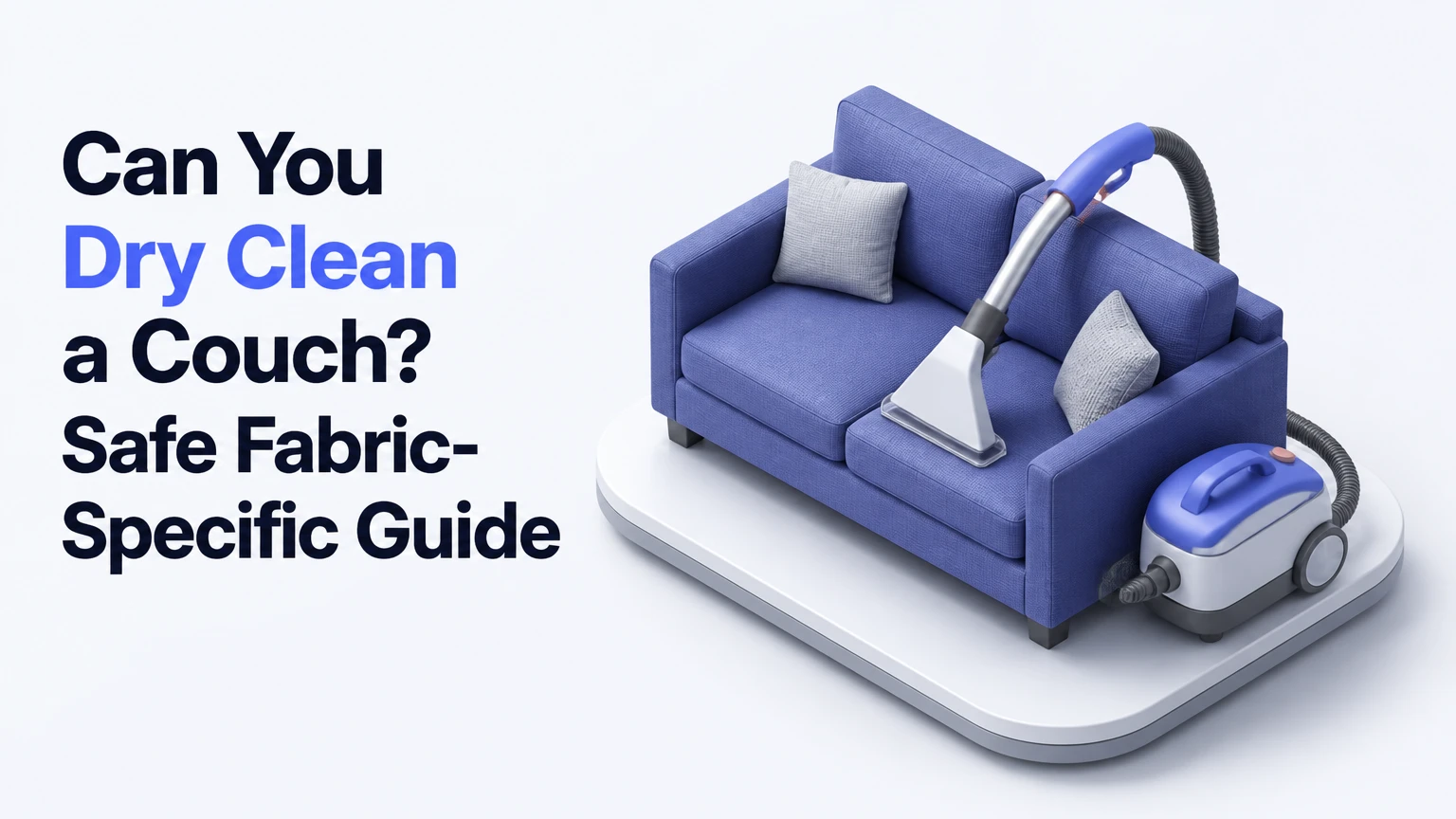
Yes, you can dry clean a couch when its upholstery care label permits solvent cleaning, usually marked S, or when a qualified upholstery technician confirms the fabric can tolerate a low-moisture process. Couch dry cleaning uses solvent, foam, or another controlled cleaning medium rather than saturating the upholstery with water. The safest method depends on the fabric code, dye stability, backing, cushion filling, and stain type.
Key Facts at a Glance
- A couch marked S requires a solvent-based upholstery cleaner, while W permits water-based cleaning and WS permits either method.
- A couch marked X should only be vacuumed or lightly brushed unless the manufacturer gives additional instructions.
- “Dry” upholstery cleaning is not moisture-free: solvent or foam still wets the fabric and must evaporate or be extracted.
- Typical professional couch cleaning costs $150-$400 and takes 1-2.5 hours, before drying and ventilation.
- Solvent cleaning handles oily soils well, but water-based extraction is often better for mud, sugar, sweat, and many protein residues.
- Never put an entire couch into a household or commercial garment dry-cleaning machine.
Can You Dry Clean a Couch?
A couch can be professionally dry cleaned if the upholstery, backing, trim, and cushion construction are compatible with a solvent or low-moisture system. The care label is the first decision point, but a code alone does not guarantee a perfect result because unstable dyes, degraded foam, glued decorations, and previous water damage can still react badly.
Upholstery dry cleaning is a field service, not usually a laundry service. A technician applies a suitable solvent or controlled foam to the installed fabric, loosens soil, and removes or evaporates the cleaning medium with specialized equipment. Removable covers may be accepted by a textile dry cleaner, but the manufacturer’s instructions must permit that treatment and the covers must be cleaned separately from the sofa frame.
The term “dry cleaning” can mislead consumers. The fabric is not necessarily dry during treatment. Volatile solvent systems minimize water exposure, while dry foam systems use a small amount of water and detergent. Drying speed depends on airflow, humidity, fabric thickness, and how much product the technician applies.
Why Does Solvent Upholstery Cleaning Work?
Solvent upholstery cleaning works because non-water-based fluids dissolve or suspend oily soil that ordinary water cannot remove efficiently. Sebum, cooking grease, body oils, wax, and some adhesive residues are often loosened by a solvent, then transferred into absorbent towels, a recovery system, or a controlled extraction tool.
Water and solvent behave differently at the fiber level. Water can swell some natural fibers, activate dyes, soften adhesives, and penetrate cushion interiors. A compatible solvent reduces those specific risks, although it introduces other concerns such as odor, flammability, residue, and dye bleeding from solvent-sensitive materials.
Professional technicians normally combine several actions rather than relying on the solvent alone:
- Dry soil removal with an upholstery vacuum.
- Controlled spot testing in a hidden area.
- Targeted pre-treatment for grease or embedded soil.
- Light application of the selected cleaning medium.
- Soil removal through absorption, vacuuming, or extraction.
- Grooming of velvet, chenille, microfiber, or other fabrics with a directional pile.
- Air movement until the upholstery is safe to use.
A solvent is not a disinfectant by default. If a household needs pathogen reduction after illness, flooding, or animal contamination, the technician must identify a compatible antimicrobial treatment and explain its limitations. Cleaning removes soil; it does not automatically sterilize the cushion.
Which Couch Fabrics Can Be Dry Cleaned?
The manufacturer’s cleaning code, rather than the fiber name alone, determines whether a couch may receive solvent treatment. Silk, velvet, wool, rayon, and viscose can be visually delicate, but some versions tolerate only specialized professional treatment, while others should not be wet or solvent cleaned at all.
| Upholstery code or material | Permitted approach | Main risk | Practical recommendation |
|---|---|---|---|
| S code, synthetic blend | Solvent-based upholstery cleaning | Residue or dye transfer | Use a trained technician after a hidden test |
| W code, polyester | Water-based low-moisture or extraction cleaning | Over-wetting and water rings | Use measured water and rapid air movement |
| WS code, nylon blend | Solvent or water-based cleaning | Method-specific color change | Choose based on stain chemistry and testing |
| X code, unknown blend | Vacuuming and brushing only | Permanent damage from liquid | Request manufacturer guidance before cleaning |
| Viscose or rayon | Specialist assessment | Browning, distortion, texture change | Avoid DIY products and aggressive agitation |
| Silk or wool | Specialist solvent or textile process | Dye bleed, shrinkage, fiber damage | Use a fabric specialist, not a general spray |
| Cotton or linen | Tested water or solvent method | Shrinkage, browning, bleeding | Follow the label and control moisture carefully |
| Mohair, velvet, chenille | Fabric-specific professional process | Crushed pile, shading, stiff nap | Test, groom, and dry with directional airflow |
What Do W, S, WS, and X Mean?
A W code means the manufacturer permits a water-based upholstery cleaning agent. An S code means a solvent-based product is specified. An WS or SW code permits either category after testing. An X code generally limits care to vacuuming or brushing.
Care labels are not interchangeable with fiber labels. “Polyester” describes a fiber, but “W” or “S” describes the tested cleaning approach for that particular fabric and backing. Two polyester couches can therefore require different treatment.
If the label is missing, photograph the sofa, search the manufacturer’s model documentation, and ask the brand for the cleaning code. Until confirmed, use only a dry upholstery vacuum with a soft brush attachment. Do not infer “S” from a couch that looks luxurious, or “W” from a couch that feels synthetic.
What Happens During Professional Upholstery Cleaning?
Professional upholstery cleaning usually takes 1-2.5 hours for a standard three-seat couch, although sectional size, access, cushion count, and stain treatment can extend the visit. The technician should inspect the entire construction before applying any product.
Step 1: Inspect the Label and Construction
The technician identifies the care code, fiber type, backing, seam condition, cushion filling, skirt, trim, and previous damage. Loose seams, brittle latex, powdering foam, and delamination are reasons to modify or refuse the service.
Success checkpoint: The technician can explain the permitted method and likely risks before treatment begins.
Common mistake: Treating the visible face fabric while ignoring a solvent-sensitive backing or glued trim.
Step 2: Vacuum Loose Soil
A professional vacuum removes crumbs, grit, pet hair, and dust from the surface, seams, crevices, and under cushions. Abrasive grit left in the fabric can act like sandpaper during agitation.
Success checkpoint: Seams and crevices are visibly free of loose debris.
Common mistake: Skipping vacuuming because the couch appears clean.
Step 3: Test for Colorfastness and Texture Change
The technician tests the selected product on an inconspicuous section, such as behind a cushion or beneath the frame. The test checks dye transfer, ring formation, texture distortion, adhesive reaction, and drying behavior.
Success checkpoint: A white towel picks up no unacceptable dye, and the test area dries without a halo or altered nap.
Common mistake: Testing only for color while overlooking stiffness or pile flattening.
Step 4: Pre-Treat Compatible Stains
Grease, ink, pet contamination, and old water marks require different chemistry. Pre-treatment should remain localized because broad application can create a larger ring or drive soil deeper into the cushion.
Success checkpoint: The stain lightens without spreading beyond the original boundary.
Common mistake: Scrubbing viscose, silk, or velvet hard enough to create permanent texture change.
Step 5: Apply Solvent, Foam, or Carbonated Product
The technician applies the smallest effective quantity with a sprayer, sponge, hand tool, or specialized machine. Dry foam contains substantially less free water than conventional wet extraction, while carbonated systems use dissolved carbon dioxide to help lift soil toward the surface.
Success checkpoint: The surface becomes evenly treated without soaking the cushion interior.
Common mistake: Applying more product to compensate for weak vacuuming or unsuitable stain chemistry.
Step 6: Remove Soil and Cleaning Residue
Solvent systems may rely on absorbent towels, controlled recovery, or evaporation. Foam systems require thorough vacuum removal because dried detergent residue can attract soil and leave a stiff hand.
Success checkpoint: The fabric feels clean rather than sticky, and no visible residue remains along seams.
Common mistake: Assuming evaporation alone removes dissolved soil. Evaporated solvent can leave the soil behind if the technician does not transfer or recover it.
Step 7: Groom and Dry the Upholstery
A soft brush restores the direction of velvet, chenille, and microfiber pile. Fans and open windows accelerate evaporation when ventilation is safe and outdoor humidity is lower than indoor humidity.
Success checkpoint: The fabric has an even nap, no dark moisture boundary, and no strong odor after the stated ventilation period.
Common mistake: Sitting on cushions while the interior remains damp or solvent odor remains intense.
How Much Does Professional Couch Cleaning Cost?
Professional couch cleaning typically costs $150-$400 in the United States for a standard sofa, with many providers quoting approximately $30-$60 per linear foot. A small loveseat may cost less, while a large sectional, luxury textile, or severe contamination can exceed the typical range.
| Furniture type | Typical price range | Typical service time | Main price driver |
|---|---|---|---|
| Armchair or recliner | $60-$150 | 30-60 minutes | Fabric testing and mechanism access |
| Two-seat loveseat | $100-$250 | 45-90 minutes | Cushion count and stain treatment |
| Three-seat sofa | $150-$400 | 1-2.5 hours | Linear footage and upholstery code |
| Five-seat sectional | $250-$650 | 2-4 hours | Multiple sections and travel access |
| Viscose or silk sofa | $250-$700 | 2-4 hours | Specialist handling and testing |
| Pet-urine treatment | $200-$600 | 2-4 hours | Odor source and cushion penetration |
| Removable cover cleaning | $80-$300 | 1-3 days | Textile cleaner, transport, and reinstallation |
Prices vary by region, minimum call-out fees, parking, stairs, fabric risk, and whether cushions are included. Ask whether the quote covers the frame, both sides of loose cushions, skirts, stain treatment, deodorizing, and a return visit.
A low quote can indicate water extraction rather than solvent cleaning, a minimum-service price, or treatment of only the visibly dirty panels. Confirm the method and the cleaning code in writing.
How Long Does a Couch Take to Dry?
A professionally solvent-cleaned couch commonly needs 1-4 hours before normal use, while a water-extracted couch often needs 6-24 hours, depending on humidity, airflow, fabric thickness, and cushion density. Dry foam can fall between these ranges because its water content and recovery method vary by product.
Do not rely only on surface feel. A cushion can feel dry on top while retaining moisture near the zipper, welt cord, or foam. Press a clean, dry white towel firmly against several areas, including seams and cushion undersides. Moisture, odor, or a cool heavy feel indicates that more drying time is needed.
Use fans to move air across, rather than directly into, the upholstery. Avoid high heat from hair dryers because it can set stains, distort synthetic fibers, or damage adhesives. Keep children and pets away until the technician confirms the solvent has evaporated and the room has adequate ventilation.
How Does Solvent Cleaning Compare With Water Extraction?
Solvent cleaning is usually the safer first choice for an S-coded or highly moisture-sensitive couch, while water extraction is often more effective for a W-coded couch with water-soluble soil, mud, or heavy embedded contamination. Neither method is universally superior.
| Decision factor | Solvent upholstery cleaning | Dry foam cleaning | Water extraction | Carbonated low-moisture cleaning |
|---|---|---|---|---|
| Suitable code | S, selected WS | S or selected WS | W, selected WS | Manufacturer-approved W or WS |
| Typical moisture exposure | Low to moderate solvent | Low, often 3%-5% water in foam | Moderate to high water | Low to moderate |
| Typical drying time | 1-4 hours | 2-6 hours | 6-24 hours | 2-8 hours |
| Strongest soil type | Grease and body oil | Light surface soil | Mud, sugar, sweat, residue | Embedded particulate soil |
| Main risk | Odor, residue, dye reaction | Detergent residue | Wicking, shrinkage, over-wetting | Inconsistent results if poorly extracted |
| DIY suitability | Low | Moderate only with label approval | Moderate with equipment | Low without professional equipment |
| Best setting | Delicate S-coded furniture | Lightly soiled moisture-sensitive fabric | Durable W-coded household sofa | Low-moisture professional service |
Water extraction is not automatically “steam cleaning.” Many upholstery machines spray heated water and detergent, then recover the mixture with vacuum pressure. Heat may improve soil removal, but excessive temperature or moisture can damage vulnerable upholstery.
Dry cleaning is also not automatically safer. Solvent-sensitive dyes, deteriorated backings, and inadequate ventilation can make a solvent process the wrong choice. The correct decision starts with the label and test results, then considers the stain.
Which Stains Can Dry Cleaning Remove?
Solvent cleaning is strongest against oil-based stains, but no upholstery method guarantees removal of every mark. Stain age, heat exposure, dye damage, cushion penetration, and previous cleaning attempts often matter more than the visible stain category.
| Stain or contaminant | Usually favored method | Dry-cleaning outlook | Important limitation |
|---|---|---|---|
| Body oil or cooking grease | Solvent cleaning | Often favorable | Old oxidation may leave a shadow |
| Candle wax | Solvent and mechanical removal | Often favorable | Heat can spread wax into backing |
| Ink | Solvent spot treatment | Variable | Some inks permanently dye fibers |
| Pet urine | Enzyme or specialized decontamination | Limited alone | Odor can remain inside foam |
| Milk or food protein | Label-approved water or enzyme process | Variable | Heat can set protein residue |
| Mud or clay | Vacuum, rinse, or water extraction | Moderate | Dry soil should be removed first |
| Red wine or juice | Water-compatible spot process | Variable | Natural dyes can permanently stain |
| Water rings | Controlled reprocessing | Often difficult | Ring may reflect backing or prior damage |
| Smoke odor | Multi-stage deodorization | Limited alone | Porous foam may hold odor |
Pet urine deserves special caution. A surface solvent treatment may improve appearance while leaving uric salts in the foam. If odor returns when humidity rises, the contamination likely extends below the upholstery, and cushion-core treatment or replacement may be necessary.
Do not apply hairspray, rubbing alcohol, vinegar, bleach, or an internet stain recipe before professional cleaning. Unapproved products can alter dye chemistry and make a technician’s test results unreliable.
Is DIY Couch Dry Cleaning Safe?
DIY couch dry cleaning is reasonable only for a small, fresh spot on a clearly labeled compatible fabric, using a product specifically designed for upholstery and following its label. Full-couch solvent application is not a safe beginner project because ventilation, flammability, extraction, dye stability, and cushion penetration are difficult to control.
Before any spot treatment:
- Photograph the stain and care label.
- Vacuum loose grit without rubbing the spot.
- Test the product behind a cushion for color and texture change.
- Use a white cloth, not a colored towel.
- Apply product to the cloth or in a very small area.
- Blot from the outside toward the center.
- Stop if dye transfers, the fabric rings, or the nap changes.
- Ventilate the room and keep ignition sources away from solvent products.
Never mix upholstery chemicals. Never use a garment dry-cleaning kit on an entire sofa. Aerosol products can create overspray, concentrated fumes, and residue that spreads beyond the original mark.
Professional cleaning is the better choice for viscose, silk, antique upholstery, large oil stains, urine, unknown fabric, or furniture with a high replacement cost. The cost of a technician is usually lower than reupholstery after a failed experiment.
What Problems Can Occur After Couch Cleaning?
The most serious couch-cleaning failures result from an incorrect care code, excessive moisture, aggressive agitation, or incomplete soil and product recovery. Some defects can be corrected, but dye loss, shrinkage, fiber distortion, and permanent stains may be irreversible.
Water Rings and Browning
Water rings occur when moisture moves soil or dissolved dyes toward a drying boundary. Browning can develop when cellulose-based fibers remain wet or alkaline residues migrate from the backing.
A technician may reduce the appearance by treating an entire panel evenly rather than repeatedly spot-cleaning one circle. The original ring may remain if the fabric or backing has chemically changed.
Wicking and Returning Stains
Wicking occurs when dissolved soil from the cushion interior travels toward the surface during drying. A stain that returns after several hours is not proof that the technician ignored it.
The correct response is controlled extraction or specialist re-treatment, not repeated household spraying. Repeatedly wetting the same area can enlarge the boundary and drive contamination deeper.
Stiff or Sticky Fabric
Stiffness commonly indicates dried detergent, foam residue, solvent incompatibility, or disturbed pile. Sticky fabric attracts dust quickly and may look dirty again within days.
A soft upholstery brush can restore a crushed pile, but brushing will not remove chemical residue. Ask the cleaner to inspect and recover the affected area instead.
Lingering Chemical Odor
A mild odor during the first few hours can occur while a volatile product evaporates. A strong odor that persists beyond the provider’s stated ventilation period requires fresh air, removal of people and pets from the room, and a call to the service provider.
Do not mask solvent odor with fragrance sprays. Fragrance adds another airborne chemical and can make it harder to identify the original problem.
Delamination or Loose Backing
Delamination occurs when the fabric separates from its backing or adhesive. Heat, moisture, age, and incompatible solvents can accelerate the failure.
If the upholstery bubbles, ripples, or develops loose areas, stop using heat and aggressive brushing. Document the condition immediately because repair may require an upholsterer rather than another cleaning appointment.
When Should You Avoid Dry Cleaning a Couch?
Avoid solvent or wet cleaning when the manufacturer prohibits liquid treatment, the fabric fails a colorfastness test, the upholstery is shedding fibers, or the cushion contains severe biological contamination that requires removal rather than surface cleaning. Cleaning cannot reverse fiber loss, sun damage, dye transfer, or degraded foam.
Ask for an assessment before cleaning if:
- The couch has no label and no manufacturer documentation.
- The upholstery is viscose, antique silk, mohair, or hand-dyed.
- The fabric has large faded areas or exposed backing.
- Foam crumbles when squeezed.
- The couch smells musty before cleaning.
- Water or solvent causes a dark ring in the hidden test.
- The stain came from bleach, dye transfer, rust, or permanent marker.
- The frame has water damage or visible mold.
Visible mold and persistent musty odor require source control and assessment of the interior materials. Surface cleaning alone can improve appearance without resolving the moisture problem.
How Should You Choose a Couch Cleaning Professional?
Choose a professional who identifies the care code, performs a documented hidden test, explains the chosen chemistry, and states the expected drying and ventilation time before starting. A reputable technician should also distinguish cleaning from deodorizing, sanitizing, stain removal, and cushion decontamination.
Ask these questions before booking:
- Do you clean S-coded upholstery with a solvent or use a water-based substitute?
- Will you test the fabric and backing before treating the whole couch?
- Does the quote include loose cushions, skirts, and both sides of cushions?
- How do you recover solvent or foam residue?
- What happens if pet urine reaches the cushion foam?
- What ventilation precautions apply to the product you use?
- Do you carry insurance and upholstery-specific training?
- What damage or stain-removal limitations will you record?
A company that promises every stain will disappear is making an unreliable claim. Experienced cleaners separate soil removal from permanent color loss and explain the difference before taking payment.
Couch Cleaning Methods by Situation
| Situation | Preferred starting method | Why it fits | When to change course |
|---|---|---|---|
| S-coded velvet with body oil | Professional solvent test | Limits water exposure and protects pile | Refuse if dye or backing reacts |
| W-coded polyester with muddy paw prints | Low-moisture water extraction | Water-based soil is easier to rinse | Use less moisture if backing is weak |
| WS couch with greasy food mark | Solvent spot treatment | Dissolves oily residue efficiently | Use water rinse only if label allows |
| Pet urine in removable cushion | Specialist extraction and enzyme treatment | Addresses soluble salts and odor source | Replace foam if odor persists |
| Rental couch with light dust | Vacuum and approved dry foam | Low cost and limited moisture | Hire a professional for rings or stains |
| Antique silk sofa | Textile conservator assessment | Protects fragile fibers and dyes | Do not use consumer sprays |
| X-coded microfiber couch | Vacuum only until confirmed | Avoids unauthorized liquid treatment | Obtain manufacturer instructions |
The Bottom Line
Can you dry clean a couch? Yes, but only when the upholstery care code, fabric construction, dye stability, and stain chemistry support the method. An S-coded couch may benefit from professional solvent cleaning, while a W-coded couch usually belongs with a controlled water-based process. Check the label, test an unseen area, avoid DIY full-couch solvent use, and choose a technician who explains both the cleaning method and its limits.
Frequently Asked Questions
Can I dry clean removable couch cushion covers?
Removable cushion covers can sometimes be professionally dry cleaned, but the care label must authorize the process. Shrinkage can prevent the cover from fitting over the original foam even when the fabric looks clean. Remove zippers, trims, and inserts only as the manufacturer permits, and never assume a removable cover is machine-safe.
Is dry cleaning safe for microfiber couches?
Microfiber couches may be safe for solvent or water-based cleaning, depending on the label and fiber blend. Many microfiber fabrics carry W, S, or WS codes, so texture and code matter more than the word “microfiber.” Test for water rings, shading, and nap change before treating a visible panel.
Can dry cleaning remove cigarette smoke from a sofa?
Dry cleaning can reduce smoke residue on the upholstery surface, but it may not remove odor from foam, batting, wood, or nearby curtains. Smoke odor often requires vacuuming, upholstery cleaning, ventilation, and targeted deodorization. Replacement of contaminated cushion interiors may be necessary when odor returns in warm or humid conditions.
How often should a couch be professionally cleaned?
A typical household may schedule professional upholstery cleaning every 12-24 months, with earlier service for pets, allergies, children, smoking, or heavy daily use. Vacuuming weekly and treating spills immediately reduces soil buildup. Luxury or fragile fabrics may need inspection rather than automatic annual solvent cleaning.
Should I dry clean a couch with a musty smell?
Do not begin with dry cleaning when a couch has a musty smell. Inspect for damp foam, leaks, mold, or high humidity first because surface treatment will not correct an active moisture source. After the source is resolved, a professional can determine whether cleaning, deodorization, cushion replacement, or upholstery repair is appropriate.