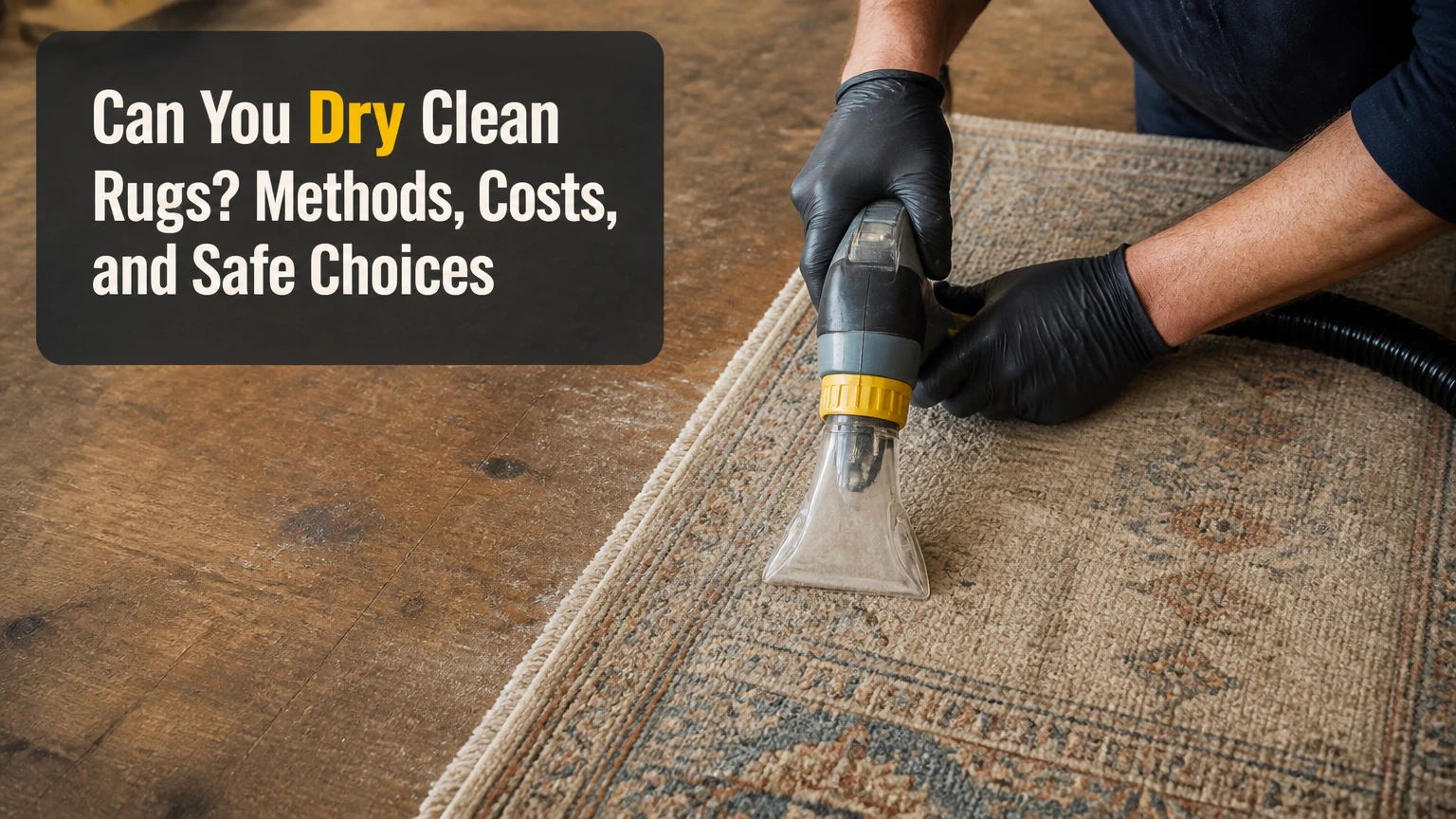
Yes, you can dry clean many rugs, but rug dry cleaning usually means low-moisture compound or encapsulation cleaning, not the same solvent process used for clothing. The safest method depends on the rug’s fiber, dyes, backing, construction, soil type, and condition. Antique, silk, jute, and urine-contaminated rugs need professional inspection before cleaning.
Key Facts at a Glance
- Rug dry cleaning uses little or no free water, but it is not risk-free.
- Dry compound and encapsulation methods usually suit surface soil and routine maintenance better than saturated contamination.
- A typical professional rug-cleaning price is about $2-$6 per square foot, with an 8-by-10-foot rug often costing $160-$480 before special treatments or minimum charges.
- Dry cleaning can reduce drying time to roughly 0-2 hours on site, while off-site inspection, cleaning, and delivery commonly take 3-7 business days.
- Pet urine salts, flood residue, and heavy grit often require controlled wet treatment or subsurface extraction rather than dry cleaning alone.
- Jute, sisal, seagrass, silk, antique wool, and rugs with unstable dyes should not be treated with an untested household product.
Can You Dry Clean Rugs Safely?
Professional rug dry cleaning is safe for many colorfast synthetic, wool-blend, and low-pile rugs when the cleaner selects a compatible method and removes the compound thoroughly. Low moisture lowers the chance of shrinkage, dye migration, and prolonged dampness, but it does not create a zero-risk process.
Rug cleaners use “dry cleaning” to describe several different techniques. A damp absorbent powder physically collects soil, an encapsulation solution crystallizes around particles as it dries, and a true solvent process dissolves selected oily soils without water. Those methods have different chemical, mechanical, and fiber effects.
The phrase “dry clean only” also creates confusion. A clothing dry cleaner may not have the dusting equipment, rug-washing area, dye-testing process, or drying controls required for an area rug. Ask whether the business specializes in rugs, rather than assuming a garment dry cleaner is qualified to handle them.
What Does Rug Dry Cleaning Actually Mean?
Rug dry cleaning means a controlled cleaning process that minimizes free water and relies on absorbent compounds, low-moisture chemistry, mechanical agitation, or specialized solvents. The process is designed to loosen and capture soil while limiting the wetting that can distort some fibers and backings.
Dry cleaning does not mean that a rug remains untouched by liquid. Many “dry” systems contain a small amount of moisture, and encapsulation products are applied as liquid sprays before drying into brittle crystals. The meaningful distinction is the amount of water left in the rug and the way soil is removed.
The Institute of Inspection Cleaning and Restoration Certification, or IICRC, treats cleaning method selection as dependent on textile construction, fiber, dyes, and soiling conditions. That principle matters because a low-moisture method that works on polypropylene may leave a urine-contaminated wool rug inadequately treated.
How Does Rug Dry Cleaning Work?
Rug dry cleaning works through chemical attraction, agitation, absorption, and vacuum recovery. Technicians first remove loose particulate soil, then apply a compatible cleaning medium, work it through the pile, allow the chemistry to act, and extract the medium with specialized equipment.
The Professional Cleaning Sequence
- Inspect the rug and identify its construction. The technician records fiber type, pile height, backing, fringe condition, stains, wear, odor, and previous repairs.
- Test for dye stability. A hidden area is checked for color transfer, bleeding, texture change, and chemical reaction before broad application.
- Pre-dust the rug. Mechanical dusting or controlled compressed air removes sand, grit, hair, and other dry particles from the pile and foundation.
- Treat localized spots. Grease, food, ink, protein stains, and pet contamination require different spotting chemistry.
- Apply the selected medium. Powder, encapsulation solution, absorbent pad, or solvent is distributed according to the rug’s tolerance.
- Agitate carefully. Counter-rotating brushes, cylindrical brushes, hand tools, or absorbent pads loosen soil without excessive fiber stress.
- Allow controlled dwell time. Many products require approximately 15-30 minutes, although the manufacturer’s label controls the actual time.
- Recover the soil and cleaning medium. Slow, overlapping vacuum passes remove powder, crystals, and loosened particles.
- Groom and dry the rug. The pile is aligned, fringe is separated, and air movement reduces residual moisture.
- Inspect the finished result. The cleaner checks for residue, color change, wick-back, odor, and remaining stains before delivery.
Why Is Pre-Dusting So Important?
Pre-dusting removes abrasive dry soil before cleaning chemistry and agitation reach the fibers. Sand and grit can sit below the visible pile, where they cut against yarns during foot traffic; adding water or liquid solution before removing that material can turn loose soil into a difficult slurry.
A professional rug plant may use a dedicated dusting machine that vibrates or beats the rug while collecting particulate matter. Home vacuuming removes surface debris, but it rarely reaches the foundation with the same control. For valuable rugs, skipping dust removal is a process failure, not a minor shortcut.
Which Rug Dry-Cleaning Method Is Used?
The correct method depends on the rug’s fiber, dye stability, construction, and soil. Dry powder is generally the least wet option, encapsulation is efficient for compatible synthetic and wool-blend rugs, and solvent treatment is specialized rather than a universal solution.
| Method | Typical moisture or medium | Suitable applications | Main limitation |
|---|---|---|---|
| Absorbent compound | Approximately 5%-10% dampness in the compound | Routine soil, low-moisture maintenance, some delicate natural fibers | Limited removal of urine salts and deep liquid contamination |
| Encapsulation or VLM | Light liquid application, often under 1 gallon per 1,000 square feet for carpet systems, adjusted for rugs | Polypropylene, nylon, polyester, low-pile wool blends | Can leave soil below the pile if pre-dusting and vacuuming are inadequate |
| Solvent treatment | Waterless or near-waterless specialty solvent | Selected oily stains, fragile textiles under specialist control | Solvent compatibility, ventilation, residue, and dye risks |
| Hot-water extraction | Substantial water followed by vacuum recovery | Heavy soil, some urine contamination, washable synthetic rugs | Shrinkage, dye migration, backing damage, and longer drying |
| Controlled immersion wash | Full washing and controlled drying | Many washable wool and Oriental rugs handled by specialists | Requires appropriate facility, dye control, and drying equipment |
Dry Powder or Absorbent Compound
Absorbent compound cleaning uses porous particles, often cellulose-based materials such as wood or corn-cob derivatives, combined with detergents and limited moisture. The compound is brushed into the pile, allowed to collect soil, then removed with repeated vacuum passes.
This approach can work well for maintenance soil, delicate construction, and settings where rapid re-entry matters. The result depends heavily on dust removal and recovery. If powder remains at the base, the rug may feel gritty, stiff, or sticky and may resoil quickly.
Encapsulation and Very Low Moisture Cleaning
Encapsulation cleaning applies a low-moisture polymer solution that surrounds soil particles and forms removable crystals as the solution dries. A cylindrical brush, counter-rotating brush, or absorbent pad distributes the chemistry and loosens soil.
Encapsulation is often practical for synthetic area rugs with stable dyes and moderate surface soil. It is less suitable when contamination has penetrated through the pile into the backing, because surface crystallization cannot flush or neutralize every contaminant below the face yarns.
True Solvent Cleaning
True solvent cleaning uses a volatile or low-water chemical solvent to dissolve particular oily soils. It is not an automatic recommendation for silk or antique rugs, because solvent sensitivity, dye behavior, backing adhesives, ventilation, and residue still require evaluation.
A specialist may use solvent spotting as one part of a broader treatment rather than immersing the entire rug in solvent. Never infer that “solvent” means gentler than water. Some natural fibers tolerate controlled washing better than an unsuitable solvent.
Which Cleaning Method Fits Each Rug Material?
Material-specific selection matters more than the word “dry.” A washable synthetic rug usually offers more cleaning flexibility, while jute, silk, antique wool, and unstable dyes demand testing and specialist handling.
| Rug material or construction | Common safe starting point | Avoid or question | Typical reason |
|---|---|---|---|
| Polypropylene | VLM, encapsulation, or controlled wet extraction | Unnecessary solvent use | Synthetic fibers resist water-related shrinkage better than many natural fibers |
| Nylon or polyester | VLM, compound, or hot-water extraction after testing | High heat or aggressive agitation | Heat and mechanical stress can alter texture or set stains |
| Wool | Specialist compound, low-moisture treatment, or controlled wash | High alkalinity and excessive heat | Wool can felt, distort, bleed, or retain moisture |
| Silk | Hand treatment after dye and structural inspection | Rotary brushing and untested household products | Fine filaments and dyes can abrade, fuzz, or bleed |
| Jute, sisal, seagrass | Dry compound or specialist low-moisture treatment | Saturation and slow drying | Plant fibers can brown, shrink, ripple, or develop odor |
| Antique or hand-knotted wool | Specialist rug plant assessment | Generic carpet-company steam cleaning | Foundation, dyes, repairs, and age change the risk profile |
| Latex-backed rug | Manufacturer-approved low-moisture process | Solvents, heat, and prolonged moisture | Latex can soften, break down, or transfer to flooring |
| Cotton flatweave | Label-approved wash or low-moisture method | High agitation without testing | Cotton can shrink, bleed, or lose shape |
Is Dry Cleaning Safe for Wool Rugs?
Dry cleaning can be safe for a colorfast wool rug when the cleaner controls moisture, pH, heat, and agitation. Wool is not automatically a dry-clean-only fiber, and many wool rugs are professionally washed with water under controlled conditions.
Wool fibers can felt when exposed to friction, heat, moisture, and alkaline chemistry in the wrong combination. The WoolSafe Organisation recommends products tested for wool and other sensitive fibers; asking whether a cleaner uses WoolSafe-approved products provides more useful information than accepting the word “dry.”
Can Silk Rugs Be Dry Cleaned?
Silk rugs may receive carefully controlled low-moisture or solvent spot treatment, but a specialist should inspect them before full cleaning. Silk has fine filaments that can abrade, fuzz, lose sheen, or distort under aggressive brushing, rotary equipment, heat, or unsuitable chemistry.
A silk rug with unstable dyes, watermarks, worn foundation, or previous color damage may need conservation-oriented treatment. A cleaner who promises that any method carries “zero risk” is giving an unreliable assurance.
Can Jute, Sisal, and Seagrass Rugs Be Dry Cleaned?
Jute, sisal, and seagrass rugs can often be maintained with a carefully controlled dry compound or minimal-moisture process. Saturating these plant fibers can cause browning, shrinkage, rippling, stiffening, or persistent odor because moisture travels through the fibers and backing unevenly.
The safest home routine is frequent low-suction vacuuming, immediate blotting of spills, and protection from tracked-in moisture. A brown perimeter after cleaning may result from soil or lignin-related browning migrating during drying, not from a simple surface stain.
Is Dry Cleaning Better Than Steam Cleaning?
Dry cleaning is better for rapid drying, moisture-sensitive construction, and moderate surface soil; hot-water extraction or controlled washing is usually better for heavy particulate contamination and liquid contamination that has penetrated the backing. Neither method is universally superior.
| Decision factor | Low-moisture or dry compound | Hot-water extraction | Controlled rug wash |
|---|---|---|---|
| Typical on-site drying | 0-2 hours | 12-24 hours or longer | 24-72 hours under controlled drying |
| Best soil profile | Surface dust, oils, moderate traffic soil | Heavy soil and some liquid contamination | Deep soil, washable fibers, whole-rug treatment |
| Water exposure | Low, often under 10% moisture in compound systems | High, with vacuum recovery | High but managed in a rug facility |
| Shrinkage risk | Lower, not zero | Moderate for wool, cotton, and unstable construction | Managed through fiber-specific drying |
| Dye-bleeding risk | Low after testing, not zero | Can be high with unstable dyes | Controlled through testing and rinse management |
| Pet urine performance | Limited when contamination is deep | Better with subsurface extraction | Strongest when urine reaches foundation and backing |
| Typical professional price | $2-$6 per square foot | $2-$5 per square foot | $3-$8 or more per square foot |
| Main failure mode | Residue or incomplete deep-soil removal | Overwetting, browning, or distortion | Incorrect dye control or slow drying |
“Steam cleaning” usually refers to hot-water extraction, not literal steam washing. The machine sprays heated solution and immediately recovers much of it through vacuum. The remaining moisture, soil load, backing, air movement, and indoor humidity determine the actual drying time.
What Does Dry Cleaning Remove Well?
Dry rug cleaning generally performs best on loose particulate soil, surface oils, light food residue, and moderate traffic soil. Encapsulation and absorbent compounds can improve appearance quickly because they remove material near the upper pile and leave limited moisture.
Dry methods are less reliable for contamination that has migrated below the face yarns. A rug can look cleaner while urine salts, milk, vomit, flood residue, or oily backing contamination remains underneath.
Can Dry Cleaning Remove Pet Urine Odor?
Dry cleaning alone often cannot remove severe pet urine odor because urine salts can crystallize inside the pile, backing, and foundation. Effective treatment may require locating contamination, applying an appropriate enzymatic or oxidizing product, flushing or extracting compatible materials, and drying the rug rapidly.
Odor treatment is not the same as fragrance masking. Tell the technician the number of accidents, approximate locations, animal type, and whether the rug has a latex or glued backing. A black-light inspection can help locate some residues, although it is not a complete diagnostic test.
How Much Does Professional Rug Dry Cleaning Cost?
Professional rug dry cleaning typically costs $2-$6 per square foot, so an 8-by-10-foot rug may cost approximately $160-$480 before pickup, minimum charges, repairs, fringe work, stain treatment, or odor remediation. Local labor rates and the rug’s material can move the final quote substantially.
| Rug example | Area | Typical base range | Common price modifiers |
|---|---|---|---|
| 5-by-7 synthetic rug | 35 square feet | $70-$210 | Minimum service charge may apply |
| 8-by-10 wool rug | 80 square feet | $160-$480 | Dye testing, fringe, and off-site handling |
| 9-by-12 silk rug | 108 square feet | $324-$864 | Specialist labor, inspection, restoration risk |
| 6-by-9 jute rug | 54 square feet | $108-$324 | Browning control and low-moisture handling |
| 10-by-14 antique rug | 140 square feet | $420-$1,120 | Repairs, fragile foundation, pickup and delivery |
A quote based only on dimensions is incomplete for a valuable or contaminated rug. Request separate prices for cleaning, urine treatment, fringe cleaning, stain reduction, deodorizing, repairs, rug-pad cleaning, and transportation.
How Long Does Rug Dry Cleaning Take?
Low-moisture rug cleaning commonly allows careful foot traffic after approximately 0-2 hours, while professional off-site service often takes 3-7 business days from pickup to delivery. Delicate rugs, repairs, unstable dyes, high humidity, and odor treatment can extend the schedule.
Immediate room re-entry does not mean the rug is perfectly dry throughout its foundation. Place the rug on a clean, dry surface, keep air moving around it, and avoid replacing heavy furniture until the cleaner confirms that residual moisture is gone.
Can You Dry Clean a Rug at Home?
You can perform limited low-moisture maintenance at home, but home dry-cleaning kits cannot replicate professional dusting, dye testing, controlled agitation, or commercial compound recovery. DIY treatment is most appropriate for a stable, synthetic, low-value rug with light surface soil.
A Safer Home Maintenance Routine
- Read the care label. Follow the manufacturer’s instructions and identify whether the rug is washable, spot-clean only, or unsuitable for water.
- Vacuum both sides if construction permits. Use low suction on wool, silk, fringe, and loose pile; disable a rotating brush when it catches fibers.
- Test a hidden corner. Apply a small amount of the proposed product to white cotton and check for color transfer after drying.
- Treat a fresh spill promptly. Blot with white towels from the outside toward the center, and never scrub a wet stain outward.
- Use powder only as labeled. Do not bury a rug in baking soda, cornstarch, or an unapproved powder that can lodge in the foundation.
- Vacuum slowly after the dwell period. Make overlapping passes in both directions without grinding residue deeper into the pile.
You should stop and call a professional when dye transfers, the backing feels brittle, the rug smells strongly of urine, the pile sheds excessively, the rug has fringe knots, or a stain reaches the underside. Household aerosol foams can leave surfactant residue that attracts new soil, especially when extraction is incomplete.
What Problems Can Occur After Dry Cleaning?
The most common dry-cleaning failures are residue, wick-back, color change, pile distortion, incomplete odor removal, and damage from unsuitable agitation. Low moisture reduces some hazards but cannot compensate for poor inspection or incorrect chemistry.
Sticky or Crunchy Residue
A sticky or crunchy texture usually indicates remaining compound, detergent, polymer, or incompletely recovered soil. Vacuum the completely dry rug slowly with a high-efficiency vacuum and no aggressive beater bar, then have the cleaner recheck the rug if the texture persists.
Stains Return After Drying
Wick-back occurs when dissolved or loosened soil travels toward the surface as moisture evaporates. A second controlled extraction or targeted treatment may help, but permanent dye damage, fiber discoloration, and chemical burns cannot always be reversed.
Colors Bleed or Change
Color bleeding means dye has migrated from one area into another, while color change can result from alkalinity, oxidation, heat, sunlight, or fiber damage. Dye testing lowers risk but does not guarantee that every color will remain unchanged under full treatment.
The Pile Looks Fuzzy
Fuzzing and sprouting often follow excessive brushing, vacuuming, or abrasion. Silk and antique wool are especially vulnerable. Do not pull protruding fibers with scissors unless a rug professional directs you, because cutting can create visible bald spots.
The Rug Smells Musty
A musty odor can indicate slow drying, contamination in the backing, or pre-existing microbial growth. Increasing air circulation may help a mildly damp rug, but a persistent odor requires inspection rather than repeated fragrance application.
What Should You Ask a Rug Cleaning Company?
Ask the cleaner to identify the rug’s fiber, construction, backing, dye stability, and contamination before recommending a process. A qualified provider should explain the method, moisture level, drying plan, limitations, price, and liability for pre-existing damage.
Use this checklist:
- Do you clean area rugs in a dedicated rug facility or on the customer’s floor?
- Will you pre-dust the rug before applying moisture or compound?
- What fiber and backing do you identify?
- Will you perform a dye-transfer and colorfastness test?
- Which product will you use, and is it approved for wool or delicate fibers?
- How will you treat urine, flood residue, or contamination below the pile?
- What drying equipment and target drying time do you use?
- Does the quote include pickup, delivery, fringe, stain treatment, and rug-pad cleaning?
- How do you document existing tears, dry rot, moth damage, or color loss?
- What result is realistic for permanent stains and fading?
A cleaner who guarantees complete stain removal without inspecting the rug is overpromising. Professional cleaning can remove soil and improve many stains, but it cannot restore missing dye, reverse sun fading, or rebuild a damaged foundation.
When Should You Choose Dry Cleaning?
Choose low-moisture rug cleaning for a stable, colorfast rug with moderate surface soil, limited drying space, or a need for quick re-entry. Choose controlled wet cleaning when contamination is deep, and choose specialist handling when the rug is valuable, fragile, antique, silk, or structurally compromised.
| Situation | Preferred starting method | Reason to reconsider another method |
|---|---|---|
| Light soil on polypropylene | VLM or absorbent compound | Heavy soil may need extraction |
| Dusty wool rug with stable dyes | Pre-dusting plus specialist low-moisture cleaning | Deep contamination may justify controlled washing |
| Strong pet urine odor | Inspection plus subsurface treatment | Dry cleaning alone may leave urine salts |
| Antique Persian rug | Specialist rug-plant assessment | Generic dry cleaner may lack dye and repair expertise |
| Jute rug with a fresh spill | Immediate blotting, then specialist low-moisture treatment | Saturation can cause browning and distortion |
| Silk rug with unstable colors | Conservation-oriented inspection | Mechanical brushing can damage the pile |
| Latex-backed rug | Manufacturer-approved low-moisture service | Heat, solvent, or water may degrade latex |
| Flood-exposed rug | Professional restoration assessment | Dry compound cannot remove all flood contaminants |
Two practitioner rules prevent many failures. First, remove dry grit before adding any liquid. Second, treat the foundation and backing as seriously as the visible pile, because deep contamination and structural damage often remain invisible until the rug dries.
Frequently Asked Questions
Can I Take an Area Rug to a Regular Dry Cleaner?
A regular clothing dry cleaner may decline an area rug or lack the equipment needed for proper rug treatment. Ask specifically whether the business has rug-dusting equipment, dye-testing procedures, controlled drying, and experience with the rug’s fiber and construction. A specialist area-rug cleaner is usually the safer choice.
Is Dry Cleaning Safe for a Rug With a Rubber Backing?
Dry cleaning may be safe for some rubber-backed rugs, but the backing must be identified before treatment. Heat, petroleum solvents, prolonged moisture, and aggressive agitation can soften, crack, or dissolve rubber and latex. Follow the manufacturer’s label and ask for a backing inspection before approving service.
How Often Should an Area Rug Be Professionally Cleaned?
Many household rugs benefit from professional cleaning every 12-24 months, while entryway rugs, homes with pets, and allergy-sensitive rooms may need service every 6-12 months. Vacuuming frequency, outdoor soil, traffic, fiber, and visible staining matter more than a fixed calendar interval.
Does Rug Dry Cleaning Kill Dust Mites?
Cleaning can remove dust, skin flakes, and other particulate material that supports allergens, but low-moisture cleaning should not be described as a complete dust-mite eradication treatment. Washable textiles can receive more thorough heat or water treatment. Vacuum slowly with effective filtration and control indoor humidity as part of broader allergen management.
Can Dry Cleaning Remove Old Red Wine or Coffee Stains?
Dry cleaning may reduce a red wine or coffee stain when the colorant has not permanently altered the fiber, but old stains can oxidize, bond chemically, or damage the original dye. A technician should test the area, identify the fiber, and explain whether improvement rather than complete removal is the realistic goal.
Should I Clean the Rug Pad Too?
Yes, the rug pad should be vacuumed and inspected whenever the rug is cleaned. Pads hold dust, oils, pet residue, and moisture against the backing, while degraded foam or rubber can transfer residue to flooring. Replace a brittle, sticky, crumbling, or strongly odorous pad rather than reinstalling it.
The Bottom Line
You can dry clean rugs, but the right meaning of “dry clean” is a low-moisture or specialty process selected for a particular fiber and soil condition. Dry compound and VLM cleaning suit many stable rugs with surface soil, while deep urine, flood residue, heavy grit, antique construction, silk, and unstable dyes require specialist assessment. Get the rug inspected, request dye testing and pre-dusting, compare the limitations of dry and wet methods, and treat the cheapest quote with caution. rug dry cleaning is useful, but method selection determines whether the result is safe.