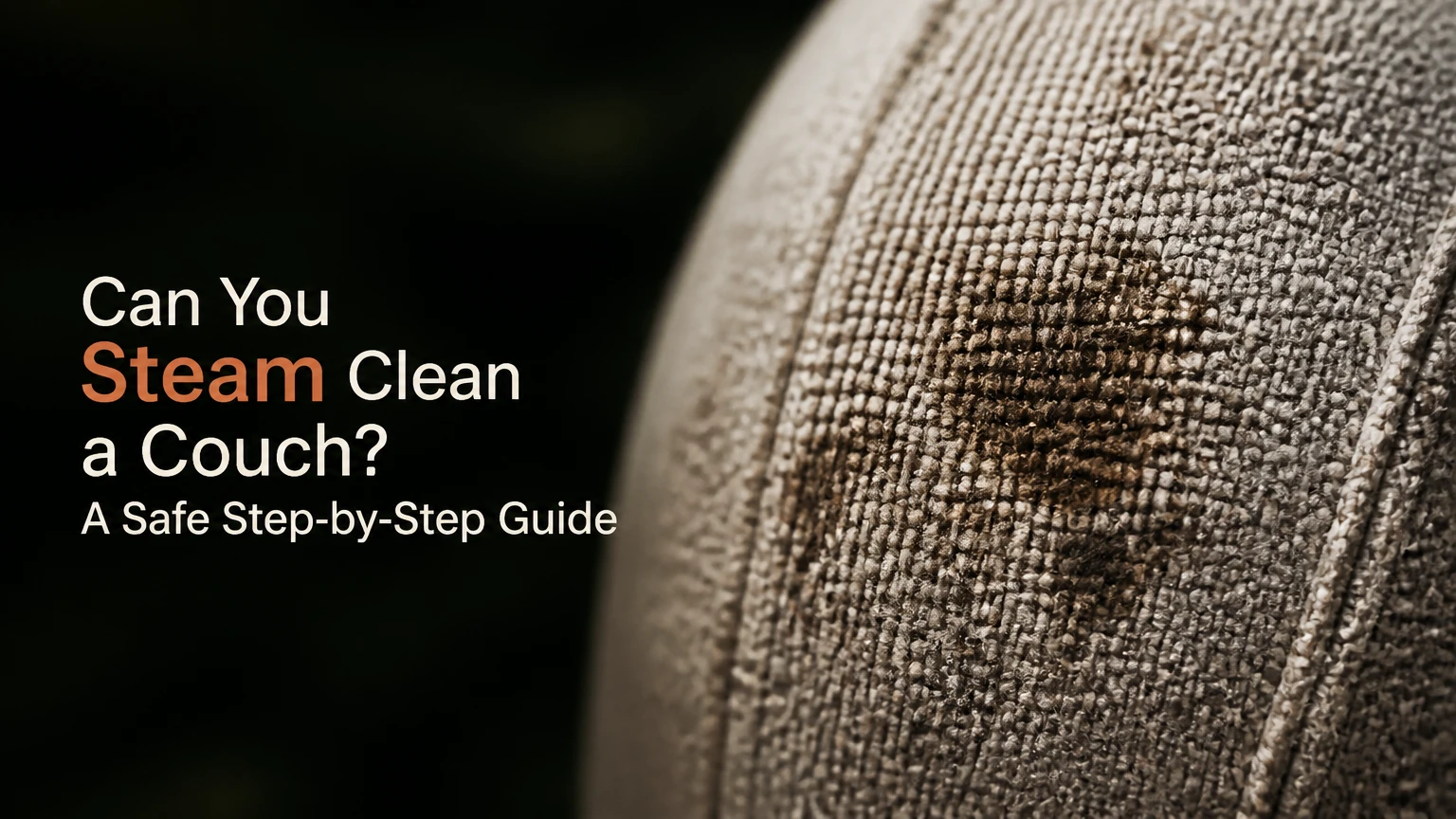
Yes, you can steam clean a couch when the upholstery manufacturer permits water-based cleaning, usually under a W or WS code. Steam cleaning is unsafe for S- or X-coded upholstery and can damage velvet, silk, leather, unsealed wood, or cushions that cannot dry quickly. The cleaning code, moisture control, and complete drying determine the result.
Key Facts at a Glance
- A W-coded couch accepts water-based upholstery cleaning, while an S-coded couch requires a solvent-based method.
- “Steam cleaning” may mean vapor steam or hot-water extraction, and those machines deliver very different amounts of moisture.
- A typical three-seat couch takes 45-90 minutes to clean and 6-24 hours to dry fully.
- Vacuuming before wet cleaning prevents loose soil from becoming muddy residue inside the fabric.
- Steam does not remove every odor, stain, or allergen source, especially contamination inside cushion foam.
- A hidden-area test cannot prove that an entire couch is safe, but it can reveal bleeding, shrinkage, or texture change before major damage occurs.
Can You Steam Clean a Couch?
Most fabric couches can receive a controlled water-based cleaning, but the answer depends on the care code, fabric construction, dye stability, and the equipment used. A W or WS label generally permits water-based cleaning; an S, X, or missing label requires a more conservative approach.
Locate the care tag beneath a seat cushion, under the frame, or along a platform seam. Furniture manufacturers sometimes place the code inside a removable cover, and a removable cover may have different instructions from the fixed upholstery.
The term “steam clean” creates a practical problem. A vapor steam cleaner uses heated water to produce low-moisture vapor, whereas a carpet or upholstery extractor sprays cleaning solution and immediately vacuums it back. Many retailers call hot-water extraction steam cleaning even when the machine does not deliver dry vapor.
The safest method is the one that matches the manufacturer’s instructions and leaves the least moisture compatible with the required soil removal. Upholstery foam holds water longer than the visible fabric, so a couch can feel dry on top while remaining damp internally.
Which Upholstery Codes Are Safe?
The cleaning code determines whether water, solvent, or neither should contact the upholstery. Code W is normally suitable for a cautious extractor or upholstery-safe vapor cleaner, while code S calls for a professional solvent process rather than steam.
| Code | Manufacturer instruction | Water-based DIY cleaning | Recommended action |
|---|---|---|---|
| W | Water-based products permitted | Yes, after testing | Use low moisture and upholstery detergent |
| WS or SW | Water or solvent permitted | Usually yes | Test both color and texture first |
| S | Solvent-based products only | No | Hire a cleaner trained in solvent upholstery |
| X | Vacuum or brushing only | No | Vacuum gently; consult the manufacturer |
| No code | Instructions unavailable | Unknown | Contact the maker or avoid wet cleaning |
A code is not a guarantee against damage. A W-coded rayon blend can still shrink, bleed, or develop rings, and an old couch may have weakened backing, degraded foam, or water-sensitive trim.
Never infer the code from appearance. Polyester, cotton, microfiber, chenille, and linen can look similar while requiring different procedures.
What Does Steam Cleaning Actually Mean?
Vapor steam cleaning heats water and releases a relatively small quantity of hot moisture, while hot-water extraction flushes a cleaning solution through the textile and removes it with vacuum suction. Extraction usually removes more embedded soil, but it also creates a higher over-wetting risk.
Vapor steam is useful for light surface soil, some grease softening, and refreshing compatible synthetic upholstery. It is not a substitute for extraction when the fabric contains substantial particulate soil. A small handheld steamer also lacks the recovery vacuum needed to remove dissolved dirt.
Hot-water extraction has four stages:
- Pre-vacuuming: The operator removes dry grit, hair, and crumbs.
- Preconditioning: An upholstery-safe product loosens oils and soil.
- Agitation and extraction: A tool applies limited solution and vacuums it away.
- Drying: Air movement removes remaining moisture from fabric and foam.
The Institute of Inspection Cleaning and Restoration Certification publishes upholstery-cleaning guidance through its ANSI-accredited standards program, including procedures collected in IICRC S300. The practical principle is consistent across professional work: apply enough chemistry and moisture to remove soil, then recover as much liquid as possible.
Which Machine Is Appropriate?
A portable upholstery extractor is usually the most effective DIY choice for a W-coded couch because it combines controlled spray with vacuum recovery. A vapor steamer can refresh a lightly soiled surface, but a handheld unit is a poor choice for deep cleaning thick cushions.
| Equipment | Typical purchase or rental cost | Moisture profile | Best application | Main risk |
|---|---|---|---|---|
| Handheld vapor steamer | $40-$150 purchase | Low spray, no recovery vacuum | Small surface marks on compatible fabric | Heat marks or prolonged dampness |
| Portable spot extractor | $100-$250 purchase | Moderate spray, local suction | One couch, spills, pet areas | Over-wetting foam |
| Rental upholstery extractor | $30-$60 per day | Higher spray and recovery | Large couch or several rooms | Excess detergent and slow drying |
| Professional portable extractor | $150-$300 typical service minimum | Controlled spray, strong vacuum | Delicate or heavily soiled upholstery | Cost if cleaning is minor |
| Truck-mounted extractor | $150-$350 typical couch service | Strong recovery, technician controlled | Multiple pieces or severe soil | Access and minimum service charge |
Use the manufacturer’s upholstery attachment. Floor heads, stiff carpet brushes, and concentrated steam jets can distort a low-pile fabric or force water beneath seams.
How to Steam Clean a Couch Safely
A typical three-seat couch requires 45-90 minutes of active cleaning, a vacuum, an upholstery tool, distilled water where mineral spotting is a concern, and a compatible detergent used at the machine’s labeled dilution. Drying commonly takes 6-24 hours, with thick foam, humid rooms, and poor airflow extending the range.
Before You Start
Prepare the couch and room before adding moisture. Remove throws, electronics, wooden accessories, and removable cushions, then read the machine manual and upholstery label.
| Preparation item | Typical amount or setting | Purpose |
|---|---|---|
| Vacuuming time | 10-20 minutes | Remove dry soil before wet cleaning |
| Upholstery detergent | Manufacturer dilution, often 1-2 oz per gallon | Loosen oils without sticky residue |
| Distilled water | 1-2 gallons for a three-seat couch | Reduce mineral deposits |
| Fans | 1-2 floor or box fans | Increase evaporation |
| Dehumidifier | 35-50 pint/day capacity | Control room humidity |
| Hidden-spot test | 2-3 square inches, wait 15 minutes | Check bleeding and texture change |
Do not mix vinegar, bleach, ammonia, enzyme products, and detergent in the machine. Chemical combinations can damage fibers or create irritating vapors.
Step 1: Vacuum Every Upholstered Surface
Remove cushions and vacuum the top, bottom, sides, seams, deck, arms, back, and crevices with an upholstery or crevice attachment. Use a low-suction setting on loose weaves, because aggressive vacuuming can pull loops from chenille or bouclé.
Success checkpoint: The vacuum collects little visible grit when passed over the same seam twice.
Common mistake: Wetting a dusty couch first turns dry particulate soil into dark slurry that can spread through the nap.
Step 2: Treat Stains According to Their Chemistry
Blot liquid spills with white towels before applying any product. Use cold water for blood, milk, egg, and other protein residues because high heat can make those residues harder to remove. Use an upholstery-labeled solvent for an S-coded fabric, not a water-based spray.
For a W-coded fabric, apply a small amount of compatible pre-spray to a towel or directly to the stained area according to its label. Allow 5-10 minutes of dwell time, then blot or gently agitate with a soft brush.
Success checkpoint: The stain lightens on the towel without transferring the couch’s dye.
Common mistake: Scrubbing a ring outward can damage the nap and create a larger visible boundary.
Step 3: Test for Colorfastness and Texture Change
Test the cleaning solution and machine process behind the couch, beneath a cushion, or on a lower back edge. Use the same temperature, tool, dwell time, and extraction pressure planned for the visible area.
Wait until the test patch is dry, not merely surface-dry. Check for color transfer on a white towel, shrinkage at a seam, puckering, stiffness, gloss, and altered nap direction.
Success checkpoint: The dry test patch matches the surrounding upholstery in color and texture.
Common mistake: Treating a five-minute wet test as conclusive when the fabric changes only after drying.
Step 4: Clean in Small, Controlled Sections
Fill the machine with water and upholstery detergent at the stated dilution. Work in sections of approximately 2 square feet, beginning with removable cushions and finishing with the frame.
Make one controlled wet pass, then two or more vacuum-only passes. Keep the tool moving, overlap adjacent sections by about 1 inch, and avoid holding the spray trigger at seams, zippers, buttons, and cushion edges.
Success checkpoint: The fabric looks evenly damp rather than saturated, and no liquid pools beneath the tool.
Common mistake: Repeating wet passes because the couch still looks dark while damp. Wait for drying before deciding whether a second treatment is necessary.
Step 5: Extract Residual Moisture
Release the spray trigger and pull the upholstery tool slowly over each section. Vacuum-only passes remove water that would otherwise migrate into foam and backing.
For removable cushions, clean both faces only if the care instructions allow it and the cushion can be dried vertically with air circulation. Do not stack wet cushions, lay them flat on a nonbreathable floor, or replace them while the underside remains damp.
Success checkpoint: A folded white towel pressed firmly against the fabric remains nearly dry after several extraction passes.
Common mistake: Assuming a high spray pressure equals better cleaning. Upholstery needs recovery, not maximum water delivery.
Step 6: Dry the Couch Completely
Stand cushions on their edges with gaps between them, position fans to move air across rather than directly into one wet spot, and run a dehumidifier in a closed room. Open windows only when outdoor air is drier than indoor air.
A thin polyester cushion in a dry room may dry in 6-8 hours. Dense foam, cotton batting, humid weather, or a couch cleaned heavily can require 18-24 hours or longer.
Success checkpoint: The fabric, seams, and cushion centers feel dry and no cool dampness returns after pressing.
Common mistake: Sitting on the couch before full drying compresses wet foam and slows evaporation.
What Can Steam Cleaning Remove?
Controlled water-based cleaning can remove surface soil, body oils, many food marks, and some water-soluble residues from compatible upholstery. Steam or heat can soften grease, but heat alone does not extract dissolved soil or guarantee disinfection.
Odor removal depends on the odor source. Smoke residue on fabric may improve after cleaning, while pet urine inside foam can remain because the contamination has migrated beyond the fabric surface.
Do not promise a universal 99.9% bacteria reduction. Sanitizing claims require a defined organism, contact time, temperature, surface condition, and validated product or process. A consumer steamer may reduce some microorganisms on a treated surface, but a couch’s seams, foam, backing, and uneven contact make whole-couch disinfection uncertain.
Steam also does not reliably eliminate dust-mite allergens inside thick cushions. Washing removable covers at the manufacturer’s permitted temperature, using a HEPA vacuum, and controlling indoor humidity can address allergen sources more reliably.
How Should You Treat Pet Urine?
Pet urine requires absorption, odor chemistry, and sometimes foam replacement, so surface steam cleaning alone is rarely sufficient for a serious accident. Blot fresh urine first, use a fabric-compatible enzyme product when the care code allows water, and prevent the enzyme from being neutralized by heat or incompatible chemicals.
A light, old odor may improve after extraction. Strong odor returning after drying indicates contamination in batting or foam. At that point, a professional may inspect the cushion, flush it with specialized equipment, or recommend replacing the affected insert.
Never combine an enzyme cleaner with bleach, ammonia, or a hot detergent bath. Follow the product’s stated dwell time and test dye stability first.
Is Steam Cleaning Safe for Every Couch Material?
Steam cleaning is not safe for every couch material. Leather, suede, silk, rayon, many cotton velvets, antique textiles, and upholstery with unstable dyes require material-specific care, and an X-coded couch should not receive water or solvent at home.
| Material or construction | Typical safe home method | Steam recommendation | Safer alternative |
|---|---|---|---|
| Polyester microfiber, W code | Low-moisture extraction | Usually acceptable after testing | Upholstery extractor |
| Cotton canvas, W code | Limited water and fast drying | Possible, shrinkage risk | Professional low-moisture cleaning |
| Rayon or viscose blend | Vacuum and specialist care | Avoid DIY steam | Certified upholstery professional |
| Velvet, silk, or antique textile | Vacuum with soft attachment | Avoid unless maker permits | Textile conservator or specialist |
| Finished leather | Leather cleaner and conditioner | Do not steam | Leather-care technician |
| Suede or nubuck | Dry suede brush and approved product | Do not steam | Suede specialist |
| S or X upholstery | Code-directed care | Not suitable | Solvent or vacuum-only service |
Microfiber can develop dark water marks or a changed nap after cleaning. Once dry, a clean, soft brush may restore the nap if the manufacturer permits brushing, but brushing wet microfiber can spread soil.
Removable, machine-washable covers are a separate case. Wash them according to the label, close zippers, avoid high heat unless expressly permitted, and refit covers while slightly damp only when the manufacturer recommends that practice.
Is Steam Cleaning Better Than Shampooing or Dry Cleaning?
No single method is best for every couch. Water-based extraction generally suits W-coded synthetic upholstery with embedded soil, low-moisture cleaning reduces drying risk, and solvent cleaning suits S-coded materials that cannot tolerate water.
| Method | Typical active time | Typical drying time | Suitable code | Cleaning strength |
|---|---|---|---|---|
| Vacuum and brush | 15-30 minutes | 0 hours | X, W, S, WS | Surface dust and crumbs |
| Vapor steam | 20-60 minutes | 2-8 hours | W, some WS | Light soil and grease softening |
| Hot-water extraction | 45-90 minutes | 6-24 hours | W, WS | Embedded water-soluble soil |
| Low-moisture encapsulation | 30-75 minutes | 1-4 hours | W, some WS | Moderate surface soil |
| Solvent upholstery cleaning | 45-120 minutes | 1-6 hours | S, some WS | Solvent-soluble oils and soil |
Shampooing can leave residue when the operator overuses detergent or fails to rinse and extract it. Dry cleaning is not automatically gentler, because solvent selection, ventilation, dye stability, and technician skill still matter.
The practical winner for a moderately dirty W-coded family couch is controlled extraction with minimal solution and strong recovery. The practical winner for S-coded upholstery is a trained solvent cleaner.
How Long Does a Couch Take to Dry?
A couch normally takes 6-24 hours to dry after careful water-based cleaning, although a thin cushion in low humidity may dry sooner and dense foam can remain damp beyond one day. Drying time depends more on extracted moisture, airflow, humidity, and cushion thickness than on the couch’s external fabric.
| Couch condition | Typical drying time | Main reason |
|---|---|---|
| Thin polyester cushions, two fans | 4-8 hours | Low absorbency and strong airflow |
| Standard three-seat couch | 6-12 hours | Moderate foam and fabric moisture |
| Cotton or linen upholstery | 8-18 hours | Higher absorbency |
| Dense foam or feather-filled cushions | 12-24 hours | Moisture remains inside filling |
| Humid room with weak airflow | 24-48 hours | Slow evaporation |
A hygrometer reading above roughly 60% relative humidity slows drying and increases odor risk. Do not cover the couch with plastic, close cushions tightly together, or direct intense heat at one small area, since uneven heating can create rings or shrinkage.
What Does Couch Cleaning Cost?
Typical DIY costs range from $30-$60 for a rental machine or $100-$250 for a residential extractor, while professional upholstery cleaning commonly costs $100-$350 for a couch before specialty treatments or minimum service charges.
| Cleaning choice | Typical price | Typical active time | Best financial case |
|---|---|---|---|
| DIY vapor steamer | $40-$150 equipment | 20-60 minutes | Light marks and refreshes |
| DIY portable extractor | $100-$250 equipment | 45-90 minutes | Several future cleanings |
| Rental extractor | $30-$60 per day | 60-120 minutes | One large cleaning project |
| Professional standard couch | $100-$250 | 45-90 minutes | Valuable or heavily soiled couch |
| Specialist delicate-fabric service | $200-$350+ | 1-3 hours | Silk, velvet, rayon, antique pieces |
Service prices vary by city, access, couch size, sectional configuration, stain treatment, and whether cushions are removable. Ask whether the quote includes pre-vacuuming, stain treatment, deodorizing, protectant, and furniture moving.
Why Did the Couch Become Stiff, Ringed, or Musty?
Stiff upholstery usually contains dried detergent residue, water rings result from uneven wetting or drying, and a musty smell indicates retained moisture or contamination that cleaning did not remove. Each problem requires a different response, so adding more product can make the result worse.
Stiff Fabric
Excess detergent leaves a sticky film that binds soil and makes fibers feel crunchy. If the care code permits water, a professional or capable extractor can perform a light rinse with clean water followed by thorough vacuum recovery. Do not repeatedly add soap.
Water Rings
Water rings often form when only a small area is wetted and dissolved soil migrates to the drying boundary. A full, even cleaning of the affected panel can sometimes blend the boundary, but repeated spot wetting usually enlarges it.
Musty Odor
Increase airflow and dehumidification immediately. If the odor persists after 24-48 hours, inspect cushion interiors and padding rather than masking the smell with fragrance. A 50/50 vinegar solution is not a universal mold treatment and can damage some fabrics, so do not apply it without a material-specific test.
Visible mold, saturated foam, or a couch that remains wet for more than 48 hours warrants professional assessment. Porous foam may need replacement when contamination has penetrated deeply.
When Should You Hire a Professional?
Hire a professional when the couch has an S or X code, lacks a reliable care label, contains silk, rayon, antique velvet, leather, or expensive handwoven fabric, or has severe pet urine, smoke, mold, or flood contamination.
Ask the cleaner for four specific details:
- Which method matches the manufacturer’s code?
- What moisture level and drying plan will the technician use?
- Does the price include stain and odor treatment?
- Does the company carry liability insurance and document pre-existing damage?
A professional is not automatically qualified because the advertisement says “steam cleaning.” Look for upholstery-specific experience, not only carpet-cleaning experience. Photograph loose seams, faded sections, and existing rings before work begins.
DIY cleaning makes sense for a durable W-coded polyester couch with moderate soil, accessible cushions, good ventilation, and a willingness to accept a small test-area risk. Professional cleaning makes more sense when replacing the couch would cost substantially more than the service.
Common Questions About Couch Steam Cleaning
Can I steam clean a couch without a cleaning code?
Avoid wet cleaning when the code is missing until the manufacturer or retailer confirms the fabric instructions. A hidden test can reveal immediate bleeding but cannot establish long-term shrinkage, backing failure, or foam-drying safety. Vacuuming and gentle brushing are the lowest-risk interim options.
Can I use a garment steamer on my sofa?
A garment steamer can refresh a compatible surface, but it does not remove dissolved soil because it has no recovery vacuum. Keep the nozzle moving, avoid saturating seams, and stop if the fabric darkens, ripples, or changes texture. Use an upholstery extractor for embedded dirt.
Can steam cleaning remove cigarette smoke from a couch?
Steam and extraction can reduce smoke residue on compatible fabric, but smoke odor may remain in foam, batting, wood, and nearby walls. Wash removable covers when allowed, clean the surrounding room, and replace contaminated cushion inserts when odor returns after thorough drying.
Can I steam clean couch cushions separately?
Separate cushions are easier to clean and dry because air can reach both faces. Clean only when the label permits water, extract each face carefully, stand cushions on edge, and wait until the center is completely dry before reinstalling them.
How often should a fabric couch be cleaned?
Vacuum upholstery weekly, address spills immediately, and consider water-based deep cleaning every 6-18 months for a W-coded couch, depending on occupancy, pets, smoking, and visible soil. Frequent heavy wet cleaning can shorten fabric life, so routine vacuuming is preferable to repeated extraction.
Can I sit on the couch while it is drying?
Do not sit on a wet couch. Body pressure compresses damp foam, transfers soil, creates uneven drying, and can leave permanent impressions or rings. Wait until the fabric and cushion centers feel dry after several hours of airflow.
The Bottom Line
You can steam clean a couch when the upholstery code permits water and the material passes a dry test. For most durable W or WS fabric, vacuum first, use minimal upholstery detergent, clean small sections, make repeated vacuum-only passes, and dry the cushions with strong airflow for 6-24 hours.
Do not steam clean S- or X-coded upholstery, leather, suede, silk, rayon, or valuable vintage fabric without specialist advice. The answer to “can you steam clean a couch” is therefore yes for compatible upholstery, but safe moisture control matters more than maximum heat.