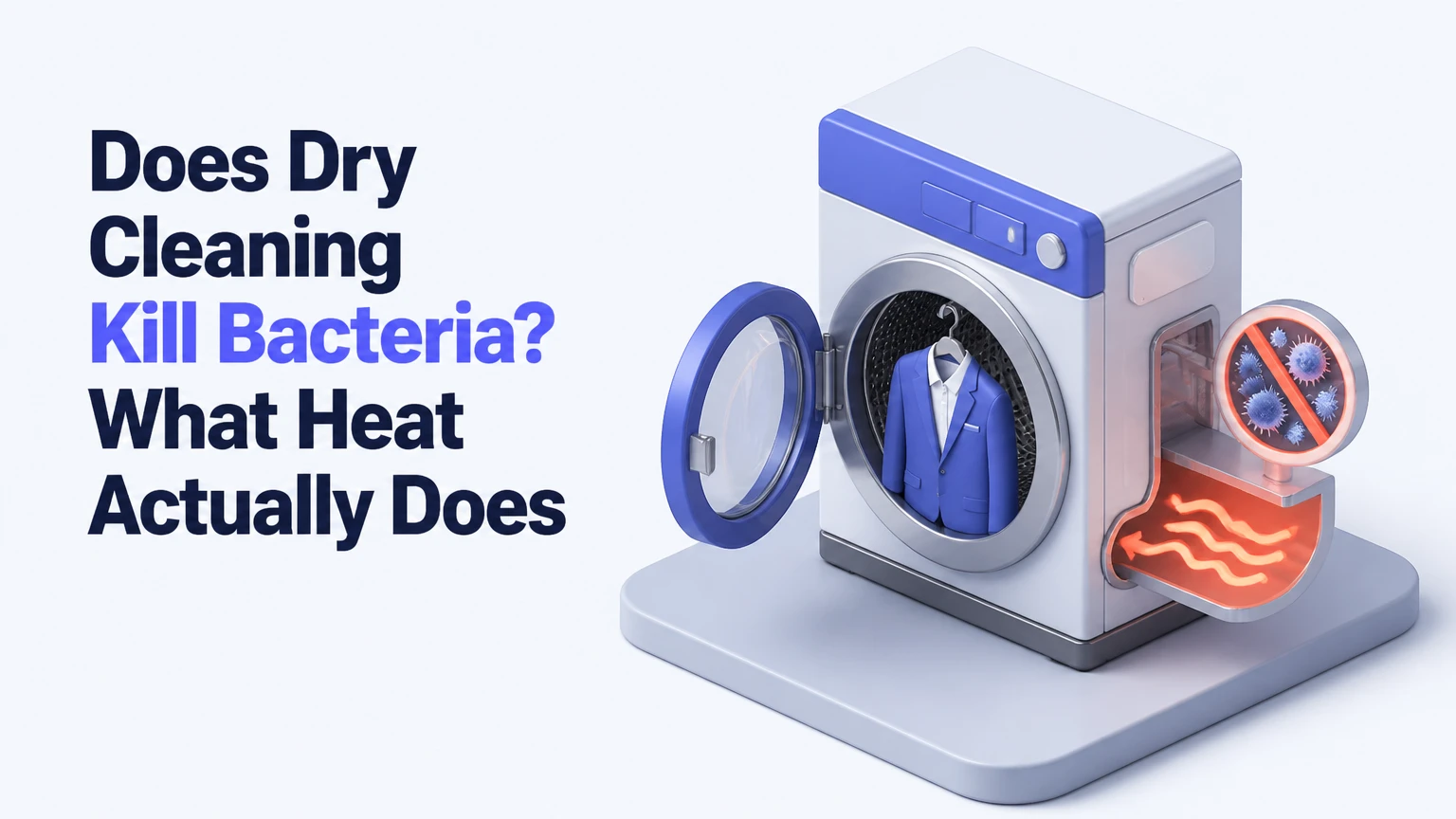
Dry cleaning removes and may kill many bacteria, but it does not guarantee sterilization or complete disinfection. Solvent extraction removes contaminated soil, while drying, steam, and pressing add heat that can inactivate some microorganisms. The result depends on the organism, fabric construction, exposure time, and cleaner’s exact process.
Key Facts at a Glance
- Conventional dry cleaning is a cleaning process, not a validated medical sterilization cycle.
- Perchloroethylene and hydrocarbon solvents primarily remove oils, soil, and microbes from fabric rather than reliably killing every organism.
- Dry-cleaning dryers commonly operate around 140-160°F, but temperature alone cannot establish a bacterial kill without a measured exposure time.
- Steam and pressing can exceed 200°F at the equipment surface, yet heat may not penetrate every layer, lining, seam, or pocket.
- Bacterial spores, some non-enveloped viruses, mold contamination, and heavy bodily fluids require more specialized handling than routine dry cleaning.
- A washable garment laundered with an appropriate detergent, temperature, and drying cycle is usually the better hygiene choice.
Does Dry Cleaning Kill Bacteria?
Dry cleaning kills or removes a substantial portion of ordinary surface bacteria from many garments, but routine service should not be treated as sterilization. The strongest microbial reduction usually comes from a combination of soil removal, solvent extraction, drying, steam, and pressing, not from the solvent alone.
The distinction matters because “clean,” “sanitized,” “disinfected,” and “sterile” describe different outcomes. The U.S. Centers for Disease Control and Prevention defines cleaning as removing “germs, dirt, and impurities from surfaces or objects.” Removing microbes lowers contamination, but it does not necessarily destroy them.
For a suit worn to an office, standard dry cleaning will usually reduce sweat residue, skin oils, odor compounds, and associated bacteria to a level that makes the garment visibly and practically cleaner. For a hospital isolation gown, clothing contaminated with vomit, feces, or blood, the required control standard is different.
No universal kill percentage applies to every dry-cleaning load. Solvent type, filtration, drum loading, garment thickness, finishing temperature, and contact time all change the result.
What Does Dry Cleaning Actually Do to Microbes?
Dry-cleaning solvents dislodge and carry away microorganisms attached to oil, skin flakes, dust, and other soil. Commercial detergents and spotting agents can improve soil removal, while mechanical agitation separates contamination from fibers.
Solvent removal is not equivalent to microbial destruction. A bacterium transferred into the solvent stream may be captured by filtration, separated in still residues, or remain viable unless the process includes a validated antimicrobial step. A heavily soiled collar also protects microbes differently from a thin polyester shell.
The practical hygiene benefit is therefore twofold: fewer organisms remain on the garment, and less organic residue remains available to support odor and microbial persistence. That benefit is substantial for routine clothing, but it has a defined boundary.
How Does the Dry-Cleaning Process Affect Bacteria?
A commercial dry-cleaning cycle reduces contamination through inspection, pretreatment, solvent washing, extraction, controlled drying, and finishing. Each stage contributes differently, and the finishing press cannot compensate for poor cleaning or inadequate exposure inside thick garments.
1. Inspection and Spotting
The cleaner identifies fiber content, construction, dyes, stains, and visible contamination before processing. Protein, oil, tannin, and particulate stains may receive different spotting agents.
This stage can improve hygiene indirectly because dried organic material protects microbes and retains odor. It can also create risk if a cleaner applies excessive heat to a protein stain before removing it.
2. Solvent Washing
The garment enters a closed-loop machine containing a solvent such as perchloroethylene, a hydrocarbon blend, or a silicone-based fluid. Agitation and detergent move oily soil away from fibers while the machine circulates and filters the solvent.
The wash removes bacteria attached to the soil. It does not provide a guaranteed broad-spectrum kill comparable to a validated disinfecting or sterilizing process.
3. Extraction and Filtration
High-speed extraction removes most solvent from the textile, and filtration captures particulate soil from the circulating fluid. Distillation or solvent reclamation systems help maintain process quality.
A poorly maintained machine can reduce cleaning performance and increase the chance of residual odor or cross-load transfer. Reputable cleaners monitor solvent condition, filters, still residues, and machine maintenance.
4. Controlled Drying
Warm air evaporates remaining solvent, commonly within a dryer range near 140-160°F, although machines and programs vary. Drying may inactivate heat-sensitive vegetative bacteria when the garment reaches the required temperature for enough time.
A displayed air temperature is not the same as the temperature inside every fiber. Thick wool, quilted insulation, bonded linings, and folded areas heat more slowly than exposed surfaces.
5. Steam and Pressing
Finishing equipment may use steam and heated presses with equipment surfaces around 200°F or higher for steam operations and approximately 300°F or more for some pressing surfaces. These temperatures can inactivate organisms directly exposed to sufficient heat.
Pressing is not a whole-garment sterilization cycle. A hot press contacts collars, cuffs, fronts, or shaped panels briefly, while pockets, linings, seams, and interior padding receive less direct exposure.
Which Microorganisms Are Most Likely to Survive?
Vegetative bacteria on exposed fabric are generally easier to remove or inactivate than bacterial spores, protected biofilms, or contamination embedded in porous material. Dry cleaning also cannot be assumed to eliminate every virus or mold colony from a garment.
| Microorganism or contaminant | Routine dry-cleaning expectation | Main limitation | Better response |
|---|---|---|---|
| Staphylococcus aureus | Large reduction likely on ordinary soiled clothing | Protected skin debris can shield cells | Launder washable items; use professional cleaning for tailored garments |
| Escherichia coli | Removal and heat inactivation likely on exposed fabric | Results depend on soil and exposure | Hot detergent laundering when the care label permits |
| Influenza or coronavirus particles | Likely reduced by cleaning and drying | Virus-specific validation is uncommon | Launder with detergent; follow public-health guidance |
| Non-enveloped viruses | Less predictable than enveloped viruses | Greater environmental resistance | Use a validated laundering or institutional protocol |
| Bacterial spores | May survive routine solvent and finishing exposure | Spores tolerate heat and drying better | Specialist remediation or validated sporicidal process |
| Mold and mildew | Surface spores may be reduced | Growth inside damp padding or leather may remain | Dry promptly; use textile or restoration specialist |
| Blood, feces, or vomit | Routine service may be refused | Organic load creates exposure and stain-setting risks | Contact the cleaner before transport and follow local guidance |
A 1993 study indexed by ScienceDirect reported substantial reductions in tested microorganisms under particular textile-cleaning conditions, but laboratory findings cannot be converted into one universal result for every commercial machine. Test organism, inoculation method, fabric, solvent, and cycle design determine comparability.
What Temperatures and Exposure Times Matter?
Temperature and time work together, so a single temperature claim cannot prove that a garment has been disinfected. A 150°F air setting may produce a different microbial result from a 150°F fabric temperature maintained for a measured interval.
| Process stage | Typical equipment or condition | What it can contribute | Why the figure is limited |
|---|---|---|---|
| Solvent wash | Near-ambient solvent, commonly below water-wash temperatures | Soil removal and microbial displacement | Solvent contact alone is not universal disinfection |
| Dryer | Approximately 140-160°F air | Heat stress and solvent evaporation | Fabric core may remain cooler |
| Steam finishing | Approximately 200-220°F steam or equipment range | Rapid heating of exposed surfaces | Steam contact and penetration vary |
| Pressing | Approximately 300-325°F surface temperature on some equipment | Strong surface heat exposure | Contact is brief and localized |
| Home hot wash | Often 120-140°F, depending on machine setting | Detergent flushing and thermal reduction | Lower temperatures require appropriate time and drying |
| Commercial laundry | Often 140°F or higher in specified programs | Water, detergent, and controlled thermal process | Exact protocol depends on textile and facility |
Drying temperatures also should not be confused with sterilization standards. Healthcare sterilization relies on validated combinations of temperature, pressure, concentration, and time, such as steam sterilization cycles designed for instruments. A garment press is not an autoclave.
Expert insight: The hottest number in a cleaner’s brochure is often the least useful hygiene number. Ask how long the fabric reaches that temperature, which garment layers are exposed, and whether the process has organism-specific validation.
Is Dry Cleaning Better Than Washing for Germ Removal?
Home or professional water laundering is usually better for microbial removal when the garment can safely tolerate detergent, water, agitation, and heat. Dry cleaning is often the safer fabric-preservation choice for structured wool, tailored garments, and textiles that can shrink, bleed, distort, or lose their finish in water.
| Decision factor | Dry cleaning | Home laundering | Professional wet cleaning |
|---|---|---|---|
| Main cleaning medium | Perc, hydrocarbon, silicone, or other solvent | Water plus detergent | Water, controlled detergent, specialized equipment |
| Bacteria removal pathway | Solvent extraction, agitation, drying, finishing | Dilution, flushing, detergent, drying | Controlled flushing and garment-specific chemistry |
| Typical garment fit | Wool suits, structured coats, silk garments | Cotton shirts, towels, washable uniforms | Delicate or labeled garments managed by specialists |
| Hygiene confidence | Moderate for routine surface contamination | High when label permits hot wash and complete drying | High when cleaner uses a defined professional protocol |
| Shrinkage or distortion risk | Usually low for compatible items | Moderate to high for wool, silk, and lined pieces | Managed through low mechanical stress and drying control |
| Typical consumer cost | $5-$45 or more per item | About $1-$4 per load, excluding equipment | Often $8-$30 per item, market-dependent |
| Best use case | Preserve shape while removing ordinary soil | Remove sweat, body fluids, and washable contamination | Balance hygiene with delicate-fabric protection |
The American Cleaning Institute recommends following care labels and using detergent and appropriate water temperature for laundry hygiene. Complete drying also matters because damp textiles support odor and microbial persistence.
Which Cleaning Method Fits Each Garment?
The care label identifies the manufacturer’s tested method, but the label does not describe every contamination scenario. Tell the cleaner whether the item has ordinary body odor, visible biological material, mold, or recent illness exposure before selecting a process.
| Garment or textile | Preferred routine method | Typical hygiene choice | Avoid or verify |
|---|---|---|---|
| Cotton T-shirt | Machine wash | Detergent wash at the highest label-safe temperature | Reusing damp laundry |
| Wool suit | Professional dry cleaning | Routine solvent cleaning and thorough drying | Hot water and aggressive tumble drying |
| Silk blouse | Label-directed dry cleaning or wet cleaning | Specialist process with low mechanical stress | Chlorine bleach and high heat |
| Down coat | Specialist cleaner | Process designed for down drying | Storing while damp |
| Towels and bedding | Machine wash | Detergent wash with complete drying | Low-temperature wash after heavy illness contamination |
| Leather or suede | Leather specialist | Specialized cleaning and drying | Water soaking or ordinary dry cleaning |
| Upholstered costume | Specialist textile cleaner | Inspection before any wet or solvent process | Sealing damp items in plastic |
A professional cleaner may recommend wet cleaning even when a label says “dry clean only,” but that decision should come from a trained operator who has assessed dye stability, construction, interlinings, and shrinkage risk.
Does Dry Cleaning Remove Odor, Mold, and Illness Contamination?
Dry cleaning can remove many odor-causing oils and residues, but persistent odor, active mold growth, and heavy bodily-fluid contamination need more than a routine solvent cycle. The correct method depends on whether contamination is on the surface, embedded in padding, biologically hazardous, or still wet.
Everyday Sweat and Body Odor
Dry cleaning often performs well on suit jackets, trousers, and silk garments carrying oil-based body soil. Odor may return if the source is inside shoulder pads, waistbands, synthetic linings, or a garment stored before it fully dried.
Air the item after collection, remove the retail plastic bag, and store the garment in breathable fabric. Plastic is useful for transport, not long-term storage.
Mold and Mildew
Dry cleaning may remove visible spores and stale odor from some textiles, but it does not guarantee that mold has been eliminated from foam, batting, leather, or deeply contaminated seams. Do not brush mold indoors because brushing can disperse spores.
Keep the item isolated and dry. Ask a textile-restoration professional whether the material can be salvaged, especially when the garment has visible growth, a musty odor after cleaning, or water-damaged padding.
Blood, Vomit, Urine, or Feces
Call the cleaner before placing biologically contaminated clothing in a drop-off bag. Some cleaners refuse these items because staff exposure, transport leakage, and local occupational-health requirements change the handling process.
Do not apply a hot iron or hot dryer to an unknown protein stain. Heat can set proteins and make removal harder. For washable clothing, follow public-health or manufacturer guidance, use gloves for handling, and wash separately when appropriate.
How Much Does Dry Cleaning Cost and How Long Does It Take?
Typical U.S. dry-cleaning prices range from $5-$10 for a shirt, $15-$30 for a two-piece suit, and $20-$45 or more for a dress or heavy coat. Standard turnaround commonly takes 24-48 hours, while pressing and packaging add roughly 5-10 minutes of shop labor per garment.
| Item | Typical price range | Typical turnaround | Main price variable |
|---|---|---|---|
| Shirt or blouse | $5-$10 | 1-2 days | Fabric, hand finishing, stain treatment |
| Two-piece suit | $15-$30 | 1-2 days | Jacket construction and pressing |
| Dress | $20-$45+ | 2-4 days | Beading, lining, length, stain complexity |
| Heavy coat | $20-$45+ | 2-5 days | Insulation, fur trim, water-repellent finish |
| Blanket or comforter | $25-$60+ | 2-5 days | Size, filling, and local equipment |
| Express service | Additional $5-$20 typical | Same day or next day | Shop capacity and cutoff time |
Prices vary by city, garment size, embellishment, and whether stain removal requires multiple treatments. Express service changes scheduling, not necessarily the microbial effectiveness of the underlying process.
What Should You Ask a Dry Cleaner?
Ask for the process rather than accepting an unsupported claim that a garment is “sanitized.” A useful cleaner can identify the solvent or wet-cleaning method, explain stain and contamination limits, and tell you whether the garment will receive steam or pressing.
Use this checklist:
- Which process will you use: perchloroethylene, hydrocarbon, silicone, CO2, or professional wet cleaning?
- Do you accept garments contaminated with blood, vomit, feces, urine, or mold?
- Is the item cleaned in a separate load or under a special protocol?
- How do you handle solvent filtration, distillation, and machine maintenance?
- Will the lining, pockets, padding, and seams receive the same treatment as the outer fabric?
- Can you remove the plastic cover before pickup if storage will continue?
- What residual odor, fragrance, or spotting-agent residue should I expect?
- Can you recommend a validated laundry or restoration service for illness-related contamination?
Expert insight: “Antibacterial” can describe a product claim, a detergent additive, or a marketing label. It does not automatically identify the organisms tested, the log reduction achieved, or the exposure conditions used.
When Is Dry Cleaning the Wrong Choice?
Dry cleaning is the wrong first choice when a garment is washable and has heavy biological contamination, when mold has penetrated porous materials, or when the wearer needs a validated infection-control outcome. Dry cleaning also cannot repair contamination that remains inside foam, insulation, or a non-cleanable lining.
Choose home laundering when the care label permits water washing and the item has sweat, ordinary skin soil, or routine post-illness contamination. Choose professional wet cleaning when a specialist can control shrinkage and dye migration. Choose textile restoration when water damage, sewage, widespread mold, or strong persistent odor affects the garment.
For immunocompromised household members, cleaning method and handling sequence both matter. Keep contaminated textiles contained, avoid shaking them, wash hands after handling, and follow instructions from the person’s clinician or local public-health authority when infection exposure is suspected.
Common Mistakes That Reduce Hygiene
- Leaving clothing in the plastic bag: Trapped humidity encourages mildew and odor. Remove the bag at home and use a breathable hanger cover.
- Assuming pressing sterilizes every layer: A press heats contacted surfaces, not necessarily pockets, linings, or padding.
- Sending wet contamination without warning: Leaking biological material creates a worker-exposure problem and may set stains.
- Over-cleaning tailored clothing: Frequent solvent cycles can wear finishes and shorten garment life. Air suits between wears and clean when visibly soiled or odorous.
- Using household disinfectant on silk or wool: Alcohol, chlorine, peroxide, and quaternary products can bleach, stiffen, or damage fibers.
- Confusing odor removal with pathogen removal: Fragrance can mask odor while contamination remains in a lining or cushion.
- Packing garments while damp: Complete drying is a hygiene step, not merely a finishing preference.
FAQ
Can Dry Cleaning Remove Bacteria From a Suit?
Dry cleaning can remove many bacteria attached to sweat, skin oil, and dust from a suit. Solvent cleaning, extraction, drying, steam, and pressing work together, but no routine suit cycle guarantees sterilization. For visible bodily fluids or known infectious contamination, call the cleaner first and ask whether professional wet cleaning is more appropriate.
Does Dry Cleaning Kill COVID-19 or Other Viruses?
Dry cleaning may reduce viral contamination through physical removal, solvent action, drying, and heat, but routine service is not a universal virus-disinfection protocol. Enveloped viruses are generally less environmentally persistent than many non-enveloped viruses. Launder washable garments with detergent and dry them completely when public-health guidance permits.
How Often Should Suits Be Dry-Cleaned?
Many suits need professional cleaning every three to five wears, but the correct interval depends on sweat, smoke, food spills, skin contact, and storage conditions. Air a suit for at least several hours between uses, brush loose soil away, and spot-clean promptly according to the fabric’s care instructions.
Can Dry Cleaning Remove Bacterial Smell?
Dry cleaning can remove oil-based soil and some odor compounds, so it often improves ordinary sweat odor. Persistent smell may originate in synthetic lining, shoulder padding, mildew, or incomplete drying. Tell the cleaner the odor remains after cleaning rather than adding fragrance at home.
Is Steam Cleaning Clothes Enough to Kill Germs?
Household garment steaming can reduce some exposed, heat-sensitive microbes when steam contacts the fabric adequately, but it is not a validated sterilization method. Steam may miss seams, linings, and thick layers. Use labeled laundering or professional cleaning for illness-related contamination, mold, or bodily fluids.
Should I Dry-Clean Clothes After Being Sick?
Dry-cleaning is not automatically necessary after routine illness exposure. Washable clothing is usually better handled with detergent laundering and complete drying, while structured or delicate garments should be discussed with a cleaner. Keep heavily contaminated items separate and disclose the contamination before drop-off.
The Bottom Line
Does dry cleaning kill bacteria? It can remove and inactivate many bacteria, especially when solvent cleaning is followed by controlled drying, steam, and pressing, but dry cleaning is not medical-grade sterilization. Use routine dry cleaning to preserve compatible garments and remove ordinary soil; use detergent laundering, professional wet cleaning, or textile remediation when the contamination or hygiene requirement exceeds a standard solvent cycle.