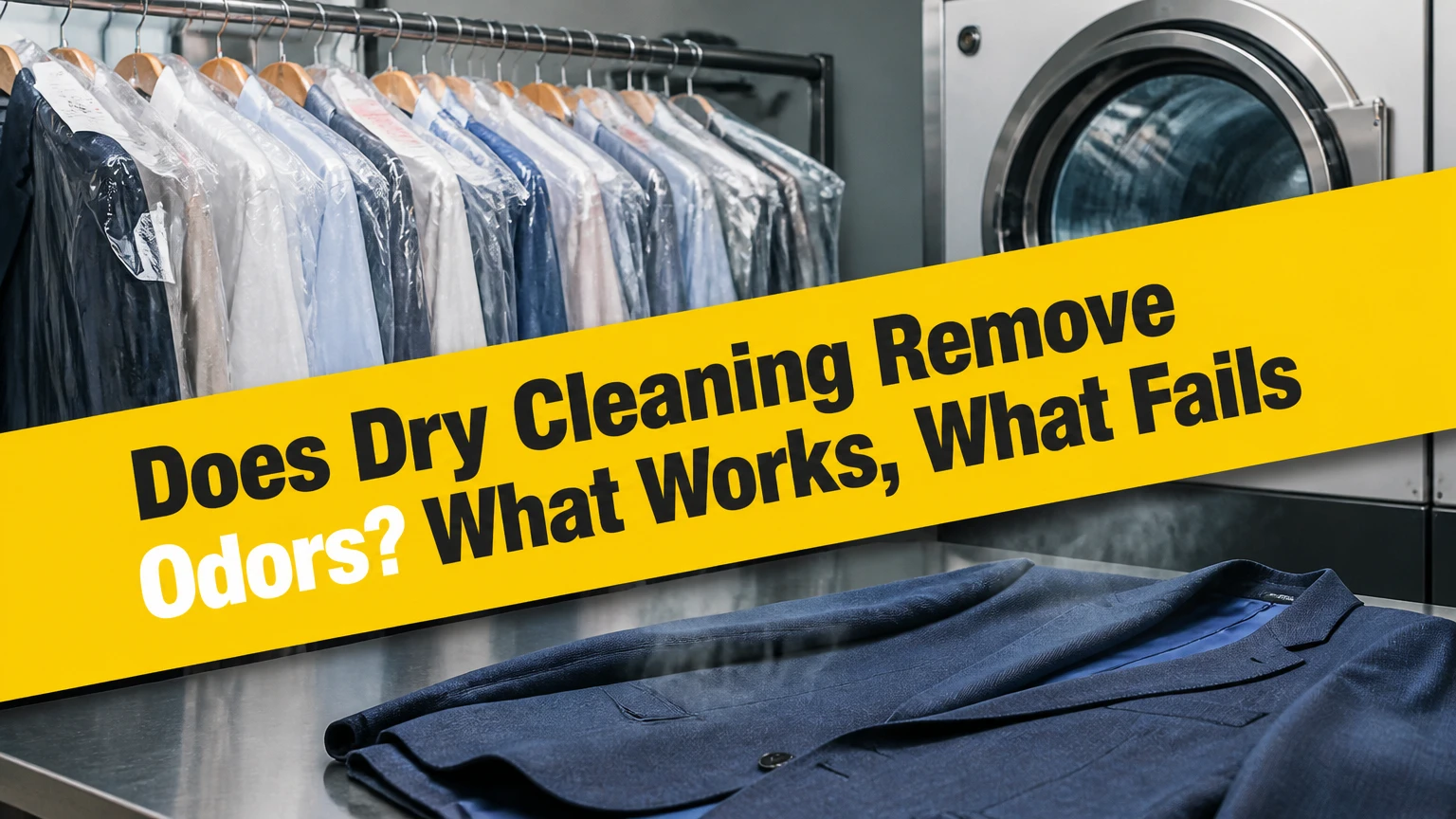
Dry cleaning removes many odors, especially smoke, perfume, cooking grease, body oils, and stale environmental smells. Dry-cleaning solvent dissolves oily residues that hold odor compounds in textile fibers, but standard solvent cleaning may leave sweat salts, urine, vomit, and other water-soluble biological residues behind unless the cleaner adds wet spotting, professional wet cleaning, or another specialized treatment.
Key Facts at a Glance
- Dry cleaning is strongest against oil-bound odors from smoke, grease, perfume, and sebum.
- Standard dry cleaning is less reliable for water-soluble sweat, urine, vomit, and milk residues.
- Telling the cleaner the odor source improves treatment selection and reduces repeat cleaning.
- A residual chemical smell usually indicates incomplete aeration, solvent carryover, or contaminated solvent, not successful deodorization.
- Typical U.S. garment pricing ranges from about $3-$10 for a shirt and $10-$25 for a two-piece suit.
- Smoke, mold, and flood damage may require a textile-restoration specialist rather than an ordinary retail cleaner.
Does Dry Cleaning Remove Odors?
Yes, dry cleaning often removes odors, but the result depends on what produced the smell, where the residue sits, and whether the garment can receive supplemental water-based treatment. Solvent cleaning works particularly well when odor molecules are attached to sebum, cooking oil, fragrance oils, tar, or other nonpolar residues.
Dry cleaning is not a universal deodorizer. A standard solvent cycle can extract oily odor carriers while leaving salts, proteins, sugars, and microbial by-products in an armpit, lining, waistband, or padded component. A cleaner may need to wet-spot a local area, professionally wet-clean the garment, steam it, or send severe contamination to a restoration facility.
The garment-care label also matters. A wool suit, silk dress, acetate lining, leather trim, and waterproof membrane respond differently to solvents, water, heat, and agitation. The best treatment removes the odor source without causing dye bleeding, shrinkage, delamination, distortion, or damage to interlinings.
How Does Dry Cleaning Affect Odor Molecules?
Dry-cleaning solvent affects odor by dissolving oily carriers and transporting loosened residue away during filtration and extraction. The solvent does not simply mask smell, and ordinary pressing does not reliably destroy odor-causing compounds.
The U.S. Environmental Protection Agency describes dry cleaning as “a process that uses a liquid solvent other than water.” Traditional perchloroethylene, hydrocarbon solvents, silicone-based solvents, and liquid carbon dioxide differ in cleaning power, fabric compatibility, equipment requirements, and environmental controls.
A typical professional cycle includes these stages:
- Inspection and tagging: Staff identify fiber content, construction, stains, odor location, and damage risk.
- Pre-treatment: The cleaner applies a compatible spotting agent, detergent, steam, or controlled moisture to targeted residue.
- Solvent cleaning: The garment is agitated in a closed machine containing filtered cleaning solvent.
- Filtration and extraction: Suspended soil and dissolved oils are removed while solvent is spun from the fabric.
- Drying and aeration: Warm air removes solvent, followed by ventilation that reduces residual vapor.
- Finishing: Steam, pressing, brushing, and inspection restore shape and expose remaining odor zones.
A key practitioner distinction is often missed: pressing may improve presentation, but it is not a dependable sanitizing step. Heat can reduce some organisms under controlled conditions, yet a pressed garment can still contain odor-producing residue.
Which Odors Does Dry Cleaning Remove Best?
Dry cleaning generally performs best on odors associated with oils, smoke particles, fragrance compounds, and food residues. Success falls when the smell comes from water-soluble salts, proteins, active moisture, or contamination inside foam and padding.
| Odor source | Main residue type | Likely solvent response | Better escalation |
|---|---|---|---|
| Cigarette smoke | Tar, resins, semi-volatile compounds | Good after one or more cycles | Restoration cleaning for heavy exposure |
| Cooking grease | Lipids and oxidized oils | Good in a standard cycle | Pre-treatment for old, polymerized grease |
| Perfume or cologne | Fragrance oils and alcohol residues | Often good | Aeration or repeat treatment if scent persists |
| Body oil | Sebum and skin lipids | Good on outer fabric | Wet-spotting for accompanying sweat salts |
| Light food odor | Mixed oils and volatile compounds | Usually good | Spot treatment for sauce or dairy residue |
| Mothballs | Naphthalene or paradichlorobenzene vapor | Variable | Ventilation, specialist treatment, or replacement |
| Skunk spray | Sulfur-containing thiols and oily residue | Variable to poor | Specialist deodorization and controlled testing |
| Mildew odor | Microbial by-products and moisture | Incomplete if moisture remains | Source removal and textile restoration |
“Organic” does not automatically mean “solvent-soluble.” Sweat, urine, and vomit are organic materials, but their salts, proteins, and sugars often require water-based chemistry. That distinction is more useful than labeling an odor simply as natural or chemical.
Why can sweat odor remain after cleaning?
Sweat odor can remain because perspiration contains both water-soluble salts and oil-soluble skin secretions, while bacteria may have converted those materials into persistent-smelling compounds. Dry cleaning can remove the sebum portion without fully removing the salt or protein residue embedded near the armpit.
Tell the cleaner that the garment has perspiration odor, identify the armpits or waistband, and ask whether the item can be wet-spotted or professionally wet-cleaned. Do not apply household bleach, vinegar, enzyme spray, or rubbing alcohol before drop-off because those products can alter dyes and interfere with professional stain testing.
Which Odors Need Wet Cleaning or Restoration?
Professional wet cleaning is usually the better first choice for heavy sweat, urine, vomit, milk, and other water-soluble residues when the fabric and construction can tolerate controlled water treatment. Textile restoration is more appropriate when smoke, mold, sewage, floodwater, or decomposition has contaminated a garment beyond ordinary retail cleaning.
Professional wet cleaning uses programmed water temperature, detergent concentration, mechanical action, extraction, and drying controls. It differs from casual home washing because operators account for fiber movement, shrinkage potential, dye stability, pressing, and garment tension.
| Situation | Preferred first treatment | Typical initial timeframe | Main risk |
|---|---|---|---|
| Fresh sweat on washable wool | Wet spotting or wet cleaning | 1-3 days | Fiber distortion from excess moisture |
| Set-in urine | Professional wet cleaning | 2-5 days | Persistent contamination in padding |
| Vomit on silk | Specialist inspection first | 2-5 days | Dye bleeding and water marks |
| Heavy cigarette smoke | Dry cleaning plus aeration | 2-5 business days | Odor retained in lining and interlining |
| Flood or sewage exposure | Textile restoration | Several days to weeks | Biohazard and irreversible damage |
| Visible mold growth | Restoration assessment | Several days | Spore spread and fiber damage |
No cleaning method guarantees odor removal from foam shoulder pads, chest pieces, interlinings, carpet-backed fabric, or glued components. If the source remains inside the garment, repeated surface cleaning may produce only temporary improvement.
What Dry-Cleaning Solvent Options Matter?
Solvent choice affects oil removal, odor carryover, fabric compatibility, and available finishing methods, but the operator’s pre-treatment and aeration practices often matter as much as the solvent name. Customers should ask about the process without assuming that a “green” label means stronger odor removal.
| Solvent or process | Odor profile | Availability | Important limitation |
|---|---|---|---|
| Perchloroethylene | Strong oil and smoke cleaning | Common in established plants | Poor fit for water-soluble residues; vapor control matters |
| Hydrocarbon solvent | Good everyday oil and fragrance cleaning | Common in some facilities | May need longer processing for heavy soil |
| Silicone-based solvent | Gentle handling for selected garments | Less common | Variable performance and higher equipment costs |
| Liquid carbon dioxide | Effective extraction with low residue potential | Rare, specialized | High equipment and operating cost |
| Professional wet cleaning | Strong for water-soluble biological residue | Increasingly available | Water and agitation can affect structure |
Perchloroethylene is often called perc. A clean, well-maintained perc system should not leave a strong chemical odor, although a faint process smell may dissipate during proper aeration. Liquid carbon dioxide is not a universal solution, and claims that any solvent method “kills” all remaining microbes overstate what routine garment cleaning can prove.
How Long Does Odor-Focused Cleaning Take?
Routine dry cleaning typically takes 1-3 days, while heavy smoke, mold-related odor, or restoration work commonly takes 3-10 business days or longer. Timing depends on inspection, repeat cycles, drying, aeration, spot testing, and whether the cleaner sends the garment to another facility.
A cleaner may hold a garment longer when odor treatment requires a second cycle. Immediate bagging after cleaning can also trap residual solvent vapor or humidity, so a professional may need extra airing time before packaging.
| Service type | Typical turnaround | Typical U.S. price per item | What changes the estimate |
|---|---|---|---|
| Shirt or blouse | 1-3 days | $3-$10 | Fabric, location, hand finishing |
| Trousers | 1-3 days | $5-$12 | Lining, pleats, stain treatment |
| Two-piece suit | 2-4 days | $10-$25 | Construction and odor severity |
| Dress | 2-5 days | $15-$40+ | Beading, silk, lining, shape |
| Comforter | 3-7 days | $20-$60+ | Fill material and drying capacity |
| Smoke restoration | 3-10+ business days | $30-$150+ | Exposure level and repeat treatment |
These are typical consumer ranges, not universal prices. Local labor rates, rush service, garment dimensions, specialty materials, and restoration documentation can change the total substantially.
What Should You Tell the Cleaner?
Tell the cleaner the odor source, exposure duration, affected locations, previous products used, and whether the garment became wet. Specific information lets the technician choose between solvent cleaning, wet spotting, wet cleaning, deodorization, or restoration assessment.
Use this drop-off checklist:
- Name the source: cigarette smoke, sweat, urine, perfume, mildew, food, or mothballs.
- State how long the odor has been present.
- Identify areas: armpits, collar, lining, pockets, cuffs, or padding.
- Mention rain, washing, spills, storage in a damp room, or flood exposure.
- Disclose sprays, detergents, bleach, enzyme products, or fragrance used at home.
- Ask whether the treatment includes pre-spotting and post-cleaning aeration.
- Request a written estimate for repeat treatment or an odor surcharge.
A useful instruction is: “The outer fabric smells of smoke, but the lining still smells after airing. Can you inspect the interlining and quote restoration treatment if a standard cycle is insufficient?” That statement gives the cleaner a location and a failure condition.
Which Method Should You Choose?
Dry cleaning is usually the best choice for structured garments with smoke, fragrance, grease, or body-oil odor, while professional wet cleaning better fits water-soluble biological residue. Home washing costs less for washable clothing, but it can shrink, fade, distort, or permanently set oily residue when high heat follows cleaning.
| Method | Best target | Typical cost | Main limitation |
|---|---|---|---|
| Professional dry cleaning | Smoke, perfume, grease, body oil | $3-$40+ per garment | Limited water-soluble residue removal |
| Professional wet cleaning | Sweat, urine, vomit, milk | $8-$50+ per garment | Water sensitivity and shrinkage risk |
| Home washing | Fresh sweat and washable cotton | $0.50-$2 per load | Unsafe for many structured garments |
| Ozone treatment | Severe smoke and selected restoration jobs | $10-$30 add-on, typical | Can age elastic and rubber components |
| Textile restoration | Flood, sewage, fire, extensive mold | $50-$200+ per item, typical | High cost and uncertain recovery |
Ozone treatment should not be treated as a routine substitute for cleaning. Ozone can react with elastomers, dyes, and finishes, and it does not remove grease, ash, urine salts, or mold debris by itself. A restoration technician should assess the material before using an ozone chamber.
Which method fits common garments?
- Wool suit: Dry clean for smoke or oil; ask about wet spotting for perspiration.
- Silk dress: Use a cleaner experienced with silk; solvent and water testing both matter.
- Cotton shirt: Launder if the care label permits; wet cleaning is often effective for sweat.
- Leather jacket: Use a leather specialist, not a standard dry-cleaning counter.
- Down coat: Follow the manufacturer’s method because solvent and drying can affect fill.
- Vintage garment: Request dye and seam testing before any full treatment.
- Waterproof outdoor shell: Use a technical-garment cleaner because ordinary solvents can affect coatings.
Why Does a Garment Still Smell After Dry Cleaning?
A garment may still smell after dry cleaning because the odor source remains in the lining, padding, trim, or water-soluble residue, or because solvent and moisture were not fully removed during finishing. A lingering smell does not prove that the entire cleaning process failed, but it does justify a targeted inspection.
| Lingering odor | Likely cause | Recommended response | Do not do |
|---|---|---|---|
| Strong solvent smell | Incomplete aeration or solvent carryover | Ventilate and request inspection | Seal it in plastic |
| Armpit odor | Sweat salts or bacterial residue | Ask for wet spotting or wet cleaning | Spray perfume over it |
| Musty odor | Damp storage or active mildew source | Correct moisture and seek restoration advice | Store it in a closet |
| Smoke odor | Lining or padding contamination | Request repeat treatment and component inspection | Apply high heat |
| Sour odor | Residual biological material | Identify source and request water-based treatment | Mix household chemicals |
First, remove the plastic garment bag and hang the item in a clean, shaded, ventilated area for 12-24 hours. Avoid direct sun, radiators, hair dryers, and ironing because heat can accelerate dye change, damage finishes, and drive volatile compounds deeper into some materials.
If the odor persists, return to the cleaner promptly. Ask what solvent system was used, whether the item received pre-treatment, whether the lining was inspected, and whether a second cleaning or professional wet-cleaning process is suitable.
What About Mold, Mildew, Smoke, and Mothballs?
Mold odor requires moisture control and source assessment, not fragrance or ordinary dry cleaning alone. Smoke and mothball odors may improve through repeated cleaning and aeration, but severe contamination can remain in interlinings, foam, or porous accessories.
Mold and mildew
Do not place visibly moldy garments beside clean clothing. Isolate the item in a breathable container, keep it dry, and consult a textile-restoration professional if growth is visible or the garment has been stored in a damp building.
Dry cleaning can remove some odor and surface soil, but it does not correct the moisture condition that allowed mold to grow. A cleaner may refuse heavily contaminated items because handling them can spread spores or create worker-safety concerns.
Cigarette and fire smoke
Smoke odor often responds well to solvent cleaning because tar and oily particulate matter adhere to fibers and surfaces. Fire damage is different: soot, acidic residue, water damage, and odor can reach deep into padding, so a restoration cleaner should inspect the garment.
Mothballs
Mothball odor comes from volatile pesticides, commonly naphthalene or paradichlorobenzene. Airing can reduce concentration, but porous wool, felt, cardboard, and lining materials may release the odor for weeks.
Never combine mothball odor treatment with ozone, bleach, ammonia, or household fragrance products without professional guidance. Chemical reactions and material damage are possible, while masking the smell provides no evidence that residues are gone.
What Mistakes Make Odors Harder to Remove?
The most damaging odor-removal mistakes are applying heat, masking the smell, delaying treatment, and failing to identify the contamination source. Each mistake can move residue deeper, alter the textile, or cause the cleaner to select an unsuitable process.
- Ironing or machine-drying a smelly garment: Heat can set oils, proteins, and dyes. Stop using heat and disclose what happened.
- Spraying perfume or deodorizer: Fragrance adds another oil or solvent mixture that complicates testing. Air the garment instead.
- Leaving the garment damp in a hamper: Moisture supports microbial activity. Dry the item according to its care requirements before storage.
- Keeping cleaned clothing in plastic: Plastic traps residual humidity and process vapor. Use the bag only for transport.
- Waiting months after smoke or flood exposure: Oxidation and repeated humidity cycles can make odor more persistent. Seek treatment early.
- Ignoring hidden components: Shoulder pads, foam, lining, and interfacings can retain odor after the shell feels clean. Ask for an inside inspection.
An experienced cleaner treats odor as a source-location problem, not merely a fragrance problem. That shift often prevents an unnecessary repeat of the same cleaning cycle.
How Can You Prevent Odors Between Cleanings?
Brush visible soil from structured clothing, air garments for several hours after wear, and store them in a dry, ventilated closet. Regular airing reduces odor accumulation, but it cannot replace cleaning after smoke exposure, body-fluid contamination, or visible soiling.
For business suits, a practical maintenance pattern is brushing after wear, using a shaped hanger, allowing 12-24 hours of airing, and dry cleaning when soil or odor returns. “Every four to six wears” is only a rough wardrobe guideline, not a rule; heavy perspiration or smoke exposure warrants earlier treatment.
Keep dirty garments away from clean textiles. Use breathable garment storage for wool and silk, maintain indoor humidity near 30%-50% when practical, and wash removable garment bags or liners according to their labels.
Frequently Asked Questions
Can dry cleaning remove the smell of cigarette smoke from clothes?
Dry cleaning often reduces cigarette smoke odor because solvent removes tar, resin, and oily particulate residue. Heavy exposure may require multiple cycles, extended aeration, or textile restoration because smoke can penetrate linings, shoulder pads, foam, and nearby accessories. Tell the cleaner whether the exposure came from smoking indoors or a fire.
Does dry cleaning remove body odor from a suit?
Dry cleaning can remove body oil from a suit, but persistent body odor may remain when sweat salts and bacterial residue are concentrated in the armpits, collar, or lining. Ask for wet spotting or professional wet cleaning if the care label and construction permit it. Do not apply household enzyme products first.
Can you dry-clean clothes that smell musty?
A dry cleaner can improve a mildly musty garment, but mustiness often signals damp storage or mildew inside the textile. Dry the storage area, isolate the garment, and request an inspection. Visible mold, recurring odor, or flood exposure requires a textile-restoration specialist rather than repeated retail cleaning.
Should you wash clothes before taking them to the dry cleaner?
Do not wash a garment before dry-cleaning unless the care label and cleaner specifically support that approach. Home washing can shrink wool, create water rings in silk, damage interfacing, or set an oil stain during tumble drying. Give the cleaner the garment as-is and describe every product or treatment already used.
How long should clothes air out after dry cleaning?
Air dry-cleaned clothes in a clean, shaded, well-ventilated area for 12-24 hours before long-term storage. A faint process odor may dissipate during airing, but a strong chemical, sour, or musty smell should be reported to the cleaner. Remove the plastic cover during airing and storage.
Does dry cleaning disinfect clothing?
Routine dry cleaning should not be assumed to disinfect or sterilize clothing. Solvent cleaning, heat, filtration, and finishing may reduce some contamination, but effectiveness varies by organism, temperature, contact time, fabric location, and process. Body fluids, sewage, visible mold, and infectious contamination require specific professional handling instructions.
The Bottom Line
Does dry cleaning remove odors? Often, yes, when smoke, perfume, grease, food oil, or body sebum carries the smell. Standard solvent cleaning is less dependable for sweat salts, urine, vomit, milk, mildew, and odors trapped inside padding. Describe the source and affected area, then ask whether dry cleaning, wet spotting, professional wet cleaning, or textile restoration is the appropriate next step.