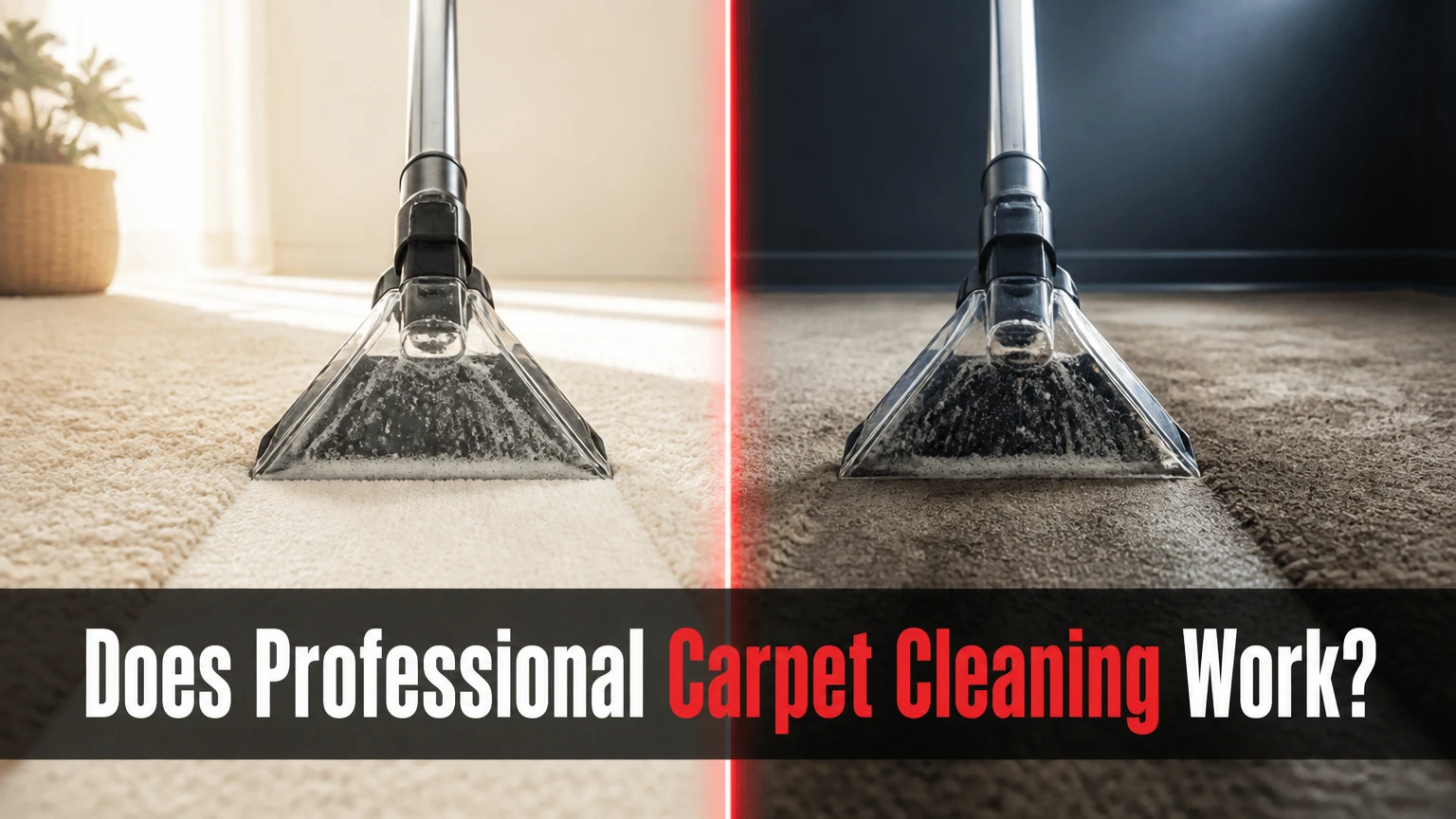
Professional carpet cleaning works when the problem is removable soil, embedded grit, many water-soluble stains, or surface allergens. Hot-water extraction usually removes more soil than routine vacuuming or a rental machine, but professional cleaning cannot reverse fiber wear, bleach marks, carpet delamination, or urine contamination trapped below the carpet pad.
Key facts at a glance
- Professional hot-water extraction commonly takes 20-30 minutes per standard room, excluding furniture moving and setup.
- Carpet drying typically takes 6-12 hours with good airflow, but dense padding, humidity, and overwetting can extend drying beyond 24 hours.
- Typical residential pricing is about $100-$150 minimum per visit, with many jobs priced at $30-$80 per room or $0.20-$0.50 per square foot.
- “Steam cleaning” usually describes hot-water extraction, not a carpet filled with live steam.
- Professional cleaning removes soil and some allergens, but a universal 98% allergen-removal claim is not reliable without a defined test method.
- Cleaning improves appearance only when discoloration comes from soil rather than permanent wear, dye loss, or fiber damage.
How well does professional carpet cleaning work?
Professional carpet cleaning produces a meaningful improvement when carpet fibers contain dry particulate soil, oily residues, tracked-in grit, or stains that have not chemically damaged the fiber. The strongest results come from combining dry vacuuming, a suitable preconditioner, mechanical agitation, controlled rinsing, and powerful water recovery.
The result is less predictable when the carpet has flattened traffic lanes, sun fading, permanent dye transfer, delamination, or pet urine in the pad and subfloor. A technician can clean the fiber while leaving the underlying odor source untreated.
What professional cleaning removes
| Contaminant or condition | Typical result | Main limitation |
|---|---|---|
| Dry soil and household dust | High removal after pre-vacuuming and extraction | Soil embedded below the pad may remain |
| Oily traffic-lane residue | Moderate to high removal | Old polymerized oil may need multiple treatments |
| Food and beverage stains | Moderate to high removal | Heat, age, dye, and prior chemicals affect results |
| Pet urine in carpet fiber | Moderate odor reduction | Pad and subfloor contamination may require subsurface treatment |
| Flattened nylon or polyester pile | Low visual recovery | Fiber memory and wear cannot be cleaned back into shape |
| Bleach or sunlight color loss | No color restoration | Dye replacement or carpet repair is required |
The Institute of Inspection Cleaning and Restoration Certification, commonly called the IICRC, treats carpet cleaning as a system involving fiber identification, soil inspection, cleaning chemistry, agitation, extraction, and drying. That framework matters because equipment power alone does not compensate for choosing the wrong pH, temperature, or moisture level.
Why does extraction clean deeper than vacuuming?
Hot-water extraction cleans deeper because a cleaning solution loosens soil inside the pile while a vacuum system removes suspended soil and spent solution through the carpet. A household vacuum removes loose particulate matter from accessible surfaces, but it cannot recover liquid soil from the backing or pad.
Professional technicians generally begin with dry soil removal because adding water to loose dust creates a heavier slurry. The technician then applies a pre-spray, allows dwell time, agitates where appropriate, and makes controlled extraction passes. High recovery is more important than simply applying hot water.
Is “steam cleaning” really steam cleaning?
“Steam cleaning” is the common consumer name for hot-water extraction, and most residential carpet is cleaned with heated water rather than saturated steam. A truck-mounted or portable extractor sprays solution through a wand and immediately recovers much of the liquid, suspended soil, and detergent.
Equipment specifications vary substantially. A truck-mounted machine may heat solution at the machine, while a portable unit may have lower heat and vacuum capacity. The temperature at the carpet surface is also lower than the heater or machine rating, so claims that a 200-250°F machine setting automatically sterilizes carpet are misleading.
Professional extraction is designed primarily for soil removal. Sanitization requires a validated process, sufficient contact time, and an appropriate antimicrobial product, and ordinary carpet cleaning should not be described as sterilization.
Which professional method works best?
Hot-water extraction is usually the best default for synthetic residential carpet with moderate or heavy soil because it combines chemical cleaning with physical flushing and recovery. Very-low-moisture methods are often better for rapid reoccupancy, commercial maintenance, or moisture-sensitive installations.
| Method | Moisture and mechanism | Typical dry time | Best application | Main risk or limit |
|---|---|---|---|---|
| Hot-water extraction | Heated solution, pressure spray, vacuum recovery | 6-24 hours | Synthetic carpet, heavy soil, periodic deep cleaning | Overwetting or slow drying |
| Encapsulation | Polymer detergent crystallizes around soil for later vacuuming | 1-2 hours | Commercial routine maintenance | Less effective on grease and heavy buildup |
| Bonnet cleaning | Rotary absorbent pad cleans upper pile | 1-3 hours | Hotels and lightly soiled commercial carpet | Can move soil downward |
| Dry compound cleaning | Moist absorbent powder is brushed through pile | 0-2 hours | Delicate or moisture-sensitive carpet | Powder residue and limited deep extraction |
| Shampooing | Foaming detergent and mechanical brushing | 6-12 hours | Older commercial applications | Residue and difficult recovery |
When should you choose hot-water extraction?
Choose hot-water extraction for visible traffic lanes, greasy household soil, neglected synthetic carpet, and carpets that need periodic restorative cleaning. Extraction is also useful before applying a protector because soil and residue can interfere with uniform treatment.
Technicians should adjust water volume, pressure, temperature, and rinse chemistry to the carpet construction. Low-profile olefin, dense polyester, nylon, wool, and looped carpet do not all tolerate the same process.
When is low-moisture cleaning the better option?
Low-moisture cleaning is preferable when a business needs carpet ready for use within one or two hours, when the building has limited ventilation, or when frequent maintenance prevents heavy soil accumulation. Encapsulation works particularly well with regular commercial vacuuming because crystallized soil is removed during subsequent vacuum passes.
Low-moisture cleaning is not a universal replacement for extraction. A heavily greasy restaurant entrance or neglected residential hallway may require restorative extraction before encapsulation becomes effective as a maintenance method.
What about wool and natural-fiber carpet?
Wool, sisal, jute, viscose, and other natural fibers require fiber-specific testing and conservative chemistry. Wool cleaning commonly uses a mildly acidic to neutral product, controlled moisture, and limited agitation because excessive alkalinity, heat, or moisture can cause shrinkage, dye bleeding, texture change, or browning.
A technician should identify the fiber before quoting the method. “Organic,” “natural,” and “delicate” do not describe one standardized cleaning requirement.
What happens during a professional appointment?
A competent residential appointment usually follows seven stages: inspection, dry soil removal, preconditioning, agitation, spot treatment, extraction, and drying. The technician should explain the carpet’s construction, expected outcome, limitations, and post-cleaning care before applying solution.
- Inspect and identify the carpet. The technician checks fiber type, backing, seams, wear, stains, furniture dye transfer, and prior treatments.
- Pre-vacuum thoroughly. Dry vacuuming removes loose particulate soil before moisture turns it into slurry.
- Apply preconditioner. A suitable detergent loosens oily binders; dwell time is commonly several minutes, according to the product label.
- Agitate the pile. A carpet rake, brush, or counter-rotating brush distributes chemistry and loosens compacted soil without damaging loops.
- Treat spots separately. Protein, tannin, oil, synthetic dye, and urine stains need different chemistry and exposure limits.
- Extract and rinse. The technician flushes loosened soil while recovering solution, then uses a rinse that reduces remaining detergent when the system requires it.
- Groom and accelerate drying. Air movers, ventilation, HVAC operation, and controlled furniture placement reduce drying time.
A useful checkpoint is the recovery process: extracted water should become progressively clearer, and the technician should make additional dry passes when the carpet feels heavily wet. A carpet that looks clean but remains saturated has not been serviced well.
How long does professional carpet cleaning take?
A standard room commonly takes 20-30 minutes to clean once equipment is positioned, while a whole-home appointment often takes 2-4 hours. Furniture moving, stairs, severe staining, multiple cleaning methods, and urine treatment can add substantial time.
| Job factor | Typical range | Why the range changes |
|---|---|---|
| One standard room | 20-30 minutes | Room size, furniture, and soil level |
| Ten carpeted stairs | 30-60 minutes | Stair shape and hand-tool work |
| Two-bedroom home | 1.5-3 hours | Carpet area and furniture movement |
| Whole-home extraction | 2-4 hours | Number of rooms, access, and treatment |
| Pet urine subsurface work | 30-120 additional minutes | Number of spots and pad access |
| Commercial encapsulation visit | 1-4 hours | Square footage and drying requirements |
How long does carpet take to dry?
Most professionally extracted carpet dries in 6-12 hours with normal humidity, strong airflow, and good water recovery. Dense padding, cold weather, high indoor humidity, poor ventilation, or excess solution can extend drying to 24 hours or longer.
Keep people and pets off the carpet until it is dry, or follow the cleaner’s specific instructions. Place furniture tabs or foil under legs when advised, avoid replacing items that can transfer dye, and use air movers or a dehumidifier if the carpet remains damp.
A musty odor after 24 hours is a warning sign rather than a normal result. Increase airflow immediately and contact the company if dampness, odor, rippling, or browning persists.
How much does professional carpet cleaning cost?
Typical residential carpet cleaning costs about $30-$80 per room or $0.20-$0.50 per square foot, but a $100-$150 minimum service charge is common. Pet urine treatment, stairs, furniture moving, deodorizer, protector, access difficulty, and regional labor costs often determine the final invoice.
| Pricing component | Typical amount | Common billing condition |
|---|---|---|
| Minimum service charge | $100-$150 | Small jobs or distant travel |
| Standard room | $30-$80 | Defined room size, often up to 200 square feet |
| Square-foot pricing | $0.20-$0.50 | Larger homes or commercial carpet |
| Stair cleaning | $3-$8 per stair | Separate stair or step pricing |
| Carpet protector | $0.15-$0.35 per square foot | Optional post-cleaning treatment |
| Pet urine treatment | $25-$100 per area | Severity and subsurface access |
| Furniture moving | $10-$40 per room | Heavy or extensive furniture |
Ask whether the quote includes pre-vacuuming, moving ordinary furniture, spot treatment, deodorizer, taxes, and a return visit for unresolved problems. A low advertised room price may exclude the minimum charge or apply only to rooms meeting strict size and access conditions.
Is professional cleaning better than DIY?
Professional cleaning is usually better for deep soil, large areas, difficult stains, and carpets where excess moisture could cause damage, because trained technicians combine stronger recovery equipment with fiber-specific chemistry. DIY cleaning can be reasonable for small fresh spills, routine vacuuming, or a lightly soiled rental property when the operator can control water use.
| Decision factor | Professional service | Rental or home machine |
|---|---|---|
| Typical equipment cost | $100-$300 per visit | $30-$60 per rental day or $150-$500 purchase |
| Water recovery | High-capacity vacuum system | Lower recovery on many consumer units |
| Technician time | 2-4 hours for a whole home | 4-8 labor hours including setup |
| Chemical selection | Multiple pH and stain categories | Limited consumer formula range |
| Drying outcome | Commonly 6-12 hours | Often 12-24 hours if overfilled |
| Damage risk | Lower with trained inspection | Higher from excess water or wrong chemistry |
| Best use | Heavy soil and periodic deep cleaning | Fresh spills and small maintenance jobs |
The table does not mean every professional produces better results. An inexperienced operator can overwet carpet, use excessive alkaline detergent, or fail to extract enough water. A careful DIY user can outperform a poor contractor on a small, simple area.
When is DIY cleaning sufficient?
DIY cleaning is sufficient for a fresh spill that has not spread into the backing, a small low-traffic area, or a temporary cleaning need before a property inspection. Blot liquid, avoid aggressive rubbing, use a compatible spotter, and test the product in an inconspicuous area.
A rental machine becomes less attractive when the carpet is large, thick, heavily soiled, wool, or already slow to dry. The operator must transport equipment, mix chemicals correctly, refill and empty tanks, make dry passes, and protect wood flooring from moisture.
Can professional cleaning remove pet stains and odors?
Professional cleaning can remove many surface pet stains and reduce odor, but extraction limited to the carpet face cannot guarantee removal of urine that has reached the pad, tack strips, or subfloor. Persistent pet odor usually requires locating affected areas with inspection tools and treating or replacing contaminated materials.
Enzyme products are designed for particular organic residues, but they do not make every urine problem disappear instantly. The cleaner may need to lift carpet, remove sections of pad, seal a subfloor, or perform subsurface extraction.
Request a written explanation of what the quoted pet treatment includes. “Deodorizer” may mask odor temporarily, while source removal addresses contamination.
Does professional cleaning improve indoor air quality?
Professional carpet cleaning can reduce dust, tracked-in soil, and some allergen-bearing particles, especially when technicians first remove dry soil and then recover the cleaning solution. It does not permanently remove allergens from the home because people, pets, ventilation, bedding, and upholstered furniture continually reintroduce them.
The AI Overview’s universal claim that professional cleaning removes up to 98% of common household allergens should not be treated as a general guarantee. A percentage requires a defined allergen, surface, collection method, cleaning protocol, and laboratory test. The Asthma and Allergy Foundation of America recommends reducing allergen reservoirs through broad household controls, not relying on one carpet treatment.
People with asthma or fragrance sensitivity should ask about fragrance-free products, ventilation, drying time, and residue management. Carpet cleaning is a maintenance measure, not medical treatment.
Which stains can professional cleaners remove?
Professional cleaners remove many soil-based and water-soluble stains, but heat, age, dye chemistry, oxidation, and prior spotters determine the result. Red food dye, hair dye, permanent ink, bleach, rust, and prolonged urine exposure may require specialized restoration or may remain permanently altered.
| Stain type | Likely treatment | Typical outcome |
|---|---|---|
| Coffee or tea | Tannin or acidic spotter | Moderate to high removal if treated early |
| Grease or cooking oil | Solvent or alkaline preconditioner | Moderate to high removal |
| Red beverage dye | Red-dye reducer or controlled heat | Variable, sometimes high |
| Blood or protein | Enzyme or protein-specific chemistry | High when untreated and cool |
| Rust | Reducing agent | Variable, fiber and backing dependent |
| Bleach mark | No cleaning chemistry | No soil removal, color remains lost |
| Permanent ink | Solvent treatment | Variable, dye migration possible |
A technician should inspect before promising complete removal. Overpromising is a service-quality warning because stain removal can involve color loss, texture change, or damage to the backing.
How often should carpet be professionally cleaned?
Most homes benefit from professional cleaning every 12-18 months, while households with pets, children, heavy traffic, or allergy concerns may need cleaning every 6-12 months. Commercial carpet may need low-moisture maintenance monthly or quarterly, with restorative extraction scheduled according to soil loading and manufacturer guidance.
Vacuum high-traffic areas frequently, use entry mats, remove shoes when practical, and treat spills promptly. Cleaning frequency should follow soil accumulation rather than an automatic calendar.
Carpet warranties may specify vacuuming and professional cleaning intervals. Check the manufacturer’s care document before using high heat, stain-resistant treatments, or an unfamiliar chemical.
When can professional cleaning cause problems?
Professional cleaning can cause problems when a technician uses excessive water, unsuitable chemistry, aggressive agitation, or insufficient extraction for the carpet construction. Common consequences include browning, shrinkage, delamination, color bleeding, rippling, sticky residue, and extended drying.
What should you do if stains return after cleaning?
Returning stains usually indicate wicking, where liquid and dissolved soil travel upward from the backing or pad as carpet dries. Blot the area with a clean white towel, avoid adding more household cleaner, and contact the company for a corrective visit.
A professional may re-extract the spot with controlled moisture, use an absorbent treatment, or access contaminated padding. Repeatedly wetting the same area without addressing the backing can enlarge the mark.
What if carpet ripples or smells musty?
Temporary ripples can occur when carpet and backing absorb moisture, but persistent buckling may require professional restretching. If a musty odor or dampness remains beyond 24 hours, increase ventilation, run HVAC or dehumidification, and notify the cleaner.
Carpet that stays wet for an extended period has increased risk of odor and microbial growth. Do not apply fragrance to conceal the problem.
How do you choose a reliable carpet cleaner?
Choose a carpet cleaner who inspects the carpet, explains the method, gives a written scope, and states realistic limitations before starting. Look for IICRC training where relevant, proof of insurance, transparent minimum charges, and a documented process for complaints or failed stain treatments.
Ask these questions:
- What fiber and backing do you identify, and what test will you perform?
- Is the quoted method hot-water extraction, encapsulation, bonnet cleaning, or another process?
- What is included in the room price and minimum charge?
- How will you control moisture and expected drying time?
- Are pet urine, stairs, furniture moving, and protector priced separately?
- What happens if a stain wicks back or odor remains?
- Which products contain fragrance, solvents, enzymes, or antimicrobial ingredients?
Avoid companies that guarantee every stain will disappear, claim that any carpet is “sanitized” solely because water is hot, or refuse to discuss drying and chemical residue.
What is professional carpet cleaning not good for?
Professional carpet cleaning is not a reliable way to restore fiber worn flat by years of traffic, replace color removed by bleach, repair torn seams, correct delamination, or remove every odor from contaminated structural materials. Cleaning improves removable soil; it does not reverse physical or chemical damage.
A practical inspection separates four conditions: removable soil, treatable staining, permanent discoloration, and structural damage. The first two justify cleaning, the third may need dyeing or replacement, and the fourth requires carpet repair or replacement.
That distinction protects the homeowner from paying for repeated cleaning when the carpet has reached the end of its serviceable life.
Frequently Asked Questions
Does carpet cleaning remove dust mites?
Professional extraction can remove dust, mite debris, and some allergen-bearing material from carpet, while heat and moisture conditions may affect living organisms. Ordinary carpet cleaning should not be advertised as complete dust-mite eradication because surviving allergens can remain in carpet, bedding, upholstery, and settled household dust.
Should carpet be vacuumed before professional cleaning?
Yes. Vacuuming before the appointment removes loose dry soil that would otherwise become wet slurry during extraction. Some companies include commercial pre-vacuuming, but homeowners should remove small objects and vacuum heavy debris beforehand, especially in high-traffic areas.
Can I walk on carpet after professional cleaning?
Wait until the carpet is dry whenever possible, commonly 6-12 hours. If walking is necessary, use clean socks or indoor footwear and avoid replacing furniture until the technician confirms the surface can support it without transfer, imprinting, or re-soiling.
Does carpet protector make cleaning unnecessary?
No. Carpet protector can increase resistance to future spills and slow soil bonding, but protector does not replace vacuuming or periodic extraction. Heavy traffic, abrasive grit, pet contamination, and sticky residues still require removal through routine maintenance.
Is professional carpet cleaning safe for pets and children?
Professional cleaning can be compatible with pets and children when the products are used according to their labels and the carpet is fully dry before normal access. Ask for product names, ventilation guidance, and fragrance-free options, and keep occupants away from wet carpet and equipment during service.
Should carpet cleaning be done before or after painting?
Clean carpet after painting and other dusty renovation work. Paint sanding, drywall dust, and construction debris can settle into freshly cleaned fibers, while cleaning afterward removes the new soil and addresses any paint spots before they cure.
Conclusion: Does professional carpet cleaning work?
Yes, professional carpet cleaning works best when embedded soil, grit, oily residue, or treatable stains are the problem and the technician matches moisture, chemistry, agitation, and extraction to the carpet. Professional cleaning cannot repair worn fibers or guarantee removal of deep urine, permanent dye loss, or every allergen. Choose a transparent cleaner, confirm the method and total price, and plan for 6-12 hours of drying.