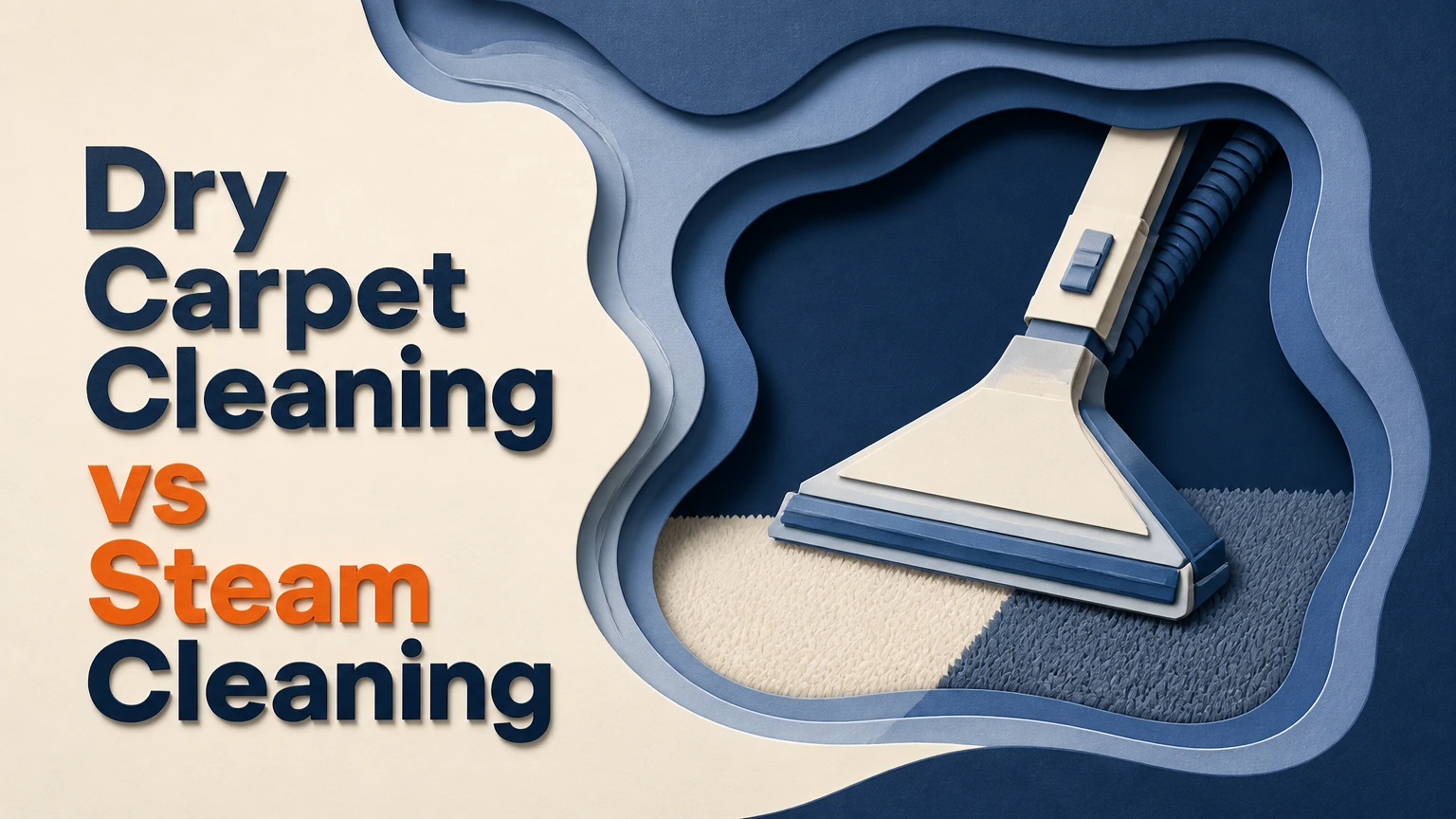
Steam cleaning (hot water extraction) flushes debris from the carpet backing using highly pressurized water, making it the best choice for heavy soil, pet stains, and allergy relief. Dry carpet cleaning (low-moisture cleaning) utilizes chemical polymers to encapsulate surface dirt for mechanical removal, offering zero downtime for commercial spaces and delicate natural fibers.
Key Facts at a Glance
- Moisture Level: Steam cleaning uses 1.5–4 gallons of water per 100 square feet; dry cleaning uses 0.1–0.5 gallons.
- Drying Time: Dry cleaning allows immediate foot traffic (0–2 hours), whereas steam cleaning requires 6–24 hours of drying time.
- Cost Comparison: Steam cleaning averages $0.25 to $0.50 per square foot, while dry cleaning runs slightly higher at $0.30 to $0.60 per square foot due to specialized chemical costs.
- Warranty Compliance: Major carpet manufacturers like Shaw and Mohawk require professional steam cleaning every 12 to 18 months to keep residential warranties valid.
- Allergen Removal: Steam cleaning removes up to 99% of embedded dust mites and bacteria through $150^{\circ}\text{F}$ to $210^{\circ}\text{F}$ water temperatures.
Quick Verdict: Which Method Wins?
- For households with pets, children, or heavy allergies: Steam Cleaning.
- For commercial offices, retail stores, or 24/7 facilities: Dry Carpet Cleaning.
- For delicate natural fibers (wool, sisal, jute): Dry Carpet Cleaning.
- For neglected carpets, move-outs, or warranty compliance: Steam Cleaning.
Master Comparison: Steam vs. Dry Carpet Cleaning
| Feature | Steam Cleaning (Hot Water Extraction) | Dry Carpet Cleaning (Low-Moisture) |
| Cleaning Depth | Deep (flushes the carpet backing and pad) | Shallow to Mid-Pile (surface encapsulation) |
| Average Cost / Sq Ft | $0.25 – $0.50 | $0.30 – $0.60 |
| Average Cost / Room | $40 – $85 | $50 – $95 |
| Drying Time | 6 to 24 hours | 0 to 2 hours |
| Water Usage | High (1.5 – 4 gallons per 100 sq ft) | Low (0.1 – 0.5 gallons per 100 sq ft) |
| Stain & Odor Removal | Excellent (extracts bio-contaminants) | Moderate (struggles with heavy liquid saturation) |
| Risk Factors | Over-wetting, wicking, slipping hazards | Chemical residue build-up, hazy appearance |
How Does Each Cleaning Method Work?
Understanding the underlying chemistry and mechanics reveals why these two methods yield drastically different results.
The Steam Cleaning (HWE) Process
Steam cleaning—professionally known as Hot Water Extraction (HWE)—does not actually use true gas-phase steam, as true steam would melt synthetic carpet fibers. Instead, hot water extraction relies on high-temperature water ($150^{\circ}\text{F}$ to $210^{\circ}\text{F}$) combined with extreme pressure and suction.
The technician applies an alkaline pre-spray (pH 9-10) to break down oily traffic lanes. A machine agitates the fibers, and then an extraction wand blasts the hot water into the carpet backing while a heavy-duty vacuum instantly pulls the water, dirt, and allergens out. Finally, an acidic rinse (pH 4-5) neutralizes the carpet to prevent a stiff, sticky residue.
The Dry Carpet Cleaning (VLM) Process
Dry carpet cleaning, or Very Low Moisture (VLM) cleaning, substitutes heavy water volume for advanced chemical engineering. This method relies on specialized absorbing compounds or liquid encapsulating polymers.
The technician mists a low-moisture pre-treatment over the carpet. Next, they spread a dry powder or liquid polymer across the surface. A Counter-Rotating Brush (CRB) machine physically scrubs the compound into the carpet pile. The chemicals act like microscopic magnets, dissolving oils and crystallizing around dirt particles during a 10 to 20-minute dwell time. A commercial vacuum then extracts the crystallized, dirt-filled compounds.
Which Method Cleans Deeper?
Steam cleaning provides a profoundly deeper clean than dry carpet cleaning. Hot water extraction flushes contaminants from the very base of the carpet fibers and the primary backing.
Dry carpet cleaning is mechanically limited to the upper and middle sections of the carpet pile. While encapsulation polymers excel at removing surface oils and restoring the visual appearance of a room, they cannot physically reach the carpet padding to flush out compacted silt, heavy sand, or saturated pet urine.
Winner: Steam Cleaning.
How Long Does Drying Take?
Dry carpet cleaning wins the drying time comparison effortlessly, requiring zero to two hours before the carpet accepts normal foot traffic. In many commercial encapsulation applications, the carpet is dry the moment the technician finishes vacuuming.
Steam cleaning requires 6 to 24 hours of drying time. The exact duration depends heavily on the suction power of the technician’s equipment (truck-mounted units leave carpets much drier than portable units), indoor humidity, and air circulation. Walking on wet carpet immediately after steam cleaning compresses the fibers and transfers new dirt from shoe soles directly into the damp yarn.
Winner: Dry Carpet Cleaning.
How Much Does Each Method Cost?
Dry carpet cleaning costs slightly more per square foot, averaging $0.30 to $0.60, compared to steam cleaning’s average of $0.25 to $0.50.
The price difference comes down to consumable materials. Steam cleaning relies on water, heat, and standard detergents. Dry cleaning requires expensive, specialized encapsulation polymers or organic absorbent micro-sponges. However, steam cleaning generally takes longer to perform (30 to 45 minutes per room) compared to dry cleaning (20 to 30 minutes), which can sometimes balance out the final invoice depending on the contractor’s minimum call-out fee.
Winner: Steam Cleaning (by a slight margin).
Which Method is Safer for Carpet Fibers?
Dry carpet cleaning is significantly safer for delicate, natural, or luxury rug fibers. Natural materials like wool, sisal, jute, and coir absorb massive amounts of water. If subjected to steam cleaning, natural fibers can shrink, bleed dyes, lose structural integrity, or develop a sour mildew odor.
Conversely, synthetic carpets (nylon, polyester, olefin) thrive under steam cleaning. In fact, major carpet manufacturers like Shaw Industries and Mohawk explicitly mandate hot water extraction every 12 to 18 months. Using a dry bonnet cleaning method on a synthetic plush carpet can void the warranty, as the spinning friction damages the yarn twist.
Winner: Dry Cleaning for natural fibers; Steam Cleaning for synthetic wall-to-wall carpets.
What Are the Most Common Cleaning Mistakes?
Both dry and steam cleaning can ruin a carpet if executed poorly by an uncertified operator. Understanding these failure modes helps you evaluate your cleaning professional.
Steam Cleaning Pitfalls
- Over-Wetting: Pumping excess water into the carpet without adequate vacuum suction saturates the underlying pad. This leads to mold growth and a sour odor within 48 hours.
- Stain Wicking: When stains resting deep in the carpet pad dissolve in water, they travel up the damp fiber via capillary action, reappearing on the surface as the carpet dries.
- Sticky Residue: Failing to use a neutralizing acidic rinse leaves alkaline detergents behind. This sticky residue acts as a dirt magnet, causing the carpet to look filthy again within weeks.
Dry Cleaning Pitfalls
- Powder Left Behind: Skipping the final, intensive vacuuming stage leaves white absorbent powders trapped in the carpet pile, resulting in a hazy, dusty appearance and poor indoor air quality.
- Chemical Overuse: Applying too much encapsulating polymer causes the carpet fibers to feel stiff, crunchy, or brittle to the touch.
- Bonnet Damage on High-Pile: Using a rotary bonnet machine (a spinning absorbent pad) on thick, cut-pile carpets physically frays and destroys the fibers. Bonnet cleaning should only be used on low-profile commercial loop carpets.
Which Should You Choose?
The decision between dry carpet cleaning vs steam cleaning hinges entirely on your environment and the carpet’s material.
Choose Steam Cleaning If:
You are moving out of a home, managing heavy pet accidents, suffering from indoor allergies, or maintaining a synthetic carpet warranty. Steam cleaning is the restorative gold standard. It flushes out biological contaminants and physically resets crushed, twisted fibers, extending the structural life of the carpet.
Choose Dry Carpet Cleaning If:
You manage a busy commercial office, run a retail space, or own expensive natural-fiber rugs. Dry cleaning prevents tripping and slipping hazards by eliminating wet floors. Encapsulation cleaning handles high-volume foot traffic efficiently and allows a business to maintain a clean appearance without shutting down operations for 12 hours.
Frequently Asked Questions
Does steam cleaning ruin carpets?
Steam cleaning only ruins carpets if performed incorrectly. Over-wetting the carpet pad or using extreme heat on natural fibers like wool can cause shrinkage and mildew. When performed by an IICRC-certified professional on synthetic carpets, steam cleaning actually extends the carpet’s lifespan by removing abrasive dirt.
Is dry carpet cleaning safe for pets?
Yes, modern dry carpet cleaning compounds are generally non-toxic and safe for pets. However, dry cleaning is highly ineffective at removing deep pet urine saturation from the carpet padding; for pet urine, hot water extraction combined with enzymatic treatments is mandatory.
How often should I professionally clean my carpets?
Residential carpets should receive professional steam cleaning every 12 to 18 months to remove embedded abrasives and maintain manufacturer warranties. High-traffic commercial carpets should undergo dry encapsulation cleaning every 1 to 3 months, followed by an annual restorative steam clean.
Can I walk on the carpet immediately after cleaning?
You can walk on a dry-cleaned carpet immediately. If the carpet was steam cleaned, you should wait 6 to 24 hours. Walking on damp carpet compresses the pile and easily transfers dirt from bare feet, socks, or shoes straight into the wet fibers.
Is bonnet cleaning the same as dry cleaning?
No. Bonnet cleaning uses a spinning absorbent pad to buff dirt off the surface of commercial loop carpets. It is a maintenance technique, not a deep cleaning method. True dry cleaning involves working encapsulating polymers or absorbent powders deep into the pile using a counter-rotating brush.