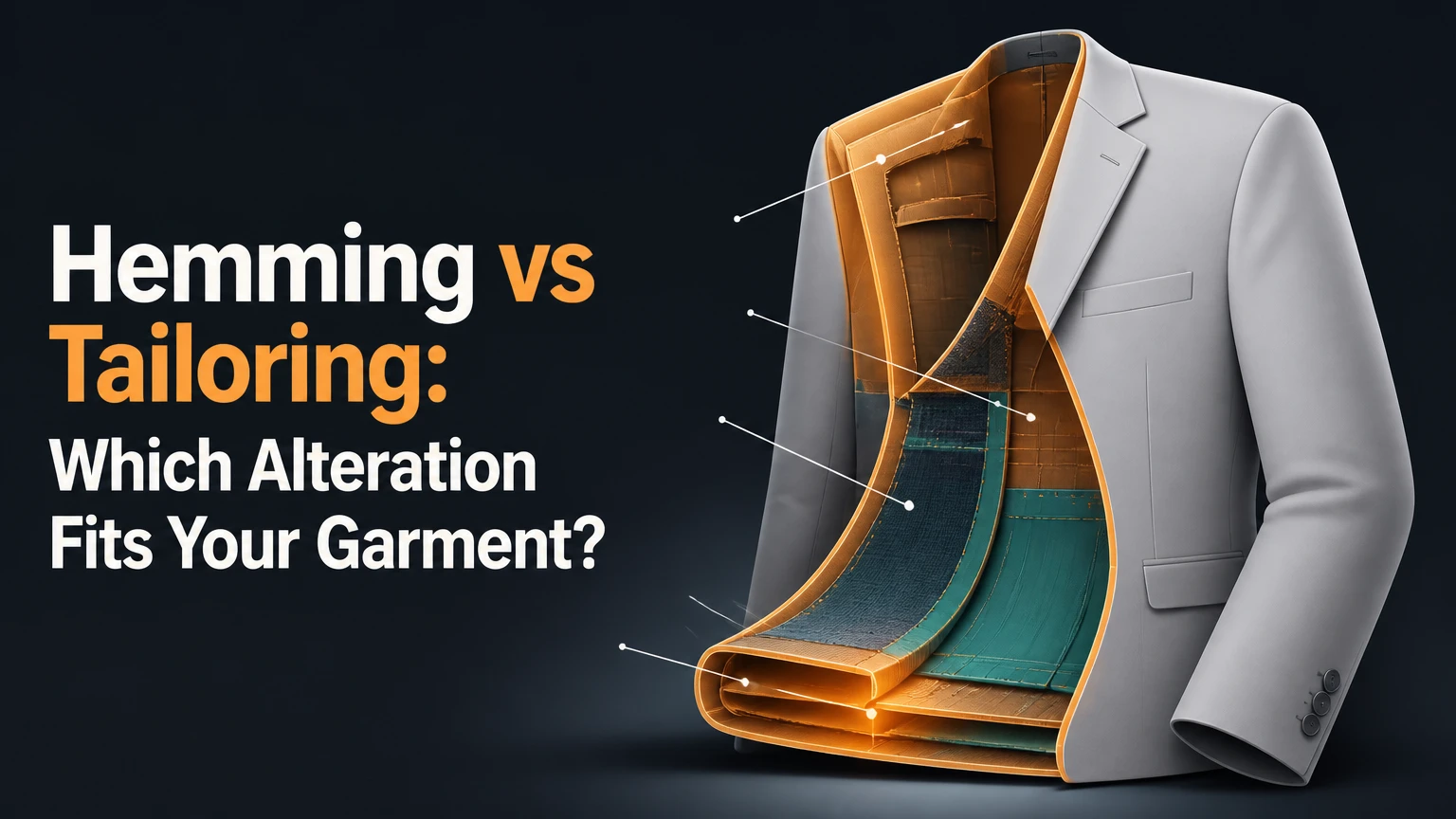
Hemming is a specific garment alteration that changes an edge length, while tailoring is the broader practice of changing clothing fit, shape, or construction. Choose hemming when pants, sleeves, skirts, or dresses are too long; choose broader tailoring when the waist, width, shoulders, rise, silhouette, or drape also needs adjustment.
Key Facts at a Glance
- Hemming changes garment length at an edge; it usually does not change circumference or body fit.
- Tailoring includes hemming, tapering, taking in seams, adjusting waists, reshaping darts, and modifying shoulders.
- Typical basic hemming costs $15-$35 and takes 2-7 days, while structural tailoring commonly costs $25-$250 or more.
- Pants should be fitted while wearing the intended shoes because heel height changes the correct hem position.
- A tailor can usually remove excess fabric more reliably than add fabric, because letting out requires usable seam allowance.
- The best garment to alter fits correctly at the shoulders, chest, hips, and rise before length is changed.
What Is the Difference Between Hemming and Tailoring?
Hemming changes the finished length of a garment by folding, trimming, and securing an edge. Tailoring changes a garment’s fit or construction through seams, darts, panels, linings, sleeves, or structural components, so hemming is one narrow service within the larger alteration category.
The distinction is easiest to understand by direction. Hemming is primarily a vertical adjustment: a trouser leg becomes shorter, or a sleeve ends closer to the wrist. Tailoring can change several dimensions at once, including waist circumference, thigh width, shoulder angle, sleeve pitch, jacket suppression, and shirt torso shape.
In everyday retail language, “alterations” is often the most accurate umbrella term. “Tailoring” may also mean making a garment from a pattern, producing made-to-measure clothing, or creating a bespoke suit. A shop that advertises tailoring services usually means alterations for existing garments, but customers should confirm the exact work before accepting a quote.
What Does Hemming Change?
Hemming changes where a garment ends and how the raw edge is finished. A trouser hem can create a full break, half break, quarter break, or no break; each option changes the amount of fabric resting on the shoe without changing the waist or thigh fit.
Hemming normally does not correct fabric pulling across the hips, a loose waistband, a wide leg, a sloping shoulder, or excess material in a jacket body. A shorter garment can look cleaner while remaining poorly fitted elsewhere.
What Does Tailoring Change?
Tailoring changes the relationship between the garment and the wearer’s body. Common work includes taking in a waistband, tapering a pant leg, adding shirt darts, shortening a jacket sleeve, adjusting a jacket waist, and reshaping a skirt or dress through side seams.
Structural tailoring becomes more difficult when the alteration affects a lining, interfacing, pocket, zipper, buttonhole, original topstitching, or sleeve head. Tailors assess garment balance, not merely the amount of fabric to remove.
How Does Each Alteration Work?
Hemming usually involves five operations: fitting, marking, trimming, finishing, and pressing. Structural tailoring adds seam opening, new sewing lines, temporary basting, a second fitting, and careful reassembly because the garment must preserve its original balance.
How Is a Garment Hemmed?
A professional hemming appointment generally follows these steps:
- Fit the garment with the intended shoes. The tailor pins the proposed length while the wearer stands naturally. Pants should be evaluated from the side and front, not only while seated.
- Choose the hem style. The tailor identifies a blind hem, visible machine hem, original jean hem, cuff, rolled hem, or another finish based on fabric and design.
- Mark the fold and cutting line. The finished length and internal hem allowance are marked separately. A typical allowance is about 1-2 inches, although the pattern and fabric determine the safe amount.
- Trim excess fabric. The tailor checks whether the original edge, decorative border, vent, flare, or distressing will be affected before cutting.
- Finish and stitch the edge. The raw edge may be serged, folded twice, pinked, bound, or stabilized before hand or machine stitching.
- Press the completed hem. Heat, steam, and a firm pressing surface set the fold and remove handling marks.
A successful hem has an even finished length, a stable edge, no rippling, and stitching appropriate to the garment. A tailor should stop and discuss alternatives if shortening would remove a border, distort a curved hem, or place a jacket vent incorrectly.
How Does Structural Tailoring Work?
Structural tailoring begins with diagnosis rather than cutting. The tailor identifies where the garment hangs incorrectly, pins excess along suitable seam lines, opens the relevant construction, and often bastes a temporary adjustment before permanent stitching.
For example, taking in a jacket waist may involve opening side seams, separating the lining, marking a gradual new seam line, grading the seam allowance, stitching the shell and lining, and pressing the altered area over a tailor’s ham. A jacket with functional sleeve buttonholes may need the sleeve shortened from the shoulder rather than from the cuff.
The fitting checkpoint matters. If the tailor permanently removes fabric before confirming the new balance, the garment may develop diagonal pulls, displaced pockets, a twisted sleeve, or a waist that looks narrow from one angle and loose from another.
Which Hem Types and Tailoring Adjustments Are Available?
The correct technique depends on fabric weight, construction, original details, and the amount of length or width involved. A blind hem suits formal wool trousers, while an original jean hem protects factory stitching and fading that a standard cut-and-fold hem would remove.
Common Hem Types
| Hem type | Typical garment or fabric | Visible result | Main constraint |
|---|---|---|---|
| Blind hem | Wool trousers, skirts, formal dresses | Minimal exterior stitching | Requires suitable fold depth and stable fabric |
| Machine topstitch | Jeans, chinos, cotton trousers | Visible straight stitching | Thread color and stitch length must match |
| Original or Euro hem | Distressed denim | Preserves factory edge and contrast thread | Usually costs more because the edge is removed and reattached |
| Cuffed hem | Dress trousers, some skirts | Visible 1.5-2-inch folded cuff | Requires enough lower-leg fabric and internal allowance |
| Rolled or formed hem | Silk, chiffon, scarves, bridal veils | Narrow 1/8-inch or smaller edge | Difficult to control on slippery or lightweight fabric |
| Lace or border hem | Bridal gowns, decorated dresses | Preserves a designed lower edge | Shortening may require panel-by-panel reconstruction |
The original hem on jeans is a construction choice, not merely a decorative preference. Cutting above the factory edge and adding a new hem can remove fading, abrasion, chain stitching, or the visual proportion intended by the manufacturer.
Common Tailoring Adjustments
| Adjustment | Typical location | Usual direction | Complexity and limitation |
|---|---|---|---|
| Take in waist | Trousers, skirts, jackets | Reduces circumference | Often practical by 1-2 inches, depending on construction |
| Let out seam | Waist, seat, jacket body | Increases circumference | Limited by available seam allowance and fabric condition |
| Taper leg or sleeve | Pants, shirts, jackets | Narrows width toward opening | Must preserve knee position, cuff, vent, and sleeve pitch |
| Add darts | Shirt back, dress waist, skirt panels | Removes localized excess | Can reshape fit but may alter the intended design |
| Shorten sleeve from cuff | Plain jacket or shirt sleeve | Reduces sleeve length | Simple only when cuffs and buttonholes permit it |
| Shorten sleeve from shoulder | Structured jacket | Reduces sleeve length while preserving cuff | More expensive because the sleeve is removed and reset |
| Adjust shoulders | Suit jackets, coats | Changes shoulder width or angle | High-risk work involving sleeve heads and internal structure |
| Reshape side seams | Dresses, shirts, coats | Changes torso or hip contour | Pockets, zippers, lining, and prints may restrict movement |
A tailor can often take in a garment, but letting it out is conditional. Extra cloth hidden inside a seam may provide only 1/2 inch of usable expansion, and pressing marks or needle damage can remain visible after the seam is released.
How Do Hemming and Tailoring Compare?
Hemming is usually faster, cheaper, and less risky because it affects an edge rather than the garment’s internal architecture. Tailoring produces a larger fit change but requires more labor, more fitting judgment, and greater attention to lining, seam placement, grain, and garment balance.
| Decision factor | Hemming | Broader tailoring |
|---|---|---|
| Primary change | Garment length | Fit, width, shape, or structure |
| Main location | Bottom edge or sleeve edge | Seams, darts, shoulders, waistband, lining |
| Typical price | $15-$35 for basic work | $25-$250 or more |
| Typical turnaround | 2-7 days | 3 days to 3 weeks |
| Fitting risk | Low to moderate | Moderate to very high |
| Reversibility | Low after fabric is cut | Sometimes reversible if allowance remains |
| Best first purchase fit | Shoulders, waist, hips, and rise correct | Garment can tolerate construction changes |
| Common failure | Wrong break, wavy edge, uneven length | Pulling, twisting, displaced pockets, poor balance |
Why Is Hemming Usually Cheaper?
Hemming involves fewer operations and normally requires no removal of pockets, zippers, lining sections, or sleeves. A basic trouser hem can often be marked, cut, finished, stitched, and pressed during one short production cycle.
Tailoring prices rise when the tailor must work through layered construction. A jacket sleeve with surgeon’s cuffs, a lined dress with multiple tiers, or a beaded gown may require handwork and repeated fitting, even when the requested change appears small.
How Much Do Hemming and Tailoring Cost?
Typical US alteration prices range from $15-$35 for basic hemming, $25-$55 for common trouser tailoring, and $80-$250 or more for complex jacket or formalwear reconstruction. Local labor rates, fabric, lining, urgency, construction, and original-detail preservation can move the final quote substantially.
| Service | Typical price | Typical turnaround | Main price driver |
|---|---|---|---|
| Plain jeans or casual trouser hem | $15-$25 | 2-5 days | Basic edge and standard stitching |
| Jeans with original hem | $25-$40 | 3-7 days | Removing and reattaching factory hem |
| Lined dress trouser hem | $20-$35 | 3-5 days | Lining and formal finish |
| Pant waist taken in | $25-$45 | 4-7 days | Waistband, seat, and pocket construction |
| Pant leg taper | $30-$55 | 4-7 days | Seam access and desired taper |
| Plain jacket sleeve shortened | $35-$60 | 1-2 weeks | Cuff construction and lining |
| Jacket sleeve shortened from shoulder | $80-$150 or more | 2-3 weeks | Sleeve removal and resetting |
| Gown or layered dress hem | $45-$120 or more | 1-2 weeks | Layers, lace, lining, and embellishment |
| Jacket shoulder adjustment | $100-$250 or more | 2-3 weeks | Sleeve head, padding, canvas, and balance |
Rush service can add roughly 25%-100% to a shop’s normal charge, although each business sets its own policy. A tailor should inspect the garment before promising a fixed price, particularly when the clothing is lined, patterned, vintage, beaded, or made from leather.
Which Garment Problems Need More Than a Hem?
A hem is appropriate when the garment is the correct width and only hangs too low. Broader tailoring is needed when fabric pulls, collapses, twists, gaps, or balloons around the body after the length is visually acceptable.
Use this diagnostic guide:
- Pants touch the floor or pool over the shoe: request hemming and specify the desired break.
- Waist gaps while the seat and thighs fit: request a waist take-in, not a smaller overall size.
- Pant legs look wide from knee to ankle: request tapering, potentially combined with hemming.
- Jacket shoulders extend beyond the natural shoulder: seek a tailor’s assessment before buying; shoulder correction is expensive and may not be worthwhile.
- Shirt fits the neck and shoulders but billows at the waist: back darts or side-seam shaping may solve the problem.
- Sleeve length is wrong but cuff buttons are functional: ask whether shortening from the shoulder is necessary.
- Dress is too long and has multiple layers: request a layer-by-layer hem rather than a single straight cut.
- Fabric pulls diagonally at the hips or crotch: do not shorten first; diagnose rise, seat, and circumference.
A shorter hem cannot correct a garment that is too small across the chest or hips. Likewise, taking in a waist cannot repair a shoulder that is fundamentally too broad or a trouser rise that is too short.
What Should You Check Before Visiting a Tailor?
Wash or dry-clean the garment according to its care label before alteration when shrinkage is possible. Cotton, linen, denim, and some wool garments can change dimensions after cleaning, making a previously accurate hem unsuitable.
Bring the shoes, belt, undergarments, and foundation garments that affect the final fit. A three-inch heel changes trouser length, while shapewear, a thick sweater, or a belt can change the position and tension of a waistband.
Check these details before the appointment:
- Wear the intended shoes. Mark pants with dress shoes, boots, sneakers, or heels as appropriate.
- Decide the trouser break. Full break creates visible stacking, half break gives moderate contact, quarter break gives a cleaner crease, and no break leaves the hem just above the shoe.
- Inspect the inside seams. Look for extra allowance, lining, interfacing, and signs that the garment has already been altered.
- Identify original details. Note cuffs, vents, distressing, embroidery, lace, zippers, pockets, and decorative borders.
- Explain the use case. A work suit, motorcycle trouser, wedding gown, and everyday jean require different mobility and durability choices.
- Ask what cannot be preserved. A professional should identify changes to topstitching, fade patterns, pocket placement, or proportions before cutting.
The most useful instruction is visual and specific. “Shorten these to a quarter break with the shoes I am wearing” gives the tailor more actionable information than “make them look better.”
Can You Hem or Tailor Clothing Yourself?
Basic hemming is a reasonable home sewing project when the fabric is stable, the edge is straight, and the garment has no lining or complex finish. Structural tailoring is less forgiving because a small change in seam angle can create tension, imbalance, or asymmetry that pressing cannot remove.
Home hemming usually requires a measuring tape, pins or clips, fabric chalk, sharp scissors, an iron, matching thread, and either a sewing machine or a hand needle. A beginner should practice on a spare garment before cutting denim, wool trousers, silk, a formal dress, or anything difficult to replace.
Avoid DIY work when:
- The garment contains a patterned plaid or stripe that must match across seams.
- A jacket has canvas, shoulder pads, sleeve heads, or functional buttonholes.
- The hem is curved, layered, beaded, scalloped, or attached to lace.
- The fabric is slippery silk, delicate chiffon, leather, or velvet.
- The garment is expensive, sentimental, vintage, or needed for a fixed event.
- The desired change affects the rise, crotch, armhole, shoulder, or sleeve pitch.
Ironing before and during sewing matters. Fabric stretched under a presser foot can produce a wavy hem, while insufficient pressing can make a correctly stitched hem appear uneven.
When Should You Choose a Seamstress, Tailor, or Alterations Shop?
Choose an alterations shop for routine hemming and common resizing, a tailor for structured menswear or complex fit correction, and a seamstress or dressmaker for soft garments, dresses, repairs, and custom sewing. Titles overlap by region, so the provider’s demonstrated garment experience matters more than the label.
| Provider type | Strongest work | Ask for evidence of | Typical customer need |
|---|---|---|---|
| Alterations shop | Basic hems and everyday resizing | Trouser, jean, skirt, and shirt examples | Fast routine fit changes |
| Tailor | Suits, coats, trousers, structured jackets | Shoulder, sleeve, canvas, and balance work | Professional menswear or formal tailoring |
| Seamstress | Dresses, repairs, soft construction | Curved hems, zippers, lining, and fabric handling | Dresses, skirts, shirts, and repairs |
| Bridal specialist | Gowns and ceremonial clothing | Lace, beading, bustle, and layered hems | Wedding and formal gowns |
| Leather specialist | Leather jackets, trousers, and suede | Leather-specific machines and edge finishes | Repairs or reshaping leather garments |
Ask whether the provider performs a fitting, offers a baste or try-on for complex work, and accepts responsibility for preserving original details. A low price is not useful if the service removes a distinctive hem or creates an obvious mismatch in denim stitching.
What Are the Most Common Alteration Mistakes?
The most common error is choosing the alteration before diagnosing the fit problem. Customers often request a shorter hem when the real issue is a wide leg, incorrect rise, or excess fabric at the seat.
Mistake 1: Fitting Pants With the Wrong Shoes
A hem marked with sneakers may be too short for boots or heels. Bring the exact footwear, or ask the tailor to leave temporary tacking so the length can be reviewed at home.
Mistake 2: Cutting Before Washing
Unwashed cotton and denim may shrink after the alteration. Launder casual garments first, following the care label, then schedule the fitting.
Mistake 3: Buying Several Sizes Too Large
Taking a garment down more than about two structural sizes can move pockets, darts, armholes, and jacket proportions out of alignment. Buy for the largest or hardest-to-expand area, then alter smaller excess where practical.
Mistake 4: Assuming Letting Out Is Always Possible
A seam allowance is not automatically usable fabric. Manufacturers may leave only narrow allowances, clipped corners, damaged cloth, or no extra material at all.
Mistake 5: Tapering Without Checking the Knee
A tailor who narrows only the lower leg can change the visual balance and make jeans appear flared. The taper should follow the intended line from the knee or calf into the hem.
Mistake 6: Ignoring the Garment Grain
A hem can measure evenly yet hang unevenly if the garment is twisted or the grain has shifted. The tailor should assess how the garment falls on the body, not rely only on measurements from a flat table.
How Do You Fix a Bad Hem or Tailoring Result?
A bad alteration should be assessed by symptom before more fabric is removed. Many stitching, pressing, or seam-line problems can be corrected, but an excessively short hem or cut-away seam allowance may be irreversible.
| Symptom after alteration | Likely cause | Practical recovery |
|---|---|---|
| Pants pool over shoes | Finished hem remains too long | Refit for quarter, half, or no break |
| Jeans look flared | Lower leg was not tapered | Taper from the knee or calf, then rehem |
| Hem ripples or puckers | Fabric stretched during stitching | Remove stitches, stabilize, press, and resew |
| One leg hangs shorter | Uneven marking or posture during fitting | Recheck on the wearer and remark both legs |
| Waist pulls at the hips | Seam was taken in too aggressively | Release part of the adjustment if allowance remains |
| Jacket sleeve twists | Sleeve pitch or armhole was disturbed | Request a structural review before further trimming |
| Pattern or stripe no longer aligns | Seam was reshaped without matching | Restore alignment where fabric and allowance permit |
Return promptly if the result differs from the agreed fitting. Do not wash, alter, or wear the garment extensively before the shop reviews the work, because new damage can make responsibility harder to determine.
Which Alteration Should Different Wearers Choose?
The correct choice depends on the garment’s existing fit, the wearer’s proportions, and the value of preserving original construction. A thrifted trouser that fits the waist and seat but is long is a strong hemming candidate; a suit with poor shoulders may be a poor alteration candidate even if the fabric is expensive.
The Budget-Conscious Shopper
Prioritize garments that fit the shoulders, chest, waist, hips, and rise, then budget for hemming. A $15-$35 hem can improve a secondhand garment substantially, while complex shoulder work can exceed the garment’s purchase price.
The Office Professional
For a suit, prioritize trouser length, jacket sleeve length, and modest jacket-waist suppression. These changes usually create more visible improvement than aggressive reshaping, provided the shoulders and chest already fit.
The Athletic or Muscular Build
Buy trousers to fit the thighs and seat, then take in the waist if needed. Expanding thighs is often impossible without matching fabric, while removing 1-2 inches from a waistband is commonly practical.
The Petite or Tall Wearer
Length alterations may be necessary on trousers, sleeves, dresses, and jackets. Petite wearers should ask whether a jacket sleeve or dress hem can be adjusted without moving pockets, vents, buttons, or decorative placement.
The Wedding or Formalwear Customer
Use a specialist for gowns, tuxedos, heavily lined dresses, or embellished garments. Schedule the final fitting close enough to the event to reflect current footwear and undergarments, but early enough to allow a correction appointment.
What Is the Best Order for Multiple Alterations?
When a garment needs several changes, fit the body and structure before finalizing the hem. A waist take-in, seat adjustment, taper, or jacket reshaping can change how the garment hangs, so the final length should be confirmed after those alterations.
A practical order is:
- Wash or clean the garment.
- Assess shoulders, chest, waist, hips, rise, and overall balance.
- Mark structural changes such as waist reduction or tapering.
- Perform a baste or first fitting for complex work.
- Confirm the leg or sleeve line.
- Mark and complete the final hem.
- Press and inspect the finished garment while standing and walking.
This order prevents a common waste of money: hemming a trouser leg first, then changing the seat or taper and discovering that the original break no longer works.
Hemming vs Tailoring: Which One Should You Choose?
Choose hemming when the garment’s circumference and shape already fit and only the edge length is wrong. Choose tailoring when the garment has excess width, tight seams, poor balance, shoulder problems, sleeve issues, or a silhouette that needs reshaping; when both problems exist, complete structural fitting before the final hem.
A reliable purchase rule is simple: buy clothing that fits the hardest-to-alter areas, especially jacket shoulders, chest, trouser rise, hips, and seat. Hemming is the low-cost finishing adjustment, while tailoring is the broader solution for body-specific fit.
Frequently Asked Questions
Is hemming cheaper than tailoring?
Basic hemming is usually cheaper, with typical prices of $15-$35 for trousers, jeans, skirts, or sleeves. Tailoring commonly starts around $25-$55 for waist or taper adjustments and can reach $80-$250 or more for jacket shoulders, sleeve resetting, gowns, or other structural work.
Does hemming make pants narrower?
Standard hemming does not make pants narrower because it changes only the bottom edge. If the leg opening is too wide, request tapering, and ask the tailor to assess the knee and calf so the finished leg does not look flared.
Can a tailor make clothes bigger?
A tailor can sometimes make clothes bigger by letting out seams, but only when the garment contains sufficient seam allowance and the fabric is undamaged. Many inexpensive garments provide little expansion room, so adding matching fabric or replacing the garment may be more realistic.
Should pants be hemmed before or after dry cleaning?
Pants should generally be cleaned according to their care label before the final hem, especially when cotton, linen, or denim may shrink. After cleaning, bring the shoes intended for wear so the tailor can mark the stable finished length.
Can a tailor fix pants that are too short?
A tailor may lengthen pants if the original hem allowance is deep enough or if matching fabric can be added discreetly. Jeans, cuffed trousers, and pants with fading may not provide enough material for an invisible extension.
Is tailoring worth it for inexpensive clothing?
Tailoring is worthwhile when a low-cost garment fits the shoulders, chest, hips, and rise and needs one or two predictable changes. Extensive reconstruction is usually poor value when the garment is several sizes too large, poorly proportioned, damaged, or made from fabric that cannot support the alteration.