Upholstery cleaning works by identifying the furniture’s fiber and care requirements, removing dry soil, dissolving bonded oils and stains with a suitable product, then extracting or absorbing the loosened contamination. Professionals finish by grooming the fabric and controlling drying, because excessive moisture, heat, or friction can cause bleeding, shrinkage, browning, rings, or fabric distortion.
Key Facts at a Glance
Upholstery cleaning is a controlled soil-removal process, not simply spraying water onto a sofa.
“Steam cleaning” commonly means hot-water extraction, where a machine rinses and immediately recovers most of the cleaning solution.
A furniture care code determines whether water, solvent, both, or neither may be appropriate.
Typical professional cleaning takes 10-120 minutes per furniture piece, while drying takes 1-24 hours.
Vacuuming before wet cleaning removes loose grit that would otherwise become abrasive mud.
A dry cushion surface does not prove that the foam core is dry.
What Is Upholstery Cleaning?
Upholstery cleaning is the cleaning of fabric, leather, suede, or synthetic coverings attached to furniture such as sofas, dining chairs, recliners, mattresses, and office chairs. The process targets dust, skin flakes, pet dander, food residue, body oils, outdoor soil, odors, and visible spots without damaging the cover, stitching, dye, padding, or frame.
Furniture upholstery differs from carpet in several important ways. Upholstery has thinner face fibers, tighter seams, decorative trims, buttons, wood components, and cushioning that can retain moisture. A cleaning method that works safely on a nylon carpet can still shrink a cotton cushion cover or leave a water ring on a solvent-sensitive fabric.
Cleaning also has a defined limit. It can remove removable soil and many stains, but it cannot always reverse sun fading, permanent dye transfer, worn fibers, heat damage, degraded foam, or a stain that has chemically altered the material.
How Does Upholstery Cleaning Work?
Upholstery cleaning works through four connected actions: dry soil removal, chemical suspension, controlled agitation, and recovery. Vacuuming removes loose particles; a pre-conditioner loosens oils; gentle agitation separates soil from fibers; extraction, solvent recovery, or absorbent foam removes the suspended contamination.
The technician’s objective is not maximum wetness. The objective is maximum soil removal with the least moisture, friction, heat, and chemical exposure that can achieve the required result. That balance changes according to fiber type, dye stability, backing construction, cushion density, stain chemistry, and the furniture manufacturer’s instructions.
A professional sequence normally contains eight stages. Each stage prevents a specific failure in the next stage.
Step 1: Inspect the Furniture and Test the Fabric
A technician first identifies the face fiber, backing, dye behavior, construction, age, and existing damage. The technician also checks for weakened seams, exposed foam, loose trim, color loss, previous water rings, and areas where the cover may not be removable.
The cleaning solution should be tested in a concealed area with a white absorbent cloth. The test checks for dye transfer, texture change, shrinkage, and chemical reaction. A successful test does not guarantee that every panel will behave identically, because sunlight, wear, and previous treatments can vary across one sofa.
Success checkpoint: the hidden test produces no meaningful dye transfer, texture distortion, or color change after drying.
Common mistake: treating an old care label as more reliable than the furniture’s current condition.
Step 2: Vacuum Dry Soil From the Cover and Crevices
High-filtration vacuuming removes grit, dust, hair, crumbs, and dander before liquid is introduced. Crevice tools reach under cushions and along welt cords, while a soft upholstery attachment lifts surface soil without pulling loops or abrading delicate pile.
Dry soil matters because sand and mineral grit are abrasive. When mixed with cleaning solution, those particles can form a gritty slurry that migrates deeper into the backing and increases friction during brushing.
Success checkpoint: the vacuum canister contains visible dry soil, and seams no longer release dust when lightly tapped.
Common mistake: skipping vacuuming because the furniture looks clean.
Step 3: Apply a Compatible Pre-Conditioner
A pre-conditioner is applied lightly and evenly to dissolve body oils, grease, food residue, and accumulated soil. Synthetic fibers often tolerate stronger alkaline products than wool, silk, rayon, cotton, and linen, which generally require more conservative chemistry and shorter dwell times.
The product must remain within its label instructions. Overapplication increases residue and moisture without guaranteeing better cleaning. A technician may allow several minutes of dwell time, but the fabric should not be left wet until the solution dries on the surface.
Success checkpoint: oily areas appear evenly damp, and loosened soil transfers more readily during extraction or wiping.
Common mistake: soaking the cushion because more chemical appears to produce a deeper clean.
Step 4: Agitate Gently and Treat Individual Stains
Soft brushing, a white towel, or a low-speed upholstery tool helps the pre-conditioner contact soiled fibers. Agitation should follow the fabric’s construction and pile direction. Aggressive scrubbing can create fuzzing, frayed yarns, shiny patches, and permanent nap distortion.
Stain treatment depends on the contaminant, not merely its color.
| Stain category | Typical examples | Suitable treatment direction | Main risk |
|---|---|---|---|
| Protein or biological | Blood, milk, urine, pet residue | Enzyme or neutral detergent after material testing | Heat can set some proteins |
| Tannin | Coffee, tea, wine, fruit | Fabric-safe acidic or tannin spotter | Bleaching or dye change |
| Oil-based | Grease, lipstick, cosmetics | Solvent-compatible spotter | Ring formation or solvent damage |
| Ink or dye | Pen ink, transferred clothing dye | Specialist solvent or dye treatment | Permanent color removal |
| Unknown | Aged brown or gray mark | Identify before applying products | Layered chemical reactions |
Blotting is safer than rubbing. Work from the outer edge toward the center, replacing the towel as it becomes soiled. A stain that has penetrated foam may require cushion disassembly or replacement rather than repeated surface treatment.
Step 5: Choose the Recovery Method
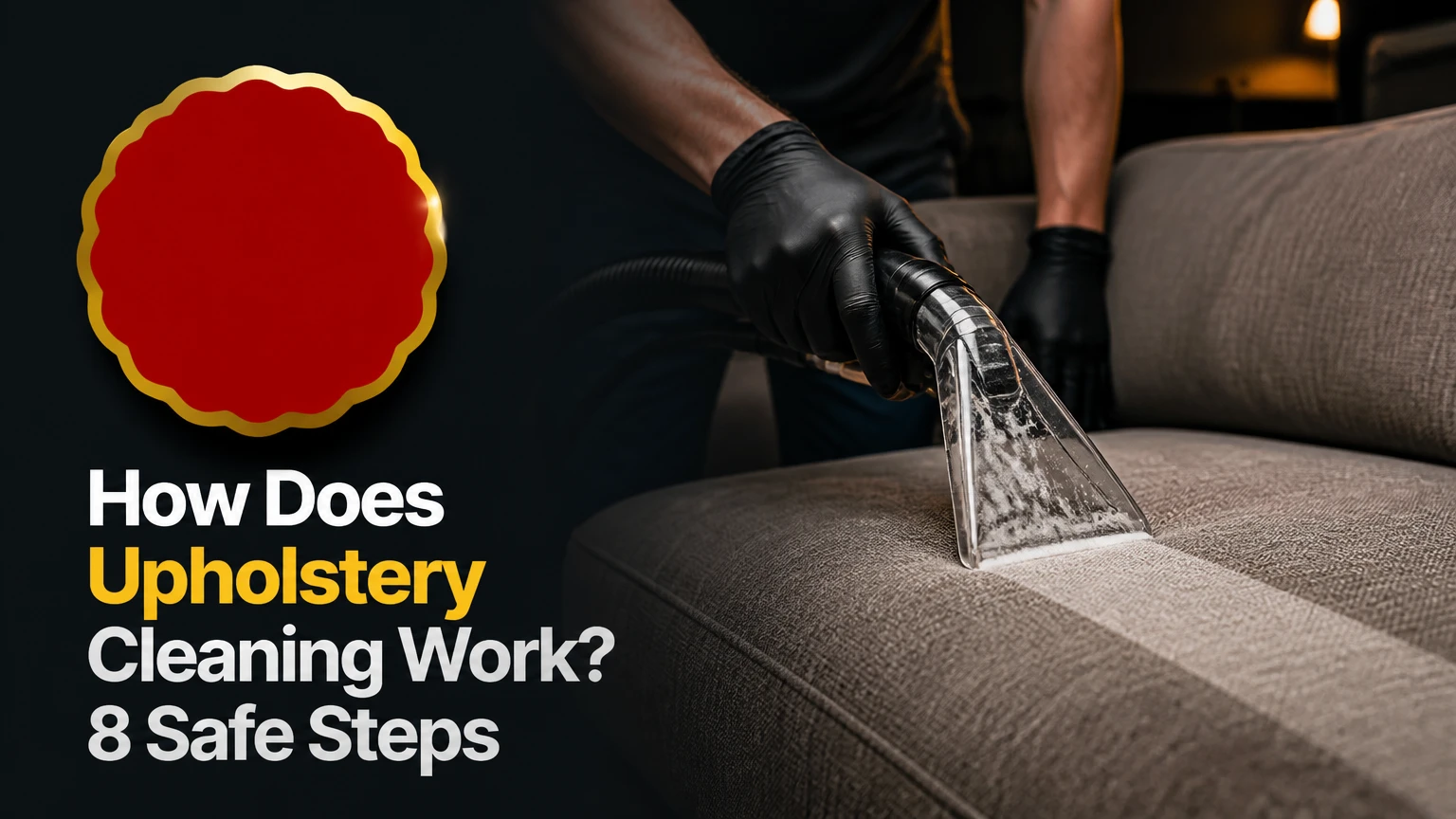
Code W and some W/S fabrics may be cleaned with a water-based process. A professional upholstery tool injects a controlled amount of warm solution and immediately recovers it through vacuum pressure. The process is often called steam cleaning, although the machine may use hot water rather than steam.
Code S materials require a solvent-based process when the manufacturer permits solvent cleaning. The solvent dissolves oil-soluble contamination and is then recovered or evaporated under controlled conditions. Solvent cleaning does not guarantee removal of water-soluble food or beverage residues, and ventilation is required.
Low-moisture systems use foam, absorbent compounds, encapsulation products, or specialized pads. These methods reduce drying time but may leave deeply embedded soil in dense padding because they do not flush the entire fiber assembly.
Leather requires a different sequence. A technician vacuums and cleans the surface with a leather-appropriate cleaner, removes residue, allows the surface to dry, and applies a compatible conditioner when the manufacturer permits it. Excess conditioner can leave a greasy film and attract soil.
| Method | Typical moisture level | Typical drying time | Best use | Main limitation |
|---|---|---|---|---|
| Hot-water extraction | Moderate to high | 4-24 hours | Code W synthetic or durable blends | Overwetting and long drying |
| Dry solvent cleaning | Low liquid water | 1-6 hours, with ventilation | Approved Code S fabrics | Odor and weaker water-soluble soil removal |
| Foam or encapsulation | Low | 1-4 hours | Maintenance cleaning and moisture-sensitive pieces | Limited deep-padded recovery |
| Leather cleaning | Minimal surface moisture | 1-3 hours | Finished leather furniture | Wrong product can strip finish |
“Dry cleaning” does not mean risk-free cleaning. Solvents can affect dyes, coatings, adhesives, and indoor air quality, so a technician must test compatibility and follow the product’s safety data.
Step 6: Extract, Rinse, or Absorb the Suspended Soil
The removal stage separates loosened soil from the upholstery. With hot-water extraction, the tool makes controlled passes, with slower wet passes followed by additional vacuum-only passes to recover moisture. With low-moisture cleaning, towels, pads, or absorbent compounds collect the suspended soil.
An acid rinse may help neutralize alkaline residue on suitable water-cleanable fabrics, but household vinegar is not a universal solution. Vinegar can affect dyes, finishes, odor chemistry, and some natural fibers, while an incorrect concentration can create a new problem.
Success checkpoint: the recovered solution becomes clearer, the fabric feels clean rather than sticky, and no visible stripe or wet edge remains.
Common mistake: making repeated wet passes after the soil has already been removed.
Step 7: Groom the Fabric and Dry the Furniture
Grooming resets the direction of a velvet, chenille, microfiber, or other pile surface. It reduces visible shading and helps prevent flattened areas from drying in an irregular position.
Drying requires airflow, not merely time. Air movers, fans, open doors, and a dehumidifier can reduce the moisture load, but furniture should not be returned to heavy use while cushions remain cool, damp, or musty. Removable cushions should be stood on edge when the construction permits, with both sides exposed to moving air.
Success checkpoint: seams, cushion edges, and the area beneath cushions feel dry at several test points.
Common mistake: placing cushions back tightly against the frame, where trapped moisture dries slowly.
Step 8: Apply Protector Only After Testing
Fabric protector is optional. A compatible protector can reduce the rate at which future spills penetrate, but it cannot make upholstery stain-proof, repair worn fibers, or eliminate existing contamination.
The product must match the fiber, dye, finish, and manufacturer’s care instructions. Protector should be applied evenly in a ventilated space, allowed to dry fully, and tested on a concealed area first.
Which Upholstery Cleaning Code Should You Follow?
Furniture cleaning codes provide a starting point, but the code does not replace inspection. W generally indicates a water-based product is allowed, S indicates a solvent-based product, W/S permits either when tested, and X commonly means no liquid cleaning should be attempted by the consumer.
| Code | Meaning | Consumer-safe starting point | Avoid |
|---|---|---|---|
| W | Water-based cleaning permitted | Vacuuming and tested upholstery detergent | Excess water and high heat |
| S | Solvent-based cleaning permitted | Vacuuming and qualified solvent cleaning | Water sprays and steam |
| W/S | Water or solvent permitted | Test both options, then choose the lower-risk method | Assuming every cleaner is suitable |
| X | No liquid method recommended | Vacuuming and gentle brushing only | DIY shampoo, extraction, and solvents |
Care-label systems vary by manufacturer. Some newer labels use icons or wording instead of the traditional letters, and some labels describe removable covers rather than the entire furniture assembly. If the label is missing, professional inspection is safer than assuming the fabric is Code W.
How Much Does Professional Upholstery Cleaning Cost?
Typical professional upholstery cleaning costs range from about ৳1,500 for a small office chair to ৳33,000 for a large sectional in the pricing example supplied for Bangladesh. Actual prices change with location, access, material, cushion count, stain severity, odor treatment, and whether the technician must clean leather or delicate textiles.
| Furniture item | Typical professional price | Cleaning time | Steam or extraction drying | Low-moisture drying |
|---|---|---|---|---|
| Office chair | ৳1,500-৳3,000 | 10-15 minutes | 2-4 hours | 1-2 hours |
| Armchair or recliner | ৳3,500-৳6,500 | 20-30 minutes | 4-6 hours | 1-3 hours |
| Two-seat sofa | ৳6,500-৳11,000 | 30-45 minutes | 6-12 hours | 2-4 hours |
| Three-seat sofa | ৳9,000-৳16,500 | 45-60 minutes | 6-12 hours | 2-4 hours |
| Large sectional | ৳16,500-৳33,000 | 1-2 hours | 8-24 hours | 3-6 hours |
These figures are typical planning ranges, not universal market prices. A quote should state whether cushions, backs, arms, skirts, stain treatment, deodorizing, travel, and protector application are included.
Is DIY Upholstery Cleaning Safe?
DIY cleaning is usually reasonable for clearly labeled Code W synthetic upholstery that has stable color, no structural damage, and no severe odor inside the foam. DIY cleaning is a poor choice for silk, antique velvet, rayon, suede, heavily dyed fabric, unknown codes, loose seams, or furniture with a history of water rings.
Before starting, prepare a vacuum, white towels, a measured upholstery detergent, a soft brush, a spray bottle if the product allows it, and fans. Do not combine bleach, ammonia, acidic products, enzyme cleaners, or solvents.
Use the smallest practical amount of solution. Extract or blot thoroughly, then dry with airflow. If a cushion still feels cool or smells damp after the expected drying period, do not cover it or return it to the frame.
Which Method Is Best for Each Situation?
Hot-water extraction is usually the strongest choice for durable Code W polyester, microfiber, and some cotton blends when deep soil and allergen removal matter more than rapid reuse. It is not the best choice for every natural fiber or dense cushion.
Dry solvent cleaning suits approved Code S fabrics and some delicate constructions where water could cause rings or shrinkage. It is less effective for water-soluble beverage residues and requires proper ventilation.
Low-moisture foam or encapsulation suits maintenance cleaning, offices that need quick turnaround, and furniture with limited moisture tolerance. The trade-off is lower recovery of contamination held deep in padding.
Leather cleaning is appropriate for finished leather, but aniline leather, nubuck, and suede require separate specialist methods. A leather cleaner designed for coated automobile interiors may be unsuitable for absorbent residential leather.
What Are the Most Common Cleaning Failures?
The most common failures involve incorrect moisture, chemistry, or friction rather than inadequate machine power.
- Water on Code S fabric: Water rings, dye migration, rippling, or shrinkage may result. Blot excess moisture without spreading the wet edge, then stop and seek solvent-trained help.
- Overwetting the foam: Persistent dampness, microbial odor, and cushion deformation can follow. Separate cushions, increase airflow, use a dehumidifier, and obtain professional assessment if odor remains.
- Aggressive scrubbing: Fuzzing and nap damage may be permanent. Blot and use a soft brush only after testing.
- High-pH chemistry on natural fibers: Cotton and linen can develop cellulosic browning, while wool can become brittle. Professional neutralization is safer than an improvised vinegar treatment.
- Cleaning over a damaged finish: Flaking leather, cracked vinyl, exposed foam, and loose dye can worsen during cleaning. Photograph the damage and ask the furniture maker or restoration specialist for guidance.
- Returning furniture too soon: Trapped moisture beneath cushions can create odor even when the top surface feels dry. Test seams, undersides, and foam-adjacent areas before use.
A professional cannot promise complete stain removal. Dye transfer, bleach spots, heat marks, sun fading, and color loss are alterations of the material, not removable soil.
How Often Should Upholstery Be Cleaned?
Most household upholstery benefits from professional cleaning every 12-24 months, while homes with pets, smokers, allergies, young children, or heavy daily use may need cleaning every 6-12 months. Vacuuming with a soft upholstery attachment every 1-2 weeks reduces abrasive soil and extends the interval.
Immediate spill response matters more than a rigid calendar. Blot liquid with white towels, remove solid material with a spoon, avoid heat, and check the care code before applying any product. A stain treated within minutes has a better chance than the same stain after repeated sitting, drying, and rewetting.
Weekly vacuuming is appropriate for high-use seating, but delicate antique fabrics may require only light brushing according to the conservator’s instructions. Manufacturer care instructions take priority over generic schedules.
What Should You Ask an Upholstery Cleaner?
Ask for the proposed method, the fabric-code interpretation, the expected drying time, and the steps used to prevent overwetting. A competent provider should explain whether the quoted service includes cushions, backs, arms, stain treatment, deodorizing, and protector.
Ask whether the technician performs a colorfastness test and how they handle dye bleeding, browning, pet urine, leather, and unknown fabrics. The provider should also explain what the service cannot remove, especially permanent dye loss, sun damage, and deteriorated foam.
Avoid a quote based only on furniture size. Material risk and construction often matter more than the number of seats.
Frequently Asked Questions
Does upholstery cleaning remove dust mites?
Upholstery cleaning can remove dust, skin flakes, dander, and some allergen-containing particles, especially when thorough vacuuming is followed by suitable extraction. Cleaning does not guarantee complete dust-mite eradication because mites and allergens may remain in foam, pillows, carpets, and bedding. Use source control and regular laundering as well.
Can upholstery be cleaned while cushions remain on the sofa?
Upholstery can often be cleaned with cushions in place, but removable cushions should usually be cleaned and dried separately. Separate handling exposes seams, improves airflow, and reduces the chance that moisture remains trapped between the cushion and frame. The furniture’s construction and care label determine the safest arrangement.
How long should I wait before sitting on a cleaned sofa?
Wait until the entire upholstery assembly is dry, commonly 4-12 hours after extraction and 1-4 hours after low-moisture cleaning. Dense cushions, high humidity, poor airflow, and heavy fabric can extend the period to 24 hours. A dry-feeling surface is insufficient if seams or cushion undersides remain damp.
Can upholstery cleaning remove pet urine odor?
Upholstery cleaning can reduce pet urine odor when contamination is limited to the cover and the correct enzyme treatment reaches the affected area. Odor may persist when urine has entered foam, batting, or the frame. In severe cases, the cushion insert, barrier layer, or affected padding may require replacement.
Is upholstery cleaning the same as carpet cleaning?
Upholstery cleaning and carpet cleaning use related soil-removal principles but require different tools, moisture levels, and techniques. Upholstery has thinner fabrics, seams, trims, and foam that are more vulnerable to overwetting. A carpet machine or carpet detergent should not be used on furniture unless the manufacturer specifically permits it.
Can professional cleaning restore faded upholstery?
Professional cleaning can remove soil that makes upholstery appear dull, but it cannot restore pigment lost through sunlight, chemical exposure, or abrasion. Cleaning may make fading more noticeable because clean fibers contrast with permanently discolored areas. Reupholstering, recoloring, or conservation treatment may be required for restoration.
The Bottom Line
How does upholstery cleaning work? The process combines inspection, dry vacuuming, compatible chemistry, controlled agitation, targeted stain treatment, moisture recovery, grooming, and complete drying. The care code, fiber type, and cushion construction determine the safe method more reliably than the furniture’s color or apparent dirt level.
Hot-water extraction provides strong deep-soil removal on suitable Code W fabrics, while solvent, low-moisture, leather, and specialist conservation methods solve different material problems. When the code is missing, the fabric is delicate, or the cushion has severe odor or damage, professional testing is safer than repeated DIY treatment.