Professionally cleaned carpet usually takes 6-12 hours to dry after hot-water extraction, although dense carpet, thick pad, poor ventilation, or high indoor humidity can extend the time to 24 hours or longer. Low-moisture cleaning may dry in 1-2 hours, while dry-compound cleaning often permits immediate use after thorough vacuuming.
Key Facts at a Glance
- Hot-water extraction carpet commonly dries in 6-12 hours when the technician extracts effectively and the room has moving, moderately dry air.
- Poor airflow, high humidity, dense pile, and thick padding can push drying time beyond 24 hours.
- Encapsulation and other very-low-moisture methods generally dry in 1-2 hours.
- Dry compound cleaning leaves little free water, but the carpet still needs careful vacuuming before normal use.
- A carpet that feels dry on top can retain moisture in its backing or pad.
- Open windows help only when outdoor air is drier than indoor air; air conditioning and dehumidification are often better in humid weather.
How Long Does Carpet Take to Dry After Cleaning?
Most residential carpet dries in 6-12 hours after professional hot-water extraction. A lightly damp, well-extracted synthetic carpet in a warm room may dry in 4-6 hours, while wool, dense plush carpet, soaked padding, or a humid room may require 12-24 hours.
The cleaning method matters more than the word “steam.” Professional hot-water extraction sprays heated water and cleaning solution into the carpet, then removes much of that liquid through vacuum suction. The amount left behind depends on the technician’s equipment, vacuum passes, spray rate, carpet density, and the condition of the backing and pad.
A 24-hour drying period is a practical upper planning range for ordinary cleaning, not a universal mold deadline. If carpet remains saturated, squishes underfoot, develops a sour odor, or wets the underside after 24 hours, treat the condition as an extraction or moisture-management problem and contact the cleaner.
Typical Drying Times by Cleaning Method
| Cleaning method | Typical usable-dry time | Typical full-dry range | Main moisture factor |
|---|---|---|---|
| Dry compound | 0-1 hour | 1-2 hours | Damp absorbent granules, not water saturation |
| Encapsulation or VLM | 1-2 hours | 2-4 hours | Light polymer solution applied to pile |
| Shampoo cleaning | 8-16 hours | 12-24 hours | Higher solution residue and slower extraction |
| Hot-water extraction | 6-12 hours | 8-24 hours | Spray volume, vacuum lift, pad moisture |
“Usable dry” means careful passage is unlikely to damage the pile or transfer moisture. “Full dry” means the backing and accessible pad have also reached normal indoor moisture conditions. Those are different milestones.
Why Does Clean Carpet Take Several Hours to Dry?
Carpet dries through evaporation: liquid water changes into vapor, and moving air carries that vapor away from the textile. Evaporation accelerates when the surrounding air is relatively dry, when air moves across the pile, and when the room is warm without becoming humid.
Relative humidity is the most frequently misunderstood variable. Warm air can hold more water vapor than cold air, but simply heating a humid room does not remove moisture. A dehumidifier or air conditioner reduces the water content of the air, which allows additional moisture to leave the carpet.
The Carpet and Rug Institute gives a practical warning in its carpet-care guidance: “Do not over-wet the carpet.” That rule matters because extraction cannot remove every drop from the pile, backing, and pad. Excess solution creates longer drying, residue, wick-back, browning, odor, and possible backing damage.
The Four Moisture-Transfer Stages
- Initial extraction, about 0-30 minutes: The technician removes free liquid from the pile and surface layers. Several slow vacuum passes usually remove more moisture than hurried movement.
- Pile drying, about 1-4 hours: Fiber tips and upper yarn bundles release water directly into the room air. The carpet may look dry while the base remains damp.
- Backing and interface drying, about 4-12 hours: Moisture migrates from the yarn base into the backing and then toward the room-facing surface or exposed edges.
- Pad and subfloor equalization, about 8-24 hours: Thick pad, sealed flooring, furniture coverage, and low air exchange slow the final stage.
These stages overlap rather than occur at exact clock times. A low-pile commercial carpet can finish quickly, while a thick residential cut pile can retain moisture below the visible surface.
What Determines Carpet Drying Time?
Carpet drying time is determined by moisture load, extraction efficiency, air conditions, carpet construction, and the surface beneath the carpet. Cleaning method alone cannot predict the result because two technicians can apply different water volumes and leave different amounts behind.
Indoor Air Conditions
| Condition | Typical effect on drying | Practical target or action |
|---|---|---|
| Indoor temperature | 65-80°F, or 18-27°C, supports evaporation | Keep the room comfortably warm |
| Relative humidity | Below 50% usually supports faster evaporation | Use a dehumidifier when humidity exceeds 60% |
| Air movement | Continuous circulation removes saturated air | Aim fans or air movers across the carpet |
| Outdoor humidity | Humid outdoor air can slow drying | Close windows when outdoor air is wetter |
| HVAC operation | Air conditioning removes heat and moisture | Run cooling or fan continuously when appropriate |
The best airflow is across the carpet, not directly downward from a ceiling fan alone. A box fan, axial air mover, or air mover supplied by the cleaning technician should move air along the pile and toward an exit or dehumidifier.
Carpet Construction and Room Layout
Dense pile holds more water between yarn bundles than low-profile loop carpet. A thick pad behaves like a sponge beneath the carpet, and a room with heavy furniture has fewer exposed surfaces through which moisture can escape.
Stairs may dry unevenly because airflow reaches the tread but not the carpet tucked against the riser. Carpet installed over concrete can also dry more slowly than carpet over a ventilated wood subfloor because concrete does not provide a rapid path for moisture to dissipate.
Seams, edges, and areas beneath furniture deserve separate checks. Those locations often remain wet after the center of the room feels normal.
Which Carpet-Cleaning Method Dries Fastest?
Dry-compound and low-moisture methods dry fastest, usually within 0-2 hours. Hot-water extraction takes longer, generally 6-12 hours, but it can remove more embedded soil when the carpet, backing, and pad tolerate controlled moisture.
| Method | Moisture level | Cleaning reach | Best fit | Main limitation |
|---|---|---|---|---|
| Dry compound | Very low, damp powder | Mostly pile and surface soil | Moisture-sensitive rooms | Requires strong vacuum recovery |
| Encapsulation | Low, polymer film | Surface and moderate soil | Offices and quick-turnaround rooms | May not remove heavy oily soil alone |
| Hot-water extraction | Moderate to high | Pile, backing interface, soluble soil | Residential deep cleaning | Longer drying and overwetting risk |
| Shampoo or rotary scrub | Moderate to high | Surface agitation with detergent | Heavily soiled resilient carpet | Residue and slow drying risk |
Is Low-Moisture Cleaning as Deep as Extraction?
Low-moisture cleaning is effective for routine soil maintenance, especially on commercial carpet with frequent cleaning intervals. It is not automatically equivalent to hot-water extraction for heavy grease, urine contamination, flooding residue, or soil embedded deeply near the backing.
Encapsulation products crystallize or immobilize soil as the polymer dries, after which mechanical vacuuming removes the dried residue. The method reduces downtime, but the technician still needs correct chemistry, agitation, dwell time, and post-vacuuming.
Hot-water extraction is usually the better choice for a restorative cleaning when the carpet manufacturer permits it and the technician can control water recovery. Faster drying is not the same as deeper cleaning.
How Can You Dry Carpet Faster After Cleaning?
To dry carpet faster, increase cross-room airflow, lower indoor humidity, expose more carpet surface, and ask the cleaner to verify extraction before leaving. Most ordinary rooms improve substantially when two or more of those controls operate together.
Step 1: Start Air Movement Immediately
Set one or more fans or air movers to move air horizontally across the carpet. Open interior doors so damp air can reach the HVAC return, but avoid blowing debris onto the wet pile.
Success checkpoint: The carpet surface feels progressively less cool and damp over 30-60 minutes.
Common mistake: Pointing a small fan at one spot and leaving the rest of the room stagnant.
Step 2: Control Humidity
Run a dehumidifier in the room with doors and windows mostly closed, emptying its tank as needed. If the home has central air conditioning, set the HVAC fan to continuous operation when the system can safely run, because cooling removes moisture while circulation redistributes air.
Success checkpoint: A hygrometer shows indoor relative humidity moving toward approximately 40-55%.
Common mistake: Running a humidifier, drying rack, or open steamy bathroom nearby.
Step 3: Decide Whether to Open Windows
Open windows only when outdoor air is cooler and drier in absolute moisture than the indoor air. On a dry day, ventilation can accelerate evaporation; during rain or a muggy summer afternoon, open windows can increase indoor humidity and prolong drying.
Success checkpoint: Indoor humidity falls after ventilation rather than rising.
Common mistake: Assuming outdoor air is dry because it feels cool.
Step 4: Remove Moisture Traps
Lift lightweight rugs, move curtains away from the carpet, and increase clearance around wet edges. Do not drag heavy furniture across damp carpet, because the movement can distort the pile and spread moisture.
Success checkpoint: Edges, doorways, and areas under tables receive visible airflow.
Common mistake: Closing a wet room tightly while leaving furniture in place.
Step 5: Request Re-Extraction When Needed
If the carpet produces a squishing sound, feels wet rather than cool, or transfers moisture to a dry towel after several hours, call the cleaning company. A professional can perform additional vacuum-only passes with commercial equipment.
Success checkpoint: A firmly pressed white towel feels only slightly cool and does not become visibly wet.
Common mistake: Adding more detergent or water in an attempt to solve a moisture problem.
When Can You Walk on Carpet After Cleaning?
You can usually walk on carpet after cleaning once it is lightly damp rather than wet, preferably in clean socks or clean indoor footwear. Avoid normal shoe traffic until hot-water-extracted carpet is mostly dry, which commonly takes 6-12 hours.
Limited access may be necessary for pets, children, or residents. Use clean plastic-free shoe covers or socks, keep traffic to a narrow route, and avoid running, dragging furniture, or repeated compression while the pile is damp.
| Activity | Typical timing after extraction | Precaution |
|---|---|---|
| Technician inspection | Immediately | Follow the technician’s moisture check |
| Clean socks, brief passage | 2-6 hours | Use only when surface is lightly damp |
| Children playing on floor | 8-12 hours | Wait until pile and edges feel dry |
| Pets crossing room | 8-12 hours | Keep paws clean and prevent digging |
| Outdoor shoes | 12-24 hours | Wait until no damp transfer occurs |
| Heavy furniture placement | 12-24 hours | Use foil or plastic furniture tabs only if advised |
Damp fibers are more vulnerable to crushing and soil transfer. Furniture can also restrict evaporation, leaving circular damp spots that persist after the exposed pile dries.
How Long Should Furniture Stay Off Clean Carpet?
Keep furniture off freshly extracted carpet for at least 12-24 hours, or until the carpet is fully dry. If furniture must return sooner, place protective tabs or foil under stable legs, provided the cleaning technician confirms that the materials will not stain or transfer dye.
Wood can bleed color into wet carpet, and metal can leave rust marks where moisture remains trapped. Rubber-backed furniture pads may also transfer plasticizers or dyes. Furniture with broad flat bases creates a larger covered area and should wait for complete drying.
Do not use ordinary cardboard beneath wet furniture because it can soften, transfer dye, and restrict airflow. Recheck the carpet under each leg after several hours.
Does Carpet Type Change the Drying Time?
Carpet type can change drying time by several hours. Synthetic nylon, polyester, and olefin fibers generally absorb less water than wool, cotton, or other natural fibers, but dense construction and thick padding can outweigh the fiber difference.
| Carpet or rug type | Typical extraction drying range | Care concern | Preferred approach |
|---|---|---|---|
| Nylon wall-to-wall | 6-12 hours | Dense pile can retain moisture | Controlled extraction |
| Polyester wall-to-wall | 6-12 hours | Oleophilic soil may need chemistry | Extraction with thorough recovery |
| Olefin loop | 4-10 hours | Low absorbency, possible texture distortion | Low-moisture or controlled extraction |
| Wool carpet | 12-24+ hours | Shrinkage, browning, dye bleeding | Wool-approved specialist |
| Cotton or viscose rug | 12-48+ hours | Cellulosic browning and dimensional change | Specialist or controlled washing |
Wool should not be treated as ordinary synthetic carpet. Wool fibers tolerate some moisture but can shrink, felt, distort, or develop browning when exposed to excessive water, heat, agitation, or slow drying.
Viscose and some cotton rugs are especially vulnerable to water marks and texture changes. A specialist should inspect the dye stability, backing, and construction before cleaning.
Can Carpet Shrink or Develop Brown Marks While Drying?
Carpet can shrink or develop brown marks when excessive moisture, heat, alkaline chemistry, unstable dyes, or slow drying affects the fiber and backing. Shrinkage is more associated with natural-fiber rugs and certain constructions than with correctly cleaned synthetic wall-to-wall carpet.
Brown lines or patches often result from wicking, where dissolved soil migrates upward from the backing as the carpet dries. Browning can also involve cellulosic material in the backing or jute, particularly on rugs and natural-fiber products.
Do not scrub a brown patch aggressively while it is wet. Let the carpet dry, document the area, and ask the cleaner which browning treatment is compatible with the fiber and dye. A post-cleaning discoloration may require professional correction rather than more water.
Why Is Carpet Still Wet After 24 Hours?
Carpet that remains wet after 24 hours usually has excessive residual moisture, saturated padding, insufficient air exchange, high humidity, or a moisture source below the carpet. Surface dampness alone is less serious than squishing, wet edges, or moisture that transfers through the backing.
Troubleshooting Delayed Drying
| Symptom after cleaning | Likely cause | Correct response |
|---|---|---|
| Cool, slightly damp pile | Normal final evaporation | Continue airflow and humidity control |
| Squishing underfoot | Wet pad or poor extraction | Call the cleaner for re-extraction |
| Musty or sour odor | Stagnant moisture or residue | Increase drying and request inspection |
| Brown edge lines | Wicking or browning | Dry fully before specialist treatment |
| Wet perimeter only | Furniture or poor edge airflow | Expose edges and circulate air |
| Moisture on underside | Pad or subfloor retention | Stop traffic and arrange assessment |
A musty smell does not prove mold, and mold does not automatically appear at exactly 24 hours. EPA moisture guidance treats prompt drying as the key control, while porous materials that remain wet for an extended period become progressively harder to restore.
Call the cleaner promptly if the pad is saturated, the carpet was exposed to sewage or floodwater, the subfloor is swollen, or the odor intensifies despite active drying. Do not apply household bleach, essential oils, or an unapproved antimicrobial spray to carpet.
Can You Use a Fan, Air Conditioner, or Dehumidifier?
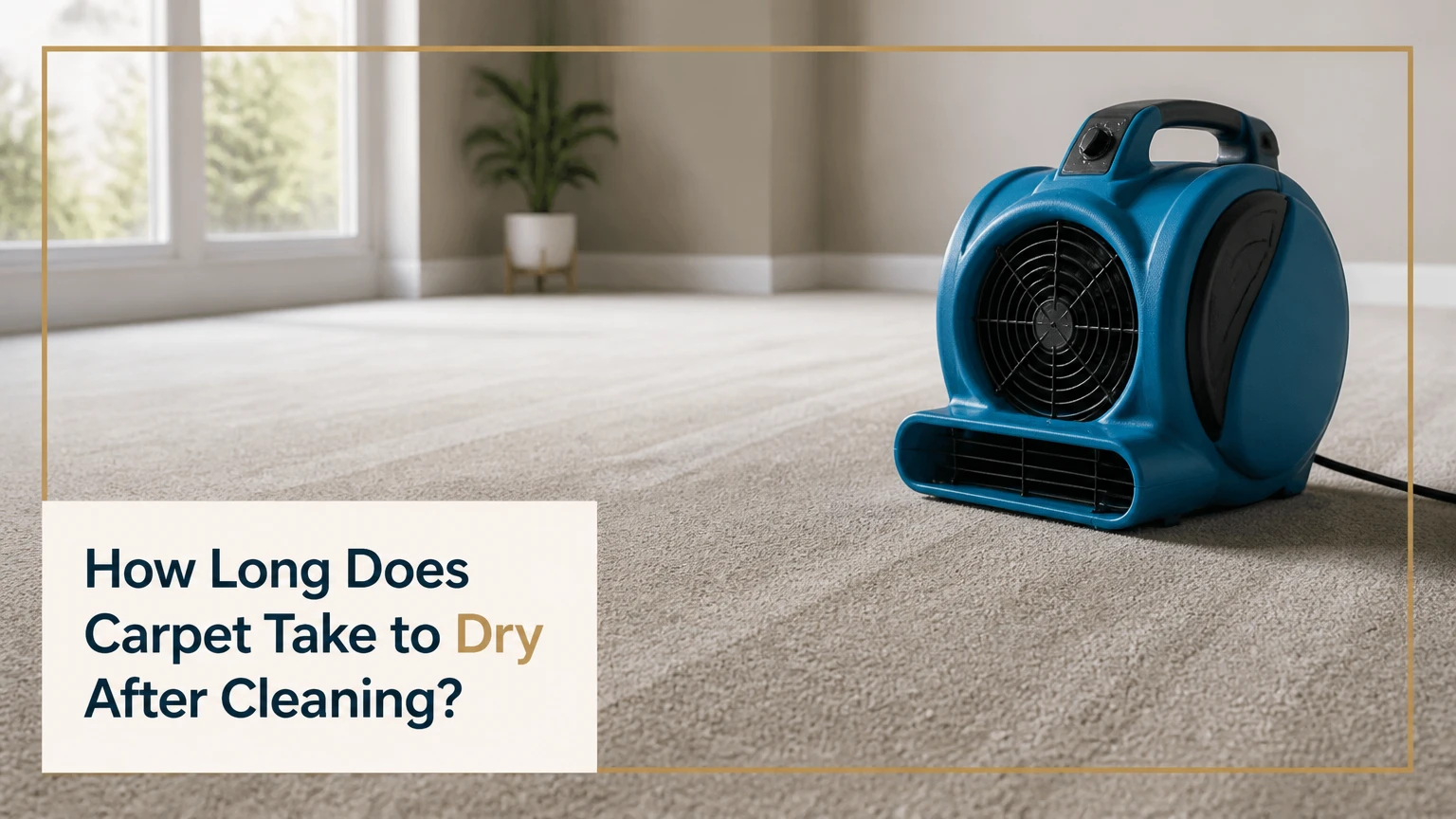
Fans, air conditioners, and dehumidifiers can all shorten carpet drying time, but each controls a different part of the drying process. Fans move saturated air away from the carpet, air conditioners cool and dehumidify in suitable conditions, and dehumidifiers remove water vapor directly from the room.
Professional air movers are usually more effective than a single household pedestal fan because they deliver higher airflow close to the carpet surface. A dehumidifier works best in a reasonably enclosed room, while a fan works best when it moves air toward the dehumidifier or HVAC return.
Avoid high heat from portable heaters. Excessive heat can accelerate evaporation at the surface while leaving the pad wet, and it can increase shrinkage or browning risk in natural fibers.
How Much Does Professional Carpet Cleaning Cost?
Professional carpet cleaning commonly costs $100-$300 for a typical home visit in the United States, with room count, stairs, furniture moving, stain treatment, rug construction, and local labor rates causing substantial variation. Drying equipment may be included or billed separately.
| Service scope | Typical price range | Typical drying range | Common variables |
|---|---|---|---|
| One small bedroom | $50-$100 | 4-10 hours | Minimum service charge |
| Three-bedroom home | $150-$300 | 6-12 hours | Stairs, furniture, pet treatment |
| Large whole-home extraction | $250-$600 | 8-24 hours | Square footage and pad condition |
| Low-moisture commercial visit | $0.15-$0.40 per sq. ft. | 1-4 hours | Access, soil load, scheduling |
These are typical planning figures, not a universal price list. A quote in another country may use a different currency and pricing structure. Ask whether the estimate includes pre-vacuuming, spot treatment, deodorizer, furniture moving, taxes, and air movers.
The cheapest method is not always the least expensive outcome. Repeated low-moisture maintenance may be economical for offices, while restorative extraction may prevent recurring odor in a heavily soiled home.
What Should You Do Before the Cleaner Arrives?
Vacuum loose debris, remove small objects, identify stains and pet accidents, and create a clear path to the rooms being cleaned. Confirm the carpet fiber if known, disclose previous treatments, and ask how long the technician expects the carpet to remain unavailable.
Before service, ask five practical questions:
- Which method will you use, and how much moisture will it apply?
- Will you perform extra vacuum passes or use air movers?
- When can residents, pets, and furniture return?
- Is the carpet wool, viscose, cotton, or another moisture-sensitive material?
- What should I do if the carpet is still wet tomorrow?
A technician who gives a drying estimate based on carpet type, weather, room ventilation, and pad condition is providing more useful information than one who promises a fixed number for every job.
Is Steam Cleaning Better Than Dry Cleaning?
Hot-water extraction is generally better for deep restorative cleaning, while low-moisture or dry-compound cleaning is better when rapid room reuse or moisture sensitivity is the priority. The right choice depends on soil type, fiber construction, backing condition, and the time available for drying.
Choose hot-water extraction for embedded soil, recurring residential traffic, and contaminants that require substantial flushing, provided the carpet manufacturer permits the method. Choose encapsulation for routine commercial maintenance where short downtime matters. Choose specialist dry or low-moisture care for delicate rugs.
No method removes every type of soil equally well. Dry methods are not a safe substitute for water-damage restoration, and extraction is not automatically safe for every natural-fiber rug.
Expert Rules for Faster, Safer Drying
- Extraction quality beats room heat. Removing another portion of liquid with vacuum passes is usually safer than heating a room aggressively.
- The pad is the hidden variable. If the pile is dry but the room still smells damp, test the backing and pad rather than repeatedly cleaning the surface.
- Outdoor temperature is a poor ventilation guide. Dew point and relative humidity determine whether outside air helps.
- Edges reveal drying failure early. Check thresholds, seams, stairs, and furniture footprints before trusting a dry-looking center.
- A clean towel is a better test than appearance. Press a white towel firmly into several areas; visible transfer indicates remaining surface moisture.
Frequently Asked Questions
Can I sleep in a room with freshly cleaned carpet?
You can usually sleep in a room with freshly cleaned carpet once the carpet is mostly dry, ventilation is adequate, and no strong chemical odor remains. For hot-water extraction, waiting 8-12 hours is a practical target. Keep bedding, clothing, and furniture from touching damp areas.
Should I turn the heat on to dry carpet?
Moderate warmth can help evaporation, but high heat is not recommended. Keep the room around 65-80°F, or 18-27°C, and combine gentle warmth with moving air and humidity removal. Excessive heat can dry the pile before the pad and increase shrinkage or browning risk in natural fibers.
Why does my carpet smell worse after cleaning?
A stronger odor after cleaning can result from residue, pet contamination in the pad, wicking soil, or moisture trapped below the backing. Increase airflow and dehumidification first. If the smell persists after complete drying, request a professional inspection instead of applying more fragrance or detergent.
Can I vacuum carpet while it is still damp?
Do not use a standard household vacuum on wet carpet unless the manufacturer specifically identifies it as a wet-dry machine. A wet-dry vacuum can remove surface water, but improper use may damage the equipment or spread contamination. Professional extraction is safer for saturated carpet and padding.
How do I know whether carpet is fully dry?
Carpet is likely fully dry when the pile, seams, edges, and areas beneath furniture feel the same as an unaffected room, a white towel shows no moisture transfer, and no cool dampness returns after several hours. A moisture meter can provide a more objective comparison with an adjacent dry area.
Does carpet cleaning damage the pad?
Carpet cleaning does not normally damage sound padding when the technician uses an appropriate moisture volume and extracts thoroughly. Overwetting can compress, delaminate, or contaminate some pads, especially when drying is slow. Saturated pad that remains wet or smells sour should be assessed rather than left to dry indefinitely.
The Bottom Line
Carpet usually takes 6-12 hours to dry after professional hot-water extraction, with 12-24 hours possible for dense carpet, wool, thick padding, poor ventilation, or humid conditions. Low-moisture methods may dry in 1-2 hours, but they trade reduced downtime for less flushing of deeply embedded soil.
Use cross-room airflow, humidity control, and careful moisture checks rather than relying on heat or open windows alone. If how long does carpet take to dry after cleaning becomes a 24-hour-plus problem with squishing, wet backing, or worsening odor, contact the cleaner for re-extraction and moisture assessment.