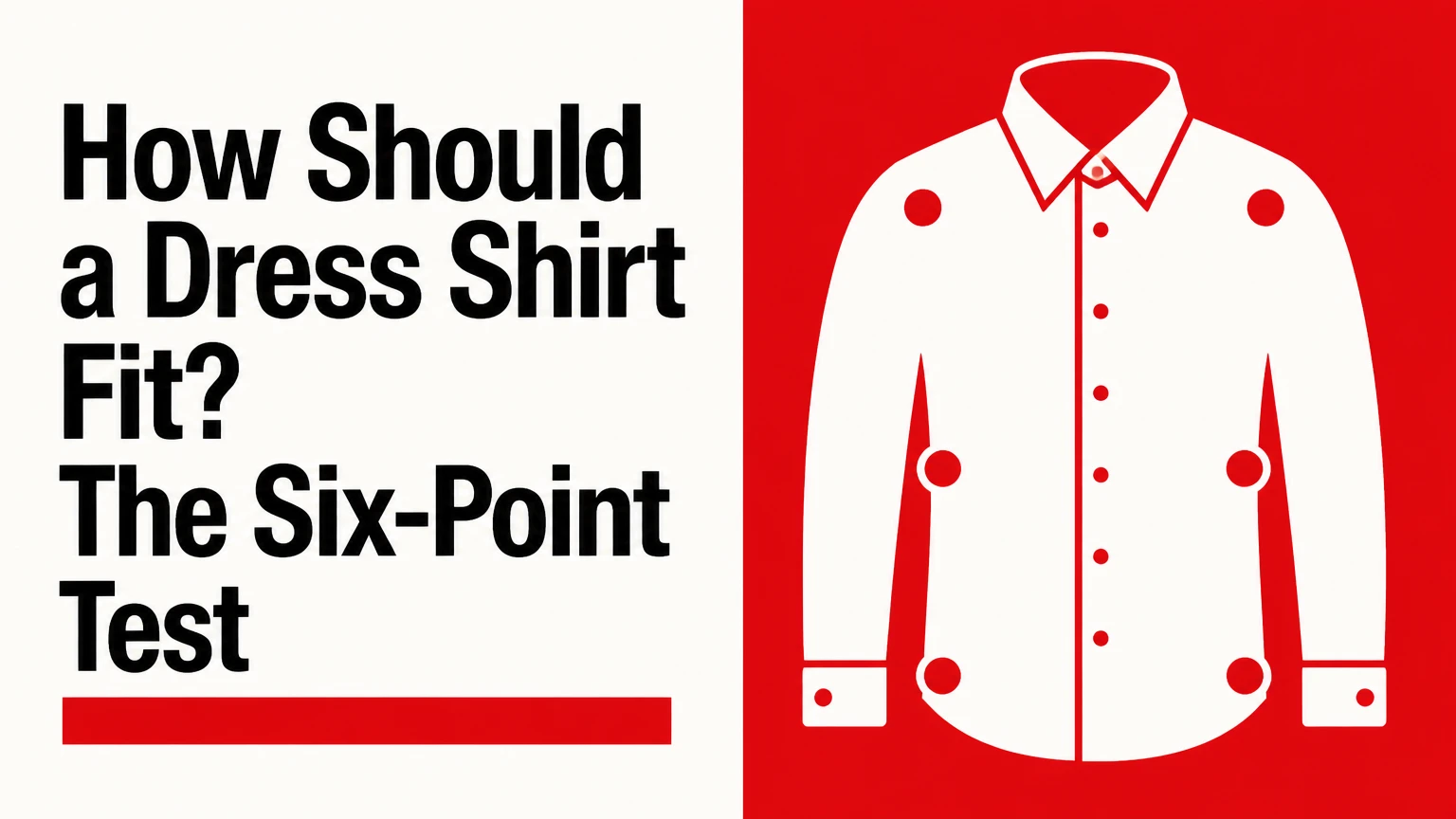
A dress shirt should follow the body at the collar, shoulders, chest, waist, sleeves, cuffs, and hem without pulling, billowing, or restricting movement. The collar should allow two fingers, the shoulder seam should meet the shoulder bone, the cuffs should reach the wrist, and the tucked hem should stay secure while sitting and reaching.
Key Facts at a Glance
- A correctly fitted collar allows about two fingers between the closed collar and the neck.
- The shoulder seam should end where the shoulder meets the upper arm, not halfway down the sleeve.
- Chest buttons should lie flat after a deep breath and while seated.
- A dress-shirt cuff should reach the wrist bone and show about 0.25-0.5 inch beyond a jacket sleeve.
- A tucked dress shirt usually needs enough tail length to cover the seat and remain inside the trousers during movement.
- Shoulders, collar, and chest are the fit priorities; waist suppression and sleeve width are usually easier to alter.
What Does Proper Dress Shirt Fit Mean?
Proper dress shirt fit means the shirt follows the wearer’s natural shape while preserving room for breathing, reaching, bending, and sitting. The collar, shoulders, and chest act as the primary anchor points: when those areas align with the anatomy, the torso fabric can fall cleanly instead of twisting or pooling.
A well-fitted shirt is not skin-tight. A small amount of controlled ease allows the fabric to move with the body, while excessive ease creates folds at the waist and lower back. The correct silhouette also depends on use. A shirt worn under a suit needs a cleaner chest and cuff line than a shirt worn open at the collar for business casual.
Fit should be judged in a normal stance and during movement. Stand naturally, button the shirt, take a deep breath, sit down, reach forward, and raise both arms. A shirt that looks excellent while motionless but pulls out of the trousers at a desk is not correctly fitted for office wear.
How Should the Collar Fit?
A dress-shirt collar should touch the neck comfortably when buttoned, with approximately two fingers fitting between the collar and the skin. One finger indicates a close fit, while three or more fingers usually indicate excessive looseness that can leave a visible gap beneath a tie.
Test the collar with the shirt washed and fully buttoned. Cotton can shrink, and a collar that feels perfect in a new shirt may become restrictive after laundering. Wear the tie knot you normally use because a substantial Windsor knot occupies more collar space than a four-in-hand knot.
| Collar result | Likely condition | Best action | Typical consequence |
|---|---|---|---|
| One finger barely fits | Collar is near its minimum tolerance | Try the next neck size | Neck pressure after meals or long wear |
| Two fingers fit comfortably | Balanced everyday fit | Keep the size | Secure with or without a tie |
| Three fingers fit easily | Collar is too loose | Try a smaller neck size | Tie gap and collar collapse |
| Collar touches front but gaps behind | Pattern or shoulder-slope mismatch | Try another brand or cut | Visible rear collar gap |
| Collar closes only with force | Neck size is too small | Size up or use a larger collar | Button strain and discomfort |
A collar should not choke when the wearer turns the head. It also should not float away from the neck when a tie is worn. The collar stand, neck size, and shoulder slope work together, so a rear gap is not always solved by changing the collar size alone.
Should a Tie Change the Collar Fit?
A tie should fill the space between the closed collar points without forcing the collar upward or away from the neck. A tie wearer should test the shirt with the intended knot, because collar spread, collar stand height, and knot size change the visual balance.
Where Should the Shoulder Seams Sit?
The shoulder seam should meet the natural shoulder point, approximately where the shoulder bone transitions into the upper arm. A seam that drops down the arm signals excess width; a seam that pulls toward the neck signals insufficient shoulder width or an incompatible shoulder slope.
Shoulders are the least forgiving area to alter. A tailor can sometimes adjust a minor shoulder issue, but reshaping the armhole and sleevehead often costs more than replacing an off-the-rack shirt. For that reason, buy a shirt that fits the collar and shoulders first, then alter the waist.
Check the shirt from the front, back, and side. Diagonal wrinkles from the collar toward the armpit can indicate a sloping-shoulder mismatch, while horizontal stress lines across the upper back often indicate insufficient back width or chest room.
| Shoulder appearance | What it usually indicates | Movement effect | Recommended decision |
|---|---|---|---|
| Seam ends at shoulder point | Correct shoulder width | Natural arm movement | Keep and assess other zones |
| Seam falls 1-2 inches down arm | Shirt is too broad | Excess sleeve fabric | Size down only if collar remains correct |
| Seam points toward neck | Shirt is too narrow | Pulling across upper back | Size up or change pattern |
| Diagonal collar-to-armpit folds | Shoulder slope mismatch | Twisting or collar gap | Try another brand |
| Raised sleevehead wrinkles | Sleeve pitch mismatch | Pulling when arms hang | Consider a different cut |
One practitioner rule matters here: a shirt with a slightly loose waist can be tailored, but a shirt with incorrect shoulders usually cannot be made economical. The shoulder seam is the strongest exchange-or-return checkpoint.
How Should the Chest and Torso Fit?
The chest should lie flat across the pectorals, with buttons closed and no radiating tension lines. The shirt should permit a deep breath and seated posture without button gaping, while the waist should retain a defined silhouette rather than forming a fabric balloon.
Pull the front fabric gently away from the stomach while standing naturally. A typical target is about 2-3 inches of total ease across the torso, though the required amount changes with fabric stretch, body shape, and intended movement. The measurement is a practical fitting guide, not a universal manufacturing standard.
Sit at a desk and bend both arms forward. If the placket opens between buttons, the chest is too tight, the button spacing is unsuitable, or the shirt pattern does not accommodate the wearer. If the fabric forms deep vertical folds at the sides and back, the shirt may be too large even when the collar fits.
How Much Room Should a Dress Shirt Have?
A dress shirt generally needs enough room for 2-3 inches of torso ease and at least one comfortable deep breath without horizontal stretching. A muscular chest, large upper arms, or frequent reaching may require more room through the chest and back, followed by waist tapering.
Do not use a single “pull-away” number as the only test. Stretch fabrics can tolerate a closer visual fit, while crisp poplin reveals tension sooner than an oxford weave. The fabric should remain smooth during normal movement, not merely while standing still.
How Should Sleeves and Armholes Fit?
A dress-shirt armhole should sit relatively high in the armpit while allowing the arms to move without lifting the entire shirt from the trousers. The sleeve should narrow gradually toward the cuff, with enough width for elbow flexion and no large accordion folds.
Raise the arms, reach toward a keyboard, and cross the forearms. If the shirt body rises dramatically, the armholes may be too low or the shirt may be too tight across the back. If the underarm binds, the armhole may be too high for the pattern, the sleeve may be too narrow, or the shoulder slope may be wrong.
| Sleeve issue | Visual symptom | Functional test | Correction |
|---|---|---|---|
| Sleeve too long | Deep folds at cuff | Cuff covers hand when standing | Shorten sleeve or choose shorter length |
| Sleeve too short | Wrist exposed | Cuff rises above wrist when arms bend | Choose longer sleeve |
| Sleeve too wide | Fabric pools along forearm | Excess cloth remains with arm relaxed | Taper sleeve |
| Sleeve too narrow | Horizontal elbow tension | Bending arm pulls cuff upward | Choose wider sleeve |
| Armhole too low | Shirt lifts with arm | Body leaves waistband during reach | Try a higher-armhole pattern |
| Sleeve pitch incorrect | Twisting seam | Sleeve rotates while arm hangs | Try another brand or cut |
High armholes are often associated with cleaner movement, but height alone does not guarantee comfort. The armhole shape, sleeve pitch, biceps width, and back pleats must work together. A low armhole can feel loose while making the shirt body move excessively whenever the wearer reaches.
Where Should the Cuffs End?
A shirt cuff should finish at the wrist bone or the base of the thumb, depending on the wearer’s wrist anatomy and cuff construction. Under a suit jacket, approximately 0.25-0.5 inch of shirt cuff should remain visible beyond the jacket sleeve when the arms hang naturally.
Button the cuff at the wrist and test it over a watch if one is normally worn. The cuff should pass over the hand when unbuttoned, then remain near the wrist after fastening. It should not slide over the hand during ordinary movement, but it should not leave a deep pressure mark.
French cuffs need extra clearance because cuff links add thickness. A cuff that fits a bare wrist may become restrictive over a watch or with a large link. Barrel cuffs are more forgiving because their button positions can sometimes be adjusted by a tailor.
A jacket sleeve that reaches the thumb joint usually hides the shirt cuff. Cuff visibility depends on arm position, jacket cut, and sleeve pitch, so assess the complete outfit rather than judging the shirt alone.
How Long Should a Dress Shirt Be?
A tucked dress shirt should extend several inches below the trouser waistband and cover the seat, usually ending about 4-5 inches below the beltline on a typical men’s shirt. The exact hem depends on torso length, rise of the trousers, shirt-tail shape, and whether the shirt is designed for tucking.
Raise both arms overhead, sit, and reach forward. The shirt should remain mostly inside the waistband without exposing the lower back. A tail that constantly escapes is too short, has an unsuitable hem shape, or is being worn with low-rise trousers.
Untucked length follows a different rule. A shirt designed for untucked wear generally ends around the middle of the seat or slightly below the belt area, while a long traditional dress-shirt tail can look unfinished and bunch at the hips when left out.
| Intended use | Typical hem position | Tail shape | Fit checkpoint |
|---|---|---|---|
| Formal tucked wear | 4-5 inches below beltline | Longer curved tail | Stays inside trousers while seated |
| Business-casual tuck | 3-5 inches below beltline | Moderate curve | Does not balloon above waistband |
| Untucked casual wear | Around mid-seat | Shorter, flatter hem | Does not cover most of the seat |
| Tall wearer | Below standard beltline | Extended tail | No lower-back exposure when reaching |
| Short-torso wearer | Slightly shorter tail | Moderate curve | No excessive bunching at hips |
A shirt can be the correct length for the wearer but wrong for the trousers. Low-rise trousers expose more fabric and increase the chance of untucking, while higher-rise trousers support a traditional dress-shirt tail more securely.
Which Dress Shirt Cut Fits Different Body Shapes?
Classic, slim, tailored, athletic, and extra-slim cuts differ mainly in chest-to-waist ratio, armhole shape, and total ease. The best cut is the one that fits the shoulders and chest without excess waist fabric, because waist volume is easier to reduce than shoulder width.
| Shirt cut | Typical chest-to-waist shape | Best starting point | Main risk | Alteration potential |
|---|---|---|---|---|
| Classic or regular | 4-6 inches of waist reduction | Broad or fuller torso | Boxy waist folds | Easy side taper |
| Tailored or modern | 6-8 inches of waist reduction | Average or lightly athletic build | Tightness at stomach | Moderate taper |
| Slim | 8-10 inches of waist reduction | Lean frame | Chest and biceps strain | Limited if already tight |
| Athletic | 10-14 inches of waist reduction | Muscular chest, narrow waist | Brand-specific sizing | Strong waist-taper option |
| Extra slim | 10-14 inches with narrow body | Very lean frame | Button stress and restricted reach | Poor if chest is broad |
These ranges are typical retail-pattern descriptions, not universal standards. Brands label cuts differently, so compare the garment’s actual chest, waist, shoulder, and sleeve measurements rather than relying on “slim” or “regular” alone.
Is Slim Fit Better Than Regular Fit?
Slim fit is better for a lean or moderately athletic body when the chest buttons remain flat and the wearer can reach forward comfortably. Regular fit is better when slim sizing creates upper-body tension, even if regular sizing requires waist suppression by a tailor.
For a muscular build, an athletic cut usually offers a better starting ratio than standard slim fit. For a broad waist, a classic cut may prevent stomach tension, but darts or side seams can reduce excess fabric if the shoulders and collar are correct.
How Should You Measure Before Buying?
Measure the neck, chest, sleeve, waist, and preferred shirt length while wearing a thin base layer and standing naturally. The neck tape should touch the skin without compression, the chest tape should pass over the fullest point, and the sleeve should run from the shoulder point through a slightly bent elbow to the wrist bone.
Use a flexible tape measure and record both the body measurements and a favorite shirt’s garment measurements. Garment measurements often predict fit more accurately because brands add different amounts of ease to the same nominal neck size.
| Measurement | How to take it | Typical use | Common error |
|---|---|---|---|
| Neck | Around base of neck, one finger under tape | Collar size | Pulling tape too tight |
| Chest | Around fullest chest and shoulder blades | Shirt chest width | Holding breath |
| Waist | Around natural waist or shirt waist area | Taper and torso fit | Measuring over thick clothing |
| Sleeve | Shoulder point to wrist with elbow slightly bent | Sleeve-length size | Starting at the neck |
| Shirt length | Base of collar to desired hem | Tucked or untucked length | Ignoring trouser rise |
Common retail sizing such as 15/32-33 means approximately a 15-inch neck and a 32-33-inch sleeve, although brands may measure sleeves differently. Treat the label as a starting reference, then verify the manufacturer’s size chart.
What Should You Check in the Fitting Room?
Button the entire shirt, stand naturally, and complete six tests in order: collar, shoulders, chest, arms, cuffs, and length. The strongest decision rule is simple: keep the shirt if the collar, shoulders, and chest pass; tailor it if only the waist, sleeve width, or sleeve length fails; return it if the shoulders or collar fail badly.
Use this sequence:
- Button the collar. Confirm comfortable two-finger clearance and no choking when turning the head.
- Inspect the shoulders. Confirm each seam ends at the shoulder point.
- Close every button. Look for placket gaps, horizontal chest lines, and strained buttonholes.
- Move the arms. Reach forward, cross the arms, bend the elbows, and raise both hands.
- Check the cuffs. Confirm wrist-bone coverage and watch clearance.
- Sit and reach. Confirm the tail remains inside the trousers and does not expose the lower back.
The most important practical rule is to test the shirt after ten minutes of ordinary movement. Fabric relaxes, posture changes, and small restrictions become easier to identify. A fitting-room mirror alone cannot reveal armhole or shirt-length problems.
Can a Tailor Fix a Poorly Fitting Dress Shirt?
A tailor can usually narrow the waist, reduce sleeve width, move buttons slightly, shorten sleeves, and shorten the body. A tailor generally cannot economically correct major shoulder-width, collar-size, armhole, or chest-capacity problems because those changes alter the shirt’s fundamental pattern.
| Alteration | Typical cost per shirt | Typical time | Suitable starting problem |
|---|---|---|---|
| Side-seam taper | $15-$35 | 2-7 days | Excess waist fabric |
| Sleeve taper | $15-$30 | 2-7 days | Wide forearms |
| Sleeve shortening | $20-$40 | 2-7 days | Cuff reaches the hand |
| Button relocation | $10-$20 | 1-5 days | Minor looseness at chest |
| Shirt shortening | $20-$45 | 2-7 days | Excessive tucked or untucked length |
| Shoulder reconstruction | $60-$150+ | 1-3 weeks | Minor structural mismatch only |
Typical alteration prices vary by city, fabric, cuff construction, and tailor. A $15 shirt that needs $80 of structural work is usually poor value, while a $70 shirt with a correct collar and shoulder fit can become excellent after a $20 waist taper.
Do not ask a tailor to make a too-small shirt larger unless the garment contains usable seam allowance. Most ready-to-wear shirts cannot gain meaningful chest or shoulder room without visible reconstruction.
How Do You Fix Common Dress Shirt Fit Problems?
Dress-shirt problems should be diagnosed by wrinkle direction and movement behavior rather than by appearance alone. The same symptom can have different causes, so change one variable at a time before buying a new size.
| Visible problem | Most likely cause | First correction | What not to do |
|---|---|---|---|
| Buttons gape at chest | Chest too small or low button spacing | Size up or change pattern | Do not tighten the waist first |
| Fabric balloons at waist | Torso too wide | Tailor side seams or darts | Do not size down if collar fails |
| Collar gaps behind neck | Shoulder slope or chest mismatch | Try another brand | Do not assume a smaller collar fixes it |
| Sleeve folds to cuff | Sleeve too long or wide | Choose sleeve length, then taper | Do not ignore cuff position |
| Shirt untucks constantly | Tail too short or trousers too low-rise | Choose longer tail or higher rise | Do not keep sizing up |
| Upper back pulls | Back width or posture mismatch | Try pleated or athletic pattern | Do not accept restricted reach |
The “muffin top” effect occurs when excess fabric spills over the waistband, often because the shirt waist is too broad or the shirt is too short for the trouser rise. Side-seam tapering usually fixes width; a longer tail fixes escape, but neither solves a tight stomach.
The collar gap deserves special attention. A rear gap can come from a sloping shoulder, forward posture, insufficient chest room, or a collar stand that does not match the neck. A smaller collar may worsen the problem by compressing the front while leaving the rear pattern unchanged.
Does Fabric Change the Required Fit?
Fabric changes how much visual and functional ease a dress shirt needs. Stretch cotton can accommodate a closer torso fit, while crisp poplin, linen, and non-stretch oxford cloth need more room for movement and can reveal pulling more clearly.
| Fabric | Typical behavior | Fit implication | Best use |
|---|---|---|---|
| Poplin | Smooth, light, low visual bulk | Avoid chest tension | Formal office and suits |
| Oxford cloth | Heavier, textured, durable | Allow moderate torso ease | Business casual |
| Linen | Breathable, naturally rumpled | Avoid over-tight shaping | Warm-weather wear |
| Stretch cotton | Adds recovery and mobility | Can tolerate closer fit | Commuting and desk work |
| Flannel | Soft, thicker, insulating | Allow extra layering room | Cool-weather casual wear |
Natural-fiber shirts can shrink if washed hot or dried at high heat. Follow the care label and judge final fit after the first proper wash, particularly around the collar, sleeve, and shirt length.
A non-stretch white poplin shirt should not fit like a stretch performance shirt. The cleaner fabric exposes every stress line, and the wearer may need a little more chest and armhole room for equal comfort.
Which Fit Works for Each Situation?
A formal dress shirt should prioritize collar stability, clean chest lines, correct cuff exposure, and a secure tucked tail. A travel or daily-work shirt should prioritize arm mobility, washable fabric, and enough torso ease to remain comfortable after prolonged sitting.
| Situation | Recommended cut | Fabric direction | Fit priority |
|---|---|---|---|
| Suit and formal event | Tailored or moderate slim | Poplin or twill | Collar, cuffs, smooth placket |
| Daily office | Comfortable tailored | Cotton with modest stretch | Armholes and seated comfort |
| Muscular build | Athletic | Stretch oxford or poplin | Chest room and tapered waist |
| Hot climate | Regular or tailored | Linen or lightweight cotton | Breathability and arm movement |
| Travel | Moderate tailored | Wrinkle-resistant cotton blend | Recovery after sitting |
| Untucked casual wear | Shorter modern cut | Oxford or linen | Hem proportion and torso ease |
For a wedding or interview, avoid experimenting with an unusually tight cut. Formal clothing is worn for hours, and discomfort becomes visible through shoulder tension, raised cuffs, and repeated untucking.
How Much Do Off-the-Rack, MTM, and Bespoke Shirts Cost?
Typical off-the-rack dress shirts cost $40-$150, made-to-measure shirts cost about $90-$250, and bespoke shirts commonly begin around $300 and can exceed $600. Off-the-rack delivery is immediate, MTM commonly takes 3-6 weeks, and bespoke commonly takes 6-12 weeks.
| Sourcing route | Typical price | Typical timeframe | Pattern process | Best value condition |
|---|---|---|---|---|
| Off-the-rack | $40-$150 | Same day | Standard size block | Collar and shoulders already fit |
| Altered off-the-rack | $55-$190 | 2-7 days | Standard block plus alterations | Waist or sleeve needs adjustment |
| Made-to-measure | $90-$250 | 3-6 weeks | Measurements modify base pattern | Repeated fit problems across brands |
| Bespoke | $300-$600+ | 6-12 weeks | New individual pattern | Structural fit and long-term wardrobe |
| Remote custom order | $80-$250 | 3-8 weeks | Questionnaire and measurements | Limited local tailoring access |
Prices and timeframes are typical market ranges rather than fixed quotes. MTM is not automatically better than a well-fitting retail shirt, because measurement errors, weak pattern adjustments, or limited fittings can produce a worse result.
For most buyers, the efficient sequence is to find one brand whose collar, shoulder, chest, and sleeve block works, then alter waist and sleeve width. Custom clothing becomes more rational when the same mismatch appears repeatedly, such as a broad chest paired with a narrow waist or an unusually long sleeve requirement.
What Are the Most Common Expert Fit Mistakes?
Three practitioner mistakes appear repeatedly: sizing down to remove waist fabric, buying by chest appearance while ignoring shoulders, and judging sleeve length with the arms hanging completely straight. Each shortcut solves a visual concern while creating a structural problem elsewhere.
- Sizing down for a slimmer waist: A smaller shirt may reduce side folds but create chest-button strain and a tight collar. Buy for the largest required anchor point, then taper the waist.
- Confusing low armholes with comfort: A low armhole may feel loose at the armpit but can lift the entire shirt when the arm rises.
- Ignoring trouser rise: A correctly sized shirt can untuck when paired with low-rise trousers. Evaluate shirt length with the trousers that will actually be worn.
- Testing only in front of a mirror: Side and rear views reveal shoulder seams, collar gaps, and back tension that a frontal view hides.
- Over-tightening cuffs: A cuff should stay at the wrist, but wrist circulation and watch clearance matter more than a rigid no-slide rule.
- Assuming brand labels are standardized: “Slim,” “tailored,” and “athletic” describe different proportions across manufacturers.
An honest limitation is necessary: no checklist can replace a fitting by someone who understands shoulder slope, sleeve pitch, posture, and fabric behavior. The checklist narrows the decision and prevents obvious errors, but unusual asymmetry or mobility requirements may require a skilled tailor.
FAQ
Should a dress shirt feel tight when buttoned?
A dress shirt should feel secure, not tight, when buttoned. The collar should allow about two fingers, and the chest should remain smooth after a deep breath. If the wearer feels pressure at the neck, chest, biceps, or upper back after sitting, the shirt is too small or the pattern is unsuitable.
Should I buy a dress shirt by neck size or chest size?
Buy a dress shirt by the neck and shoulder fit first, then verify chest capacity and sleeve length. A collar that is too small cannot be fixed easily, while a slightly loose waist can usually be tapered. When sizes conflict, choose the size that accommodates the largest structural measurement.
Why does my dress shirt wrinkle under the arms?
Wrinkles under the arms can result from a low armhole, insufficient chest or back width, incorrect sleeve pitch, or a shoulder-slope mismatch. Reach forward and raise both arms: if the shirt body lifts sharply, test a higher-armhole or athletic pattern rather than automatically sizing down.
Should a dress shirt have back pleats?
Back pleats add movement through the shoulders and upper back, making them useful for broad, muscular, or highly active wearers. A plain back creates a cleaner silhouette but may restrict reaching if the pattern is narrow. Pleats should not compensate for a shirt that is fundamentally too small.
Can a dress shirt be worn untucked?
A dress shirt can be worn untucked when its hem is cut for that purpose and ends around the mid-seat rather than covering most of the thighs. Traditional tucked shirts are usually longer, with curved tails that look disproportionate and bunch heavily when left outside trousers.
The Bottom Line
How a dress shirt should fit is determined first by the collar, shoulders, and chest, then refined through sleeves, cuffs, waist, and length. Use the six-point test in normal clothing and movement: keep a shirt that fits its structural anchors, tailor manageable excess, and return any shirt with major shoulder, collar, or chest problems. A correct fit should look clean while standing and remain comfortable while sitting, reaching, and wearing the intended jacket.