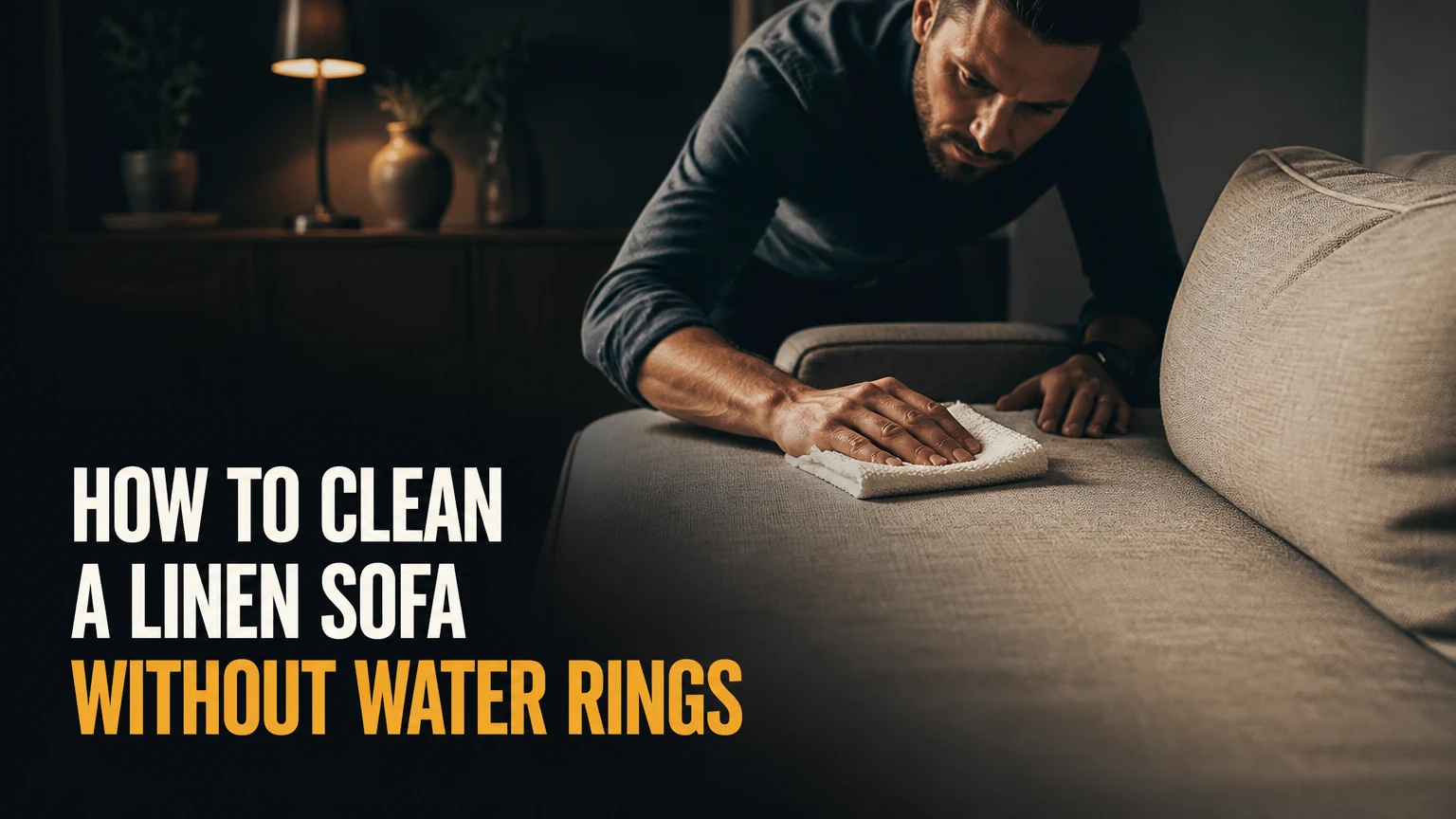
To clean a linen sofa, first read the manufacturer’s upholstery care code, then vacuum thoroughly and use only the compatible water-based, solvent-based, or vacuum-only method. Work on small areas, blot rather than scrub, apply minimal moisture, and dry the fabric rapidly with airflow. The care code determines whether DIY cleaning is appropriate.
Key facts at a glance
Code W permits a controlled water-based upholstery cleaner; Code S requires a water-free solvent.
Code WS permits either method, while Code X allows vacuuming or brushing only.
Linen upholstery should never be saturated because moisture can reach foam, batting, adhesive, and the frame.
Test every cleaner on a hidden area for color transfer, texture change, and shrinkage before visible cleaning.
A water-cleaned linen cushion typically needs 12-24 hours to dry fully, depending on humidity and airflow.
Professional upholstery cleaning is the safest choice for antique, fragile, non-colorfast, or Code X linen sofas.
Why Linen Requires Controlled Cleaning
Linen upholstery is woven from flax fibers, which are absorbent and relatively stiff compared with many synthetic upholstery fibers. The fabric can develop tide marks when one small area becomes wet, and the upholstery backing can shrink at a different rate from the visible linen face.
A linen sofa is also a layered object. Beneath the fabric may be polyester or cotton backing, foam, fiberfill, webbing, adhesive, and wood. Excess liquid does not remain at the surface, so a seemingly mild spot-cleaning attempt can create a larger ring, prolonged odor, or microbial growth inside the cushion.
The safest professional rule is simple: remove dry soil first, use the least aggressive compatible chemistry, and control moisture from application through final drying. Linen is not automatically dry-clean-only, but pure linen, linen blends, finishes, and backing materials respond differently.
What affects the cleaning result?
| Factor | Typical range or condition | Cleaning consequence |
|---|---|---|
| Linen content | 30%-100% flax fiber | Higher linen content can increase shrinkage and texture change |
| Surface moisture | Damp cloth to saturated cushion | Saturation increases rings, migration, and foam drying time |
| Drying time | 12-24 hours for light water cleaning | Longer drying raises odor and mildew risk |
| Room humidity | 30%-60% relative humidity | Higher humidity slows evaporation |
| Test dwell time | 10-15 minutes | Reveals dye bleeding, haloing, or texture change |
| Professional service | $150-$400 typically | Price rises with size, access, stain complexity, and location |
Which Care Code Does Your Linen Sofa Have?
The care label determines which cleaning chemistry can contact the linen sofa. Code W means water-based products are permitted, Code S means use a water-free solvent, Code WS permits either category, and Code X means vacuuming or gentle brushing only.
Look beneath removable cushions, along the platform, under the sofa, or behind a zippered cover. A manufacturer’s written instructions override generic code guidance because some brands restrict steam, machine washing, solvent use, or removable-cover cleaning even when the standard code appears permissive.
| Code | Permitted method | Do not use | DIY suitability |
|---|---|---|---|
| W | Water-based upholstery foam or low-moisture extraction | Oil-based solvent unless manufacturer permits it | Suitable for small, tested areas |
| S | Upholstery dry-cleaning solvent | Water, steam, wet shampoo | Limited spot work with ventilation |
| WS | Water-based or solvent method | Un-tested chemistry and saturation | Most flexible, still test first |
| X | Vacuuming and soft brushing | Water, shampoo, solvent, steam | Professional cleaning for stains |
| Missing label | Manufacturer confirmation required | Assumptions based on appearance | Delay liquid cleaning |
A code is not a guarantee that the exposed linen face will remain unchanged. Colorfastness, pigment printing, protective coatings, seam thread, and the backing can still fail a test.
What Do You Need Before Cleaning?
Prepare the sofa, cleaner, towels, and drying equipment before applying any product. A typical small spot-cleaning job costs $10-$30 and requires 30-60 minutes of active work, followed by 12-24 hours of drying for water-based methods.
Before-you-start checklist
| Requirement | Recommended specification | Typical quantity |
|---|---|---|
| Vacuum | Upholstery brush and crevice tools, adjustable suction | 1 |
| Cloths | White, lint-free microfiber towels | 6-10 |
| Water | Distilled water for W or WS fabrics | 2-4 cups |
| Cleaner | pH-neutral upholstery foam or labeled solvent | 1 product |
| Drying equipment | Fan, air mover, or dehumidifier | 1-2 units |
| Protective equipment | Nitrile gloves; eye protection for solvent work | 1 set |
| Test area | Hidden seam, skirt underside, or rear panel | 10 x 10 cm |
Do not begin if the sofa has active mold, a soaked cushion, unknown antique fabric, loose dye, or a missing label. Photograph the stain and label first. That record helps a cleaner identify what chemistry has already touched the upholstery.
How to Clean a Linen Sofa Step by Step
The safest linen-sofa process has six stages: inspect, dry-vacuum, test, treat, extract residue, and dry. The care code controls Stage 4, while the other stages remain broadly similar for W, S, WS, and X upholstery.
Step 1: Read the label and inspect the sofa
Remove throws, toys, and detachable cushions, then inspect seams, piping, zipper areas, and the underside for weakened fabric. Identify whether the stain is oily, water-soluble, protein-based, particulate, or unknown before choosing a cleaner.
Photograph faded areas and pre-existing marks. Check for sun damage, loose threads, fabric slippage, and cushion labels that may specify a different method from the main frame.
Success checkpoint: You can state the care code, fabric blend if available, stain type, and whether the cover is removable.
Common mistake: Treating every beige or white linen sofa as washable because its color appears light.
Step 2: Remove dry soil with a vacuum
Fit a clean upholstery brush and set suction to low or medium. Vacuum the frame, cushion tops, bottoms, sides, seams, tufting, crevices, and the area beneath the cushions; use the crevice tool without pressing its hard edge into the fabric.
For pet hair, place a thin nylon stocking over the nozzle or use a fabric-safe rubber tool before vacuuming. Do not repeatedly drag a stiff brush across a loose weave because the motion can pull loops and create fuzz.
If odor is the only problem, vacuum first. Baking soda can absorb some surface odor and oil, but it is not a disinfectant or a substitute for washing. Use only a very thin layer on dry, colorfast fabric, leave it for 15-20 minutes, and remove every grain. Avoid it on damp upholstery, dark fabric, velvet-like linen, or fabric with a manufacturer prohibition.
Success checkpoint: No loose grit remains in the seams, and the fabric feels dry before liquid or solvent is introduced.
Common mistake: Spraying deodorizer over dust, which binds soil to the weave.
Step 3: Blot a fresh spill immediately
Press white paper towels or a white microfiber cloth onto a fresh spill to transfer liquid into the towel. Replace the towel as soon as it becomes wet, and work from the outer edge toward the center without rubbing.
For solids such as mud, allow the material to dry, lift it with a blunt spoon, and vacuum the remaining particles. Hot water can set some protein stains, including milk or egg, while vigorous rubbing spreads oily pigment through the weave.
Success checkpoint: The towel picks up liquid without enlarging the original perimeter.
Common mistake: Applying a household spray before identifying the care code.
Step 4: Test the compatible cleaner
Test the chosen product on a hidden 10 x 10 cm area. Apply enough to imitate the planned treatment, wait 10-15 minutes, blot with a dry white towel, and inspect again after the test area has completely dried.
Look for color transfer on the towel, a darker halo, shrinkage, stiffness, gloss, raised fibers, or a changed weave. A successful wet test does not prove that the entire sofa can tolerate saturation; it only supports a limited, low-moisture application.
For Code W or WS, choose a pH-neutral upholstery product labeled for linen or natural-fiber upholstery. For Code S or WS, choose a product specifically labeled as an upholstery dry-cleaning solvent. Do not improvise with acetone, paint thinner, lighter fluid, or an unlabeled petroleum solvent.
Success checkpoint: The dry test area matches the surrounding fabric in color, hand feel, and dimensions.
Common mistake: Testing only while the fabric is wet, when bleeding and rings may become visible later.
Step 5: Treat W or WS linen with controlled foam
Mix the product exactly as its label directs. If the product has no dilution guidance, do not invent a strong dish-soap formula; household dish detergents can leave surfactant residue and may alter a protective finish. A practical low-moisture approach is to create foam, place a small amount on a white cloth, and avoid pouring liquid directly onto the linen.
Blot the stain from the outside inward using short presses. Work in areas of approximately 10 x 10 cm, changing to a clean section of cloth frequently. Avoid circular rubbing, which can distort the weave and produce a visible texture patch.
After treatment, use a separate cloth barely dampened with distilled water to lift cleaner residue. The cloth should feel damp, not wet enough to drip. Do not clean only the center of a large cushion if a water ring is likely; for severe or broad soiling, professional low-moisture cleaning can produce a more even result.
Success checkpoint: The stain lightens, the fabric is evenly damp rather than wet, and no cleaner foam remains.
Common mistake: Using tap water when the local supply is hard. Dissolved minerals can leave a pale boundary after evaporation, although distilled water cannot prevent every ring caused by uneven wetting.
Step 6: Treat S or WS linen with solvent
Use solvent only in a well-ventilated room, away from flames, pilot lights, cigarettes, heaters, and children. Wear gloves, follow the product’s safety data sheet, and never pour solvent directly onto the sofa.
Moisten a white cloth with a small amount of labeled upholstery solvent, then press it onto the stain. Use a new cloth section as soil transfers. Solvents can dissolve oily grime without adding water, but they can also remove finishes, affect dyes, and create flammable vapors.
Allow the treated area to evaporate naturally. Do not use a hairdryer or enclosed room. If the stain covers a large area, the label is Code X, or the sofa has high monetary or sentimental value, stop after vacuuming and hire a trained upholstery cleaner.
Success checkpoint: The area dries without an oily edge, color transfer, or persistent strong odor.
Common mistake: Increasing solvent quantity when the first application does not remove a set stain. More solvent can spread the stain and increase vapor exposure.
Step 7: Dry the upholstery completely
Press dry white towels into water-cleaned areas to remove surface moisture. Position cushions upright with space around every side, run a fan across the fabric rather than directly against one small spot, and reduce room humidity with a dehumidifier if necessary.
Keep the sofa out of direct sunlight and away from radiators. Heat can dry the outer linen faster than the backing, producing uneven shrinkage or tension. Do not replace cushions or sit on the sofa until the fabric, seams, and cushion edges are fully dry.
Success checkpoint: The linen feels the same temperature and texture across the treated and untreated areas, with no cool dampness at seams or underside edges.
Common mistake: Judging dryness by the surface alone. Press a dry towel into seams and cushion edges, where moisture often remains.
Step 8: Restore texture after full drying
Once the linen is completely dry, use a soft clothes brush with light strokes in the fabric’s existing direction. Do not brush damp linen, because wet flax fibers can distort more easily.
A handheld steamer is not a universal fix. Steam may relax wrinkles, but heat and moisture can create rings, shrinkage, or backing separation. Use steam only when the manufacturer permits it, keep the head several inches away, and test first.
Success checkpoint: The treated area has a consistent nap and does not feel crunchy or tacky.
Common mistake: Pressing a hot steamer plate against the fabric.
Which Cleaning Method Is Best for Linen Upholstery?
Low-moisture DIY cleaning is usually the best choice for a small, fresh stain on tested Code W or WS linen. Professional cleaning is safer for broad soil, Code S or X upholstery, expensive furniture, unstable dyes, and stains that have migrated into foam.
| Method | Typical cost | Active time | Main risk | Best use |
|---|---|---|---|---|
| Vacuum and blot | $0-$10 | 15-30 minutes | Incomplete stain removal | Fresh dry soil and spills |
| DIY water-based spot clean | $10-$30 | 30-60 minutes | Ringing or shrinkage | Tested W or WS linen |
| DIY solvent spot clean | $15-$40 | 20-45 minutes | Vapor, dye, finish damage | Small tested S stains |
| Professional upholstery cleaning | $150-$400 | 2-4 hours onsite | Cost and scheduling | Large, valuable, or fragile sofas |
| Machine-washable cover cleaning | $10-$30 | 1-2 hours active | Shrinkage and distortion | Explicitly washable covers |
Professional cleaning is not automatically risk-free. Ask the provider whether the technician has handled natural-fiber upholstery, whether the process is low-moisture or solvent-based, how the sofa will be dried, and whether a hidden-fabric test is included.
Can You Wash Linen Sofa Covers in a Machine?
Machine washing is safe only when the manufacturer explicitly permits it for the complete cover assembly. Removable linen upholstery can contain a backing, zipper, piping, foam insert, lining, or finishing treatment that responds differently from ordinary linen clothing.
If the label says machine wash, close zippers, wash covers separately in cool water on a gentle cycle, use a small amount of mild detergent, and avoid bleach, optical brighteners, and fabric softener. Do not overload the machine. Air-dry the cover while slightly damp if the instructions permit, then refit it before it becomes fully rigid.
| Cover instruction | Water temperature | Drying method | Risk level |
|---|---|---|---|
| Machine wash permitted | Cold to 30°C | Air dry, no direct heat | Moderate |
| Hand wash permitted | Cold water | Flat or air dry | Moderate |
| Dry clean only | Not applicable | Professional solvent service | High if improvised |
| Do not remove cover | Not applicable | In-place upholstery cleaning | Low when label is followed |
| No care information | Do not wash | Manufacturer confirmation first | High |
Never put a linen sofa cover in a hot dryer unless the manufacturer gives a specific temperature and cycle. Even a small dimensional change can prevent the cover from fitting over the foam.
How Should You Remove Common Linen Sofa Stains?
Stain removal depends on the substance, care code, and age of the mark. Blot fresh liquid first, avoid aggressive home remedies, and use only a tested product compatible with the label.
| Stain | First response | W or WS option | S or X response |
|---|---|---|---|
| Coffee or tea | Blot with dry towel | Tested upholstery foam, then distilled-water rinse | Solvent only if label permits; otherwise professional |
| Red wine | Blot, do not add salt | Low-moisture upholstery product after testing | Professional service preferred |
| Grease or butter | Lift solids, cover briefly with absorbent paper | Labeled upholstery degreaser after testing | Labeled solvent on cloth |
| Mud | Dry completely, lift, vacuum | Foam only for remaining mark | Vacuum, then professional service |
| Ink | Do not spread with water | Professional stain treatment preferred | Professional solvent assessment |
| Pet urine | Blot and remove cushion cover if permitted | Enzyme product only if labeled safe for linen | Professional odor treatment |
| Wax | Harden, lift gently | Treat residue professionally | Treat residue professionally |
Vinegar, hydrogen peroxide, chlorine bleach, and abrasive powders are poor default choices for linen upholstery. They can alter pH, fade dyes, weaken flax, or leave residues that attract more soil. An enzyme cleaner can help with biological odors, but only when both the product and the upholstery manufacturer permit it.
Common Mistakes and How to Fix Them
Linen cleaning failures usually come from excess moisture, incompatible chemistry, or uneven treatment rather than from insufficient scrubbing. Stop immediately when color transfers or the fabric changes texture.
| Failure | Likely cause | Immediate response | When to call a professional |
|---|---|---|---|
| Water ring | Uneven wetting or mineral residue | Stop spot treatment; dry evenly | Ring remains after complete drying |
| Stiff or crunchy fabric | Cleaner residue or dried fibers | Vacuum gently and soft-brush when dry | Texture remains altered |
| Color bleed | Dye instability | Stop, blot without rubbing, air-dry | Any visible migration |
| Pilling or fuzz | Friction or stiff brush | Stop brushing; do not shave immediately | Surface damage is widespread |
| Musty odor | Foam or backing remains damp | Increase airflow and dehumidify | Odor lasts beyond 24-48 hours |
| Wrinkles or shrinkage | Heat or uneven drying | Avoid reheating and stretching | Cover no longer fits or seams distort |
Do not “fix” a water ring by wetting the entire cushion unless the care label permits water and you can control drying. Even wetting can spread dye or drive moisture into foam. A professional may use an upholstery extractor, but consumer carpet machines can deposit too much water and leave detergent behind.
Is Steam Cleaning Safe for Linen?
Steam cleaning is safe only when the sofa manufacturer permits steam and the fabric passes a hidden-area test. Linen can tolerate brief, controlled vapor in some constructions, but steam adds both heat and moisture, which may shrink the face fabric, affect adhesive, or create a ring.
Steam is especially unsuitable for Code X upholstery, antique linen, loose weaves, laminated backing, and cushions that cannot be dried quickly. A steamer may relax a superficial wrinkle, but it will not remove oily soil and can set some stains by spreading moisture through the weave.
How Often Should You Clean a Linen Sofa?
Vacuum linen upholstery weekly, blot spills immediately, and schedule a deep clean approximately every 12-24 months when the sofa receives ordinary household use. Homes with pets, children, allergies, cooking smoke, or heavy daily use may need professional assessment every 6-12 months.
Use a clean upholstery attachment and low suction for routine maintenance. Rotate reversible cushions monthly when the manufacturer permits it, keep them away from strong sunlight, and avoid sitting repeatedly on one edge because compression changes the way linen reflects light.
A protective spray is not automatically safe for natural fibers. Use only a product whose label names upholstery and the relevant linen or blend, and test for darkening, stiffness, and odor before treating the full sofa.
Situational Advice for Different Sofas
Pet owners should prioritize frequent vacuuming, washable throws, and rapid urine response rather than repeated wet cleaning. A linen-polyester blend may tolerate household use better than delicate pure linen, but the care label remains decisive.
Renters should document the sofa’s condition, label, and any spill before treatment. Small Code W marks may be manageable with low-moisture foam, while Code S or X upholstery should not be exposed to improvised cleaners.
Owners of vintage or designer sofas should avoid experiments on visible panels. A conservator or upholstery cleaner familiar with natural fibers can assess dye stability, weave tension, and the condition of the lining before cleaning.
High-use households should choose upholstery with a documented cleaning code, removable covers, and a durable blend at the buying stage. Pure linen offers a distinctive hand and texture, but it is a poor candidate for aggressive, frequent wet cleaning.
How Much Time and Money Does Linen Sofa Cleaning Take?
A small DIY spot treatment typically costs $10-$30 and takes 30-60 minutes, excluding drying. A full professional service commonly costs $150-$400, while drying usually takes 12-24 hours after controlled water cleaning and 1-4 hours after a small solvent treatment.
| Job type | Typical price | Active labor | Total elapsed time |
|---|---|---|---|
| Fresh spill blotting | $0-$10 | 15-30 minutes | 15-30 minutes |
| One small W-code stain | $10-$30 | 30-60 minutes | 12-24 hours |
| Several cushion spots | $20-$60 | 1-2 hours | 12-24 hours |
| Professional sofa service | $150-$400 | 2-4 hours | 12-36 hours |
| Antique or complex restoration | $300-$800+ | 3-8 hours | 1-3 days |
These are typical consumer ranges, not fixed prices. Location, sofa size, access, fabric blend, stain history, and whether cushions can be removed can change the quote substantially.
What Should You Do When Cleaning Goes Wrong?
Stop applying products when a ring, bleed, or texture change appears. Blot excess liquid with dry towels, improve airflow, and allow the area to dry before deciding whether further treatment is appropriate.
For a water mark on tested W or WS upholstery, a professional may re-wet and extract a larger, defined panel to reduce the contrast between wet and dry boundaries. Do not repeatedly mist the cushion at home, because each cycle can move more soil into the perimeter.
For stiffness, remove residue only with the method allowed by the care label. A soft brush can loosen dry surface fibers, but brushing cannot reverse chemical damage or shrinkage. For persistent odor, inspect cushion cores and undersides rather than masking the smell with fragrance.
FAQ
Can I clean a linen sofa with dish soap?
Use dish soap only if the sofa manufacturer and product instructions permit it, and never apply a concentrated solution directly to linen. Dish detergents are designed to remove kitchen grease, so they can leave surfactant residue or affect fabric finishes. A labeled, pH-neutral upholstery cleaner is the safer default for Code W or WS fabric.
Is baking soda safe on linen upholstery?
Baking soda is generally suitable only for a thin application on dry, colorfast linen, followed by complete vacuum removal after 15-20 minutes. Baking soda will not remove embedded urine, mold, or deep grease, and powder residue can remain in open weaves. Never use it to absorb a wet cushion that cannot dry quickly.
Can I clean linen upholstery with a carpet cleaner?
A carpet cleaner is not automatically suitable for linen upholstery because its spray and extraction volume may saturate the fabric and foam. Use the machine only when the sofa manufacturer permits extraction and the machine has an upholstery tool with controllable moisture. Code S and Code X sofas should not receive water extraction.
How can I prevent water marks on a linen couch?
Prevent water marks by using the correct code, distilled water when water is allowed, foam rather than free liquid, small controlled sections, and rapid even drying. Spot cleaning the center of a visibly soiled cushion often creates contrast, so broad soil should be cleaned across the complete panel by a professional.
Should linen sofa cushions be cleaned separately?
Clean removable cushions separately only when the label permits the same method for both covers and cushion inserts. Remove covers carefully, photograph their original orientation, and never machine-wash them based solely on the presence of a zipper. Cushion foam can retain moisture longer than the linen cover and needs separate drying checks.
When should I hire a professional linen upholstery cleaner?
Hire a professional for Code X fabric, widespread staining, dye transfer, mold, urine odor in foam, antique construction, expensive designer furniture, or any sofa with no reliable care label. Choose a provider who tests natural fibers, explains the moisture level, and gives a drying plan before starting.
The Bottom Line
To clean a linen sofa safely, identify the care code, vacuum before introducing chemistry, test a hidden area, and use the lowest-moisture compatible method. Code W and WS linen can sometimes receive careful foam cleaning, Code S requires labeled solvent, and Code X should remain liquid-free. Dry every treated area completely before use. When the sofa is valuable, unstable, heavily soiled, or unlabeled, professional cleaning is the lower-risk choice.