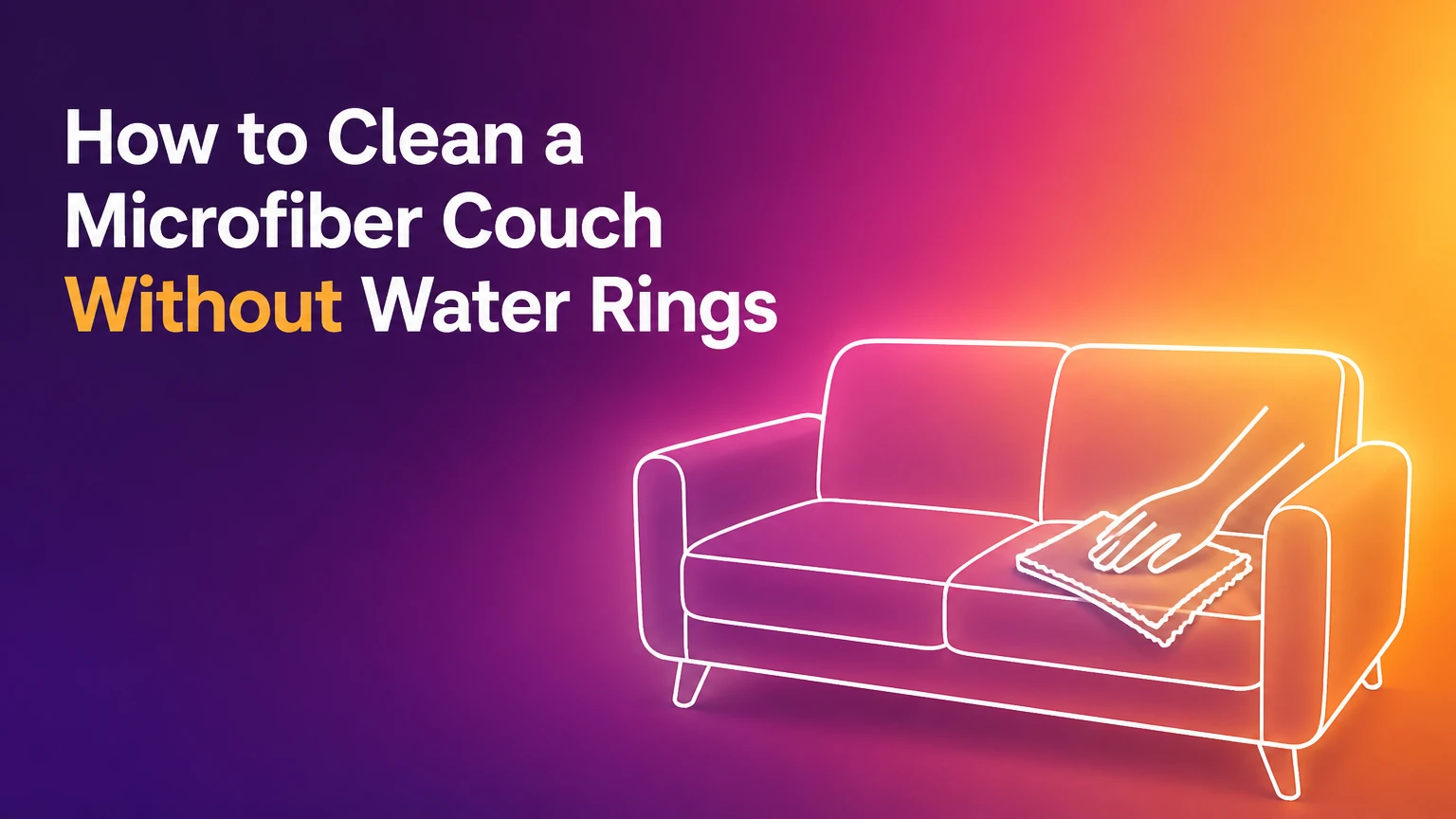
To clean a microfiber couch safely, first read its upholstery care code, vacuum away dry debris, then use only the approved water-based or solvent-based method in small sections. Blot rather than soak, test every cleaner on a hidden area, dry the fabric with airflow, and brush the nap after it is completely dry.
Key Facts at a Glance
A W code permits water-based upholstery cleaning, while an S code requires a water-free solvent method.
An S/W code permits either method, but the furniture manufacturer’s instructions still take priority.
An X code means avoid liquid and rely on vacuuming or professional care.
Typical DIY cleaning takes 30-60 minutes of active work, followed by 2-8 hours of drying.
Water rings usually result from uneven moisture or dissolved soil migrating to the edge, not from microfiber itself.
Isopropyl alcohol is flammable, so solvent cleaning requires ventilation and distance from flames, heaters, and sparks.
Which Care Code Does Your Microfiber Couch Have?
The care label determines whether microfiber upholstery can receive water, solvent, both, or neither. Look beneath a removable seat cushion, along the underside of the frame, or on the original furniture paperwork before applying any cleaner.
Care symbols are manufacturer instructions, not a guarantee that every product labeled “safe for microfiber” will work on your couch. Polyester, nylon, dyes, backing fabric, thread, and foam can react differently, so a hidden-area test remains necessary.
| Code | Cleaning permission | Typical compatible method | Main restriction |
|---|---|---|---|
| W | Water-based cleaner allowed | Diluted upholstery shampoo or controlled soap suds | Do not saturate foam or backing |
| S | Water-free solvent required | Manufacturer-approved upholstery solvent or tested isopropyl alcohol | Do not add water |
| S/W | Water or solvent allowed | W or S method after patch testing | Choose the method that limits moisture and color risk |
| X | No liquid cleaning | Vacuuming, dry brushing, professional assessment | Do not apply soap, alcohol, steam, or spray |
Some labels use additional symbols or brand-specific instructions. If a tag says “professional clean only,” “do not wet,” or gives a named product, follow that instruction instead of relying on a generic code chart.
What if the care label is missing?
Treat an unlabeled microfiber couch as an unknown-fiber upholstery until the manufacturer confirms its care method. Search the model number, contact the retailer, or test a hidden seam with the least invasive dry method first. Do not begin with steam or a large wet patch.
If no information is available, vacuum thoroughly and consult an upholstery professional before using liquid. A small test area can reveal color transfer, but it cannot reveal every long-term problem, including backing delamination or foam moisture retention.
What Should You Gather Before Cleaning?
A standard microfiber couch needs a vacuum with an upholstery attachment, a crevice tool, white absorbent cloths, a soft brush, a spray bottle for solvent cleaning, and a fan. W-code cleaning also requires clear dish soap or a labeled upholstery cleaner, while S-code cleaning requires a compatible water-free solvent.
Before-you-start checklist
| Item | Typical quantity or setting | Use |
|---|---|---|
| Vacuum and upholstery nozzle | 1 machine, low or medium suction | Remove dust, hair, crumbs, and loose grit |
| Crevice tool | 1 narrow attachment | Clean seams, joins, and frame gaps |
| White cotton or microfiber cloths | 6-10 cloths | Blotting without dye transfer |
| Clear dish soap | 1 tablespoon per 4 cups of water | W-code suds only |
| Isopropyl alcohol | 70% or 91%, typically 250-500 ml | S-code spot cleaning after testing |
| Soft upholstery or suede brush | 1 brush with clean, flexible bristles | Restore the nap after drying |
| Fan | 1 room fan, 1-2 metres away | Increase airflow without high heat |
Typical active cleaning time is 30-60 minutes for a three-seat couch. The supply cost is commonly $10-$30 if a vacuum and fan are already available; professional upholstery cleaning commonly falls around $100-$300 in the United States, depending on region, access, size, and stain severity.
How to Clean a Microfiber Couch Step by Step
The safest process has six steps: identify the code, vacuum dry soil, test the product, clean small sections, remove residue, and dry completely before brushing. The care code is the factor that most determines success because the wrong liquid can create rings, discoloration, or trapped moisture.
Step 1: Remove cushions and dry debris
Take off loose cushions, pillows, throws, and removable covers. Shake washable items outdoors only if their own labels permit it, then inspect the couch for coins, food particles, pet hair, and grit that could scratch or smear during cleaning.
Vacuum the seat decks, cushion tops, sides, back, and underside edges. Use the crevice attachment along piping and between cushions, then vacuum in two directions so the nozzle reaches the microfiber nap from more than one angle.
You’ll know it worked when: the vacuum collects loose debris without leaving visible crumbs or hair in the seams.
Common mistake: pressing the nozzle hard against the fabric. Excessive suction can distort loose upholstery, so use the upholstery attachment and keep the nozzle moving.
Step 2: Inspect the fabric and test the cleaner
Choose a hidden location beneath a cushion or behind the lower skirt. Apply the intended cleaner to a white cloth or cotton swab, then touch a 2-by-2-inch area rather than spraying the whole couch.
Wait until the test area dries. Check for dye on the cloth, a darker edge, rough texture, stickiness, fading, or a change in sheen. The Home Depot’s microfiber upholstery guidance uses the direct instruction, “Always test your cleaning solution on an inconspicuous area first,” a rule worth following even when the product label claims universal fabric compatibility.
You’ll know it worked when: the dried test area matches the surrounding fabric in color, texture, and reflectivity.
Common mistake: judging a solvent while the area is still wet. Alcohol and some upholstery products temporarily change the nap and sheen before evaporation.
Step 3: Clean W-code microfiber with controlled suds
Mix 1 tablespoon of clear dish soap with 4 cups of lukewarm water. Stir the mixture and use the foam on top, not the liquid beneath it. Dip a white cloth or soft sponge into the suds, wring it until nearly dry, and work across a 6-by-6-inch section.
Use light overlapping strokes rather than aggressive circles. Circular rubbing can create a visible nap change, especially on dark microsuede-style upholstery. Rinse a second cloth with plain water, wring it very thoroughly, and wipe the section once to reduce soap residue.
Clean an entire cushion panel or defined upholstery section when possible. Stopping in the middle of a broad panel increases the chance of a visible boundary.
You’ll know it worked when: soil transfers to the cloth, the fabric feels damp rather than wet, and no liquid pools at seams.
Common mistake: dipping the cloth into the cleaning solution and carrying excess water to the couch. The cloth, not the upholstery, should hold most of the moisture.
Step 4: Clean S-code microfiber with a water-free solvent
Use only a solvent approved by the furniture maker or one that passes the hidden-area test. Many care guides recommend 70% or 91% isopropyl alcohol for S-coded microfiber, but alcohol is not automatically safe for every dye, finish, backing, or blended fabric.
Ventilate the room and remove candles, cigarettes, gas flames, heat guns, and other ignition sources. Put the alcohol in a labeled spray bottle if permitted by the container instructions, then mist a small area lightly from about 20-30 centimetres away.
Do not flood the fabric. Immediately agitate the section with a clean white sponge or soft cloth, then blot with another dry white cloth. Move from a clean area of the cloth to a dirty area as soil transfers.
You’ll know it worked when: the solvent evaporates quickly, the stain lightens, and the dry fabric does not show a darker perimeter.
Common mistake: spraying alcohol near a heater or using it in a poorly ventilated room. Isopropyl alcohol is flammable and its vapour should not accumulate indoors.
Step 5: Handle S/W and X upholstery conservatively
S/W microfiber permits either water or solvent cleaning, but the best choice depends on the stain and the amount of moisture the construction can tolerate. Use solvent for small oily marks or when water rings are a known problem; use controlled suds for water-soluble food or mud when the label and test area permit it.
X-coded upholstery should receive no DIY liquid, steam, alcohol, enzyme spray, or soap. Vacuuming and gentle dry brushing are appropriate routine care, while a professional can assess whether the fabric can be cleaned with a specialized low-moisture process.
Baking soda may absorb some surface odor and loose oil, but it does not disinfect upholstery or neutralize urine inside foam. If used on X fabric, apply a thin layer for about 30 minutes, vacuum slowly, and stop if powder remains embedded in the nap.
Step 6: Dry, inspect, and restore the nap
Keep cushions separated and position a fan to move air across the couch rather than blasting one wet spot. Allow W-code upholstery to dry for a typical 4-8 hours; S-code alcohol cleaning often dries in 30-90 minutes, although dense cushions and humid rooms take longer.
Do not reinstall cushions or sit on damp fabric. Moisture trapped between a cushion and its deck can create odor and prolong drying. Avoid high heat from hair dryers, irons, heat guns, or radiators because synthetic fibers and upholstery adhesives can deform.
When the fabric is fully dry, brush gently with a clean soft upholstery brush. Follow the existing nap direction first, then use short cross strokes only where the texture remains compressed.
You’ll know it worked when: the fabric feels dry and flexible, the color is even, and the nap rises without a crunchy residue.
Common mistake: brushing while the couch is damp. Wet brushing can set an uneven texture and spread remaining soil.
Which Cleaner Works for Each Common Stain?
Stain treatment should match both the substance and the care code. Remove solids first, blot liquids from the outside toward the centre, and use the smallest amount of approved cleaner that can dissolve the mark.
| Stain or soil | First action | W or S/W option | S option |
|---|---|---|---|
| Coffee or juice | Blot with a dry white cloth | Controlled suds, then minimal plain-water wipe | Tested upholstery solvent, then blot |
| Mud | Let it dry, then vacuum | Suds on remaining residue | Solvent only if the label permits |
| Grease or butter | Lift solids with a spoon | Upholstery degreaser labeled for W fabric | Tested solvent, applied lightly |
| Ink or marker | Do not rub | Manufacturer-approved stain remover | Alcohol may help after a hidden test |
| Pet urine | Blot immediately | Enzyme upholstery product labeled for W fabric | Specialist assessment if water is prohibited |
| Gum or wax | Harden with a wrapped ice pack | Lift gently with a blunt card | Lift gently, then test solvent residue |
Ink can dissolve and spread quickly, so use a cotton swab and work inward rather than wiping across the whole mark. Grease often needs a solvent or a product designed for oil, while soap alone may redistribute it.
Never combine alcohol, bleach, ammonia, vinegar, enzyme products, and dish soap in one container. Chemical mixtures can damage fabric, create irritating vapours, or make residue harder to remove.
What Are the Main Cleaning Methods?
Water-based suds are inexpensive and useful for W-coded food and mud stains, while solvent cleaning dries faster and reduces water-ring risk on S-coded microfiber. Commercial upholstery products offer controlled formulas, and professional extraction is the better choice when soil has reached the foam or when the label prohibits home liquids.
| Method | Compatible code | Typical active time | Main advantage | Main limitation |
|---|---|---|---|---|
| Soap suds | W, sometimes S/W | 30-60 minutes | Low cost, useful for food soil | Requires careful moisture control |
| Isopropyl alcohol | S, sometimes S/W | 20-45 minutes | Fast evaporation, low water-ring risk | Flammable and test-sensitive |
| Commercial upholstery cleaner | Label-specific | 30-60 minutes | May include fabric-safe instructions | Product compatibility varies |
| Professional low-moisture cleaning | X, W, S, or S/W after inspection | 1-3 hours on site | Better equipment and stain assessment | Typical cost is $100-$300 |
| Steam or hot-water extraction | Usually W only if approved | 1-4 hours | Can remove embedded soil | Overheating or over-wetting can damage upholstery |
Steam is not automatically the deepest or safest choice. Heat, pressure, and extraction settings must match the fabric, dye, adhesive, backing, and cushion construction; a W label alone does not authorize every machine or temperature.
How Do You Fix Water Rings and Stiff Microfiber?
Water rings usually form when moisture dries unevenly and carries dissolved soil or minerals to the edge of the wet area. Stiff microfiber usually contains dried detergent residue or has a flattened nap, so the solution is controlled residue removal followed by complete drying and brushing.
For a small ring on S-coded fabric, test a light mist of the approved solvent and treat slightly beyond the visible edge, then blot from the outside inward. For W-coded fabric, use a nearly dry cloth with plain distilled water or the approved rinse method, but test first because re-wetting can enlarge the mark.
If the fabric feels crunchy, brush it after drying and inspect the cloth for white or sticky residue. A second, carefully controlled wipe may remove excess soap on W fabric. Do not add water to S upholstery merely to soften it.
A practitioner rule is to avoid “spot halos” by cleaning a complete cushion face when a stain has spread beyond a small mark. Local treatment is efficient for a coin-sized spot, but a broad wet boundary can remain visible on directional microfiber.
How Do You Remove Pet Hair and Odor?
Vacuuming removes loose pet hair, but urine odor requires access to the contaminated foam when liquid has passed through the upholstery cover. Use a rubber hair tool or upholstery nozzle twice weekly for heavy shedding, then treat odor according to the care code.
For W-coded fabric, blot fresh urine, apply a labeled enzyme upholstery cleaner in the quantity specified by its manufacturer, and allow the required dwell time without saturating the cushion. Enzymes need contact with the odor source, so a surface mist may fail when urine has reached foam.
For S or X fabric, do not improvise with water-based enzyme products. Remove the cover only if the manufacturer allows it, and seek professional treatment when odor returns after the surface is dry.
Baking soda can reduce a mild surface smell temporarily, but it cannot digest urine compounds inside foam. Repeated powder applications may also leave abrasive residue in the nap.
What Should You Avoid on Microfiber Upholstery?
Avoid untested cleaners, colored rags, soaking, abrasive scrubbing, high heat, and mixed chemicals. These mistakes either transfer dye, push soil deeper, create a ring, alter the nap, or damage synthetic fibers and upholstery backing.
- Do not use water on S or X upholstery.
- Do not use alcohol on W fabric unless the manufacturer specifically permits it.
- Do not scrub with a stiff household brush before testing the nap.
- Do not saturate seams, zippers, cushion edges, or the area around a reclining mechanism.
- Do not use bleach, acetone, nail-polish remover, or undiluted disinfectant.
- Do not place damp cushions back on the sofa.
- Do not clean one small spot repeatedly while ignoring the surrounding soiled panel.
Colored towels can release dye onto pale microfiber. White cloths make transfer visible and allow you to monitor whether soil is still moving from the fabric.
How Often Should You Clean a Microfiber Couch?
Vacuum microfiber upholstery weekly, vacuum twice weekly in homes with pets, and deep-clean W or S/W couches every 6-12 months or when visible soil develops. Spot-clean spills immediately because dried sugar, milk, grease, and urine become harder to remove after they reach the backing or foam.
| Household condition | Vacuum schedule | Spot treatment | Deep-clean interval |
|---|---|---|---|
| Two adults, no pets | Every 7 days | Within 15 minutes | Every 9-12 months |
| Children under 5 | Every 3-4 days | After each spill | Every 6-9 months |
| One shedding pet | Twice weekly | Within 10 minutes | Every 6 months |
| Multiple pets or allergies | 2-4 times weekly | Immediately | Every 3-6 months |
| X-coded upholstery | Weekly or twice weekly | Dry method only | Professional schedule based on inspection |
These are practical maintenance intervals, not guarantees. Light-colored upholstery, high humidity, smoking, and frequent food use can justify shorter intervals, while a rarely used formal sofa may need less frequent deep cleaning.
When Should You Hire a Professional?
Hire an upholstery professional when the care label says X, a stain has penetrated the foam, a large area has water rings, mold or persistent odor is present, or the fabric bleeds during testing. Professional cleaning is also sensible for antiques, expensive custom upholstery, and cushions that cannot be removed or ventilated.
Ask the cleaner to identify the fabric code, proposed chemistry, moisture level, drying plan, and method for protecting wood or metal components. A reputable technician should inspect the fabric before promising complete stain removal.
Professional cleaning cannot guarantee removal of aged ink, dye transfer, oxidation marks, or urine that has chemically altered foam. The honest objective is safe soil reduction and odor control, not a promise that every mark will disappear.
How Much Time and Money Does Couch Cleaning Take?
Typical DIY microfiber couch cleaning costs $10-$30 when basic household tools are available and requires 30-60 minutes of active work. Drying adds approximately 30-90 minutes for light solvent treatment or 4-8 hours for controlled water-based cleaning.
| Cleaning situation | DIY supply cost | Active time | Drying or return-to-use time |
|---|---|---|---|
| One small S-code stain | $3-$10 | 10-20 minutes | 30-90 minutes |
| Three-seat W-code couch | $10-$30 | 30-60 minutes | 4-8 hours |
| Pet odor surface treatment | $10-$25 | 30-75 minutes | 6-12 hours |
| Professional upholstery visit | $100-$300 typical | 1-3 hours on site | 4-24 hours, depending on moisture |
| X-code inspection and service | $100-$350 typical | 1-3 hours | Provider-specific |
Prices vary by city, upholstery size, access, stain complexity, and whether cushions are included. A quote that excludes cushion faces, travel, stain treatment, or deodorizing may not represent the final cost.
Frequently Asked Questions
Can I use a carpet cleaner on a microfiber sofa?
Use a carpet or upholstery machine only when the furniture label and cleaner instructions permit it. A machine designed for carpet may deliver too much water or suction for delicate upholstery, and its cleaning formula may leave residue. Test first, use the lowest suitable moisture setting, and dry cushions separately.
Can I wash microfiber couch cushion covers in a washing machine?
Only wash removable covers when the cover label explicitly permits machine washing. Check the water temperature, cycle, detergent, zipper position, and drying instructions, because shrinkage can prevent the cover from fitting over the cushion again. Never assume a removable cover is washable simply because it has a zipper.
Why does microfiber change color when I rub it?
Microfiber changes apparent color when its fine nap lies in different directions and reflects light differently. Rubbing can also flatten fibers or create a sheen, especially on dark microsuede upholstery. Brush gently in one consistent direction after drying and avoid aggressive circular scrubbing.
Is vinegar safe for cleaning microfiber?
Vinegar is not a universal microfiber cleaner because acidity can affect dyes, finishes, backing, or odor chemistry, and it does not replace an enzyme product for urine. Use vinegar only if the furniture or cleaner manufacturer specifically permits it. A tested, code-compatible upholstery product is the safer default.
Can I use baby wipes on a microfiber couch?
Baby wipes are not a dependable substitute for code-approved upholstery cleaning. Preservatives, oils, fragrances, and moisture can leave a visible residue or spread a stain. For a fresh spill, remove solids and blot with a clean white cloth, then follow the W, S, S/W, or X instructions.
How can I clean a microfiber couch without making it smell?
Prevent odor by using minimal liquid, removing soap residue, separating cushions, and providing airflow until the upholstery is fully dry. Surface deodorizer cannot correct urine or vomit inside foam. Persistent odor after drying indicates that the cushion interior may require professional extraction or replacement.
The Bottom Line
To clean a microfiber couch safely, identify the care code, vacuum thoroughly, patch-test the chosen product, and control moisture at the cloth rather than the furniture. Use suds for approved W upholstery, a tested water-free solvent for S upholstery, and no liquid on X upholstery. Dry completely, brush the nap, and escalate embedded stains or odors to a professional.