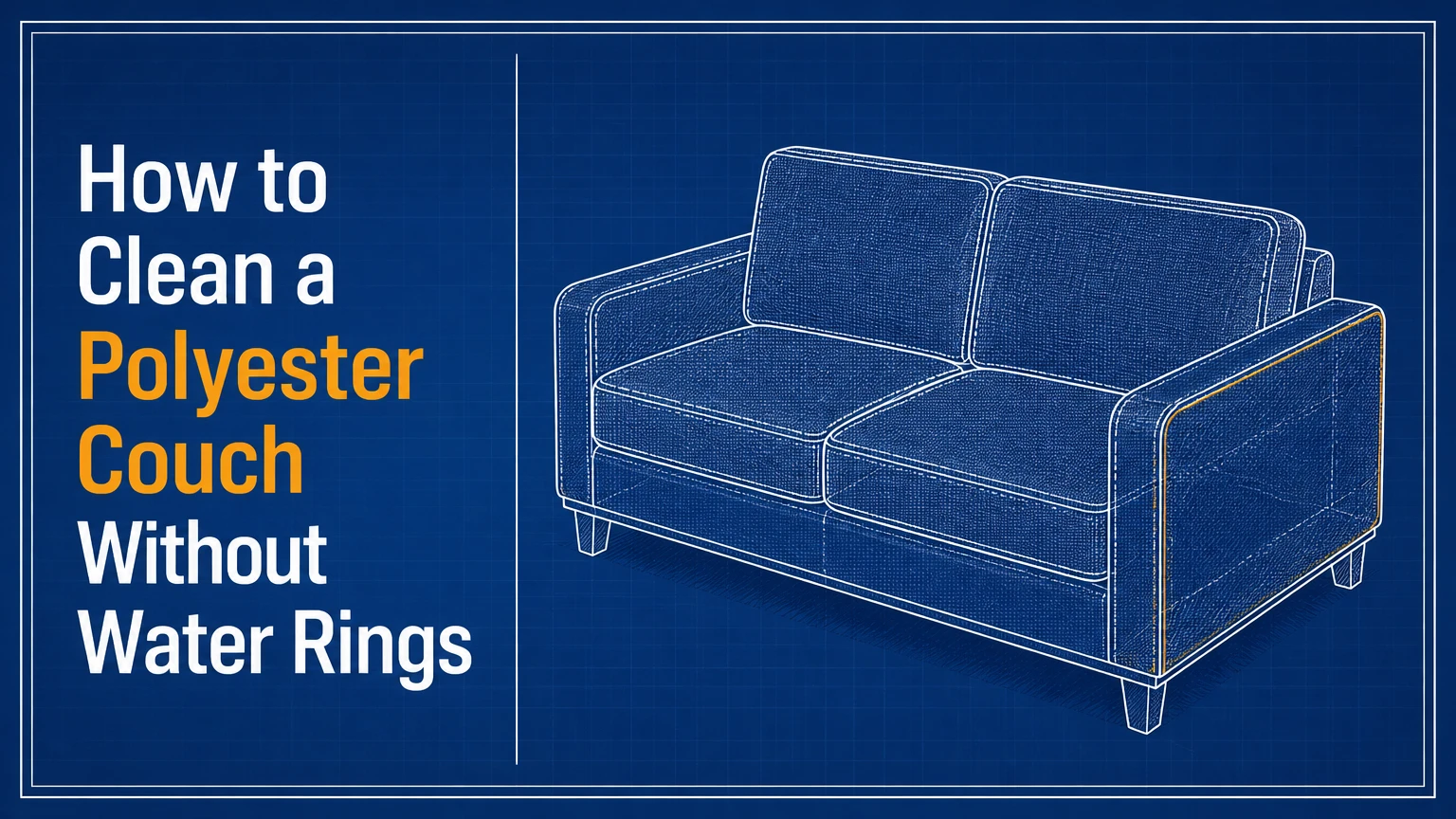
To clean a polyester couch safely, first find the upholstery cleaning code, then vacuum thoroughly, test the chosen product, treat stains with the correct low-moisture method, remove residue, and dry the fabric quickly with airflow. The cleaning code, not the word polyester alone, determines whether water, solvent, or professional cleaning is appropriate.
Key Facts at a Glance
- A W code permits carefully controlled water-based upholstery cleaning, while an S code requires a solvent-based product.
- An S/W or WS code permits either method, but low moisture remains safer for cushion foam.
- An X code means vacuuming and light brushing only; liquid or solvent can permanently damage the upholstery.
- Vacuuming removes abrasive grit before wiping, reducing fabric wear and preventing muddy residue.
- Typical hand cleaning takes 45-90 minutes, while complete drying commonly takes 2-6 hours with strong airflow.
- Polyester can tolerate routine cleaning, but high heat, oversaturation, dye transfer, and aggressive scrubbing can deform or discolor the cover.
Step 1: Find the Upholstery Cleaning Code
The upholstery care code identifies the safest cleaning medium for a polyester couch. Look under seat cushions, beneath the sofa frame, along the rear platform, or on the manufacturer’s care label attached to a cushion cover.
| Code | Permitted method | Suitable product | Main restriction |
|---|---|---|---|
| W | Water-based cleaning | Upholstery shampoo, diluted detergent, extraction solution | Avoid soaking foam or backing |
| S | Solvent-based cleaning | Upholstery dry-cleaning solvent | Do not apply water or vinegar |
| S/W or WS | Water or solvent | Tested product from either category | Choose the lower-moisture option |
| X | Vacuuming only | Vacuum and soft upholstery brush | No liquid, steam, shampoo, or solvent |
A polyester fiber can be water-tolerant while the couch backing, dye, adhesive, foam, or finish is not. That is why a “100% polyester” label does not override the care code. Removable covers may carry a separate laundering instruction, but “machine washable” still requires checking water temperature, drying temperature, zipper condition, and shrinkage warnings.
If the cleaning code is missing
Treat an unlabeled polyester couch as S/W only after a cautious test, not as automatically water-safe. Test a hidden seam with a barely damp white cloth and wait until it dries; check for color transfer, a hard edge, puckering, texture change, or a water ring.
If the fabric is vintage, velvet-like, tightly tailored, coated, patterned with unstable dyes, or already showing discoloration, stop after the dry test and contact the manufacturer or an upholstery cleaner. A hidden test reduces risk, but it cannot reveal every problem inside a cushion.
Step 2: Gather Materials and Prepare the Room
Prepare the couch before applying any liquid or solvent. Removing dry soil first is important because moisture turns loose dust, skin oil, and food particles into a sticky film that is harder to remove.
Before you start
| Item | Typical amount or setting | Purpose |
|---|---|---|
| Upholstery vacuum tool | 1 attachment, low suction if adjustable | Removes grit without pulling loops |
| Crevice tool | 1 narrow attachment | Cleans seams and frame gaps |
| White microfiber cloths | 4-8 cloths | Prevents dye transfer and spreads clean moisture |
| Distilled or clean water | 2 cups for a small batch | Reduces mineral deposits on W fabrics |
| Mild clear dish detergent | 1 teaspoon per 2 cups water | Loosens water-soluble soil |
| Upholstery solvent | Label-directed amount for S fabric | Dissolves oil-based soil without water |
| Portable fan | 1, positioned 2-4 feet away | Speeds evaporation and reduces dampness |
Remove blankets, toys, and loose pillows. Take off detachable cushions only if the manufacturer allows it, and photograph their original positions so patterned fabric, labels, and directional pile return correctly.
Open a window when using a water-based cleaner if outdoor humidity is moderate. For solvents, use cross-ventilation, keep flames and pilot lights away, and follow the product’s label because many upholstery solvents are flammable or irritating.
Step 3: Vacuum the Polyester Upholstery Completely
Vacuum every exposed surface before spot treatment or deodorizing. Use overlapping passes, then clean the seams, cushion edges, underside, and floor beneath the sofa where grit commonly remains.
Start with the lowest suction that lifts debris. Pressing a strong vacuum nozzle directly into polyester can pull threads, flatten a raised pile, or leave a visible track. Use the upholstery brush for broad surfaces and the crevice tool along welting and between cushions.
Vacuum pet hair separately with short strokes in the direction of the fabric weave. A rubber glove or clean upholstery brush can gather stubborn hair before the final vacuum pass. Do not spread baking soda over visible grease, wet spills, or a heavily soiled couch, because powder can combine with moisture and form residue.
You will know this step is complete when the vacuum produces little loose debris, seams feel free of crumbs, and a white cloth dragged lightly across the fabric picks up minimal gray soil. The common mistake is using a wet cloth first, which drives dry grit deeper into the weave.
Step 4: Choose the Lowest-Moisture Cleaning Method
The safest general method for a W or S/W polyester couch is low-moisture hand cleaning with diluted detergent, while an S couch requires a compatible upholstery solvent. Use steam or extraction only when the care label permits it and the operator can remove nearly all applied moisture.
| Method | Code compatibility | Typical cleaning time | Typical drying time | Best use |
|---|---|---|---|---|
| Hand cleaning | W, S/W | 45-90 minutes | 2-4 hours | Light soil and isolated stains |
| Portable extractor | W, S/W | 60-120 minutes | 4-8 hours | Broad, embedded water-soluble soil |
| Steam upholstery tool | W, S/W only if label permits | 45-90 minutes | 3-6 hours | Heat-tolerant fabric with controlled moisture |
| Solvent hand cleaning | S, S/W | 30-60 minutes | 30-90 minutes | Grease and water-sensitive upholstery |
| Professional cleaning | Any code after inspection | 1-3 hours on site | 4-12 hours | Severe soil, delicate fabric, or uncertain condition |
For W and S/W fabrics
Mix 2 cups of distilled water with 1 teaspoon of clear, mild dish detergent. Avoid a tablespoon of detergent for this small volume because excessive soap can leave a tacky film that attracts soil. White vinegar is not necessary for routine cleaning and can affect dyes, finishes, or odor-sensitive occupants; use a labeled upholstery product when the manufacturer recommends one.
Spray the cloth, not the couch, until the cloth is damp but not dripping. Work in sections about 12 by 12 inches, using light strokes or blotting from the outside of a stain toward its center. Do not scrub in circles, because friction can roughen polyester fibers and spread oily soil.
After each section, wipe once with a fresh cloth dampened with plain distilled water. The rinse cloth should be nearly dry. A successful section feels clean rather than sticky, shows no dark moisture boundary, and dries evenly within the expected time.
For S fabrics
Use only a dry-cleaning solvent labeled for upholstery and compatible with the manufacturer’s instructions. Apply a small amount to a white cloth in a ventilated room, then blot the stain from the outside inward without saturating the cushion.
Never pour solvent directly onto upholstery. Keep the product away from heat, sparks, children, and pets until all vapors have cleared. If the stain enlarges, color transfers, or the fabric becomes stiff, stop immediately and allow the area to dry before seeking professional advice.
For X fabrics
Do not use water, vinegar, steam, detergent, enzyme spray, or solvent on an X-coded couch. Vacuum slowly, brush the surface in its natural direction, and use a professional upholstery service for stains or odors after disclosing the X code.
Step 5: Treat the Stain by Type
The correct polyester couch treatment depends more on the stain’s chemistry than on its color. Remove solids first, absorb liquid before wiping, and use the least aggressive product that the care code allows.
| Stain or soil | First action | W or S/W treatment | S-code treatment |
|---|---|---|---|
| Coffee, tea, juice | Blot with a dry cloth | Diluted upholstery detergent, then plain-water blot | Upholstery solvent only |
| Grease or butter | Lift solids with a spoon | Detergent solution after dry absorption | Solvent blotting is usually preferable |
| Ink | Blot edges, do not spread | Manufacturer-approved ink treatment after patch test | Solvent product labeled for ink and upholstery |
| Pet urine | Absorb repeatedly | Enzyme cleaner labeled for upholstery, then controlled rinse | Professional assessment is safer |
| Mud | Let dry fully, then vacuum | Diluted detergent on remaining mark | Solvent only if label permits |
| Makeup or sunscreen | Lift surface residue | Small detergent test, then blot | Solvent treatment often limits spreading |
For a fresh liquid spill, place folded white towels over the area and press straight down. Replace the towel as it becomes wet. Rubbing moves the contaminant sideways and can force it into the cushion filling.
Enzyme cleaners can help with protein-based pet accidents on water-safe fabric, but they are not automatically safe for every polyester couch. Follow the product label, avoid mixing enzyme products with disinfectants or vinegar, and test for dye stability first. If urine has reached foam, surface cleaning may remove the mark while leaving the odor source below.
Step 6: Remove Residue and Dry the Couch
Rinse water-safe polyester upholstery with a barely damp white cloth, then dry the couch with moving air. The objective is not to flush the cushion with water; it is to remove enough detergent to prevent a sticky, soil-attracting surface.
Position a fan 2-4 feet from the couch and aim airflow across the fabric rather than directly into one small spot. Separate cushions, expose both sides where permitted, and rotate each cushion after about 60-90 minutes. Keep the room ventilated and do not replace cushions until seams, corners, and undersides feel dry.
Avoid high heat from a hair dryer, radiator, iron, or heat gun. Polyester softens and deforms at temperatures far above ordinary room conditions, but localized household heat can still damage the finish, flatten pile, create shiny patches, or distort foam before the fiber itself melts.
The couch is ready when the fabric feels room-temperature and dry at seams, no cool dampness remains inside cushion edges, and the room no longer smells of cleaner. If drying exceeds 8-12 hours, increase airflow and inspect for oversaturation.
Steam, Extraction, Solvent, or Hand Cleaning?
Hand cleaning is the best first choice for light soil because it uses less moisture and gives the operator more control. Extraction is more effective for embedded water-soluble dirt, but excess passes can wet foam deeply; steam adds heat and should never be selected from fabric type alone.
The statement that steam cleaning “kills 99.9% of bacteria and dust mites” is not a universal upholstery result. Efficacy depends on temperature at the fabric, contact time, equipment, soil load, and penetration, so routine couch cleaning should be described as soil and odor removal rather than guaranteed disinfection.
Professional cleaners commonly use the fabric code, fiber blend, dye stability, and backing construction to select a method. The Institute of Inspection, Cleaning and Restoration Certification publishes upholstery-cleaning standards and training guidance, but no standard makes every polyester couch safe for one universal process.
How Do You Prevent Water Rings?
Prevent water rings by cleaning an entire cushion panel evenly from seam to seam rather than wetting only the visible spot. Water rings form when moisture, dissolved soil, or minerals dry at different rates, leaving a boundary where the damp edge meets the dry fabric.
For a W or S/W cushion, lightly dampen the whole panel with distilled water or the approved low-moisture solution, keeping the amount uniform. Blot from the seams inward with overlapping passes, then dry the full panel with airflow.
Do not repeatedly wet a small ring. Local rewetting can enlarge the boundary and drive old soil outward. If the ring remains after complete drying, inspect for detergent residue, dye migration, or backing damage; a professional may need to clean the entire cushion face rather than the isolated mark.
What If the Fabric Feels Crunchy?
Crunchy polyester usually indicates dried detergent, mineral residue, or disturbed surface pile. Remove likely residue with a barely damp distilled-water cloth on W or S/W fabric, blot with dry towels, and let the area dry completely before gentle brushing.
If the fabric is a microfiber or velvet-style polyester, brush in one consistent direction with a soft upholstery brush after drying. Compare the brushed section with an untouched section under the same light. A color change may be altered pile direction rather than a stain.
Do not brush S or X fabric with a wet tool. Do not keep adding products to a stiff patch without identifying the cleaning code, because layered chemicals can create a larger residue problem.
Can You Wash a Polyester Couch Cover?
A removable polyester cover can be machine-washed only when its care label permits laundering. Upholstery fabric, zipper tape, seam construction, backing, and foam inserts may respond differently from the polyester fiber itself.
| Cover instruction | Water temperature | Drying instruction | Main risk |
|---|---|---|---|
| Machine wash, gentle | Cold to 30°C | Air dry or low heat if labeled | Shrinkage and zipper distortion |
| Hand wash | Cold water | Drip dry, reshape damp | Stretching seams |
| Spot clean only | Not applicable | Air dry treated area | Cover damage from full immersion |
| Dry clean | Solvent specified by label | Professional pressing or air dry | Solvent incompatibility |
| Do not remove | Not applicable | Clean in place | Water reaching foam or frame |
Before washing, close zippers, turn covers inside out, measure length and width, and photograph the fit. Air-dry the cover while slightly damp if the label permits, then refit it before the fabric becomes fully rigid. A dryer can shrink a cover enough to make reinstalling it impossible.
How Much Time and Money Does Cleaning Take?
Typical DIY cleaning costs $10-$35 for cloths, detergent, distilled water, and a suitable spot product, while an equipment rental commonly costs $30-$70 per day. Professional upholstery cleaning often ranges from $100-$300 for a sofa, depending on region, size, fabric complexity, travel, and stain severity.
| Cleaning scenario | Typical cost | Active time | Drying or return-to-use time |
|---|---|---|---|
| One fresh spot, hand cleaned | $2-$10 in supplies | 10-20 minutes | 1-3 hours |
| Full sofa, low-moisture DIY | $10-$35 | 45-90 minutes | 2-6 hours |
| Extractor rental | $30-$70 | 60-120 minutes | 4-8 hours |
| Professional standard sofa | $100-$300 | 1-3 hours | 4-12 hours |
| Severe urine or unknown damage | $150-$500+ | Inspection required | 12-48 hours or replacement |
These are typical US ranges, not fixed prices. Local labor rates, sectional size, parking, fabric testing, stain treatment, and minimum service charges can change the final quote substantially.
Common Mistakes and How to Fix Them
Using water on an S-coded couch
Water can create rings, move dye, or alter the backing on solvent-only upholstery. Stop adding moisture, blot any wet area with dry white towels, ventilate the room, and ask a professional to identify the fabric before further treatment.
Oversaturating the cushion
Heavy wetting pushes moisture into foam, where airflow is poor and drying is slow. Remove cushions if possible, stand them on edge, use fans on both sides, and do not reinstall them until the interior feels dry.
Scrubbing aggressively
Hard rubbing can roughen fibers, spread oil, and create a lighter-looking patch. Switch to short blotting motions, use a fresh cloth surface frequently, and stop when the stain stops transferring rather than escalating pressure.
Applying colored cloths
Colored towels can release dye into damp upholstery. Replace them with white cotton or microfiber cloths and test each new cloth by wetting it and pressing it against white paper.
Using too much detergent
A strong solution may look effective while leaving a tacky film that attracts soil. Use measured dilution, perform a light plain-water wipe on W or S/W fabric, and allow complete drying before evaluating the result.
Heating the fabric to dry it faster
Direct heat can create shiny polyester patches, flatten pile, or shrink adjacent materials. Use room-temperature moving air instead, and improve ventilation rather than increasing heat.
When Should You Hire a Professional?
Hire a professional when the couch has an X code, extensive pet urine, mold-like odor, widespread dye bleeding, antique construction, delicate pile, severe water damage, or a stain that remains after one careful treatment. Professional cleaning is also sensible when the couch has a high replacement cost and the care label is unclear.
Ask the cleaner to identify the code, explain the planned moisture level, test for dye stability, and state the expected drying window. A reputable technician should not promise that every stain will disappear, because age-related discoloration, fiber damage, and permanent dye changes cannot always be reversed.
DIY cleaning is not good for hiding mold or correcting foam contamination. Surface treatment can make an odor temporarily weaker while leaving the underlying source untreated.
How Do You Maintain a Polyester Couch?
Vacuum polyester upholstery weekly in high-use homes and every two weeks in lightly used rooms. Blot spills immediately, rotate reversible cushions monthly, and inspect seams and cushion undersides every three months.
Keep food, sunscreen, body oils, and pet moisture from accumulating because polyester resists many spills but still holds oily soil. Use washable throws only when their dyes are colorfast, and keep the sofa away from prolonged direct sunlight if fading is visible.
A practical schedule is:
- Weekly: vacuum seats, backs, seams, and beneath cushions.
- Monthly: rotate cushions, inspect stains, and brush raised or microfiber pile.
- Every three to six months: clean high-contact panels if the code permits.
- Annually: arrange professional cleaning for heavily used, high-value, or difficult-to-dry upholstery.
Frequently Asked Questions
Is polyester upholstery easy to clean?
Polyester upholstery is generally easier to maintain than many natural fibers because the synthetic fiber resists abrasion and absorbs relatively little water. Ease of cleaning still depends on the weave, finish, backing, blend, dye, and care code. A polyester couch with an S or X code can be less forgiving than a W-coded couch.
Can I use rubbing alcohol on a polyester couch?
Use rubbing alcohol only if the manufacturer or a product label specifically approves it for that upholstery. Alcohol can dissolve finishes, spread dye, create a lighter patch, or leave an edge. For S fabric, choose a labeled upholstery solvent; for W fabric, begin with diluted detergent and a hidden patch test.
Can I use baking soda to remove couch odors?
Baking soda can absorb some surface odors after it sits dry for about 20-30 minutes, but it does not disinfect fabric or remove urine inside foam. Vacuum the powder thoroughly, avoid it on damp upholstery, and use an approved enzyme product or professional treatment when odor comes from biological contamination.
How often should I deep-clean a polyester sofa?
Most households should deep-clean a polyester sofa every 6-12 months, with more frequent spot treatment and vacuuming for pets, children, allergies, or daily use. The correct interval depends on visible soil, odor, traffic, and the manufacturer’s instructions rather than polyester fiber alone.
Can I clean polyester upholstery with a carpet cleaner?
A carpet cleaner can be used only when the couch care code permits water and the machine has an upholstery attachment. Apply minimal solution, make slow extraction passes, and provide strong airflow afterward. Carpet-cleaner settings and detergents can over-wet furniture foam or leave residue if used without upholstery-specific controls.
What should I do if the couch still smells after cleaning?
If a polyester couch still smells after its surface is dry, inspect the foam, underside, dust cover, and nearby flooring for the source. Persistent urine, mildew, smoke, or vomit odor may require cushion-foam treatment or replacement. Do not repeatedly soak the couch, because additional moisture can worsen the problem.
The Bottom Line
To clean a polyester couch, follow the care code first, vacuum before adding moisture, use a measured low-moisture solution, blot rather than scrub, remove detergent residue, and dry every cushion with moving air. Water-safe polyester can usually be maintained at home, but S, X, delicate, saturated, or odor-contaminated upholstery is safer with professional assessment.