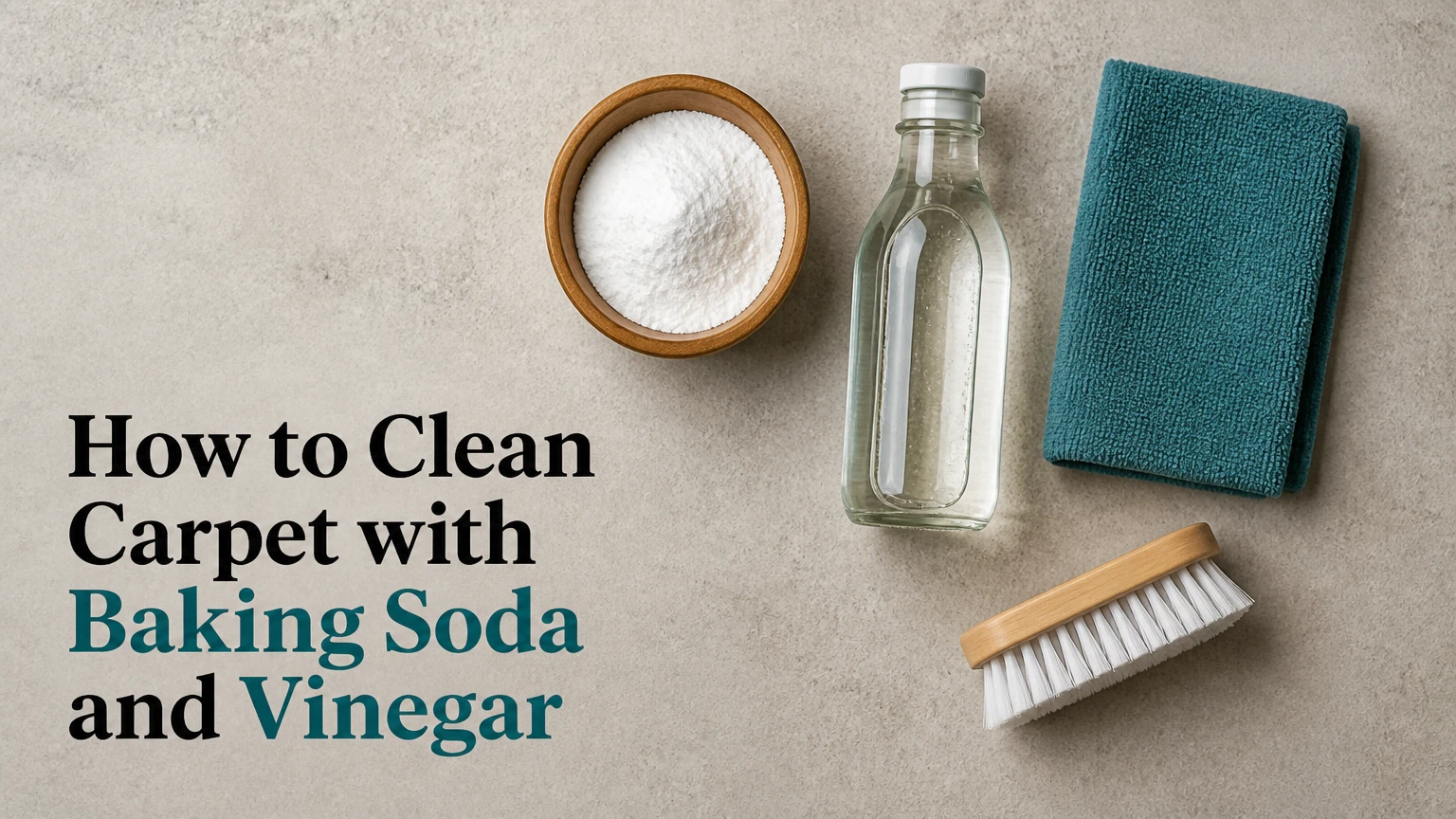
You can remove tough organic stains and neutralize odors using basic household chemistry. This guide teaches you how to clean carpet with baking soda and vinegar through seven precise steps: blot, test, powder, spray, agitate, dry, and vacuum. Expect 25 minutes of active labor and a 12-hour drying period. Complete dryness determines your success.
Before You Start
Success with this method depends on controlling moisture. Over-saturating the fibers pushes the stain deeper into the backing pad. The Institute of Inspection, Cleaning and Restoration Certification (IICRC) S100 standard dictates that carpets should dry within 12 hours to prevent microbial growth. Maintain a room temperature above 65°F and indoor humidity below 60% for optimal drying.
| Requirement | Details |
| Active Time | 20 to 25 minutes. |
| Drying Time | 4 to 12 hours. |
| Difficulty | Beginner. |
| Total Cost | $2 to $5. |
Assemble your materials before you begin to ensure you can treat spills while they are fresh.
Required Tools and Materials
| Item | Quantity or Specification | Typical Cost | Purpose |
| Baking Soda | 1 cup (Sodium bicarbonate) | $1.50 | Absorbs odors and lifts soil when reacting. |
| White Vinegar | 1 cup (Exactly 5% acidity) | $2.00 | Reacts with the base to release carbon dioxide. |
| Warm Water | 1 cup (Around 100°F) | Free | Dilutes the acid to protect carpet dyes. |
| Spray Bottle | 1 standard 16oz bottle | $3.00 | Controls the volume of liquid applied. |
| Microfiber Cloths | 3 clean, white towels | $4.00 | Absorbs excess liquid without dye transfer. |
| Brush | 1 soft-bristled brush | $5.00 | Works the paste into the carpet pile. |
| Vacuum Cleaner | 1 machine with a hose attachment | N/A | Removes the dried, encapsulated soil. |
| Dull Spoon | 1 standard soup spoon | Free | Breaks up the dried crust safely. |
Process Overview: Step-by-Step Summary
This table outlines the sequential workflow. You must follow these steps in order to prevent permanent damage to your carpet fibers.
| Step | Action | Time Required | Most Common Mistake |
| 1 | Blot the Stain | 5 mins | Rubbing the stain side to side. |
| 2 | Test Colorfastness | 15 mins | Skipping the test entirely. |
| 3 | Apply Baking Soda | 2 mins | Piling the powder too thick. |
| 4 | Spray Vinegar | 3 mins | Pouring liquid directly from a cup. |
| 5 | Agitate Fibers | 5 mins | Scrubbing hard enough to untwist yarn. |
| 6 | Evaporate Moisture | 4-12 hrs | Touching the paste before it solidifies. |
| 7 | Break and Vacuum | 10 mins | Vacuuming wet powder. |
Complete Execution Guide
Follow these seven steps exactly as written. This method relies on the chemical reaction between a base (sodium bicarbonate) and an acid (acetic acid). The resulting carbon dioxide gas creates a lifting action that pulls suspended dirt particles to the surface.
Step 1: Blot the Liquid Downward
Press a clean, dry white microfiber towel firmly over the fresh liquid stain using straight downward pressure.
Place the towel over the spill and press down with the heel of your hand. Apply roughly 10 to 15 pounds of pressure for 30 seconds. Lift the towel straight up. Rotate the towel to a dry section and repeat this process until no more liquid transfers to the cloth. Never rub or wipe the stain side to side. Rubbing untwists the carpet yarns in a process called “blooming,” which permanently destroys the texture of the carpet.
You’ll know it worked when: The towel comes away completely dry after holding firm pressure for 15 seconds.
Step 2: Test the Vinegar Solution for Colorfastness
Apply a few drops of diluted vinegar to an inconspicuous area of the carpet and hold a white cloth against it for one minute.
Mix one tablespoon of 5% acidity white vinegar with one tablespoon of warm water. Find a section of carpet inside a closet or under heavy furniture. Apply the mixture, wait five minutes, and press your white towel against the damp spot. Check the towel for any dye transfer. Some cheaper synthetic carpets use unstable dyes that break down upon contact with mild acids.
You’ll know it worked when: The white towel shows absolutely no color transfer from the carpet fibers.
Step 3: Apply the Baking Soda Layer
Sprinkle a 1/8-inch thick layer of baking soda directly over the entire stained area.
Pour the baking soda onto the spot until the carpet fibers are no longer visible. Do not dump the entire cup in a massive mound. A layer measuring exactly 1/8 inch provides enough material to fuel the chemical reaction without leaving a thick cake that becomes impossible to extract later. Extend the powder roughly one inch past the visible edge of the stain to catch any liquid that spread horizontally near the backing pad.
You’ll know it worked when: The stain is completely hidden under a thin, even, flat sheet of white powder.
Step 4: Prepare and Spray the Vinegar Solution
Mix equal parts warm water and white vinegar in your spray bottle, then mist the baking soda until it fizzes vigorously.
Combine one cup of 100°F water with one cup of 5% white vinegar in your spray bottle. Warm water accelerates the chemical reaction. Adjust your spray nozzle to the finest mist setting. Spray the powder evenly from a height of six inches. Apply just enough liquid to saturate the powder and start the fizzing reaction. Stop spraying immediately if liquid begins pooling on the surface.
Warning: Never mix baking soda and vinegar inside a closed spray bottle. The expanding carbon dioxide gas will cause the plastic container to rupture explosively. Always mix the liquids in the bottle and spray them onto the dry powder on the floor.
You’ll know it worked when: The entire powdered area actively bubbles and foams, rising slightly above the carpet level.
Step 5: Agitate the Carpet Fibers
Use a soft-bristled brush to gently work the fizzing paste into the carpet fibers using a gentle tapping and twisting motion.
Hold the brush vertically and push the bristles straight down into the paste, giving a slight quarter-turn twist. Lift the brush and repeat this across the entire stain. This forces the active bubbles down the shafts of the carpet yarn, allowing the reaction to lift dirt from the lower sections of the pile. Do not scrub back and forth. You are pushing the chemistry into the fibers, not mechanically scrubbing the dirt away.
You’ll know it worked when: The loose powder and liquid combine into a uniform, slightly foamy paste that coats every fiber down to the base.
Step 6: Wait for Complete Evaporation
Leave the paste completely undisturbed for 4 to 12 hours until it hardens into a dry, crunchy powder.
Open nearby windows or place a box fan pointing directly at the wet spot to accelerate evaporation. The chemical reaction neutralizes the stain, but the drying process is what traps the dirt. As the water evaporates, the baking soda recrystallizes, locking the lifted soil and odor molecules inside the solid structure. Touching or walking on the paste during this time breaks these fragile crystals and pushes the dirt back into the carpet.
You’ll know it worked when: You can tap the area with a finger and feel a hard, bone-dry crust that does not yield or feel cool to the touch.
Step 7: Break the Crust and Vacuum the Residue
Use the edge of a dull spoon to gently scrape the dried crust, loosen the fibers, and vacuum the area thoroughly.
Take a standard soup spoon and lightly scrape the surface of the dried paste to crack the solid cake into fine powder. Once you have broken the surface tension, use the hose attachment of your vacuum cleaner to suck up the large pieces. Next, attach the standard rotating brush head and run the vacuum over the area five times in a north-to-south direction, then five times in an east-to-west direction. This cross-hatching ensures you extract all microscopic sodium bicarbonate particles from the twisted yarns.
You’ll know it worked when: The carpet feels soft, the fibers stand upright, and no white dust remains when you run your hand over the area.
Common Mistakes and How to Fix Them
Beginners routinely encounter issues when attempting DIY carpet extraction. Recognizing these failure modes allows you to correct them quickly before permanent damage sets in.
Failure Mode 1: The Stain Wicks Back Up
Sometimes a stain disappears immediately after cleaning, only to reappear 48 hours later. This process is called wicking. It happens when you spray too much vinegar solution, pushing the liquid down into the carpet pad. As the surface dries, capillary action pulls the dirty liquid from the pad back up to the tips of the fibers.
The Fix: Repeat the blotting process using dry towels weighed down by a heavy object (like a stack of books) for 24 hours. Once completely dry, repeat the baking soda method using half the amount of liquid spray.
Failure Mode 2: A Stubborn White Residue Remains
If your carpet looks chalky or white after vacuuming, you applied too much baking soda or failed to break up the crust adequately. Sodium bicarbonate clings aggressively to synthetic fibers when applied too thickly.
The Fix: Fill a clean spray bottle with plain hot water. Mist the chalky area very lightly. Blot immediately with a dry white towel to lift the reconstituted baking soda. Allow the area to dry completely and vacuum again.
Failure Mode 3: The Carpet Smells Strongly of Vinegar
Acetic acid produces a sharp, unpleasant odor. While the smell usually dissipates naturally as the liquid evaporates, poor ventilation can trap the acidic vapors inside the room.
The Fix: Open two opposing windows to create a cross-breeze. Place a dehumidifier or a strong floor fan directly next to the treated area. The odor will vanish completely within 24 hours once the moisture content drops to zero.
Failure Mode 4: The Vacuum Cleaner Clogs or Smells
Vacuuming the paste before it has completely dried pulls wet, clumpy baking soda into your vacuum’s intake valves and HEPA filter. The wet paste will harden onto the motor and ruin the internal components.
The Fix: Stop the vacuum immediately. Remove and wash the canister or replace the bag. Remove the internal HEPA filters and let them dry out completely before tapping them into a trash can to dislodge the dust. Never use a standard vacuum on damp materials.
Variations for Specific Situations
The standard baseline method requires adjustment depending on the nature of the spill and the material of your flooring.
Variation 1: Oil-Based and Set-In Stains
Baking soda and vinegar excel at organic and acidic stains (like wine, coffee, or mud). They struggle against lipids and heavy oils (like salad dressing or grease).
How to Adjust: Add exactly one tablespoon of clear, dye-free liquid dish soap to your vinegar and water mixture. The dish soap acts as a surfactant, breaking the surface tension of the oil so the bubbling action can lift the grease away from the fiber.
Variation 2: Natural Wool Carpets
Wool fibers are highly sensitive to high pH levels and heavy friction. Standard cleaning products can cause wool to become brittle or lose its natural oils.
How to Adjust: Reduce the vinegar concentration. Mix one part vinegar with two parts water. Never use a brush on a wool carpet. Instead of agitating with a brush in Step 5, use the back of a spoon to gently press the liquid into the powder. Keep agitation to an absolute minimum.
Variation 3: Pet Urine and Biological Odors
Urine requires a specialized approach because uric acid crystals bind tightly to carpet fibers and become active again when exposed to humidity.
How to Adjust: Before applying any baking soda, soak the stain thoroughly with a commercial enzymatic cleaner and let it dwell for 15 minutes. Blot it completely dry. The enzymes break down the uric acid proteins. Once dry, follow the standard baking soda and vinegar steps to remove the visual stain and remaining surface odors.
Time and Cost Breakdown
Professional hot water extraction (steam cleaning) typically costs between $0.25 and $0.50 per square foot, with companies requiring minimum call-out fees ranging from $100 to $150.
For spot treatments, DIY methods offer massive cost advantages. A standard 16-ounce box of baking soda costs roughly $1.50, and a gallon of 5% white vinegar costs $3.50. Treating a standard four-inch stain requires roughly 5 cents worth of materials.
The primary trade-off is time. While a commercial carpet extractor pulls the moisture out immediately, allowing the floor to dry in two hours, the chemical method requires up to 12 hours of passive waiting. You trade speed for affordability and chemical simplicity.
Frequently Asked Questions
Can I leave baking soda on the carpet overnight?
Yes, leaving baking soda on the carpet overnight is highly recommended. The chemical reaction completes quickly, but the drying phase takes hours. An overnight dwell time ensures the paste turns completely chalky, making it safe and easy to vacuum the next morning.
Will vinegar bleach or discolor my carpet?
Standard 5% household white vinegar is a mild acid that is generally safe for nylon, polyester, and wool carpets. However, it can react with unstable dyes found in cheap area rugs. You must perform a discrete patch test before applying it to the center of your room.
Can I use apple cider vinegar instead of white vinegar?
No. Apple cider vinegar contains tannins and natural brown colorants that will transfer directly to light-colored carpet fibers. You must use distilled white vinegar to guarantee that no organic dyes are deposited into the carpet pile during the reaction.
Do I need to use a carpet shampoo machine after this?
No, the bubbling action of the mixture physically lifts the dirt, and the baking soda encapsulates it. Once you vacuum the dry powder away, the dirt leaves with it. Using a wet carpet shampooer afterward will simply re-wet the area and risk wicking.
Why is my carpet stiff after vacuuming?
Stiffness indicates that microscopic sodium bicarbonate crystals remain bonded to the carpet fibers. You likely sprayed too much liquid, creating a cement-like bond. Scrape the area firmly with a spoon to break the bonds, then make several very slow passes with your vacuum on maximum suction.