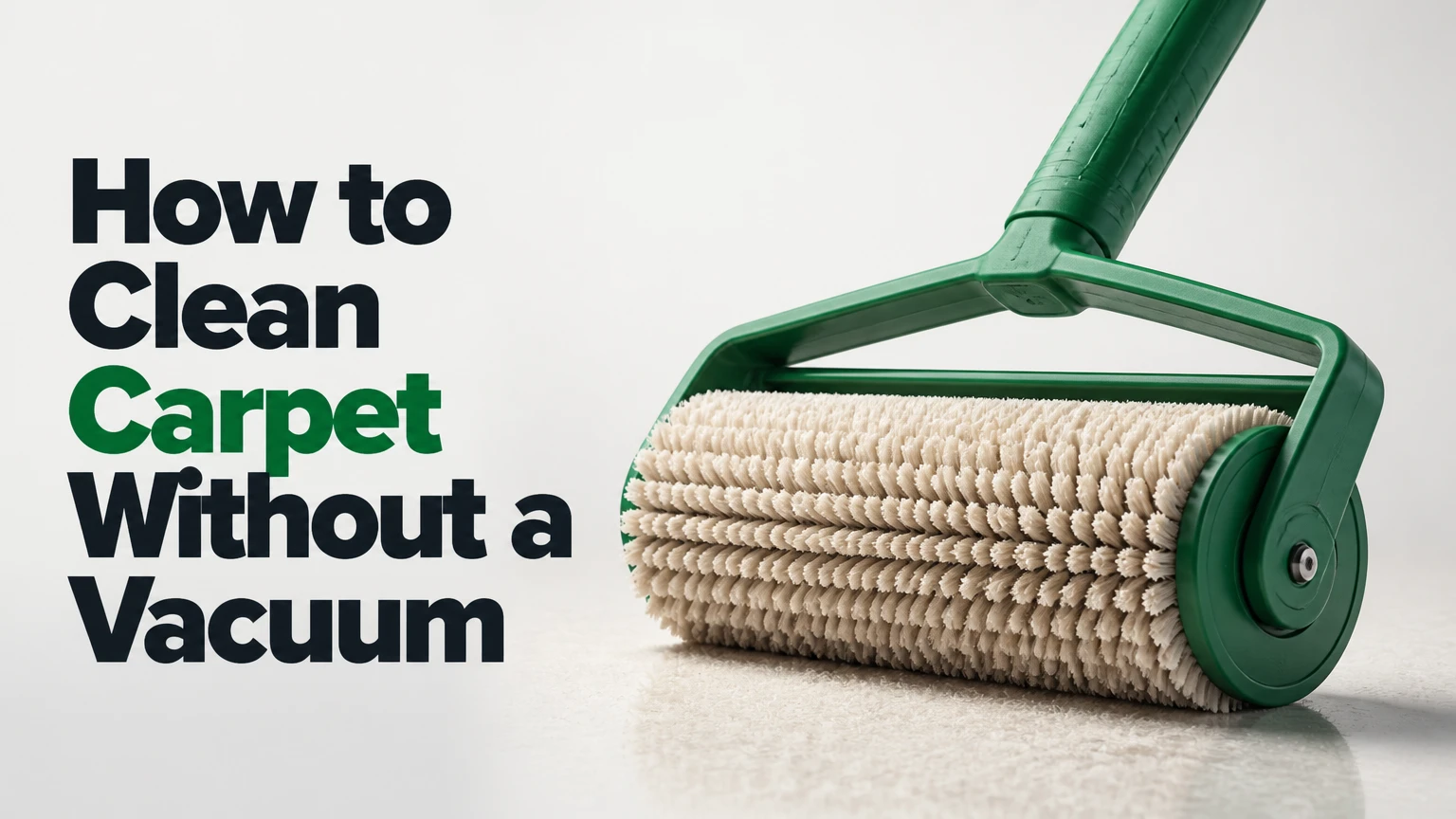
You can completely clean a carpet without a vacuum by utilizing mechanical agitation with a squeegee, followed by a targeted baking soda and vinegar treatment to lift embedded soils. This seven-step process requires manual effort but effectively extracts deep dirt, neutralizes trapped odors, and restores the carpet pile. The entire operation takes roughly two hours of active work plus drying time, and success relies entirely on strict moisture control to prevent mildew inside the carpet padding.
Before You Start
- Time Required: 1 to 2 hours of active work per room, plus 2 to 4 hours of drying time.
- Difficulty Level: Moderate. Requires sustained physical exertion.
- Estimated Cost: $5 to $15 for basic household supplies.
Tools and Materials Required:
- Rubber carpet squeegee or stiff-bristle push broom (1 count).
- Pure baking soda (1 cup per 100 square feet of carpet).
- Distilled white vinegar (1 cup).
- Warm water heated to exactly 40°C or 104°F (1 cup).
- Spray bottle with an adjustable nozzle set to a fine mist (1 count).
- Clean, white microfiber cloths or highly absorbent terry towels (4 to 6 counts).
- Medium-bristle nylon scrub brush (1 count).
- Rubber cleaning gloves (1 pair).
Prerequisite Conditions: Ensure the room has adequate ventilation. Open at least two windows to create a cross-breeze, or position a box fan blowing directly across the floor. Do not begin this process in a humid, unventilated basement, as the carpet will not dry fast enough to prevent bacterial growth.
Step 1: Prepare the Room and Inspect Fibers
Clear the room entirely and establish the layout and condition of your carpet fibers before applying any mechanical force.
Remove all freestanding furniture from the area. Leaving furniture in place forces you to work around legs and bases, which traps dirt in high-traffic transition zones. If a heavy piece like a bookshelf cannot be moved, wrap the base or legs in plastic wrap. This prevents the moisture applied later in the process from pulling wood stains or metal rust directly into the carpet fibers.
Run your hand across the carpet to find the grain. Carpet fibers naturally lay in one direction. You will feel resistance when pushing against the grain and smoothness when pushing with it. You must perform all sweeping and wiping actions against the grain to stand the fibers up and expose the dirt trapped at the base. Finally, scan the room for heavy, wet, or sticky stains. These require isolated spot treatment before you apply any dry powders.
You will know this step is complete when the floor is completely bare, the pile direction is identified, and you have mentally mapped out the heavy stain locations.
Common Mistake at this Step: Skipping the plastic wrap on heavy furniture legs. Moisture travels fast through carpet backing, and a rust stain from a metal sofa leg is nearly impossible to remove without professional chemical extraction.
Step 2: Sweep to Remove Surface Debris
Extract all loose dirt, pet hair, and human hair using mechanical friction rather than suction.
Put on your rubber cleaning gloves. Take your rubber carpet squeegee or stiff-bristle broom and start at the corner of the room furthest from the door. Apply firm downward pressure and pull the tool directly toward your body using short, aggressive strokes of about 12 to 18 inches. Do not use long, sweeping motions like you would on a hard floor. Long strokes simply push the dirt around the surface. Short strokes dig into the pile and pull the debris upward.
Work in small 3×3 foot grid sections. As you pull the squeegee toward you, the friction generates a slight triboelectric charge (static electricity) that forces lint and hair to bind together and roll into clumps. Gather these clumps by hand and place them in a trash bag. If your broom is too soft and misses fine pet hair, put your hands flat on the carpet wearing the rubber gloves and vigorously rub the fibers. The rubber will pull the remaining hair to the surface immediately.
You will know it worked when the carpet surface looks uniformly fluffed and you have filled a trash bag with visible dust bunnies, hair, and grit.
Common Mistake at this Step: Sweeping back and forth. Always pull the dirt in one direction. Pushing the broom away from you drives the dirt deeper into the primary backing of the carpet.
Step 3: Beat Removable Area Rugs
Dislodge deeply embedded particulate soil from movable rugs by utilizing gravity and blunt force.
If you are cleaning wall-to-wall carpeting, skip this step. If you are cleaning an area rug, roll it up and take it outside. Hang the rug over a sturdy railing, a specialized rug beating rack, or a strong clothesline. Ensure the back of the rug is facing you.
Take a broom handle, a tennis racket, or a traditional rattan rug beater and strike the back of the rug firmly and repeatedly. Start from the top and work your way down in rows. Striking the back of the rug forces the trapped dirt and sand to travel out through the front fibers and fall to the ground. Continue beating the back until you no longer see large clouds of dust ejecting from the front. Then, flip the rug over so the front pile faces you and gently beat it to dislodge any remaining loose surface debris.
You will know this step worked when striking the rug produces no visible dust cloud in the sunlight.
Common Mistake at this Step: Beating the front of the rug first. Striking the pile directly drives sharp sand particles deeper into the foundation yarns, which physically cuts and destroys the rug over time.
Step 4: Treat Specific Stains Before Full Cleaning
Isolate and dissolve heavy localized soils before applying the broad deodorizing treatment.
Locate the heavy stains you identified in Step 1. Do not apply baking soda to these yet. If you have a sticky spill, scrape away the solid matter using the dull edge of a butter knife. For liquid stains, dampen a clean microfiber cloth with plain warm water. Press the cloth directly onto the stain and apply heavy downward pressure with the heel of your hand. Hold it for 10 seconds. Lift the cloth to check if the color has transferred.
If the stain persists, apply three drops of standard dish soap to the wet cloth and dab the area repeatedly. Do not scrub in circles. Scrubbing untwists the carpet yarn and causes permanent fraying. Once the stain lifts into the towel, blot the area with a separate dry towel to remove as much moisture as possible before moving to the next phase.
You will know it worked when the distinct discoloration of the stain is gone, leaving only a slightly damp patch of clean carpet.
Common Mistake at this Step: Applying the baking soda and vinegar mixture directly to a heavy mud or food stain. This creates a thick, glue-like cement that binds to the fibers and is incredibly difficult to wash out by hand.
Step 5: Apply Baking Soda to Absorb Odors and Oils
Neutralize acidic odors and absorb human and pet oils using a dry sodium bicarbonate treatment.
Ensure the carpet is mostly dry from the spot treatment phase. Measure out pure baking soda. You need exactly one cup of baking soda for every 10×10 square foot area. Sprinkle the powder evenly across the carpet. Avoid dumping it in large piles.
Take your medium-bristle nylon scrub brush and gently work the baking soda into the carpet fibers. Brush against the grain you identified earlier. The goal is to distribute the fine powder all the way down to the base of the yarn without aggressively grinding it into the latex backing. Once the room is coated, leave the room and let the baking soda sit completely undisturbed for a minimum of 30 minutes, or up to 60 minutes for severe pet odors. During this dwell time, the alkaline structure of the baking soda absorbs acidic scent molecules and draws out greasy residues.
You will know it worked when the carpet has a uniform, light dusting of white powder and the ambient smell of the room has noticeably neutralized.
Common Mistake at this Step: Rushing the dwell time. Baking soda does not absorb odors instantly. Sweeping it up or spraying it down before 30 minutes renders the deodorizing process completely ineffective.
Step 6: Spray and Agitate with Vinegar Solution
Break down the remaining grime and chemically lift the baking soda using a mildly acidic solution.
In your spray bottle, combine one cup of distilled white vinegar with one cup of warm water. The water must be around 40°C (104°F) to effectively loosen greasy dirt, but not boiling, as boiling water melts synthetic carpet fibers. Set the spray bottle nozzle to the finest possible mist setting.
Working in 3×3 foot sections, lightly mist the carpet surface. The vinegar will react slightly with the baking soda, causing a very mild fizzing action. This chemical reaction helps lift the dirt upward. Do not soak the carpet. The fibers should feel damp to the touch, not wet. Immediately after misting a section, take your medium-bristle brush and lightly agitate the damp fibers in straight lines. Wait 10 to 15 minutes to allow the vinegar to break down the heavy grime.
You will know it worked when you see the soil lifting to the top of the fibers and the baking soda begins to dissolve into a very light, damp residue.
Common Mistake at this Step: Over-saturating the carpet. Pouring the solution or using a heavy stream setting on the spray bottle pushes the liquid into the carpet padding. Padding acts like a sponge, trapping the liquid and causing severe mold growth within 48 hours.
Step 7: Blot the Moisture and Restore the Carpet Pile
Extract the damp soil and reset the carpet fibers for drying.
Take your clean, dry microfiber cloths. Fold a cloth into a flat square. Starting in the corner of your 3×3 foot grid, press the cloth firmly onto the damp carpet. Put your full body weight behind your hands and push straight down into the floor. Hold for five seconds. Lift the cloth straight up. You will see dark soil and moisture transferred to the white cloth. Refold the cloth to expose a clean square and repeat the stamping motion across the entire section.
Once you have blotted the entire room, the carpet will still be slightly damp. Take your stiff-bristle broom or brush and gently rake the carpet in one uniform direction to stand the fibers up. This is called grooming the pile. Leave the windows open or fans running. Stay off the carpet entirely for 2 to 4 hours while it air dries.
You will know the entire process worked when the carpet is completely dry to the touch, smells neutral, and feels soft and springy under bare feet.
Common Mistake at this Step: Wiping the towels aggressively side-to-side to dry the floor faster. This distorts the wet fibers and leaves the carpet looking permanently crushed and matted once it dries.
Common Mistakes and How to Fix Them
Even with careful execution, manual carpet cleaning can result in minor issues during the drying phase. Here are the most frequent failures and exact instructions for reversing them.
1. White Powder Residue Remains After Drying
The Root Cause: You used more than one cup of baking soda per 100 square feet, or you applied the vinegar spray too heavily, causing the baking soda to form a crust on the fibers. The Fix: Wait until the carpet is 100 percent dry. Do not attempt this while it is damp. Put on your rubber gloves and aggressively rub the affected area to break up the crust. Then, take a slightly damp, dark-colored microfiber cloth and wipe the surface to lift the white dust. Rinse the cloth frequently and repeat until the white cast disappears.
2. The Carpet Smells Like Sour Vinegar
The Root Cause: The room lacked adequate airflow during the 2 to 4 hour drying phase, trapping the moisture and the acetic acid smell in the fibers. The Fix: The smell of distilled white vinegar completely dissipates when it dries. You must rapidly accelerate the evaporation process. Open all doors and windows. Place a high-velocity box fan directly on the floor, angled slightly downward, and blow air continuously across the dampest sections. The smell will vanish the moment the moisture is gone.
3. Carpet Fibers Feel Crunchy or Stiff
The Root Cause: The dirt was successfully extracted, but the carpet pile was not groomed (raked upright) while it was wet, causing the fibers to dry clumped together. The Fix: Lightly mist the stiff area with plain, warm water just enough to relax the fibers. Immediately take a medium-bristle nylon brush and aggressively brush the fibers upward against the grain. Allow it to air dry again without walking on it.
4. Water Marks or Brown Rings Appear
The Root Cause: This is known as cellulosic browning. It happens when the carpet backing gets too wet. As the water slowly evaporates upward, it carries tannins from the jute backing to the surface of the carpet. The Fix: You must apply a targeted acidic treatment to reverse the tannin stain. Mix a fresh batch of 50 percent vinegar and 50 percent water. Mist only the brown ring. Blot heavily with a dry towel using extreme downward pressure. Dry the spot immediately using a hair dryer on a cool setting to prevent the moisture from sinking back into the padding.
Variations for Different Carpet Types
The standard procedure requires modification depending on the length and material of your carpet fibers.
Cleaning Thick Shag Carpeting
Shag carpets possess extremely long, loose yarns that easily trap large debris and hide it deep near the backing.
- The Variation: A squeegee will not work on shag carpeting. You must use a carpet rake with long plastic tines to dig out the hair and lint. Furthermore, do not use the baking soda powder treatment on shag rugs. The powder falls too deeply into the long pile and is nearly impossible to remove without a high-powered vacuum. Instead, rely entirely on the vinegar and water misting process, followed by deep, heavy blotting.
Cleaning Natural Wool Area Rugs
Wool is highly absorbent and sensitive to extreme pH levels. Harsh alkaline powders or heavy liquids will permanently damage the protein structure of wool yarn.
- The Variation: Never use baking soda on wool. It is too alkaline and will leave the fibers brittle. Adjust your spray solution to use only 1/4 cup of vinegar mixed with 1 cup of cold water. Do not use warm water, as heat shrinks wool fibers. Mist very sparingly and blot immediately. Extend your drying time expectations to 6 to 8 hours.
Cleaning Low-Pile Commercial Carpet
Commercial carpeting features very tight, densely packed loops designed for high traffic. Dirt sits firmly on the surface rather than sinking in.
- The Variation: The rubber squeegee is highly effective here. You can apply maximum physical pressure during the sweeping phase. Because the pile is so tight, liquid does not penetrate easily. You must let the vinegar solution sit for the maximum 15 minutes to properly break the surface tension of the dirt before blotting.
How Long Does It Take and What Does It Cost?
Cleaning a carpet without a vacuum is significantly more labor-intensive than using machinery, but it is highly cost-effective.
Time Investment:
- Preparation and Sweeping: 15 to 20 minutes for a standard 12×12 foot room.
- Deodorizing Dwell Time: 30 to 60 minutes of passive waiting.
- Spraying and Agitating: 15 minutes of active work, followed by 15 minutes of passive waiting.
- Blotting and Grooming: 20 to 30 minutes of intense physical labor.
- Total Active Time: Approximately 1 hour per room.
- Total Drying Time: 2 to 4 hours depending on local humidity.
Cost Breakdown:
- Baking Soda (16 oz box): $1.00 to $2.00.
- Distilled White Vinegar (1 gallon): $3.00 to $5.00.
- Rubber Squeegee or Stiff Broom: $10.00 to $15.00 (one-time purchase).
- Microfiber Towels (pack of 10): $8.00 to $12.00.
- Total Cost Per Room: Less than $2.00 in consumable liquids and powders once the basic tools are acquired.
Frequently Asked Questions
Can I clean my carpet with just water?
Yes, but plain water only removes loose surface dust. Water lacks the chemical properties required to break down oils from bare feet, pet dander, or food spills. Without a mild acid like vinegar to cut the grease or an alkaline powder like baking soda to absorb it, plain water simply turns the existing dirt into mud.
Will vinegar bleach or discolor my carpet?
No, diluted white vinegar is extremely safe for colorfast synthetic carpets like nylon and polyester. It is a mild acid that actually helps set dyes. However, you must always test the solution in an inconspicuous corner first, especially on older carpets or hand-dyed natural fiber rugs, to ensure the dyes remain stable.
How often should I manually clean my carpet this way?
If you do not own a vacuum, you should perform the sweeping phase (Step 2) at least twice a week to manage surface debris and prevent grit from cutting the carpet fibers. The full wet chemical extraction (Steps 4 through 7) should only be done every three to four months to prevent excessive wear and tear on the carpet backing.
Does salt work instead of baking soda for cleaning?
Salt is an excellent abrasive for lifting fresh, wet stains like red wine because it rapidly absorbs liquid. However, salt does not neutralize odors, nor does it absorb dry oils. You cannot substitute salt for baking soda during a full-room deep clean, as the salt crystals will simply sink to the bottom of the pile and remain there.
Knowing exactly how to clean carpet without a vacuum allows you to maintain a sanitary living space in any situation. By combining mechanical agitation, strategic chemical application, and rigorous moisture control, you can achieve a professional-grade clean entirely by hand.