To clean couch cushions, identify the upholstery care code, vacuum every surface, test the cleaner, treat stains, apply minimal moisture, remove residue, and dry the cushion completely. Removable fabric covers usually take 2-4 hours to wash and air-dry, while damp foam can require 24-48 hours. The care label determines which method is safe.
Key Facts at a Glance
- Upholstery code W permits water-based cleaning, while code S requires a solvent-based method.
- Code WS permits water or solvent cleaning, but the manufacturer’s instructions take priority.
- Code X means vacuum-only care unless a qualified professional gives different written guidance.
- A wet cushion should dry completely before use, because trapped moisture can create mildew odors and support mold growth.
- Removable covers can shrink even on a cold, gentle cycle, so air-drying is safer than heated tumble-drying.
- Standard polyurethane foam should not be submerged unless the cushion manufacturer specifically permits washing.
Before You Start Cleaning Couch Cushions
A typical DIY cleaning session takes 45-90 minutes of active work and 12-24 hours of drying. The main variable is moisture: upholstery that receives more liquid takes longer to dry and has a greater risk of water rings, dye transfer, and foam odor.
Check the care code and construction
Find the sewn-in care tag along the cushion casing, beneath the cushion, or under the sofa frame. Also determine whether the cushion has a removable cover, loose foam insert, feather filling, memory foam, leather upholstery, or bonded backing.
| Code or material | Safe starting method | Avoid | Typical DIY time |
|---|---|---|---|
| W fabric | Water-based upholstery cleaner, low-moisture foam, extraction | Flooding, bleach, hot dryer | 45-90 minutes |
| S fabric | Manufacturer-approved upholstery solvent | Water, steam, household detergent | 30-60 minutes |
| WS fabric | Water or approved solvent after testing | Mixing solvent and water | 45-90 minutes |
| X fabric | Vacuuming and professional assessment | All liquid and steam products | 15-30 minutes |
| Finished leather | Damp cloth and leather cleaner | Soaking, dish soap, alcohol | 20-40 minutes |
| Suede or nubuck | Dry suede brush and specialist cleaner | Water, steam, general leather conditioner | 30-60 minutes |
| Microsuede microfiber | Code-approved solvent or minimal water | Saturation, aggressive scrubbing | 30-60 minutes |
Care codes are useful screening instructions, not a universal guarantee. Fabric blends, printed surfaces, latex coatings, and aged adhesives can react differently even when two cushions carry the same code.
Gather tools and cleaning materials
Prepare a vacuum with an upholstery nozzle, white microfiber towels, a soft upholstery brush, a spray bottle, distilled water, mild dye-free detergent, and a fan. Use an enzyme cleaner only for biological contamination such as urine, vomit, or milk, and follow its label dilution rather than improvising a stronger mixture.
Do not combine enzyme products with bleach, ammonia, disinfectants, or acidic cleaners. Chemical mixtures can deactivate enzymes, release irritating vapors, or damage upholstery dyes.
How Does Couch-Cushion Cleaning Work?
Couch-cushion cleaning removes loose particles first, suspends oily or protein-based soil with a suitable cleaner, and then removes the suspended soil through blotting, rinsing, or extraction. Drying completes the process because residual moisture can transport dissolved soil toward seams and leave rings.
Dust, skin oil, food residue, pet dander, and drink spills behave differently. Vacuuming handles loose particulate matter. A detergent helps surround oily soil, while an enzyme product breaks down some organic residues. A solvent dissolves compatible oily stains without adding water, but solvent chemistry must match the fabric and ventilation conditions.
The Canadian Conservation Institute describes mechanical textile cleaning as a process that removes surface particles while minimizing abrasion. That principle matters on upholstery: repeated hard brushing can damage a fabric faster than a single controlled cleaning session.
What cleaning method matches each problem?
| Problem | Preferred method | Quantity or setting | Expected result |
|---|---|---|---|
| Dry crumbs and dust | Upholstery vacuum nozzle | 2 slow passes per side | Loose debris removed |
| Fresh water-based spill | White towel blotting | 15-30 seconds per pass | Transfer decreases |
| Greasy food mark | Code-approved detergent or solvent | 2-5 minute dwell | Oil film loosens |
| Pet urine | Enzyme product | Label dilution, 10-15 minute dwell | Biological odor reduces |
| Ink | Manufacturer-approved solvent | Cotton swab, 1-2 drops at a time | Ink transfers without spreading |
| Dried gum | Ice in a sealed bag | 5-10 minutes | Gum hardens for lifting |
| Musty foam odor | Full drying and professional assessment | Fan for 24-48 hours | Odor improves if no mold exists |
Step 1: Remove Covers and Vacuum the Cushion
Remove loose cushions, open zippers fully, and vacuum the top, bottom, four edges, seams, piping, and the exposed sofa deck. Use slow overlapping strokes rather than fast passes, because upholstery fibers hold dust in the seam channels.
Vacuuming before liquid cleaning prevents dry soil from becoming muddy residue. A crevice tool reaches zipper tracks and piping, while a brush attachment can loosen hair from microfiber without pulling the fabric.
You’ll know it worked when: the vacuum collects little visible debris during a second pass and the seams no longer release crumbs when tapped.
Common mistake: vacuuming only the seating surface. Pet hair and skin flakes often collect underneath cushions, where they later contribute to odor.
Step 2: Test Colorfastness and Fabric Reaction
Prepare the exact cleaner and dilution you intend to use. Apply two drops to a hidden seam, wait five minutes, then press a white towel against the area for 30 seconds; stop if dye, finish, adhesive, or texture transfers.
A colorfastness test reduces risk but cannot predict every outcome. Test a second hidden area if the cushion has contrasting piping, a printed pattern, a repaired seam, or a worn section. Allow the test area to dry before judging a watermark or texture change.
You’ll know it worked when: the white towel remains clean, the test patch dries without a ring, and the fabric feels unchanged.
Common mistake: testing with plain water but cleaning with detergent or solvent. The test must use the complete product and dilution.
Step 3: Treat Stains From the Outside In
Blot a fresh spill with folded white towels, working from the outer edge toward the center. For a dry stain, vacuum first, apply a small amount of compatible cleaner, and lift the residue with a towel rather than grinding it into the weave.
Use the treatment table as a starting point, then follow the upholstery manufacturer’s instructions. Stain chemistry is situational: milk and urine contain proteins, grease is oil-based, and ink may dissolve rapidly when the wrong solvent spreads it.
| Stain | First action | Product limit | Dwell and removal |
|---|---|---|---|
| Coffee or tea | Blot immediately | Water-based code only | 2-5 minutes, then blot |
| Grease or butter | Lift solids with a spoon | Use solvent on code S | 5 minutes, then towel-lift |
| Milk | Blot and use enzyme cleaner | Do not mix with disinfectant | 10-15 minutes, then blot |
| Urine | Absorb deeply without rubbing | Enzyme cleaner by label | 10-30 minutes, then extract |
| Red wine | Blot, do not add salt | Avoid peroxide unless approved | Repeat small applications |
| Ink | Isolate with white towels | Use only approved solvent | 1-2 drops per application |
| Chewing gum | Chill and scrape gently | No oily solvent on delicate fabric | 5-10 minutes chilling |
You’ll know it worked when: the stain becomes lighter without expanding and the towel shows transfer after each lift.
Common mistake: using a circular scrubbing motion. Scrubbing can fuzz fibers, spread dissolved dye, and drive the stain below the casing.
Step 4: Clean the Upholstery With Minimal Moisture
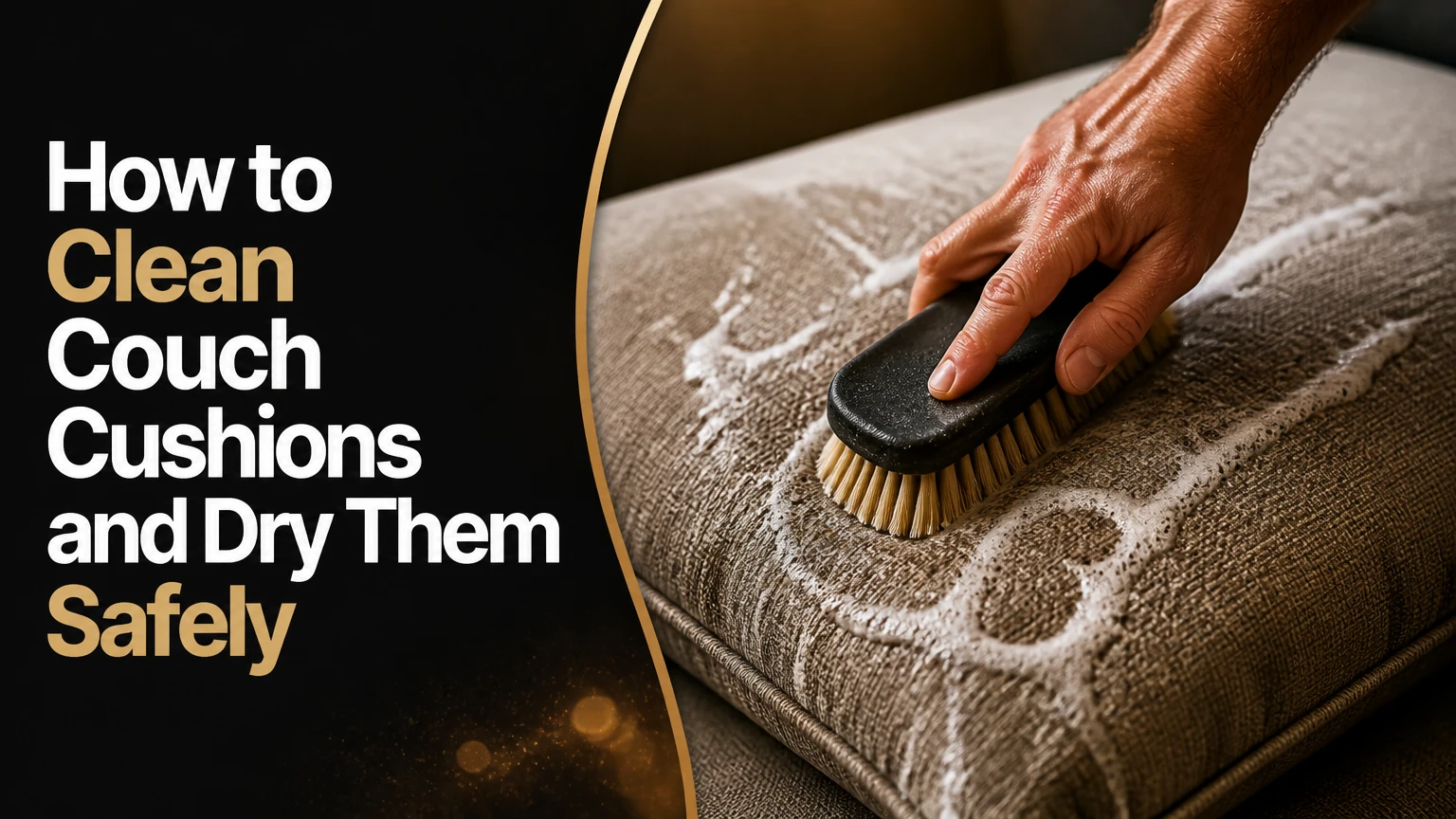
For code W or WS fabric, mix approximately 1 teaspoon of mild, dye-free liquid detergent with 2 cups of lukewarm water. Create suds, place the foam on a soft brush or towel, and work a small section with light pressure; do not pour the mixture directly onto the cushion.
Clean the entire visible panel from seam to seam when possible. Partial wetting often creates a visible boundary, especially on cotton, linen, rayon, and dark fabrics. For a machine extractor, make one controlled solution pass followed by two or three extraction-only passes.
You’ll know it worked when: the fabric looks evenly damp rather than wet, soil transfers to the towel, and no liquid pools along seams.
Common mistake: applying extra detergent because the first pass did not remove a set stain. Residual soap attracts soil and can create a stiff, dark patch after drying.
Step 5: Rinse and Extract Residue
Lightly mist a clean towel or the surface with distilled water, then blot or extract the cleaned area. Rinsing removes detergent residue, but the rinse should contain less water than the cleaning application.
Tap water can leave mineral deposits that become visible as a pale ring on dark upholstery. Distilled water is useful for the final light rinse, although it cannot correct dye bleeding, shrinkage, or damage caused by incompatible chemicals.
You’ll know it worked when: the towel no longer feels slippery, the fabric has no visible suds, and extraction removes only a small amount of clear moisture.
Common mistake: skipping the rinse after using detergent foam. Soap left in the fibers can attract new dirt within days.
Step 6: Dry the Cushion Completely
Stand the cushion upright in a V-shape or on its edge, leaving space around every side. Run a fan across the surface, open windows when outdoor humidity is low, and rotate the cushion every 2-3 hours.
Most lightly damp fabric cushions dry in 8-24 hours. Dense foam, cool rooms, high humidity, and deep extraction can extend drying to 24-48 hours. The U.S. Environmental Protection Agency states, “The key to mold control is moisture control,” which is why odor-free surface appearance does not prove that the interior is dry.
You’ll know it worked when: the cushion feels the same temperature as a dry cushion, weighs close to its original weight, and has no cool or damp center when pressed.
Common mistake: replacing the cushion after the fabric feels dry. Foam can remain damp beneath a dry casing, particularly after urine treatment or extraction.
Can You Machine-Wash Removable Couch Cushion Covers?
Machine-wash a removable cover only when the care label permits it and the fabric has passed a colorfastness test. Close the zipper, turn the cover inside out, use cold water and a gentle cycle, then air-dry it before reinstalling.
Do not force a tight cover over foam while it is fully wet. Heat and agitation can shrink cotton, distort woven blends, damage zipper seams, and fuse synthetic backing. A cover that is slightly damp but no longer dripping may be easier to reshape, but the manufacturer’s instructions override this general practice.
Use this cover-washing sequence
- Photograph the cushion orientation and mark matching covers discreetly.
- Zip each cover closed to protect the teeth and fabric.
- Wash separately with approximately half the usual mild detergent dose.
- Skip bleach, fabric softener, and heated drying.
- Reshape the cover on a clean surface while air-drying.
- Refit only when the cover is fully dry or the manufacturer permits slight dampness.
Checkpoint: the cover fits without stretching the zipper or creating diagonal seam tension.
Which Cleaning Method Should You Choose?
Low-moisture hand cleaning is the safest DIY option for compatible fabric when soil is light to moderate. A portable extractor is faster for heavily soiled code W upholstery, while solvent cleaning or professional service is safer for code S, code X, antiques, silk, rayon, and unstable dyes.
| Method | Best use | Typical cost | Drying time | Main risk |
|---|---|---|---|---|
| Hand foam cleaning | Light soil, code W or WS | $3-$15 | 8-24 hours | Residue or uneven wetting |
| Machine-washed cover | Approved removable cover | $2-$15 | 4-24 hours | Shrinkage and zipper stress |
| Portable extraction | Heavy soil, pet contamination | $40-$60 rental | 12-48 hours | Over-saturation |
| Upholstery solvent | Code S fabric | $10-$25 | 1-4 hours | Solvent marks or fumes |
| Professional low-moisture cleaning | Delicate or valuable furniture | $150-$500 sofa | 1-6 hours | Cost and scheduling |
| Professional restoration | Mold, severe urine, structural damage | $250-$1,000+ | 24-72 hours | Limited color recovery |
A rental extractor is not automatically better. It can remove more soil only when the operator controls solution volume, extraction passes, airflow, and drying conditions.
How Do You Clean Leather, Suede, and Microsuede Cushions?
Leather requires a damp cloth and a leather-specific cleaner, while suede and nubuck require dry brushing or a product approved for those nap surfaces. Microsuede is often polyester microfiber, but its code still determines whether water or solvent is acceptable.
Genuine leather
Vacuum seams, wipe with a barely damp microfiber cloth, and apply a small amount of pH-balanced leather cleaner to the cloth rather than directly to the cushion. Buff away residue and allow the leather to dry at room temperature, away from radiators and direct sunlight.
Apply conditioner only when the leather manufacturer recommends it, typically every 6-12 months. Too much conditioner can darken leather, soften weakened coatings, and leave an oily surface that attracts dust.
Suede and nubuck
Brush dry soil with a suede brush, then use a specialist suede cleaner on a hidden area. Do not use saddle soap, household detergent, steam, or unrestricted rubbing alcohol unless the product maker specifically approves it for that leather type.
Microsuede
Check whether the label specifies W, S, WS, or X. Some polyester microsuede tolerates a small amount of isopropyl alcohol, but alcohol can affect dyes, printed finishes, adhesives, and mixed-fiber constructions. Test first and ventilate the room.
How Should You Clean the Inner Foam Core?
Standard polyurethane foam should not be submerged in a bathtub unless the furniture manufacturer explicitly says the foam is washable. Submersion can trap water in the center, break down adhesives, distort the foam, and create an odor that remains after the casing feels dry.
For a small fresh spill, remove the casing if permitted, press towels into the foam, and use a wet/dry vacuum if available. Apply a limited amount of enzyme cleaner for urine or vomit, respect the label dwell time, then extract repeatedly and dry with strong airflow.
Replace severely contaminated foam when the odor returns after complete drying, the foam crumbles, or the contamination reaches the full depth. Foam replacement is often more reliable than repeated soaking, especially for inexpensive standard polyurethane inserts.
Expert rule of thumb: if foam still feels cool in the center after 24 hours, assume it remains wet. A fan improves evaporation, but it cannot remove liquid that has not first been extracted.
What Should You Never Use on Couch Cushions?
Never use chlorine bleach, ammonia, boiling water, uncontrolled steam, or an untested solvent on upholstery. These products can strip color, weaken backing fibers, dissolve foam, create rings, or release irritating fumes.
Avoid these specific shortcuts:
- Bleach: can create permanent color loss and weaken textile fibers.
- Ammonia: may damage dyes, coatings, and some synthetic fibers.
- Dish soap applied directly: concentrates surfactant in one area and leaves residue.
- Baking soda on wet foam: forms a paste that is difficult to extract.
- Hair dryers on high heat: can set stains, shrink fibers, and soften adhesives.
- Hard brushing: raises fuzz and changes the nap direction.
- Steam on code S or X fabric: adds water where the label prohibits it.
If an incompatible product has already been applied, stop adding chemicals. Blot the area, ventilate the room, and contact the furniture maker or an upholstery professional before attempting neutralization.
How Do You Fix Water Rings, Odors, and Mildew?
Water rings sometimes improve when a compatible water-cleanable cushion is cleaned evenly from seam to seam, but a code S cushion should not be re-wetted as a home repair. Persistent odor, visible mold, or foam that remains damp requires professional assessment.
Water rings
For code W or WS fabric, lightly dampen the complete panel uniformly with the approved cleaner, extract evenly, and dry with airflow. Do not spot-wet only the ring. For code S or X fabric, use the specified solvent or call a professional.
Pet odor
Blot urine immediately, extract the contaminated area, and apply an enzyme cleaner according to its label. Fragrance sprays mask odor without removing the residue. If urine reached the decking or foam core, treating only the top fabric will rarely solve the problem.
Mildew or mold
Do not use a household vacuum on visible mold because it can distribute spores. Isolate the cushion, keep it away from children and pets, and consult a qualified restoration or upholstery professional. The EPA recommends controlling moisture and drying wet materials promptly; porous foam with established mold may require replacement.
How Often Should Couch Cushions Be Cleaned?
Vacuum couch cushions weekly in homes with pets, children, or allergies, and deep-clean compatible upholstery every 6-12 months. Spot-clean spills immediately because dried proteins and oils bind more strongly to fibers and often require more moisture to remove.
| Household condition | Vacuum frequency | Deep-clean interval | Extra prevention |
|---|---|---|---|
| Low-use adult household | Every 2 weeks | Every 12 months | Rotate cushions monthly |
| Daily family use | Weekly | Every 6-9 months | Wash approved throws monthly |
| Dogs or cats | 2-3 times weekly | Every 3-6 months | Use washable pet covers |
| Allergy-sensitive home | Weekly, including seams | Every 6 months | HEPA vacuum and ventilation |
| Frequent spills | After each spill | Every 3-6 months | Keep white towels available |
Cushion rotation reduces uneven compression but does not make every cushion reversible. Follow the original orientation if the underside lacks upholstery fabric, has a zipper, or contains a non-slip panel.
Common Mistakes and How to Fix Them
| Failure | Likely cause | Immediate correction | Escalate when |
|---|---|---|---|
| Brown ring | Uneven wetting or dissolved soil | Stop spot-cleaning, dry evenly if code permits | Ring remains after one controlled attempt |
| Sticky surface | Excess detergent | Blot with a barely damp towel and extract | Surface remains tacky after drying |
| Dye on towel | Poor colorfastness | Stop cleaning and air-dry | Dye transfer continues |
| Sour odor | Wet foam or residue | Extract and fan for 24-48 hours | Odor returns after full drying |
| Shrunken cover | Heat or agitation | Do not force the zipper | Cover cannot refit without strain |
| Fuzzy nap | Aggressive brushing | Let dry, then brush gently in one direction | Texture remains permanently altered |
The safest recovery is usually less chemistry, not more. Adding vinegar, peroxide, fragrance, or disinfectant without knowing the fiber and finish can turn a reversible stain into permanent discoloration.
Frequently Asked Questions
Can I clean couch cushions without removing the covers?
Yes, if the care code permits the chosen method and the cushion can dry quickly. Vacuum thoroughly, test the cleaner, use low-moisture foam or controlled extraction, rinse lightly, and position the cushion for airflow. Non-removable upholstery should never be saturated simply because the cover cannot be unzipped.
How do I clean couch cushions that smell like smoke?
Vacuum all surfaces, ventilate the room, and use the approved low-moisture upholstery method. Smoke odor may have penetrated foam, batting, decking, and curtains, so surface cleaning alone may not work. Avoid masking sprays; persistent odor after 24-48 hours of drying warrants professional deodorization or foam replacement.
Can I use vinegar on fabric couch cushions?
Vinegar is not a universal upholstery cleaner and may affect dyes, finishes, or odor chemistry. Use it only when the furniture manufacturer specifically permits it. For routine code W cleaning, a properly diluted mild detergent is more predictable; for code S or X fabric, avoid water-based vinegar solutions.
How do I clean a couch cushion after a dog urinates on it?
Blot immediately, remove the cover if permitted, and extract urine from the foam rather than treating only the surface. Apply an enzyme cleaner at the label dilution, allow the stated dwell time, extract again, and dry with airflow for 24-48 hours. Replace foam if the odor returns after complete drying.
Should I steam-clean couch cushions?
Steam cleaning is appropriate only when the care label and manufacturer permit water-based heat cleaning. Steam can over-wet foam, set some stains, damage adhesives, or create rings on sensitive textiles. A low-moisture method is safer for many home users, while code S and X cushions require a different approach.
When should I hire a professional upholstery cleaner?
Hire a professional for code X furniture, delicate silk or rayon, antiques, severe dye bleeding, visible mold, deep urine contamination, or cushions that remain wet or odorous after 48 hours. Professional cleaning is also sensible when the sofa is expensive enough that shrinkage or color loss would exceed a typical $150-$500 service cost.
The Bottom Line
The safest way to clean couch cushions is to follow the care code, remove dry soil first, test every product, apply minimal compatible moisture, extract residue, and dry the cushion completely before use. Code W and WS cushions are usually manageable at home, while code S, code X, delicate materials, mold, and deeply contaminated foam deserve professional treatment. A careful process prevents the most expensive problems: shrinkage, dye bleeding, water rings, and persistent odor.