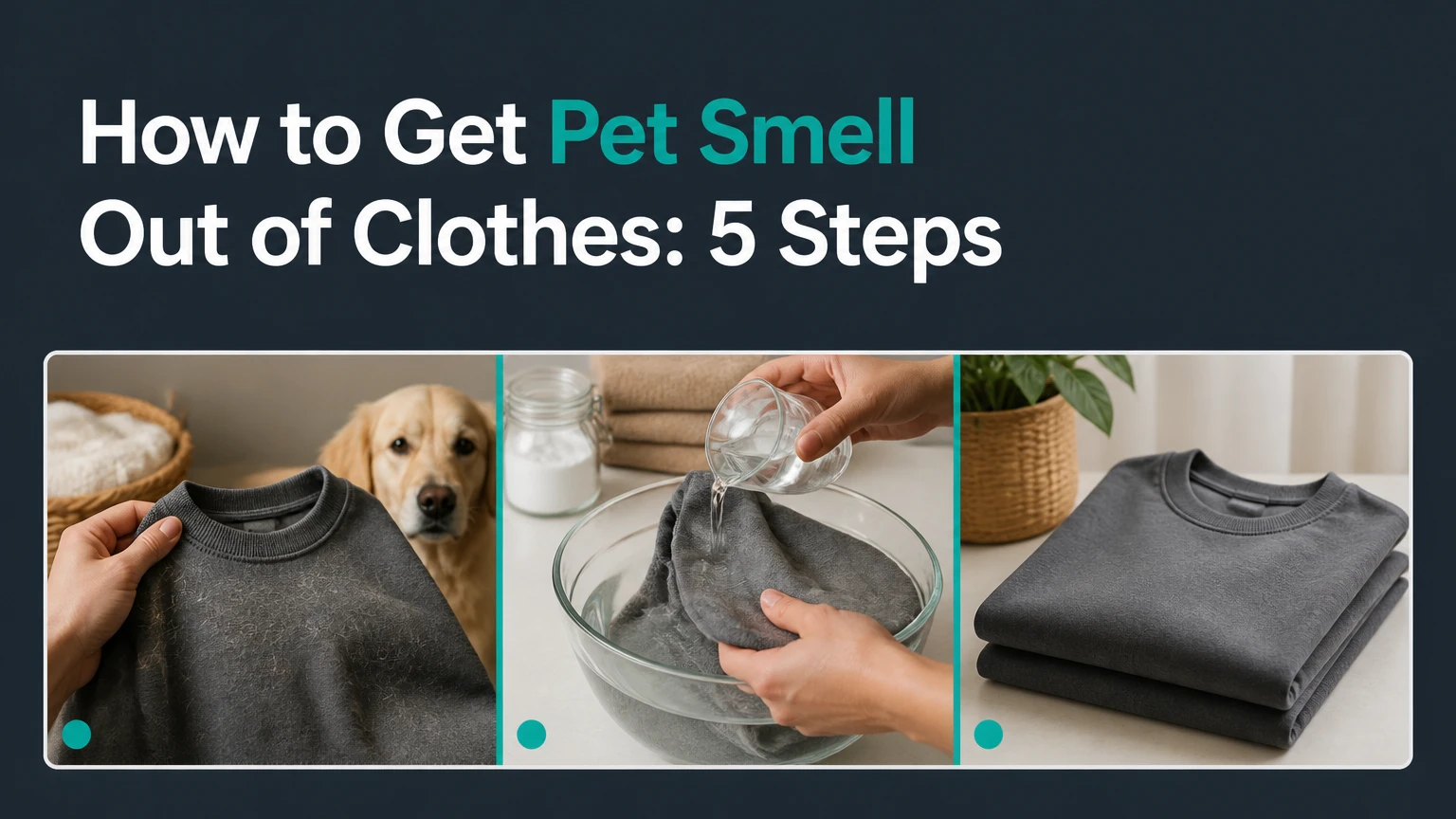
To get pet smell out of clothes, remove hair and solids, rinse the odor source, pre-treat with an enzyme laundry product, wash without overloading, and air-dry before inspection. Enzyme detergent works best for urine, vomit, feces, and saliva, while oxygen bleach can help with washable colorfast fabrics and oily, persistent smells.
Key Facts at a Glance
- Enzyme laundry products are the first choice for urine, feces, vomit, saliva, and other protein-rich pet residues.
- A dryer can intensify or fix a remaining odor, so inspect clothing while damp before applying heat.
- Vinegar may reduce some general odors, but it does not reliably dissolve dried urine crystals or heavy pet oils.
- Baking soda freshens surface odors but rarely removes a deep urine stain by itself.
- Oxygen bleach is suitable for many colorfast cotton and synthetic garments, but not for wool, silk, leather, or untested dyes.
- Pet hair should be removed while dry because washing spreads loose hair through the garment and machine.
How Pet Odor Bonds to Clothing
Pet odor on clothing usually comes from a combination of water-soluble residue and oil-soluble residue. Urine leaves urea breakdown products and mineral salts, while wet-dog odor commonly involves skin oils, sebum, dander, and microbial by-products transferred from damp fur. Saliva, vomit, and feces add proteins and fats that ordinary washing may not fully remove.
The practical distinction is important. A lightly worn shirt with dander needs degreasing and rinsing; a cat-urine garment needs a urine-focused enzyme treatment; skunk spray needs oxidation and careful safety controls. Fragrance-heavy detergent can cover the smell temporarily while leaving the source in the fibers.
Laundry enzymes are not all the same. Proteases break down protein residues, lipases target fats, and amylases target starches. Commercial bio-detergents may contain several enzymes, but the product label determines its intended temperature, dosage, and fabric restrictions.
Why does pet smell return after washing?
Pet smell returns when odor molecules or residues remain in the yarn, seams, elastic, lining, or washing machine. Heat then increases volatility, making the odor noticeable again even when the garment seemed acceptable while cool and damp.
Polyester and other hydrophobic synthetics deserve special attention. Research published in the Applied and Environmental Microbiology journal has found that odor compounds from human sweat can persist differently on polyester than on cotton, a useful parallel for oily pet residue because synthetic fibers retain hydrophobic compounds more readily. A longer cycle cannot compensate for the wrong chemistry.
Before You Start
| Requirement | Typical amount or range | Practical specification |
|---|---|---|
| Treatment time | 45 minutes-24 hours | Use 45-90 minutes for fresh odor; allow overnight contact only when the label permits |
| Machine-wash cost | $0.25-$2 per garment | Detergent, water, and optional oxygen bleach included |
| Enzyme product | 1-2 tablespoons per 4-6 kg load | Follow the bottle or detergent label first |
| Oxygen bleach | 1-2 tablespoons per 4-6 kg load | Use only on compatible, colorfast washable fabrics |
| Tools | 1 lint roller, 1 basin, 1 clean towel | Add a soft brush for seams and cuffs |
| Water temperature | Cold to lukewarm | Follow the care label and enzyme-product instructions |
Read the care label before treating the clothing. Check fiber content, maximum temperature, “do not bleach” symbols, dry-cleaning instructions, and whether the garment contains leather trim, glued interfacing, or delicate elastic.
Test every chemical on an inside seam. Apply a small amount, wait 10 minutes, blot with white cloth, and check for dye transfer or fading. Do not combine chlorine bleach with urine, ammonia-based cleaners, vinegar, hydrogen peroxide, or other household chemicals.
How to Get Pet Smell Out of Clothes Safely
The five-step process normally takes 1-3 hours of active or waiting time, plus air-drying. The factor that most determines success is complete contact between the odor residue and the correct treatment before dryer heat is used.
Step 1: Remove Hair and Solid Residue
Remove dry pet hair, dried food, feces, and visible debris before wetting the garment. Use a lint roller, rubber glove, silicone brush, or vacuum upholstery attachment, then scrape dried solids into a disposable bag with a dull card.
Wet hair becomes harder to separate from fabric and can collect in the washer filter, gasket, and drain path. Do not scrub feces or vomit deeper into the textile. For a visible stain, lift from the outside toward the center.
You’ll know it worked when: loose hair no longer transfers to a dry white towel rubbed over the garment.
Common mistake: putting heavily fur-covered clothing directly into the washer, which distributes hair across the entire load.
Step 2: Rinse the Odor Source
Rinse a urine, vomit, or fecal area from the reverse side with cool water for 2-5 minutes. Running water should push residue out of the fabric rather than drive it farther into the garment.
For oily general dog odor, skip an aggressive rinse if the garment is not visibly soiled and proceed to detergent pretreatment. For fresh urine, blot first with a towel, then rinse. Do not use chlorine bleach on urine. The American Cleaning Institute advises following product labels and avoiding unsafe chemical combinations, and that rule matters more than any homemade formula.
You’ll know it worked when: the rinse water becomes clear and the garment no longer feels sticky or gritty at the affected area.
Common mistake: assuming hot water permanently “cooks” every protein stain. Hot water can make some protein stains harder to remove, but the care label, residue type, and treatment chemistry determine the risk. Cool water is the safest initial choice.
Step 3: Apply an Enzyme Pre-Treatment
Apply a laundry enzyme product or pet-odor laundry additive directly to the affected area, using the label dilution. Fully saturate both sides of the fabric, especially seams, cuffs, waistbands, pockets, and thick hems where urine and saliva collect.
Place the garment in a basin and keep it wet for the label’s stated contact time, commonly 30-90 minutes. Enzymes need moisture and adequate contact; a quick spray followed by immediate washing may not provide enough exposure. Avoid mixing an enzyme product with chlorine bleach, peroxide, disinfectant, or a strong acid because those chemicals can reduce enzyme activity or create an unsafe reaction.
For a broad wet-dog smell without a stain, a detergent pre-treatment is often more useful than a concentrated pet-stain spray. Work a small amount of liquid laundry detergent into oily collars and cuffs with a soft toothbrush, then let it sit for 10-15 minutes.
You’ll know it worked when: the odor is substantially weaker before the machine wash and treated areas remain visibly wet.
Common mistake: allowing enzyme solution to dry on the garment. Dry residue stops the contact process and can leave a stiff film.
Step 4: Wash With Enzyme Detergent
Wash the garment with a full-dose enzyme detergent on the longest suitable cycle. Use the warmest temperature allowed by the care label and product directions, but do not assume hotter is always better because excessive heat can damage dyes, elastane, wool, and synthetic finishes.
Leave enough room for the garment to move. A washer filled to roughly three-quarters of its drum capacity gives bulky or heavily soiled clothing better mechanical action than a tightly packed load. Add an extra rinse when detergent residue, urine salts, or fragrance buildup is present.
Oxygen bleach can be added to a compatible cotton or synthetic load after a colorfastness test. Sodium percarbonate products release hydrogen peroxide in water and can help oxidize discoloration and residual odor, but they are not interchangeable with chlorine bleach and should not be used on wool, silk, leather, or many specialty finishes.
You’ll know it worked when: the garment smells neutral or only faintly detergent-scented while still wet.
Common mistake: adding baking soda and vinegar together. The acid and alkaline powder largely react with each other, producing carbon dioxide and a salt solution rather than delivering the full deodorizing effect of either product.
Step 5: Air-Dry and Inspect Before Heat
Air-dry the garment completely on a line or drying rack, away from direct sun if the care label warns against fading. Smell the garment at the underarm, collar, seams, and original contamination point while damp and again when dry.
Do not use a tumble dryer until the odor is gone. Dryer heat may not make every odor permanent, but it can accelerate odor binding, set stains, shrink fibers, and make repeat treatment more difficult. If the garment still smells, repeat the enzyme treatment before drying.
Sunlight can assist drying and may reduce some microbes on exposed surfaces, but ultraviolet light is not a substitute for removing urine salts, skin oils, or fecal residue. Keep colored garments inside out when outdoor drying to reduce fading.
You’ll know it worked when: the garment remains odor-free after warming to room temperature and after 30 minutes of wear.
Common mistake: judging success from the fragrance of wet detergent. Fragrance can mask a residue that becomes obvious once the clothing dries.
Which Pet-Odor Method Works Best?
The best method depends on the odor source, fabric, and whether the residue is fresh or dried. Enzyme detergent is the most versatile first choice for washable clothing, while oxygen bleach helps with compatible stains and vinegar is better treated as an optional rinse aid for general freshness rather than a urine cure.
| Method | Best target | Typical time | Fabric limits |
|---|---|---|---|
| Enzyme laundry detergent | Urine, vomit, feces, saliva | 30-90 minutes pretreatment | Check label; avoid mixing with bleach |
| Oxygen bleach powder | Colorfast cotton, polyester, yellow residue | 30-180 minutes | Avoid wool, silk, leather, and untested dyes |
| Liquid laundry detergent pretreatment | Sebum, wet-dog oil, dander | 10-15 minutes | Use care-label temperature |
| White vinegar rinse | Mild general odor, detergent residue | 5-10 minutes rinse | Do not mix with bleach; limited urine performance |
| Baking soda dry treatment | Surface odor on robust dry garments | 4-12 hours | Weak against deep liquid contamination |
| Professional cleaning | Tailoring, silk, wool, leather, persistent odor | 1-7 days | Tell the cleaner the odor source |
Enzyme Detergent Versus Oxygen Bleach
Choose enzyme detergent for organic contamination and oxygen bleach for compatible stains or lingering oxidation-resistant odor. Enzyme products work by breaking large organic molecules into smaller, more washable fragments, while oxygen bleach oxidizes some colored and odor-causing compounds.
Neither method is universal. Oxygen bleach can fade unstable dyes and damage protein fibers. Enzyme detergent may not remove heavy mineral deposits from old cat urine without repeated wetting and rinsing. For severe contamination, use sequential treatments, not a chemical mixture: rinse, enzyme-treat, wash, inspect, then use oxygen bleach only if the garment remains compatible.
Vinegar Versus Baking Soda
Vinegar and baking soda have limited, different roles. Vinegar may reduce alkaline residues and detergent buildup in a rinse, but it is not a dependable substitute for a urine enzyme product; baking soda can absorb some surface moisture and odor but does not digest a deep stain.
Never combine them in the same container or expect the familiar fizz to equal stronger cleaning. If using vinegar, add a modest amount, such as 120-240 milliliters in the rinse compartment for a full load, and never use it in a load that contains chlorine bleach.
Fabric-Specific Pet-Odor Treatments
Fabric determines the safe temperature, agitation, chemical exposure, and drying method. The following decisions prevent a successful odor treatment from becoming a damaged garment.
| Fabric or garment | Preferred treatment | Water and drying | Avoid |
|---|---|---|---|
| Cotton T-shirt | Enzyme detergent, optional oxygen bleach | Warm if label allows; line-dry first | Chlorine bleach on urine |
| Polyester activewear | Liquid enzyme detergent, extra rinse | Cool-warm; air-dry | Fabric softener and overloaded loads |
| Wool sweater | Air out, wool-safe wash, professional cleaner | Cool water; flat dry | Oxygen bleach, hot soak, enzyme overexposure |
| Silk blouse | Blot, ventilate, professional cleaner | Cool water only if labeled washable | Peroxide, baking soda scrubbing, sunlight |
| Leather-trim garment | Isolate trim, professional cleaner | Follow leather-care instructions | Soaking and household bleach |
| Suit or dry-clean-only coat | Ventilate, charcoal container, cleaner | No home soaking | Machine washing and saturation |
Polyester and Synthetic Sportswear
Polyester can retain oily odor compounds even after a garment appears clean. Pretreat the collar, chest, and underarms with liquid enzyme detergent for 10-15 minutes, wash inside out, use the recommended dosage, and skip fabric softener because its coating can trap oily residues.
Do not seal damp sportswear in a hamper. Hang it until dry, then place it in a ventilated basket. Repeated fragrance products often worsen the problem by adding another persistent layer.
Wool, Silk, and Dry-Clean-Only Clothing
Do not soak wool, silk, leather, or dry-clean-only garments in oxygen bleach, peroxide, vinegar, or a pet-stain product unless the care label and manufacturer specifically permit it. Air the garment in a shaded, ventilated location for 24-48 hours, then place it in a breathable garment bag with activated charcoal nearby, not touching the fabric.
If odor remains, use a professional cleaner and identify whether the source was urine, vomit, feces, skunk spray, or general fur contact. A cleaner can choose solvent, wet-cleaning, or specialized deodorization based on the fiber and construction.
Special Situations
How should you treat cat urine on clothing?
Treat cat urine clothing with an enzyme laundry product designed for urine, not vinegar alone. Rinse the garment, saturate the affected area, maintain the labeled wet contact time, wash with enzyme detergent, and air-dry before inspection.
Old cat urine may persist because uric-acid salts crystallize and become noticeable again in humidity. Repeat treatment may be necessary. If the garment has a waterproof coating, thick padding, or inaccessible lining, home washing may not reach the full contamination.
Do not use ammonia-based cleaners because ammonia-like odor can encourage repeat marking and can create dangerous fumes if mixed with chlorine products. If the smell remains after two complete treatment cycles, professional laundering is more realistic than adding stronger household chemicals.
How do you remove wet-dog smell from clothes?
Remove wet-dog smell by targeting oils and dander with liquid enzyme detergent or a heavy-duty laundry detergent, followed by a warm care-label wash and complete air-drying. Vinegar may help with mild general freshness, but it does not replace degreasing.
Shake or brush away fur, pretreat oily areas, and wash the garment separately from towels or pet bedding during the first treatment. Towels can release large amounts of hair and oil into the same load. A second wash is often cheaper and safer than increasing detergent beyond the label dose.
How do you remove skunk odor from washable clothes?
For washable, colorfast clothing exposed to skunk spray, use a fresh mixture of 1 quart of 3% hydrogen peroxide, 1/4 cup baking soda, and 1 teaspoon liquid dish detergent, test first, apply for up to 5 minutes, rinse thoroughly, and then launder. Do not store the mixture in a sealed bottle because it releases oxygen.
The Humane Society of the United States has published this peroxide-based approach for skunk odor, but the formula can bleach dyes and damage finishes. Do not use it on wool, silk, leather, dark unstable colors, or garments with metal trim without professional advice. Never combine peroxide with vinegar or chlorine bleach.
Common Mistakes and How to Fix Them
| Mistake | Why it fails | Recovery action |
|---|---|---|
| Drying before inspection | Heat and evaporation reveal or intensify residual odor | Rewet, enzyme-treat, wash, and air-dry |
| Using fragrance alone | Perfume masks odor without removing residue | Wash with unscented or enzyme detergent |
| Overloading the washer | Clothing receives less water and mechanical movement | Rewash at half to three-quarters capacity |
| Adding excess detergent | Residue traps oils and attracts soil | Run an extra rinse, then use correct dosage |
| Mixing vinegar with bleach | The combination can release chlorine gas | Stop, ventilate, and follow poison-control guidance |
| Washing pet hair with clothes | Hair spreads through the washer and load | Remove hair dry, then clean the gasket and filter |
A washer can become the hidden source of recurrence. Inspect the door gasket, detergent drawer, lint filter, and drain filter, then run the manufacturer’s cleaning cycle with a washing-machine cleaner. Never pour pet urine or fecal residue into a washer that cannot drain properly.
Fabric softener is another common failure point. The Association of Home Appliance Manufacturers and laundry manufacturers commonly caution that excess softener can build up in dispensers and fabrics; for odor-prone synthetics, skipping it removes one source of coating and residue.
Cost, Time, and When to Call a Cleaner
A typical home treatment costs $0.25-$2 per washable garment and takes 45 minutes to 24 hours, depending on enzyme contact time and drying conditions. Professional odor treatment commonly costs about $15-$50 for a single washable garment and $30-$150 or more for a tailored coat, silk item, leather garment, or heavily contaminated piece; local prices vary by construction and region.
Use home treatment for washable cotton, linen, and colorfast synthetic clothing with localized odor. Use a cleaner when the care label prohibits water, the lining is contaminated, the garment contains leather or adhesive structure, dye transfers during testing, or two complete treatments fail.
Do not discard a garment after one unsuccessful wash. Do discard or isolate it when contamination involves hazardous chemicals, extensive sewage-like exposure, mold growth, or a fabric that cannot be safely cleaned.
Prevent Pet Odor From Returning
Prevent recurrence by separating pet-contact clothing from ordinary laundry, removing hair before the hamper, and drying damp garments immediately. Wash pet bedding separately because bedding transfers concentrated oils, dander, saliva, and urine residue to other clothes.
Store clean garments in a dry, ventilated closet. Address the source as well: wash pet blankets, clean the washing machine, groom oily coats according to veterinary guidance, and investigate repeated urine accidents with a veterinarian because urinary disease, stress, or litter-box problems can cause recurrence.
A practical rule is to treat the first contaminated garment immediately rather than letting it sit for several days. Fresh residue usually requires less chemistry, less soaking, and fewer repeat washes than dried residue.
Frequently Asked Questions
Does white vinegar really remove pet smell from clothes?
White vinegar can reduce mild alkaline odor and detergent residue during a rinse, but it does not reliably remove dried cat urine, feces, vomit, or embedded pet oils. Use an enzyme laundry product for organic contamination, and never combine vinegar with chlorine bleach or peroxide.
Can I put pet-smelly clothes straight in the dryer?
Do not put pet-smelly clothes in the dryer until the garment passes a damp and dry odor check. Heat can intensify remaining odor and set some stains, although it does not permanently fix every type of pet smell. Air-dry after washing and repeat treatment if any odor remains.
How long should clothes soak in enzyme cleaner?
Most enzyme laundry products need 30-90 minutes of wet contact, but the product label controls the correct duration. Keep the garment saturated, avoid incompatible bleach or disinfectant, and extend contact only when the manufacturer permits overnight treatment.
Why do clothes smell like cat pee after drying?
Clothes smell like cat pee after drying when urine salts remain in fibers, seams, elastic, or lining and become more noticeable as the garment warms. Rewet the affected area, apply a urine enzyme product thoroughly, wash, and air-dry. Persistent odor after two cycles may require professional cleaning.
Can baking soda remove dog smell from clothes?
Baking soda can absorb limited surface moisture and mild odor, especially on a dry, robust garment, but it rarely removes deep pet oil or urine residue. Use it as a supplementary dry freshener, not as the main treatment for stains or strong contamination.
The Bottom Line
The most dependable way to get pet smell out of clothes is to remove dry hair and solids, rinse the residue, apply an enzyme treatment, wash with correctly dosed detergent, and air-dry before inspection. Use oxygen bleach only on compatible colorfast fabrics, reserve vinegar for limited rinse applications, and keep delicate or dry-clean-only garments with a professional cleaner.