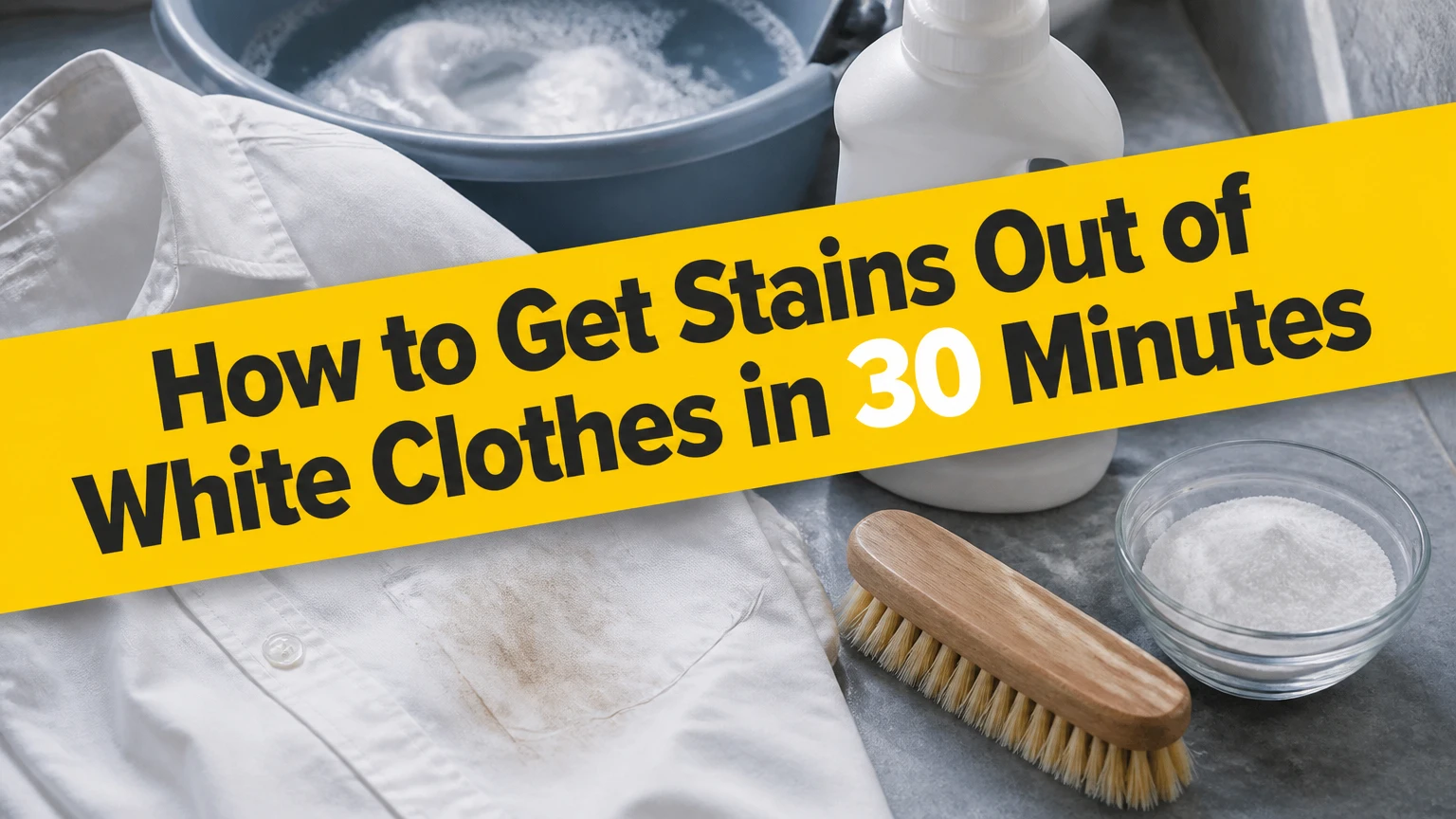
To get stains out of white clothes, remove excess material, flush the spot from the back with cool water, apply a stain-specific pretreatment, wash according to the care label, and inspect before drying. Fresh stains often need 10-30 minutes of treatment, while oil, rust, dye, and heat-set marks may require repeated treatment or professional cleaning.
Key Facts at a Glance
- Cool water is the safest first rinse for blood, milk, egg, and other protein stains.
- Dish soap is more effective than baking soda on cooking oil, makeup, and greasy sunscreen.
- A 3% hydrogen peroxide solution can lighten many organic stains, but patch testing is necessary.
- Oxygen bleach is generally safer than chlorine bleach for washable cotton and many synthetic whites.
- Never dry, iron, or expose a treated stain to high heat until the mark has disappeared.
- Never mix chlorine bleach with vinegar, ammonia, alcohol, or other cleaning products.
Before You Start
Most fresh stains can be treated at home in 15-30 minutes, excluding the washing cycle. The cost is typically $0.10-$1.00 per garment when using detergent, dish soap, peroxide, or oxygen bleach already in the home.
| Requirement | Typical amount or setting | Why it matters |
|---|---|---|
| Treatment time | 10-30 minutes | Gives pretreatment time to loosen residue |
| Water temperature | Cool to lukewarm, 60-100°F | Limits protein setting and fabric damage |
| Liquid detergent | 1-2 teaspoons | Provides surfactants and detergent builders |
| Dish soap | 2-5 drops | Breaks up oil and grease films |
| 3% hydrogen peroxide | 1-2 teaspoons for a small spot | Oxidizes many organic pigments |
| Oxygen bleach | Product-label amount, often 1-2 tablespoons per gallon | Whitens washable garments during soaking |
| Tools | White towel, spoon, soft toothbrush, gloves | Prevents dye transfer and skin exposure |
Read the garment’s fiber content and care symbols before applying any chemical. Cotton and polyester whites usually tolerate more treatment than silk, wool, rayon, acetate, elastane, or garments with glued decorations.
Test the treatment on an inside seam for five minutes, then rinse and check under bright light. White fabric can still develop a pale yellow or gray reaction that is difficult to see under warm indoor lighting.
How Does Stain Removal Work?
Stain removal works by dissolving residue, suspending particles in water, breaking down organic molecules with enzymes, or changing colored molecules through oxidation. The best method depends on whether the stain is water-soluble, oily, protein-based, particulate, or dye-like.
Surfactants in laundry detergent have a water-attracting end and an oil-attracting end. They surround grease and soil so the washing water can carry the material away. Enzymes perform a narrower job: protease targets proteins, amylase targets starch, and lipase targets certain fats.
Oxidizers such as hydrogen peroxide and sodium percarbonate alter some colored molecules, making them less visible. Oxidation is useful for coffee, tea, wine, fruit, and some grass marks, but it can also weaken fibers or damage dyes and finishes when used too strongly.
The American Cleaning Institute advises consumers to “never mix bleach with ammonia or other cleaners.” That warning applies even when the products are diluted, because incompatible mixtures can release dangerous gases or create corrosive solutions.
Step 1: Remove Excess Material and Blot the Stain
Scrape solids away with a spoon, then blot liquid stains with a clean white towel or paper towel. Do not rub outward from the center because friction can spread pigment and force residue deeper into the weave.
Use a lifting motion rather than a wiping motion. Replace the towel section as it absorbs the stain, especially with red wine, coffee, blood, and liquid foundation. A stained towel can redeposit color on white cotton.
You’ll know it worked when no loose food, mud, powder, or surface liquid remains. The common mistake is starting with a wet cloth on a thick food stain, which dilutes the material across a larger area.
Step 2: Flush the Fabric From the Back
Hold the reverse side of the garment under cool running water for 30-60 seconds. Water should push the contaminant out through the front rather than drive it farther into the fibers.
Place the stained area over a sink or basin and keep the rest of the garment away from colored surfaces. For a large stain, use a basin of cool water and change the water after each rinse so pigment does not return to the garment.
Warm water is unsuitable as the first step for blood, egg, milk, yogurt, and meat juices because heat can denature and bind proteins to fibers. The exception is a greasy stain after the excess oil has been removed, when lukewarm water can help detergent dissolve the remaining film.
You’ll know it worked when the rinse water becomes clear and the visible edge stops expanding. The common mistake is rinsing from the front only.
Step 3: Apply the Correct Pretreatment
Choose the pretreatment according to the stain category, not according to the garment’s color alone. Apply enough product to wet the stained fibers without saturating the entire garment.
| Stain category | Examples | First-choice pretreatment | Typical dwell time |
|---|---|---|---|
| Protein | Blood, milk, egg, sweat | Enzyme detergent and cool water | 10-20 minutes |
| Oil-based | Butter, lipstick, sunscreen, motor oil | Liquid dish soap or heavy-duty detergent | 10-15 minutes |
| Tannin or beverage | Coffee, tea, wine, cola | Liquid detergent, then oxygen bleach if needed | 10-20 minutes |
| Pigment or plant | Grass, tomato, berries | Enzyme detergent, then oxygen bleach | 15-30 minutes |
| Dye or ink | Pen, marker, hair dye | Isopropyl alcohol test, then laundering | 5-10 minutes |
| Mineral | Rust, hard-water marks | Textile-safe rust remover | Product-label time |
Work liquid detergent gently into cotton with a fingertip or soft toothbrush. Use a light touch on polyester because aggressive brushing can roughen the surface and make the spot look permanently dull.
For an oil stain, place a folded towel behind the mark, add two to five drops of grease-cutting dish soap, and wait 10 minutes. Rinse thoroughly before adding any oxygen bleach. Soap residue can interfere with later treatment and attract soil.
You’ll know it worked when the mark becomes lighter or transfers onto the backing towel. The common mistake is applying several products at once, which makes chemical reactions and residue difficult to control.
Step 4: Treat Persistent Organic Stains
Use 3% hydrogen peroxide or oxygen bleach only after the initial detergent treatment has removed loose residue. Pour 1-2 teaspoons of 3% hydrogen peroxide onto a small white cotton spot, wait five minutes, rinse, and repeat once if the fabric remains unchanged.
Sodium percarbonate, the active ingredient in many oxygen-bleach powders, releases hydrogen peroxide in water. Dissolve the product completely according to its label, commonly in water around 80-100°F, and soak washable whites for 1-6 hours. Do not assume a longer soak is safer; prolonged exposure can affect elastic, dyes, coatings, and weak fibers.
Chlorine bleach is a last-resort product for bleach-safe white cotton or linen. Follow the bottle dilution exactly, never pour concentrated bleach directly onto fabric, and rinse thoroughly. The University of Georgia Cooperative Extension and many care-label authorities distinguish bleach-safe cotton from garments containing spandex, wool, silk, or decorative finishes.
You’ll know it worked when the stain is visibly absent while the garment is still wet. The common mistake is using chlorine bleach to compensate for an unidentified stain, which can permanently yellow or weaken the textile.
Step 5: Wash According to the Care Label
Wash the garment with a quality liquid or powder detergent after pretreatment. Select the warmest temperature permitted by the care label and fabric, because detergent performance generally improves with warmth, while protein stains require a cool first rinse.
Use a normal cycle for durable cotton shirts and towels, a gentle cycle for lightweight synthetics, and hand washing for delicate fabrics. Do not overload the drum; tightly packed garments receive less mechanical action and poorer rinsing.
Avoid fabric softener on a stain-marked garment. Softener deposits can coat fibers and reduce water absorption, which makes later stain treatment less effective. Do not add vinegar to the same wash as chlorine bleach.
You’ll know it worked when the garment looks clean after rinsing and has no slick, sour, or chemical residue. The common mistake is adding more detergent than the label recommends, which can leave a film that attracts soil.
Step 6: Inspect Before Drying
Check the garment in daylight while it is damp, then air-dry it if any shadow remains. Dryer heat can oxidize or set residual oils, dyes, and proteins, turning a removable mark into a much harder repair.
If the stain is gone, dry the garment according to its care label. If the mark remains, repeat the stain-specific pretreatment once rather than escalating immediately to stronger bleach.
A practical rule is simple: never iron or tumble-dry a visible stain. Heat is especially risky for blood, milk, egg, sunscreen, cooking oil, and ink.
You’ll know it worked when the fabric has the same color and texture as the surrounding area after drying. The common mistake is judging success under dim bathroom lighting.
Which Treatment Works for Each Common Stain?
The correct treatment for white clothes varies by stain chemistry. Blood needs cold water and enzymes, grease needs surfactants, and rust needs an acid-based textile product rather than bleach.
| Stain | Procedure | Avoid | Typical success window |
|---|---|---|---|
| Fresh blood | Cold rinse, enzyme detergent, 15-minute pretreat | Hot water and chlorine bleach on protein residue | Same day |
| Sweat or deodorant | Liquid detergent, oxygen bleach soak if yellowed | Mixing vinegar with bleach | 30 minutes to 6 hours |
| Coffee or tea | Blot, detergent, 3% peroxide or oxygen bleach | Dryer before inspection | 15-60 minutes |
| Red wine | Blot, cool rinse, detergent, oxygen bleach | Salt as the only treatment | 20-60 minutes |
| Tomato sauce | Scrape, back-rinse, detergent, oxygen bleach | Hot dryer after a partial wash | 30-90 minutes |
| Grass | Enzyme detergent, gentle brushing, oxygen bleach | Chlorine bleach without testing | 20-60 minutes |
| Grease or makeup | Dish soap, rinse, detergent wash | Baking soda alone | 15-45 minutes |
| Ink | Dab with isopropyl alcohol over a towel, rinse, detergent | Rubbing the ink outward | 10-30 minutes |
| Rust | Textile-safe rust remover, rinse thoroughly | Chlorine bleach | Label-specific |
| Turmeric or hair dye | Specialist color-stain remover, peroxide test | Uncontrolled chlorine bleach | Several treatments |
How Do You Remove Blood From White Clothes?
Remove blood from white clothes with cool water and an enzyme detergent, treating the stain before washing. Flush from the back for at least 30 seconds, apply detergent for 10-20 minutes, rinse, and repeat before using oxygen bleach.
Fresh blood usually responds better than dried blood because less pigment has bonded to the fibers. For dried blood, soak the garment in cool water for 30-60 minutes, change the water, and then apply enzyme detergent.
Hydrogen peroxide can help on white cotton, but test it first because some “white” fabrics contain optical brighteners or finishes that can react unevenly. Chlorine bleach should not be the first treatment for blood because remaining protein can discolor and the chemical can damage fibers.
How Do You Remove Grease and Makeup?
Remove grease and makeup with concentrated liquid dish soap or heavy-duty liquid laundry detergent. Apply two to five drops to the dry stain, place a towel behind it, gently work from the outer edge inward, wait 10-15 minutes, and rinse with lukewarm water.
Lipstick, foundation, sunscreen, butter, and cooking oil contain hydrophobic compounds that water alone cannot carry away. Dish soap is useful because its surfactants are designed to emulsify fats, but rinse it out before the main wash.
For motor oil, use a commercial degreasing laundry pretreatment and expect two treatment cycles. Do not use gasoline, paint thinner, or acetone on clothing at home because they create fire, inhalation, and fiber-damage hazards.
Which Stain Remover Should You Choose?
Oxygen bleach is the best general whitening option for washable white cotton, enzyme detergent is the best first choice for organic stains, and dish soap is the fastest low-cost option for grease. Chlorine bleach works selectively, not universally.
| Product or method | Best use | Typical cost | Treatment time | Main limitation |
|---|---|---|---|---|
| Liquid enzyme detergent | Blood, sweat, grass, dairy | $0.10-$0.40 per load | 10-20 minutes | Less effective on rust and mineral stains |
| Liquid dish soap | Oil, makeup, sunscreen | $0.05-$0.20 per spot | 10-15 minutes | Requires thorough rinsing |
| 3% hydrogen peroxide | Coffee, wine, fruit, blood shadows | $0.05-$0.30 per spot | 5-10 minutes | Can alter finishes or dyes |
| Oxygen bleach powder | Yellowing and broad organic stains | $0.20-$0.80 per soak | 1-6 hours | Not suitable for every delicate fiber |
| Chlorine bleach | Label-approved cotton whites | $0.20-$0.60 per treatment | 5-15 minutes | Weakens fibers and can yellow fabric |
| Textile rust remover | Rust and iron marks | $0.50-$2.00 per spot | 2-10 minutes | Acidic; requires exact label use |
Baking soda can deodorize and mildly improve washing water, but it is not a strong substitute for a surfactant on grease. White vinegar can reduce some odors and mineral residue, yet it does not reliably remove set-in pigment and must never contact chlorine bleach.
“Natural” does not mean risk-free. Lemon juice can lighten fabric unevenly, vinegar can affect elastics over repeated exposure, and baking soda can leave alkaline residue if it is not dissolved and rinsed.
What Changes for Different Fabrics?
Fabric type determines whether a stain treatment is safe. White cotton and linen are comparatively durable, while silk, wool, rayon, acetate, and elastane can shrink, weaken, distort, or develop permanent marks from household bleach and strong solvents.
| Fabric | Safer first treatment | Avoid or restrict | Drying guidance |
|---|---|---|---|
| Cotton | Enzyme detergent, oxygen bleach | Repeated chlorine bleach | Label-approved tumble or air dry |
| Linen | Cool rinse, mild detergent | Abrasive scrubbing | Air dry to limit creasing |
| Polyester | Detergent, dish soap, oxygen bleach test | Undiluted chlorine bleach | Low heat or air dry |
| Elastane or spandex | Mild detergent, short cool soak | Chlorine bleach and high heat | Air dry or lowest label setting |
| Silk | Blot, cool water, professional cleaner | Peroxide, bleach, enzymes | Lay flat or label direction |
| Wool | Cold water, wool detergent | Enzymes, bleach, hot water | Lay flat, reshape |
| Rayon or viscose | Minimal water, professional advice | Soaking, rubbing, bleach | Air dry flat if label permits |
White polyester is not automatically safe for chlorine bleach. Repeated chlorine exposure can weaken synthetic fibers, degrade finishes, and produce yellowing that ordinary washing cannot reverse. Check the care label and manufacturer guidance first.
For silk, wool, rayon, acetate, leather trim, sequins, and “dry clean only” garments, stop after blotting and professional assessment. A cleaner needs to know the stain’s origin and every product already applied.
Common Mistakes and How to Fix Them
Using hot water first
Hot water can set blood, egg, dairy, and other protein residues. Rinse with cool water, apply enzyme detergent, and wash only after the protein has loosened.
Scrubbing hard
Aggressive brushing can break surface fibers and leave a pale halo that resembles a stain. Use fingertip pressure or a soft toothbrush, working from the edge toward the center.
Using chlorine bleach on an unidentified mark
Chlorine bleach can react badly with rust, elastane, dyes, and some synthetic finishes. Rinse the garment completely, identify the stain, and choose an oxygen bleach or specialist product when the label permits.
Mixing cleaning products
Never combine bleach with vinegar, ammonia, alcohol, peroxide, toilet cleaner, or acidic rust removers. If products were mixed accidentally, leave the area, ventilate from a safe distance, and contact local emergency or poison-control services.
Drying too soon
A dryer can set the residue that washing failed to remove. Air-dry the garment until the stain decision is complete.
Applying too much product
Excess detergent or powder can leave a film and cause a new gray or yellow appearance. Rinse thoroughly and run an additional rinse cycle before adding another chemical.
How Do You Rescue a Stain After Washing or Drying?
A stain that remains after washing can often receive one more targeted treatment, but a dryer or iron may permanently set some dyes and oils. Do not use stronger chemicals automatically; identify the residue and test the garment first.
For a washable cotton garment that was washed but not dried, repeat detergent treatment for 15 minutes, rinse, and wash again. If a faint organic shadow remains, use an oxygen-bleach soak for 1-6 hours according to the product label.
For a dryer-set stain, expect partial improvement rather than guaranteed removal. Grease may respond to two dish-soap cycles, while ink, hair dye, turmeric, and transferred garment dye may require a professional cleaner.
If chlorine bleach caused yellowing, stop bleaching. Rinse repeatedly, check the care label, and ask a textile cleaner whether the discoloration is chemical damage or removable residue. Do not apply rust remover or another acid unless the product specifically identifies the garment and the bleach-related condition as compatible.
When Should You Use a Professional Cleaner?
Use a professional cleaner for “dry clean only” clothing, silk, wool, rayon, acetate, structured tailoring, expensive garments, unknown dyes, and stains caused by hair dye, permanent marker, rust, or transferred color. Professional cleaners can use controlled solvents and identify fiber damage that home treatment cannot reverse.
Tell the cleaner whether the garment has been washed, dried, ironed, bleached, or treated with peroxide, vinegar, alcohol, or dish soap. Product history changes the safest next step.
Home treatment is most appropriate for washable cotton and polyester with fresh food, blood, sweat, grass, or grease marks. It is least appropriate when the garment has a lining, bonded decoration, unstable trim, or a care label that prohibits water.
FAQ
Can I use baking soda and hydrogen peroxide together?
Baking soda and 3% hydrogen peroxide can form a mild paste for some organic stains, but the combination is not a universal remover. Apply a small amount for five minutes, rinse completely, and test first. Dish soap works better for grease, while oxygen bleach provides more predictable whitening for washable fabrics.
Is vinegar good for removing stains from white shirts?
White vinegar is better for odor and some mineral residue than for set-in stains. Dilute it in water when the care label permits, rinse thoroughly, and never combine it with chlorine bleach. Vinegar will not reliably remove oil, rust, permanent ink, or heat-set food pigment.
Can sunlight remove stains from white clothes?
Sunlight can gradually fade some plant and organic pigments, especially after washing, but it is not a controlled stain-removal method. Extended ultraviolet exposure can weaken fibers and yellow certain finishes. Treat the stain first, rinse the garment, and use brief indirect or moderate sunlight only when the fabric label permits.
How long should I soak white clothes in oxygen bleach?
A typical oxygen-bleach soak lasts 1-6 hours, but the product label and fabric determine the safe duration. Use a shorter soak for polyester, elastane, and decorated garments. Dissolve the powder fully, keep the garment submerged, rinse well, and inspect before drying.
Why did my white clothes turn gray after washing?
Grayness commonly results from dye transfer, excess detergent, hard-water minerals, soil redeposition, or an overloaded washer. Rewash the garment separately with the correct detergent amount and an oxygen-bleach product approved for the fabric. Do not add chlorine bleach until you know the cause.
Can I remove a stain that has been ironed?
An ironed stain may be permanently heat-set, but some residues can still lighten. Try one controlled treatment that matches the stain, such as dish soap for oil or enzyme detergent for protein, then stop if the fabric develops a halo or texture change. Professional cleaning is safer for valuable garments.
The Bottom Line
The safest way to get stains out of white clothes is to blot, rinse from the back with cool water, match the pretreatment to the stain, wash according to the care label, and inspect before applying heat. Enzyme detergent handles protein, dish soap handles grease, oxygen bleach handles many organic pigments, and chlorine bleach belongs only on specifically approved garments.