To get urine smell out of carpet, remove the liquid, treat the full contaminated depth with a compatible enzymatic or oxidizing cleaner, and dry the carpet completely. Fresh spots may improve within 24 hours, while old urine in carpet padding can require two treatments, professional subsurface extraction, or replacement of the pad and affected carpet.
Key Facts at a Glance
- Urine odor usually returns when dried urine salts remain in carpet backing, padding, or subfloor.
- Blot fresh urine immediately; scrubbing spreads liquid sideways and deeper into the carpet.
- Enzymatic cleaners need enough liquid to reach the contaminated layer, not merely a surface mist.
- A 1:1 cleaner-to-urine estimate is a starting point, not a guaranteed dosing rule.
- Keep pets away until the treatment is dry and the odor has been assessed under normal humidity.
- Never mix enzyme products, bleach, ammonia, hydrogen peroxide, or vinegar in the same application.
Why Does Urine Odor Return After Carpet Dries?
Urine odor returns because soluble water evaporates while less-soluble urine residues remain attached to carpet fibers, backing, pad, or flooring. Moisture from humidity or a new cleaning treatment can dissolve or mobilize those residues, releasing an ammonia-like smell again.
Urine chemistry is more complicated than the phrase “uric acid crystals.” Fresh urine contains water, urea, salts, creatinine, pigments such as urochrome, and other compounds. As urine dries, urate salts and other residues can adhere to porous materials. Cat urine often smells especially strong because concentrated urine contains additional sulfur-containing odor compounds.
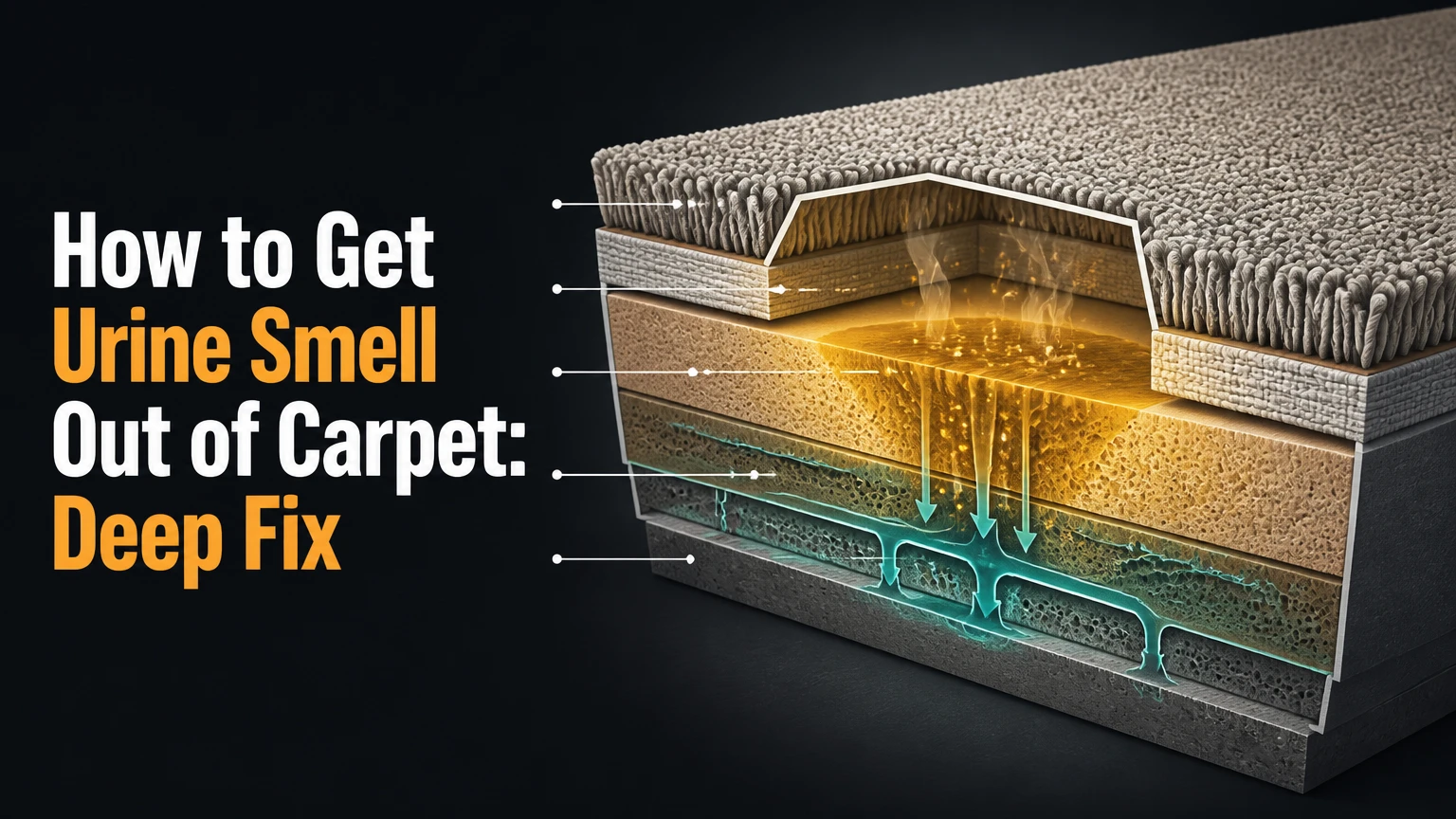
The contamination pattern is usually wider and deeper than the visible mark. A pet accident can travel through the pile, primary backing, secondary backing, carpet pad, and sometimes the wood or concrete beneath. A surface deodorizer may hide the odor for several days without removing the source.
The Carpet and Rug Institute advises following carpet manufacturer care instructions and testing cleaning chemicals in an inconspicuous area. That matters because nylon, polyester, polypropylene, wool, cotton, jute, dyes, and adhesives react differently to moisture and oxidizers.
What You Need Before Cleaning
Prepare white absorbent towels, a wet-dry vacuum or carpet extractor, a UV flashlight, gloves, a measuring jug, a soft brush, plastic sheeting, and a carpet-safe odor treatment. Choose a cleaner labeled for urine odor and the specific carpet fiber whenever the manufacturer provides that information.
Before You Start
| Requirement | Typical value | Why it matters |
|---|---|---|
| Treatment time | 30 minutes to 24 hours | Enzymes often need extended contact |
| Drying time | 12-48 hours | Residual moisture can reactivate odor |
| DIY material cost | $15-$45 | Covers cleaner, towels, gloves, and detection light |
| Professional treatment | $150-$600 per room | Typical US range for severe contamination |
| Equipment | Wet vacuum, extractor, or towels | Removes liquid after treatment |
| Ventilation | 2 fans plus open airflow | Reduces drying time and humidity |
Protect finished wood, painted walls, furniture legs, and metal furniture feet from prolonged contact with cleaning liquid. Keep children and animals outside the treatment area, and read the product label before use.
How Do Enzymatic Urine Cleaners Work?
Enzymatic urine cleaners use enzymes and, in some formulations, microorganisms to break down organic residues that contribute to odor. The process works only where the solution reaches the residue, remains active for the label-specified dwell period, and avoids chemical conditions that deactivate the formula.
The common claim that enzymes always convert uric acid directly into carbon dioxide and water is too broad. Product chemistry varies, and an enzyme cleaner may break down urine-related organic material without removing every mineral residue or repairing permanently discolored fibers. Odor elimination depends on penetration, contact time, extraction, and drying.
Do not add bleach, ammonia, vinegar, disinfectant, or peroxide to an enzymatic product. Those substances can reduce biological activity, create irritating vapors, damage fibers, or produce an unpredictable reaction. Use one product at a time, and rinse or extract according to its label.
Which Cleaner Type Fits the Problem?
| Cleaner type | Best application | Contact time | Main risk |
|---|---|---|---|
| Enzymatic formula | Fresh or dried pet urine | 8-24 hours typical | Ineffective if applied only to the surface |
| Hydrogen peroxide product | Small synthetic-carpet spot | 5-15 minutes typical | Dye lightening or fiber damage |
| Oxygen-based powder | Washable synthetic carpet | 10-30 minutes typical | Residue or color change |
| White vinegar solution | Temporary fresh-odor reduction | 5-10 minutes | Does not reliably remove deep urate residue |
| Professional subsurface treatment | Pad, backing, or subfloor contamination | 3-8 hours on site | Higher cost and moisture load |
A tested enzymatic formula is usually the best first choice for pet urine on synthetic carpet. Wool, silk, viscose, antique rugs, and plant-fiber rugs require a specialist because high moisture and alkaline or oxidizing products can cause shrinkage, browning, dye bleed, or texture change.
Step 1: Find the Entire Contaminated Area
Use a UV flashlight in a dark room to locate likely dried urine, then mark the perimeter with removable tape. Urine fluorescence is only a screening aid because detergents, optical brighteners, and some food spills can also glow, while old or diluted urine may not fluoresce clearly.
Inspect at floor level and check nearby baseboards, furniture edges, pet beds, rug underlays, and vertical surfaces. A cat that repeatedly marks one corner can contaminate the carpet edge, tack strip, drywall, and subfloor even when the central carpet patch appears small.
Measure the treatment zone beyond the visible or fluorescent edge. A practical starting boundary is 2-4 inches beyond the detected area, but expand it when the pad feels wet, the smell is stronger near a wall, or multiple accidents overlap.
Step 2: Blot Fresh Urine Immediately
Press folded white towels into fresh urine until the towels remain nearly dry, replacing them as they become saturated. For a larger puddle, place several towels over the area and apply body weight for 30-60 seconds without twisting or scrubbing.
A wet-dry vacuum can remove more liquid before treatment. Make several slow passes in different directions, then empty and rinse the machine according to its instructions.
You will know this step is complete when a fresh towel picks up little moisture and the carpet pile no longer feels wet at the surface. The common mistake is rubbing first, which pushes urine laterally through the pile and increases the treatment footprint.
Step 3: Estimate the Required Cleaner Volume
Apply enough urine cleaner to reach the same depth as the contamination, rather than misting the top fibers. For a small spot, 250-500 milliliters may be sufficient; a heavily saturated square meter can require 1-3 liters, depending on carpet and pad thickness.
The frequently repeated 1:1 cleaner-to-urine ratio is a useful minimum estimate only when the urine volume is known. Because most dried accidents have an unknown volume, use the product label and treat the measured area deeply enough to contact the pad without flooding an untreated floor.
| Contamination level | Area example | Typical cleaner volume | Expected treatment |
|---|---|---|---|
| Fresh surface spot | 20 x 20 cm | 250-500 ml | Blot, treat, extract |
| Moderate pet accident | 60 x 60 cm | 750 ml-1.5 L | Reach carpet backing and upper pad |
| Repeated accidents | 1 square meter | 1.5-3 L | Treat pad, extract, reassess |
| Broad cat marking | 2-4 square meters | 3-8 L | Professional assessment often appropriate |
Use a plastic sheet under removable rugs or small carpet pieces to prevent cleaner from soaking into the floor. Do not create a large wet area on glued-down carpet unless the product and flooring manufacturer allow it.
Step 4: Apply the Urine Treatment
Pour or slowly distribute the cleaner across the marked zone, working from the outside toward the center. The solution must wet the contaminated fibers and backing, but the correct amount is governed by label directions, carpet construction, and what lies beneath the carpet.
Gently work the cleaner into the pile with a soft brush. Avoid aggressive agitation because it can distort cut pile, damage looped carpet, or spread contamination beyond the treated boundary.
Cover the damp area with loose plastic sheeting when the product label permits it. Covering slows evaporation and can maintain contact, but it also increases drying time, so remove the plastic if condensation accumulates or the manufacturer prohibits covering.
You will know application was adequate when the treated zone has consistent moisture from edge to edge and the product has reached the suspected depth. The common mistake is using a trigger sprayer for a pad-level problem.
Step 5: Maintain Dwell Time and Extract
Follow the label dwell time, which commonly ranges from 15 minutes for a surface spot to 8-24 hours for dried or pad-level urine. Do not assume a shorter contact time is better because rapid extraction can remove active cleaner before it contacts the residue.
After dwell time, extract slowly with a clean wet vacuum or carpet machine. Make one wet pass, followed by two or three dry passes, and avoid adding detergent unless the equipment instructions require it.
For a small rug, press clean towels over the area after extraction and replace them until they stay mostly dry. For wall-to-wall carpet, place fans so air moves across the surface rather than blowing moisture into a wall or under furniture.
The success checkpoint is a carpet that feels only slightly cool or damp, with no pooling beneath the backing. The common mistake is leaving treated liquid in the pad, where it can wick upward and recreate the odor.
Step 6: Dry Completely and Reassess
Dry the carpet for 12-48 hours with ventilation, low indoor humidity, and fans. Avoid judging success while the carpet is damp because moisture can temporarily suppress or intensify odor, producing a misleading result.
Check the area after it reaches normal room temperature and feels dry at the pile, backing edge, and pad if accessible. Recheck during a humid period because residual urine salts often become more noticeable when relative humidity rises.
If the smell is gone after 48 hours, vacuum the carpet and return furniture only after the surface and pad are fully dry. If the odor remains, repeat the treatment once with correct penetration before escalating to professional extraction or replacement.
Which Urine-Removal Method Should You Choose?
Enzymatic treatment is the best first option for most fresh or moderately old pet accidents on synthetic carpet. Professional subsurface extraction becomes the better choice when urine has reached the pad, multiple spots overlap, or two correctly performed DIY treatments fail.
| Method | Typical cost | Time to reassess | Suitable carpet | Limitation |
|---|---|---|---|---|
| Enzyme cleaner | $15-$45 per bottle | 24-48 hours | Nylon, polyester, polypropylene | Needs deep contact |
| Peroxide spotter | $8-$25 per bottle | 1-4 hours | Colorfast synthetic fibers | Can lighten dye |
| Vinegar and water | Under $5 | 12-24 hours | Limited fresh-spot use | Weak against old residue |
| Rental extractor | $40-$90 per day | 24-48 hours | Synthetic wall-to-wall carpet | Can over-wet pad |
| Professional treatment | $150-$600 per room | 1-3 days | Severe or broad contamination | Cost and access |
| Pad replacement | $2-$8 per square foot installed | 1-2 days | Saturated pad | Carpet may also need replacement |
Vinegar can reduce the sharpness of a fresh odor because its acidity changes the local chemistry, but vinegar does not reliably dissolve or remove old urine deposits in carpet padding. Baking soda absorbs some surface odor after drying; it is not a substitute for extraction or enzymatic treatment.
Steam cleaning is not automatically forbidden, but heat alone does not destroy urine residue. The Institute of Inspection Cleaning and Restoration Certification, or IICRC, emphasizes matching cleaning methods to fiber and construction; a hot-water extraction technician who treats the source and controls moisture may succeed, while steam used as a quick surface pass may spread or reactivate the problem.
What Should You Avoid?
Avoid ammonia-based cleaners because ammonia-like odor can encourage repeat marking and may irritate the respiratory system. Avoid chlorine bleach on carpet because it can damage dyes and fibers and may produce hazardous fumes when mixed with acids or ammonia.
Avoid mixing cleaning chemicals, applying concentrated peroxide without a color test, scrubbing looped carpet, and sealing a wet carpet under furniture. Avoid fragrance deodorizers as the primary treatment because they mask odor while leaving the urine source in place.
What If a Brown Ring Appears?
A brown or yellow ring usually indicates wicking, soil migration, dye change, or residue left at the drying edge. Lightly re-wet the complete affected section with a compatible carpet spotter, blot from the outside inward, and dry the entire zone evenly rather than treating only the ring.
What If the Smell Returns After Two Treatments?
A returning odor after two correctly applied treatments usually means contamination remains below the carpet, inside the pad, along the tack strip, or in the subfloor. Lift a carpet corner if safe, inspect the pad, and compare odor intensity above the floor and at the edge.
Replace a section of pad when it is visibly stained, stiff, crumbling, or strongly odorous after drying. If wood subfloor is affected, cleaning may need to be followed by controlled drying and a compatible sealer; concrete can also retain odor in pores and joints.
Situational Variations for Different Carpet Problems
How Do You Remove Cat Urine Smell?
Cat urine usually requires a larger treatment area and more aggressive source investigation because repeated marking can saturate the pad and adjacent structures. Treat the carpet, pad, baseboard, and floor edge separately, and address litter-box access or veterinary concerns when marking continues.
How Do You Remove Dog Urine From Carpet?
Dog urine is often easier to isolate when the accident is recent. Blot immediately, use a measured enzyme treatment, and inspect around doors, rugs, and corners where repeated accidents can create overlapping contamination.
How Do You Remove Human Urine From Carpet?
Human urine from incontinence or illness may cover a broader area than a pet accident and can involve furniture, mattress edges, or underlays. Wear gloves, remove heavily contaminated absorbent materials, ventilate the room, and use a labeled cleaner suitable for organic contamination.
What If the Carpet Is Wool?
Do not saturate wool carpet with a general pet enzyme product unless the manufacturer confirms compatibility. Blot, avoid alkaline products and peroxide, and contact a wool-rug or textile specialist when odor has reached the backing or underlay.
When Is Professional Cleaning or Replacement the Better Choice?
Professional service is justified when contamination covers more than 2-4 square meters, reaches the subfloor, persists after two complete treatments, or affects a rental property with a documented move-out deadline. Ask for urine-specific subsurface treatment, moisture control, and a written statement about whether pad replacement is included.
Typical US pricing is $150-$600 per room for specialized odor treatment, while broad remediation, carpet lifting, pad replacement, or subfloor sealing can exceed $1,000. Local prices vary with access, room size, contamination depth, and whether furniture must be moved.
A professional cannot guarantee that every old stain will disappear. Odor may be removable while yellowing, bleaching, delamination, or permanent fiber damage remains. Replacement is often more economical when the pad is saturated across a room or the carpet adhesive has failed.
Expert Rules That Prevent Repeat Odor
- Treat the pad, not only the pile. A surface that looks clean can conceal a larger contamination cone below.
- Measure drying, not fragrance. A perfumed room can still contain wet urine residue and active odor.
- Use the smallest effective treatment footprint. Excess water increases wicking, drying time, and subfloor risk.
- Test color before using peroxide or oxygen bleach. A hidden 1-inch test patch can prevent a visible 2-foot lightened area.
- Inspect the source of repeat accidents. Cleaning does not stop marking caused by litter-box problems, stress, pain, or access to a previously soiled location.
Frequently Asked Questions
Can baking soda remove urine smell from carpet?
Baking soda can reduce some surface odor after carpet has been cleaned and dried, but baking soda cannot reliably remove urine deposits in carpet padding or subfloor. Apply it only to a dry surface, leave it for several hours, vacuum thoroughly, and never use it to replace source removal.
How long does urine smell stay in carpet?
Fresh urine odor may improve within 24-48 hours after complete blotting, treatment, extraction, and drying. Old urine in padding can persist for weeks or indefinitely until the contaminated pad, backing, or subfloor receives treatment or replacement.
Can I use hydrogen peroxide on carpet urine?
Hydrogen peroxide can work on a small, colorfast synthetic-carpet spot when the product label allows it. Test first because peroxide can lighten dyes, alter wool, weaken some fibers, and create a visible patch that is harder to repair than the original stain.
Why does carpet smell worse after shampooing?
Carpet can smell worse after shampooing because water rehydrates dried urine salts, spreads contamination through the pad, or leaves the area damp for too long. Extracting slowly, drying with airflow, and treating the full contaminated depth reduces this temporary or recurring odor.
Will a UV light find every urine stain?
A UV light will not find every urine stain. Detergent residues, optical brighteners, and other substances can fluoresce, while old or diluted urine may be faint. Confirm suspected areas by odor, location, texture, and inspection beneath the carpet when possible.
The Bottom Line
To permanently get urine smell out of carpet, remove fresh liquid, identify the complete contaminated footprint, apply a compatible cleaner deeply enough to reach the backing or pad, honor its dwell time, extract excess moisture, and dry the carpet for 12-48 hours. Vinegar and baking soda may help a fresh surface spot, but old or repeated urine usually requires enzymatic treatment, professional subsurface extraction, pad replacement, or subfloor remediation.