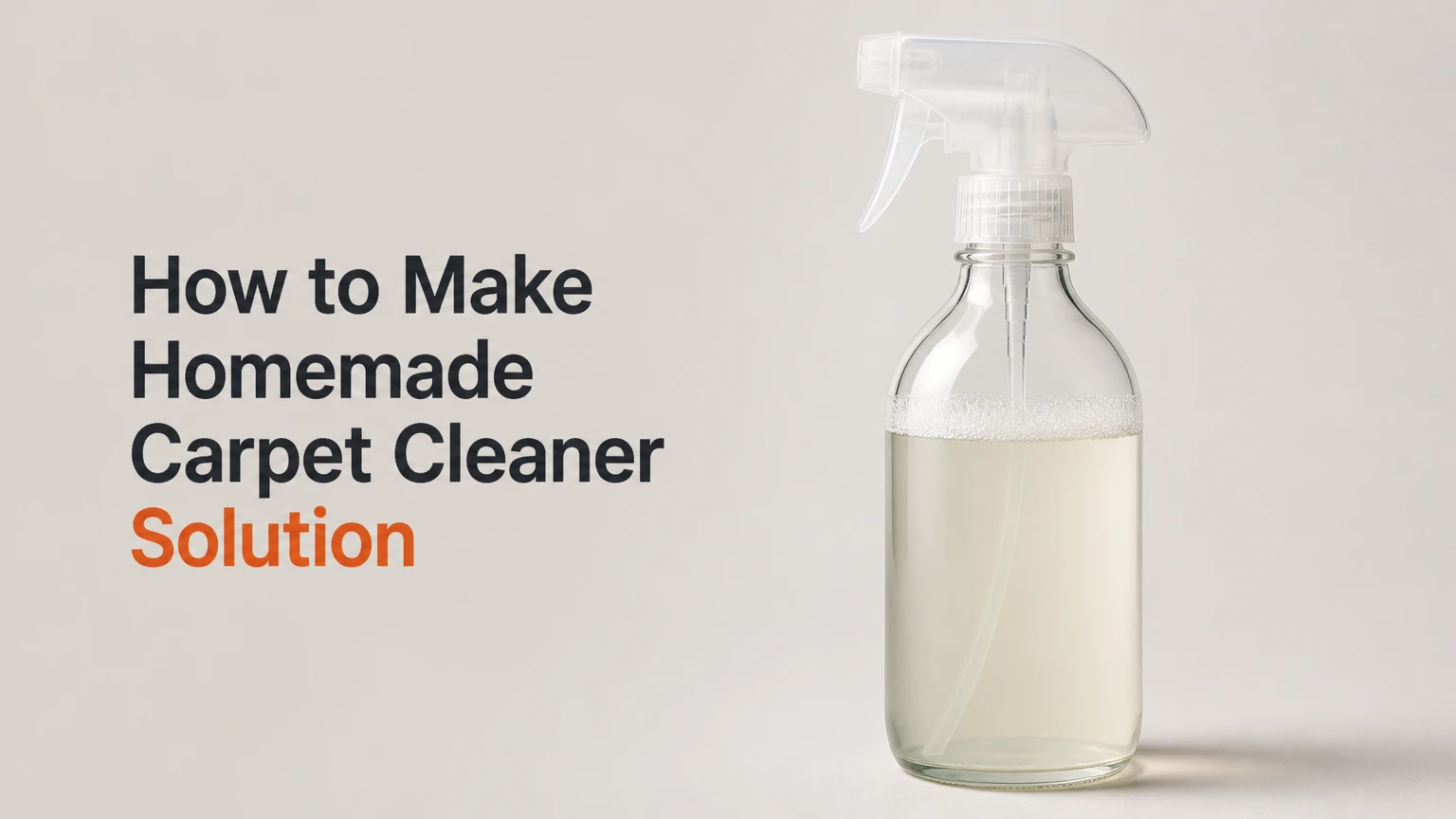
The best homemade carpet cleaner solution for routine synthetic-carpet spot cleaning is 2 cups of warm water mixed with 1 teaspoon of clear, unscented dish soap. Blot the spill, apply only enough solution to dampen the fibers, rinse with clean water, and dry completely. Use hydrogen peroxide, alcohol, vinegar, or an enzymatic cleaner only when the stain chemistry and carpet fiber allow it.
Key facts at a glance
- A low-suds mixture of 1 teaspoon clear dish soap in 2 cups warm water is the safest general spot-cleaning formula for many synthetic carpets.
- Vinegar and baking soda neutralize each other when mixed, so the fizz is not evidence of superior carpet cleaning.
- Hydrogen peroxide can lighten dyed carpet, especially dark, natural, or unstable fibers; always perform a hidden-area test.
- Pet urine usually requires an enzyme-based urine treatment because odor compounds can remain below the carpet surface.
- Carpet should feel barely damp after spot cleaning and typically dries in 2-6 hours with ventilation.
- Never put an unapproved homemade formula into a rental extractor without checking the machine instructions and carpet manufacturer’s care label.
What homemade carpet cleaner solution actually does
Homemade carpet cleaner solution uses water, a surfactant, an acid, an oxidizer, or a solvent to loosen a particular type of soil. Water carries the active ingredient into the carpet, dish soap surrounds oily particles, hydrogen peroxide changes some colored organic compounds, and isopropyl alcohol dissolves selected inks and oils.
The formula must match both the stain and the fiber. A surfactant that removes cooking oil may leave residue when overused, while an oxidizer that fades red wine can also fade a navy carpet. Carpet construction matters because face fibers, dye, latex backing, and the pad respond differently to moisture and chemicals.
Vinegar is acetic acid in dilute water. It can help dissolve alkaline mineral residue, but it is not a universal disinfectant and should not be presented as a substitute for an EPA-registered disinfectant. Baking soda is mildly alkaline and useful as a dry odor-adsorbing powder, but its reaction with vinegar mainly produces carbon dioxide, water, and sodium acetate.
Which ingredients perform each cleaning job?
| Ingredient | Typical concentration | Best target | Main risk |
|---|---|---|---|
| Clear dish soap | 1 teaspoon per 2 cups water | Oily food, tracked soil, light grime | Sticky residue and re-soiling |
| White vinegar | 1 part vinegar to 4 parts water | Mineral residue, mild alkaline soil | Odor, dye or backing sensitivity |
| 3% hydrogen peroxide | Ready-to-use, spot tested | Blood, coffee, wine, tomato pigment | Color loss or fiber damage |
| 70% isopropyl alcohol | Undiluted on cloth | Ink, marker, some grease | Flammability and backing damage |
| Baking soda | Dry powder, thin layer | Surface odor and moisture | Dust, residue, difficult extraction |
| Enzyme cleaner | Product-label dilution | Pet urine and organic odor | Incompatibility with some fibers or finishes |
Which homemade formula should you use?
Use diluted dish soap for ordinary dirt, hydrogen peroxide for a tested light-colored synthetic carpet with an organic pigment stain, isopropyl alcohol for transfer-treated ink, and an enzyme product for urine. Use vinegar sparingly for mineral or alkaline residue, and do not combine vinegar and baking soda as though the mixture were a stronger cleaner.
| Stain or soil | Preferred formula | Amount | Contact time | Avoid |
|---|---|---|---|---|
| Mud or tracked dirt | Dish-soap solution | 1 tsp in 2 cups water | 3-5 minutes | Saturating the pad |
| Coffee or red wine | 3% peroxide | Apply by cloth | 5-10 minutes | Dark or untested carpet |
| Blood | Cool water, then peroxide if needed | Water first, peroxide second | 5 minutes | Hot water |
| Pet urine | Enzyme treatment | Label dilution | Usually 10-30 minutes | Vinegar-only treatment |
| Ink or marker | 70% isopropyl alcohol | Cloth application | Blot immediately | Pouring onto carpet |
| Mineral residue | Diluted white vinegar | 1:4 vinegar to water | 2-5 minutes | Mixing with bleach |
| Grease or oil | Dish-soap solution, then rinse | 1 tsp in 2 cups water | 5 minutes | Scrubbing outward |
Fresh stains are easier because the contaminant has not migrated through the pile and backing. Old stains can require repeated controlled applications, but repeated wetting increases the chance of wicking, backing separation, or a damp pad.
Is vinegar and baking soda a good carpet cleaner?
Vinegar and baking soda are not a superior combined carpet cleaner. When the acidic vinegar contacts alkaline baking soda, the ingredients react rapidly and largely neutralize one another; the visible bubbling provides mechanical agitation at the surface but does not reliably extract soil from the pad.
For an odor, vacuum dry baking soda after a short application instead of wetting the carpet with a large quantity of vinegar. For a stain, use a correctly diluted surfactant or a stain-specific treatment, then rinse and extract the residue.
Before you start
| Requirement | Typical specification |
|---|---|
| Time | 15-25 minutes of work, 2-6 hours drying |
| Difficulty | Beginner for synthetic spot cleaning |
| Cost | About $0.05-$0.40 per small batch |
| Tools | White cloths, measuring spoon, spray bottle, vacuum |
| Water volume | 2 cups for spot cleaning |
| Test area | 2-inch hidden section |
| Safety | Gloves, ventilation, no open flame near alcohol |
Read the carpet care label first. Nylon and polypropylene commonly tolerate controlled water-based spot cleaning, while wool, silk, viscose, jute, and antique rugs need more conservative treatment. Manufacturer instructions override a generic internet recipe.
Use white towels rather than colored cloths. A colored towel can transfer dye, and a paper towel can disintegrate into the pile. Remove furniture feet from the damp area where possible, and keep children and pets away until the carpet is fully dry.
How to make homemade carpet cleaner solution
The following process cleans a small spill or isolated traffic mark without flooding the backing. The most important control is moisture: carpet should receive enough liquid to mobilize the stain, not enough to soak the underlay.
Step 1: Identify the carpet and stain
Find the manufacturer’s label, usually attached to the carpet edge, stair underside, or rug backing. Record whether the fiber is nylon, polyester, polypropylene, wool, viscose, or an unknown blend, then classify the stain as water-based, oily, protein-based, pigmented, or urine-related.
You will know the choice is reasonable when the treatment addresses the contaminant directly. A coffee stain is primarily water-based and pigmented, while lipstick is oily and solvent-sensitive.
Common mistake: Treating every mark with vinegar. Acid may do little for grease and may damage acid-sensitive natural fibers.
Step 2: Blot or vacuum loose material
Blot a wet spill with a folded white towel, pressing vertically from the outside toward the center. Vacuum dry debris, soil, and crusted material before adding liquid so the solution does not turn loose particles into mud.
Replace the towel section as it becomes wet. Continue until the towel picks up little additional liquid.
Common mistake: Rubbing a fresh spill. Friction spreads the stain laterally and can abrade the yarn tips.
Step 3: Mix the general-purpose solution
Add 2 cups of warm, not hot, water to a clean container. Stir in 1 teaspoon of clear, unscented, low-suds dish soap, and avoid colored soap, bleach, ammonia, fabric softener, and essential oils.
Use the mixture immediately or store it in a labeled bottle for up to one week. A water-and-vinegar mixture is more stable, but a soap mixture can become contaminated and should not be stored indefinitely.
You will know the dilution is controlled when the solution produces only a small amount of foam. Excess foam is a residue and extraction problem.
Common mistake: Increasing the soap because the carpet looks heavily soiled. More detergent usually leaves more sticky residue rather than removing proportionally more dirt.
Step 4: Test for dye transfer
Dampen a white cloth with the selected solution and press it onto a hidden section for 30 seconds. Check the cloth and carpet after 10 minutes for color transfer, lightening, texture change, or a stiff dried patch.
Stop if the cloth shows carpet dye or the fibers change appearance. For an expensive rug, an unstable dye, or an unknown fiber, use a professional rug cleaner.
Common mistake: Testing only for immediate color bleeding. Some changes become visible after drying, so inspect the area again when completely dry.
Step 5: Apply a small amount
Dip a cloth into the solution, wring it until damp, and press it onto the stain. For a larger traffic mark, use a spray bottle with one or two light sprays per square foot, then work in small sections.
Avoid pouring liquid directly onto carpet. Direct pouring drives moisture toward the backing and pad, where it dries slowly and can carry dissolved soil upward later.
You will know the application is adequate when the fibers are damp at the surface but no liquid reaches the backing or forms a wet halo.
Common mistake: Using a steam-cleaner level of water for a hand-cleaning task. Spot treatment requires controlled dampening, not saturation.
Step 6: Agitate gently and wait
Use a soft nylon brush or clean toothbrush to make a few short strokes in the direction of the pile. Let the dish-soap solution sit for 3-5 minutes, which gives the surfactant time to loosen oily soil.
Do not use a stiff brush, wire brush, or circular scrubbing motion. Delicate looped carpet can snag, and cut-pile carpet can develop a permanently fuzzy patch.
You will know agitation is sufficient when the stain edge softens and soil transfers to the cloth without visible fiber distortion.
Common mistake: Scrubbing until the mark disappears while the carpet is wet. Wet fibers can conceal dye loss and texture damage.
Step 7: Rinse and blot
Dampen a second white cloth with clean warm water and press it over the treated area. Follow with a dry towel, applying firm vertical pressure to extract soap and dissolved soil.
Repeat the damp-cloth and dry-towel sequence once or twice. A rinse is especially important after dish soap because residue attracts fresh soil and can leave a crunchy surface.
You will know rinsing is adequate when the towel no longer feels slippery and the fibers do not feel tacky.
Common mistake: Skipping the rinse because the spot looks clean. Residual detergent is a common cause of rapid re-soiling.
Step 8: Dry completely and vacuum
Place a dry towel over the area and weigh it with a flat, non-staining object for 30-60 minutes. Remove the weight, increase ventilation with a fan, and avoid walking on the area until it is dry.
Most lightly dampened spots dry in 2-6 hours. A saturated area, thick rug, or damp pad can require 12-24 hours, and the carpet should not be closed under furniture during that period.
You will know the job is complete when the carpet feels dry and flexible, has no cool dampness at the base, and smells neutral. Vacuum afterward to restore the pile and remove loosened particles.
Common mistake: Judging the result before drying. Wicking and residue often become visible only after evaporation.
How should you adapt the solution for difficult stains?
Different stains require different chemistry, but every treatment begins with blotting and a hidden-area test. The following formulas apply mainly to colorfast synthetic carpet, not wool, silk, viscose, antique rugs, or unknown textiles.
Blood, coffee, wine, and tomato
Start with cool water for blood because heat can set protein. If a colorfast synthetic carpet passes testing, apply 3% hydrogen peroxide to a white cloth, press it against the stain for 5 minutes, and blot with clean water.
Hydrogen peroxide is an oxidizer, not a universal bleach-safe treatment. It can lighten carpet dye, especially on dark nylon, wool, viscose, and older fibers exposed to sunlight.
For coffee, wine, juice, and tomato, remove excess liquid first, then use peroxide only when the dye test is clear. Never mix peroxide with vinegar, ammonia, bleach, or other cleaners.
Pet urine and persistent odor
An enzyme-based pet-urine cleaner is generally more suitable than vinegar and baking soda because urine can migrate below the visible pile into the backing and pad. Follow the product label, apply enough to reach the contaminated depth when the label permits, allow the stated dwell time, and extract or blot as directed.
A surface spray cannot reliably remove urine in the pad. If the odor returns after two controlled treatments, the pad or subfloor may be contaminated and professional extraction or pad replacement may be necessary.
Do not use ammonia on urine. Its odor profile can encourage repeat marking, and mixing ammonia with chlorine bleach creates dangerous chloramine gas.
Ink, marker, lipstick, and grease
Use 70% isopropyl alcohol on a white cloth for some transfer-treated inks and markers. Press and lift repeatedly, moving to clean cloth sections as pigment transfers; never pour alcohol onto the carpet.
For lipstick, cooking oil, and greasy food, begin with the diluted dish-soap solution. If the mark persists, a professional solvent treatment is safer than escalating to unknown household chemicals.
Isopropyl alcohol is flammable and can affect latex backing or adhesive when over-applied. Ventilate the room, keep the solution away from flames, and stop if the carpet backing feels soft or the color changes.
Can you put homemade carpet cleaner in a machine?
A homemade carpet cleaner solution should go into an extraction machine only when the machine manufacturer and carpet warranty permit it. Dish soap creates more foam than carpet-extraction detergent, and foam can reduce recovery, enter the vacuum motor, or leave residue in the carpet.
For a machine, use the manufacturer’s recommended low-foam product whenever possible. If the instructions explicitly allow a homemade formula, use a very dilute mixture, measure precisely, and perform a clean-water rinse pass.
| Cleaning method | Solution volume | Typical drying time | Main control |
|---|---|---|---|
| Hand spot clean | 2 cups | 2-6 hours | Damp cloth application |
| Portable extractor | 0.5-1 gallon tank | 6-12 hours | Slow recovery passes |
| Rental carpet machine | 1-3 gallon tank | 8-24 hours | Low foam and ventilation |
| Dry baking-soda refresh | 1-2 tbsp per small area | 30-60 minutes before vacuuming | Complete vacuum removal |
Never use boiling water. Hot water can set protein stains, damage some fibers, soften adhesives, and increase shrinkage risk in natural textiles. Follow the machine’s maximum temperature and solution-volume instructions.
A useful extraction rule is two slow recovery passes for every wet application pass. If the carpet remains visibly wet after extraction, stop adding solution and continue recovery passes with the vacuum function.
Which carpet fibers can use homemade solutions?
Synthetic nylon, polyester, and polypropylene generally tolerate carefully diluted water-based spot treatment better than natural or regenerated fibers. Fiber tolerance is not a guarantee because dye stability, backing construction, stain-resistant treatments, age, and prior chemical exposure also affect the outcome.
| Carpet material | Water-based soap solution | Vinegar or peroxide | Recommended approach |
|---|---|---|---|
| Nylon | Usually suitable after testing | Peroxide may lighten dye | Small damp applications |
| Polyester | Usually suitable after testing | Peroxide test required | Blot and rinse thoroughly |
| Polypropylene | Usually water tolerant | Solvents may affect backing | Use low moisture |
| Wool | High caution | Avoid peroxide and strong acid | Wool-safe professional product |
| Viscose or rayon | High risk | Water can distort texture | Professional rug cleaning |
| Silk or antique rug | High risk | Avoid household oxidizers | Certified rug specialist |
Wool contains protein fibers and can felt, shrink, or develop texture changes with friction and excess moisture. Viscose can become weak when wet and may show permanent pile distortion. These materials are poor candidates for experimental household recipes.
What does homemade carpet cleaner cost and how long does it last?
A small dish-soap batch typically costs about $0.05-$0.20, while a peroxide treatment costs roughly $0.10-$0.40 depending on bottle size. The main financial advantage is avoiding a single-use commercial spotter, not producing a professional-grade extraction detergent.
| Formula | Batch size | Typical cost | Storage guidance |
|---|---|---|---|
| Dish soap and water | 2 cups | $0.05-$0.20 | Use within 1 week |
| Vinegar and water | 2 cups | $0.10-$0.25 | Several months in a clean bottle |
| Peroxide and water | 1 cup | $0.10-$0.40 | Mix fresh, protect from light |
| Dry baking soda | 2 tbsp | $0.05-$0.15 | Store dry and sealed |
| Enzyme product | Label dose | $0.50-$2.00 | Follow product expiration |
Hydrogen peroxide gradually decomposes with light, heat, and air exposure, so a fresh 3% solution is more predictable than an old diluted mixture. Label every bottle with its ingredients and date.
Commercial carpet formulas may cost more because they control foam, pH, residue, corrosion, and machine compatibility. Homemade cleaner is economical for isolated spots, but the cost advantage narrows when a large carpet requires repeated treatment.
Common mistakes and how to fix them
The stain returned after drying
Returning discoloration usually indicates wicking, where dissolved soil in the backing or pad moves upward as moisture evaporates. Re-dampen the smallest possible area with clean water, blot deeply with stacked white towels, and dry it under airflow.
If the mark returns again, surface cleaning has reached its limit. The contamination may be in the pad.
The carpet feels crunchy
Crunchiness usually comes from dried detergent or powder residue. Apply a small amount of clean water, blot repeatedly, and dry with ventilation; do not add more soap or baking soda.
A persistent stiff area may indicate fiber damage rather than residue. Compare the treated patch with an adjacent untreated section after vacuuming.
The vinegar smell remains
A lingering vinegar odor usually means moisture remains in the pile, backing, or pad. Run a fan, open windows where weather permits, and use a dehumidifier until the carpet is fully dry.
Do not mask the odor with essential oils. Fragrance adds residue and can irritate pets or people without removing the source.
The stain spread
A spreading halo results from over-application, outward rubbing, or treating beyond the stain without controlled extraction. Blot from the outside toward the center, use less liquid, and rinse the surrounding fibers evenly.
The carpet became lighter
Lightening indicates dye loss or chemical damage, not successful cleaning. Stop applying products, rinse only if residue remains, document the product used, and contact a carpet or rug restoration professional.
When should you stop using a homemade solution?
Stop DIY treatment when the carpet is wool, silk, viscose, antique, heavily saturated, visibly delaminated, or affected by widespread urine. Professional help is also appropriate when a stain covers more than a few square feet, returns after two treatments, or has reached the pad.
Homemade formulas cannot repair bleach damage, permanent dye loss, melted fibers, frayed pile, adhesive failure, or subfloor contamination. They also cannot guarantee pathogen removal because household vinegar and soap mixtures are not standardized disinfectants.
A certified technician can identify fiber content, measure moisture, select an appropriate pH and solvent system, and extract soil from deeper layers. That expertise matters more than adding another ingredient to a failing recipe.
FAQ
Can I use laundry detergent to clean carpet?
Laundry detergent is usually a poor substitute for carpet detergent because it may contain brighteners, fragrances, enzymes, or high-sudsing surfactants. For a small synthetic-carpet spot, use 1 teaspoon of clear dish soap in 2 cups of warm water, then rinse thoroughly. Use a labeled carpet product in extraction machines.
Does homemade carpet cleaner remove odors permanently?
Homemade carpet cleaner removes surface soil and some odor, but it may not remove odor trapped in carpet padding. Pet urine usually needs an enzyme treatment that reaches the contaminated material. If odor returns after the carpet dries, repeat surface spraying is unlikely to solve the underlying problem.
Can I use essential oils in carpet cleaner?
Avoid essential oils in homemade carpet cleaner. Oils can leave a greasy residue, affect dye or backing, and create respiratory or toxicity concerns for pets, particularly cats. Ventilation and complete drying remove temporary cleaning odors more reliably than added fragrance.
How often can I clean carpet with vinegar?
Use diluted vinegar only when a specific residue calls for mild acidity, not as a routine weekly carpet treatment. Repeated wetting can increase wicking and moisture exposure, while repeated acid exposure may affect dyes, wool, or backing. Vacuuming and prompt blotting are safer maintenance practices.
Is hydrogen peroxide safe for black carpet?
Hydrogen peroxide is not reliably safe for black carpet because it can oxidize dye and create a lighter patch. Perform a hidden-area test and inspect the carpet after it dries, but choose a professional color-safe treatment when the carpet is valuable or the stain is large.
Why does my carpet smell worse after cleaning?
A worse smell after cleaning usually means the carpet or pad remains damp, soil was redistributed, or an incompatible product left residue. Increase airflow, extract with clean water if the machine permits, and allow complete drying. Persistent odor after 24-48 hours warrants professional moisture and pad assessment.
Conclusion
To make homemade carpet cleaner solution safely, start with 1 teaspoon of clear dish soap in 2 cups of warm water for a tested synthetic-carpet spot. Blot first, apply minimal moisture, rinse the detergent out, and dry completely. Match peroxide to tested organic stains, alcohol to carefully controlled ink treatment, and enzyme cleaner to pet urine. For wool, viscose, silk, antique rugs, saturated carpet, or recurring stains, skip improvised chemistry and use a qualified professional.