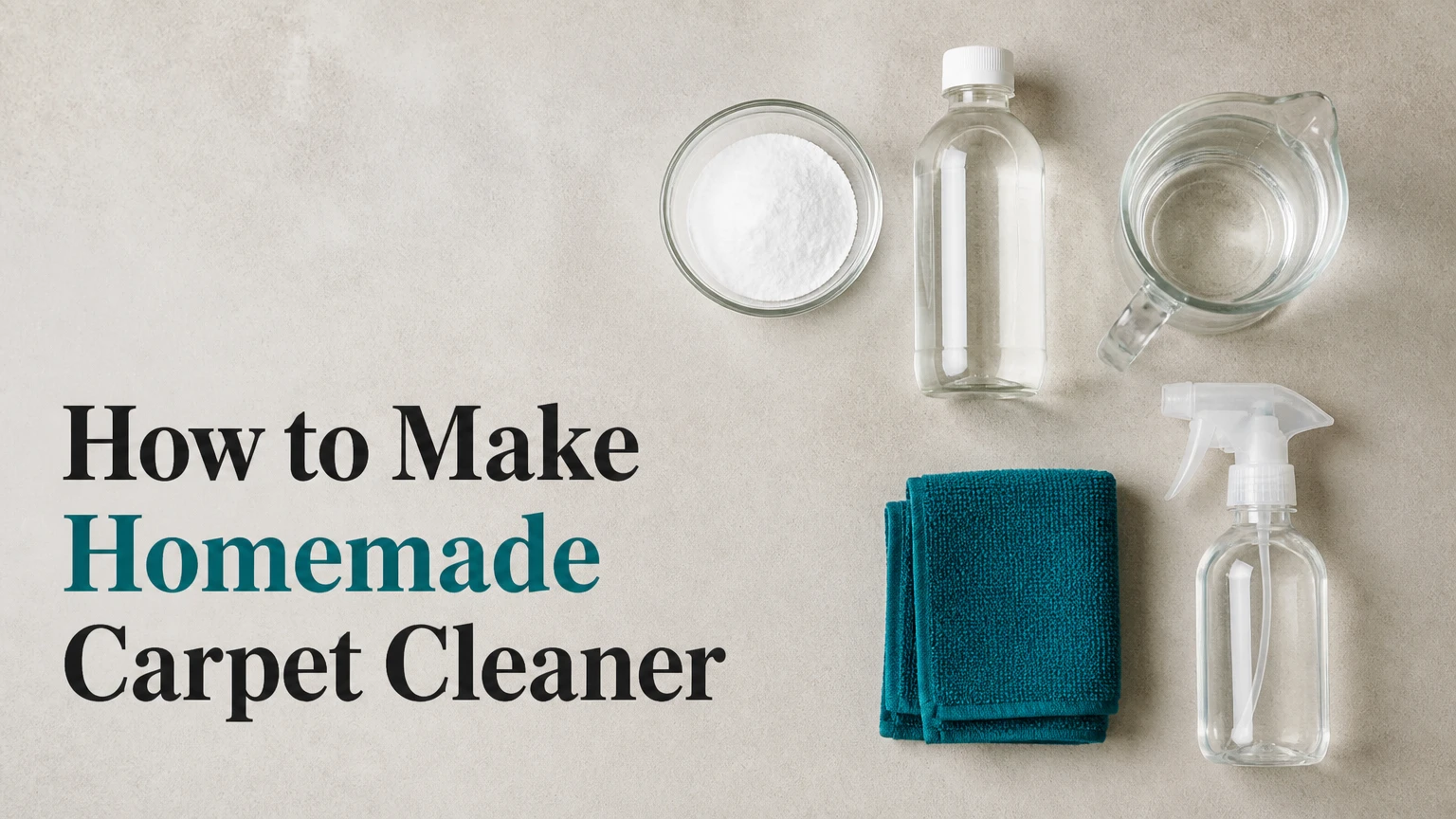
To make homemade carpet cleaner, combine 2 cups warm water, 1 tablespoon white vinegar, and 1 teaspoon clear dish detergent for a small spot-treatment batch. Vacuum first, patch-test the mixture, apply only enough to dampen the fibers, blot instead of scrubbing, rinse with plain water, and dry the carpet completely.
Key facts at a glance
- A basic homemade carpet spot cleaner uses 2 cups warm water, 1 tablespoon white vinegar, and 1 teaspoon clear dish detergent.
- Clear dish detergent lifts oily soil, while vinegar changes the solution’s acidity; neither ingredient replaces extraction for deeply contaminated padding.
- Baking soda deodorizes dry carpet surfaces, but it cannot remove urine salts, mold growth, or liquid trapped beneath the carpet.
- Three-percent hydrogen peroxide can lighten organic stains, but it may fade dyed carpet and requires a hidden-area test.
- Most hand-treated spots dry in 2-6 hours with towels and moving air; saturated carpet can require 12-24 hours.
- Never mix hydrogen peroxide with vinegar, chlorine bleach, ammonia, or other cleaners.
What homemade carpet cleaner can and cannot do
Homemade carpet cleaner is a diluted household solution used to loosen surface soil, remove small fresh stains, or reduce temporary odors. It works best on limited areas of synthetic carpet when the spill is recent and the carpet backing remains dry.
Homemade solutions are not universal disinfectants, deep-extraction formulas, or guaranteed color-safe treatments. A surface spray cannot reliably remove urine that has reached the pad, and a deodorizing powder cannot correct moisture damage beneath the carpet.
The Carpet and Rug Institute gives simple consumer guidance: “Blot, don’t rub.” That rule protects pile appearance because rubbing spreads liquid laterally, drives particles deeper, and can distort tufts. The Institute of Inspection Cleaning and Restoration Certification, through its S100 carpet-cleaning standard, also treats controlled moisture and residue removal as central parts of safe carpet cleaning.
How the ingredients work
| Ingredient | Primary function | Best target | Main limitation |
|---|---|---|---|
| Clear dish detergent | Surfactant that surrounds oily soil | Food grease, body oils, tracked soil | Excess leaves sticky residue |
| White vinegar | Mild acid that changes pH | Mineral film, some alkaline odors | Can affect dyes and natural fibers |
| Baking soda | Dry absorbent and odor modifier | Surface freshness, light oily residue | Does not extract deep contamination |
| 3% hydrogen peroxide | Oxidizing stain treatment | Blood, wine, juice, berries | Can fade or lighten dyed fibers |
| Warm water | Solvent and carrier | Water-soluble soil | Too much moisture damages backing |
What should you gather before cleaning?
A small stain treatment usually costs $0.25-$1.00 when household ingredients are already available and takes 10 minutes to prepare. You need a vacuum, two or more white absorbent towels, a measuring spoon, a spray bottle or bowl, and a fan.
Before you start
| Requirement | Typical specification | Why it matters |
|---|---|---|
| Preparation time | 5-10 minutes | Allows vacuuming and patch testing |
| Treatment time | 10-25 minutes | Includes application, dwell, blotting, and rinsing |
| Drying time | 2-6 hours for a small spot | Depends on airflow and humidity |
| Basic batch | 2 cups warm water, 1 tablespoon vinegar, 1 teaspoon detergent | Treats approximately 2-4 square feet |
| Tools | Vacuum, white towels, spoon, fan, gloves | Limits dye transfer and excess moisture |
| Prerequisite | Identify fiber and check care label | Prevents incompatible treatment |
Check the manufacturer’s care instructions before using any liquid. Nylon and polyester generally tolerate carefully diluted spot treatments, while wool, silk, viscose, jute, sisal, and antique rugs need fiber-specific guidance. Natural fibers can shrink, bleed, brown, or develop texture changes after wet cleaning.
How to make homemade carpet cleaner for common stains
The safest general formula is 2 cups warm water, 1 tablespoon white vinegar, and 1 teaspoon clear, dye-free dish detergent. Mix gently in a bowl rather than shaking a spray bottle, because excessive foam increases residue and makes dosage inconsistent.
Use the formula on fresh food spills, light tracked soil, and small marks on colorfast synthetic carpet. Do not store the diluted mixture for weeks. Make a small batch, label the bottle if you transfer it, and discard unused solution after several days because homemade mixtures have no preservative system.
Recipe options by cleaning task
| Cleaning task | Recipe quantity | Application time | Typical cost |
|---|---|---|---|
| Light soil spot spray | 2 cups warm water, 1 tablespoon vinegar, 1 teaspoon detergent | 5-minute dwell | $0.25-$0.75 |
| Greasy food stain | 2 cups warm water, 2 teaspoons detergent | 5-10-minute dwell | $0.10-$0.40 |
| Dry deodorizing powder | 1 cup baking soda, no liquid | 30-60 minutes | $0.15-$0.60 |
| Organic stain test | 1 cup 3% peroxide, 1 teaspoon detergent | 5-minute maximum test | $0.75-$2.00 |
| Plain-water rinse | 2 cups cool or lukewarm water | Immediate blotting | Under $0.05 |
Vinegar is not automatically the best treatment for every stain. Coffee and juice contain pigments that may remain after the acidic component changes the surrounding chemistry, while grease responds more directly to a surfactant. Match the formula to the material instead of adding every ingredient to one bottle.
Why should you not mix baking soda and vinegar?
Baking soda and vinegar neutralize each other rapidly, producing carbon dioxide, water, and a diluted salt solution. The visible fizz does not provide sustained cleaning power, and a sealed bottle can build pressure.
Apply baking soda only as a dry powder when you need surface deodorizing. Use a diluted vinegar solution separately when the carpet and fiber permit it, and never combine vinegar with hydrogen peroxide in the same container. That mixture can create irritating peracetic acid and should not be used as a household carpet formula.
How to clean a carpet stain with the homemade solution
A small carpet stain normally requires six controlled actions: remove solids, vacuum, test, apply sparingly, blot and rinse, then dry with airflow. The most important variable is moisture control, because a clean-looking surface can still develop wicking or odor if liquid reaches the backing.
Step 1: Remove solids and vacuum
Lift food, mud clumps, and pet material with a spoon or dull edge, then vacuum loose particles before adding liquid. Vacuuming prevents dry grit from becoming muddy paste and removes hair that would otherwise absorb the solution.
You will know the surface is ready when the visible debris is gone and the vacuum head moves without dragging particles across the mark. A common mistake is vacuuming wet material, which can spread contamination through the machine and drive it into the pile.
Step 2: Test for colorfastness
Apply one teaspoon of the mixed solution to a hidden section, such as beneath furniture or inside a closet edge. Press a white towel over the test area for 30 seconds, then inspect the towel and fibers after 10 minutes.
Proceed only if the towel shows no transferred dye and the carpet texture remains unchanged. A common mistake is testing only for immediate color loss; some dyes bleed after prolonged dampness, so inspect the test patch again when it dries.
Step 3: Apply a controlled amount
Mist the cleaner onto a white cloth or apply 1-2 teaspoons directly to a small spot measuring about 3 inches across. Work from the outer edge toward the center, and keep the carpet damp rather than wet.
You will know the dosage is controlled when the backing feels dry beneath the treated area. A common mistake is flooding the stain because more liquid appears to improve coverage; excess solution increases wicking, drying time, and residue.
Step 4: Allow a short dwell time
Leave the solution in contact with synthetic carpet for 5 minutes, then begin blotting. Grease may need 8-10 minutes, but do not let the area dry with detergent still present.
You will know the dwell time was adequate when the stain transfers more readily to the towel than it did before treatment. A common mistake is allowing an unknown mixture to sit for 30 minutes or longer, which increases dye and backing risk without guaranteeing better removal.
Step 5: Blot, rinse, and extract
Press a clean white towel straight down, hold it for 10-15 seconds, and repeat with dry sections until little moisture transfers. Follow with a cloth dampened in plain water, then blot again to remove detergent and vinegar residue.
You will know the rinse is sufficient when the fibers feel soft rather than slick or crunchy. A common mistake is skipping the rinse; dried detergent can attract soil and make the same area appear dirty again within days.
Step 6: Dry the carpet completely
Place folded dry towels over the spot and press them down with a flat, washable weight for 15-30 minutes. Remove the weight, raise the airflow with a fan, and keep people and pets off the area until it feels dry at the base.
You will know the carpet is dry when the pile and backing feel the same temperature and texture as nearby carpet. A common mistake is judging dryness only by the surface, because moisture can remain underneath and cause odor or browning.
Which homemade cleaner works for each stain?
Stain type determines the suitable first treatment more reliably than a general “natural” or “chemical-free” label. Use detergent for oil, water for water-soluble residue, an enzyme product for biological contamination, and cautious peroxide testing for some colored organic stains.
| Stain or soil | First choice | Quantity or setting | Avoid |
|---|---|---|---|
| Grease or butter | Clear detergent and water | 2 cups water plus 2 teaspoons detergent | Vinegar-only treatment |
| Coffee or tea | Plain water, then diluted detergent | 1 teaspoon solution per application | Hot water on unknown fibers |
| Red wine or berries | Blot, then 3% peroxide test | 1 teaspoon, 5-minute maximum | Peroxide on dark carpet without testing |
| Blood | Cool water, then peroxide test | Cool water first, 3% peroxide second | Warm or hot water |
| Wet mud | Dry completely, vacuum, then detergent | 5-minute dwell | Scrubbing wet grit |
| Pet urine | Absorb, rinse, enzyme cleaner | Repeat extraction may be needed | Vinegar as a complete urine treatment |
| Nail polish or paint | Solvent-specific professional advice | Varies by coating and fiber | Random household mixtures |
Pet urine needs a different approach
Baking soda and vinegar can reduce surface odor, but they do not reliably remove uric acid salts deposited in carpet padding. An enzymatic urine product designed for carpet is usually more appropriate because its biological ingredients target urine residues that household acids cannot fully extract.
Absorb fresh urine with towels, rinse with a small amount of cool water, and remove the rinse water immediately. If the odor returns after drying, the contamination likely extends below the pile. Repeatedly adding homemade liquid can enlarge the affected area.
What about hydrogen peroxide?
Three-percent hydrogen peroxide is an optional spot treatment for some light-colored synthetic carpets, especially after a small blood, wine, or berry spill. Apply a teaspoon to a tested area, wait up to 5 minutes, blot, and rinse with plain water.
Hydrogen peroxide is an oxidizer, not a universal carpet disinfectant. Sunlight, dye chemistry, fiber type, and dwell time affect fading, so dark nylon, wool, silk, viscose, and strongly dyed rugs carry higher risk. Never pour peroxide into a machine tank unless the machine and carpet manufacturer explicitly approve it.
Is homemade carpet cleaner safe for a carpet-cleaning machine?
Homemade carpet cleaner is generally unsuitable for a carpet extraction machine unless the machine manufacturer approves the formula. Dish detergent creates foam, baking soda can leave particulate residue, vinegar may affect seals or finishes, and an incorrect pH can damage fibers or void equipment guidance.
Use the manufacturer’s low-foam extraction detergent when operating a rental or household machine. If you use a homemade rinse by hand, keep the solution out of the recovery system and tank.
| Machine concern | Homemade ingredient | Possible consequence | Safer practice |
|---|---|---|---|
| Excess foam | Dish detergent | Recovery-tank overflow or pump stress | Use approved low-foam detergent |
| Particles | Baking soda | Filter or nozzle residue | Keep powders out of tanks |
| Acidity | Vinegar | Finish, dye, or seal compatibility issue | Follow machine label |
| Oxidation | Hydrogen peroxide | Dye change or material damage | Use only as a tested spot treatment |
| Over-wetting | Any water-based recipe | Wicking, odor, backing damage | Make slow passes and extract fully |
When is a machine or professional cleaner better?
A machine is more suitable for broad soil across a room because it distributes solution and recovers water more consistently than a spray bottle and towel. Professional treatment is the better choice for flooding, sewage, extensive pet urine, mold, large dye-transfer areas, or valuable natural-fiber rugs.
A homemade spot cleaner is not a substitute for removing the contaminated pad. If odor persists after one careful treatment and complete drying, stop adding chemicals and identify the depth of the problem.
What are the alternatives to homemade carpet cleaner?
Homemade cleaner costs less and can handle small fresh marks, but commercial products provide controlled pH, preservatives, instructions, and formulas designed for specific machines or stain categories. Enzyme cleaners offer a more targeted option for biological residues, while professional extraction provides better water recovery.
| Option | Typical cost | Best use | Main trade-off |
|---|---|---|---|
| Homemade spot mix | $0.25-$1 per batch | Small fresh synthetic-carpet stains | Variable pH and no preservative |
| Commercial spot cleaner | $5-$15 per 16-24 ounces | Repeated household stain care | Higher cost and possible fragrance |
| Enzyme urine cleaner | $8-$20 per 32 ounces | Pet urine and biological residue | Requires longer dwell and saturation control |
| Rental extractor | $30-$60 per day | One or more carpeted rooms | Heavy equipment and drying risk |
| Professional cleaning | $100-$300 for a small home | Deep soil, odor, or sensitive fibers | Appointment and service cost |
Prices are typical US household ranges and vary by region, product size, rental period, and room count. Ingredient cost alone does not measure total value: a failed treatment can create dye damage or require professional correction.
Common mistakes and how to fix them
The carpet becomes crunchy
Crunchy fibers usually indicate dried detergent or powder residue. Mist the area lightly with plain water, press with absorbent towels, and repeat once rather than soaking the carpet.
The stain reappears after drying
A returning mark is often wicking, where dissolved soil moves from the backing toward the tips as moisture evaporates. Re-treat with half the original liquid, rinse more thoroughly, and place weighted towels over the area during drying.
The stain spreads outward
Spreading usually results from excess solution or outward scrubbing. Stop applying cleaner, surround the mark with dry towels, and blot from the perimeter toward the center.
The carpet develops a brown edge
Browning can occur when natural-fiber cellulosic material or backing residues migrate during drying. Avoid repeated wet treatment, dry the area quickly with airflow, and consult a professional if the discoloration remains.
The carpet smells worse
A stronger odor after cleaning often means moisture has reached the pad or bacteria remain below the surface. Increase ventilation, verify complete drying, and use a carpet-specific enzyme treatment for urine rather than adding vinegar or fragrance.
The vacuum struggles after baking soda
Fine powder can load filters and reduce airflow, especially in bagless machines. Empty or clean the filter according to the vacuum manual, and use smaller amounts of baking soda less often.
How long does homemade carpet cleaner take to dry?
A lightly dampened hand-treated spot typically dries in 2-6 hours, while a heavily treated room can require 12-24 hours. High humidity, dense pile, foam pad, poor ventilation, and cold indoor temperatures extend drying time.
| Treatment area | Applied moisture | Airflow | Typical drying range |
|---|---|---|---|
| 3-inch spot | 1-2 teaspoons | Fan nearby | 1-3 hours |
| 1-square-foot spot | 1-3 tablespoons | Fan and open window | 2-6 hours |
| Small rug section | 1/4-1/2 cup | Elevated airflow | 4-12 hours |
| One cleaned room | 1-2 gallons through extraction | Two fans | 8-24 hours |
These are practitioner ranges, not guarantees. The carpet is ready for normal use when the backing is dry, no cool dampness remains, and the fibers do not feel stiff from residue.
How can you make homemade carpet cleaner safer?
Use the least aggressive formula that matches the stain, and reduce the amount of liquid before increasing chemical strength. Clear detergent and plain water are safer starting points than peroxide, solvents, or concentrated acids.
Follow these rules:
- Read the carpet, rug, and machine care labels.
- Patch-test every new mixture, including on supposedly colorfast synthetic carpet.
- Use white towels so dye transfer is visible.
- Keep children and pets away until the area is dry.
- Wear gloves when handling peroxide or contaminated pet-waste material.
- Label every bottle with its ingredients and preparation date.
- Never mix bleach, ammonia, vinegar, peroxide, or drain products.
- Avoid essential oils around cats and other sensitive pets.
- Store ingredients separately in their original containers.
- Dispose of towels used for feces, vomit, or sewage according to local sanitation guidance.
Natural ingredients are not automatically harmless. Vinegar can damage some dyes, peroxide can bleach fibers, and detergent residue can accelerate resoiling.
FAQ
Can I use laundry detergent as homemade carpet cleaner?
Laundry detergent is usually too concentrated and may contain brighteners, enzymes, fragrances, or dyes that leave residue or alter carpet color. Use a small amount of clear dish detergent for a hand-treated synthetic spot, or use a carpet detergent approved by the machine manufacturer for extraction cleaning.
Can I use hot water on carpet stains?
Use warm water for a mild detergent solution, but begin protein stains such as blood with cool water. Heat can set protein residues and may affect dyes, adhesives, or natural fibers. The carpet manufacturer’s care label takes priority over a general household recipe.
Does baking soda remove carpet odors overnight?
Baking soda can reduce a light surface odor after sitting for 30-60 minutes, but overnight use does not guarantee deeper odor removal. Vacuum thoroughly afterward, and treat urine, vomit, mildew, or damp-pad odors at their source with an appropriate enzyme or professional process.
Can vinegar damage carpet?
Vinegar can damage or discolor some wool, silk, viscose, jute, sisal, and dyed carpets, particularly when concentrated or left wet. Diluted vinegar is lower risk on many synthetic carpets, but a care-label review and hidden-area test are still required before application.
Should I use essential oils in carpet cleaner?
Essential oils are unnecessary for cleaning and may leave oily residue, create a new stain, or irritate people and animals. Cats are particularly sensitive to several essential oils. Use ventilation and source removal instead of fragrance when treating carpet odors.
When should I stop treating a carpet stain myself?
Stop after one careful treatment if the color changes, the backing becomes wet, the odor persists, or the stain covers more than a few square feet. Professional help is appropriate for flooding, sewage, mold, extensive urine, valuable rugs, and damage involving carpet adhesive or padding.
The Bottom Line
The most dependable homemade carpet cleaner for a small synthetic-carpet spot is 2 cups warm water, 1 tablespoon white vinegar, and 1 teaspoon clear dish detergent, applied sparingly after vacuuming and patch testing. Blot, rinse, and dry completely. For how to make homemade carpet cleaner safely, moisture control and fiber identification matter more than adding stronger ingredients.