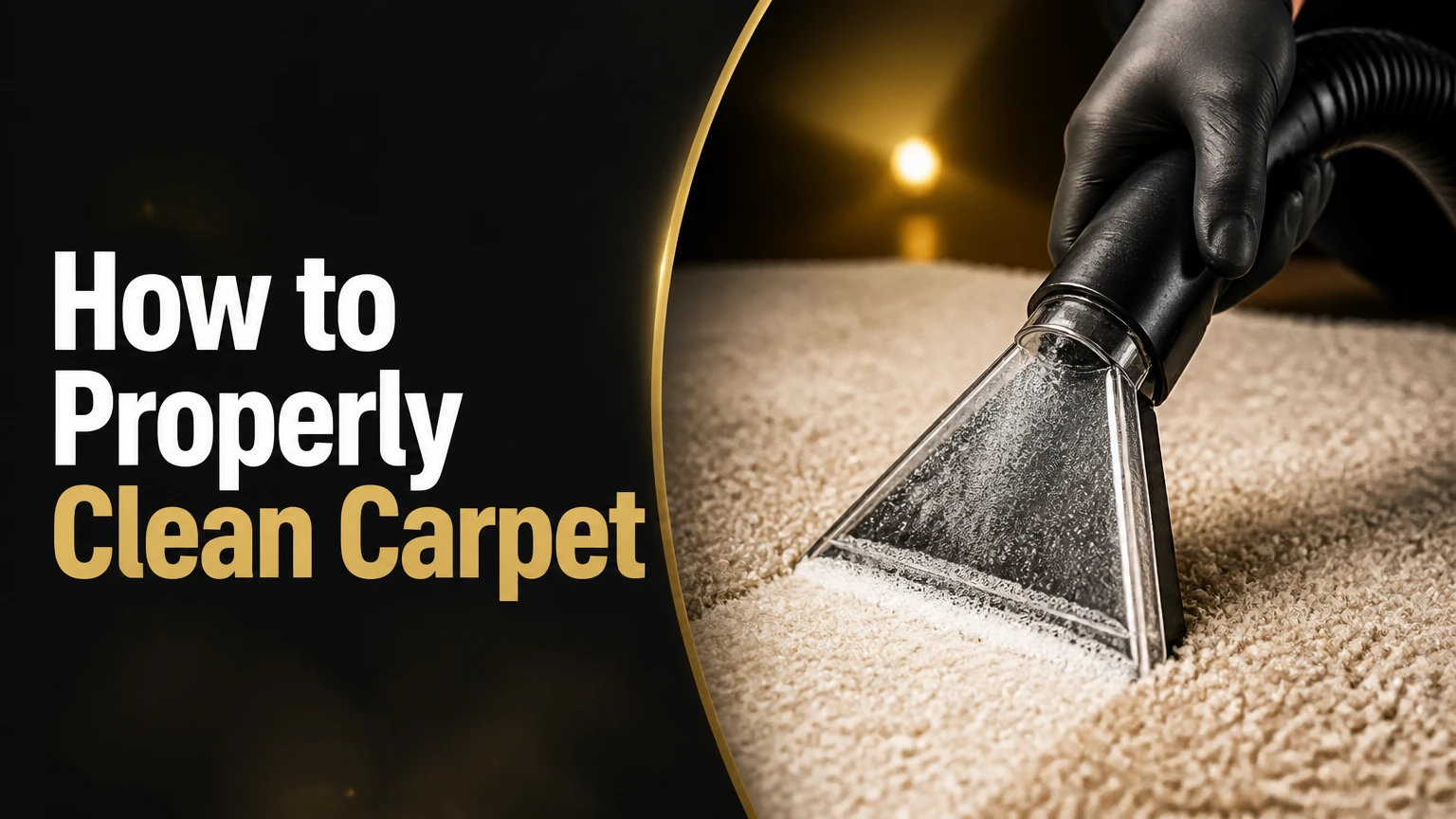
To properly clean carpet, remove dry grit first, test every solution, pre-treat soil, agitate gently, extract with minimal moisture, and dry the carpet rapidly. A typical room takes 45-90 minutes to clean and 6-12 hours to dry, but fiber type, humidity, carpet backing, and extraction quality determine the final result.
Key facts
- Vacuuming removes loose abrasive grit before moisture turns it into mud inside the pile.
- Hot-water extraction provides the deepest routine clean when the operator controls detergent, water, and drying.
- Carpet should dry completely within 12-24 hours; persistent dampness increases odor and microbial risk.
- Blotting is safer than rubbing because aggressive friction can spread stains and damage yarn tips.
- Cleaning chemicals must match the fiber, dye stability, backing, and stain chemistry.
- A professional is usually safer for wool, viscose, jute, severe urine contamination, flooding, and carpet with ripples.
What does carpet cleaning actually remove?
Carpet cleaning removes dry soil, oily film, food residue, particulate allergens, pet contamination, and stains from carpet fibers and backing. Routine cleaning also reduces abrasive particles that cut against yarn during foot traffic, which helps preserve texture and appearance.
Carpet soil has different forms. Sand and grit are abrasive particles. Cooking oils and body oils are non-polar soils that detergents help emulsify. Sugary drinks create sticky residue, while protein stains such as milk, blood, and urine require different chemistry. One product cannot safely solve every category.
The Carpet and Rug Institute summarizes the practical stain rule as “Blot, don’t rub.” That instruction matters because rubbing pushes liquid sideways and downward, while blotting transfers dissolved soil into a clean towel.
How the cleaning mechanism works
Effective carpet cleaning combines chemistry, heat, agitation, and extraction. Surfactants loosen oily films, warm solution reduces oil viscosity, controlled brushing separates soil from yarn, and vacuum recovery removes suspended soil with water.
The final stage is decisive. A detergent that loosens soil but remains in the carpet leaves a sticky film that can attract new dust. A machine that sprays heavily but recovers poorly can leave the backing wet even when the surface appears clean.
What should you do before cleaning carpet?
Before cleaning carpet, identify the fiber, inspect the backing, remove furniture, vacuum slowly, and perform a hidden colorfastness test. Read the carpet manufacturer’s care label first, because wool, viscose, cotton, jute, and some glued installations can react badly to ordinary alkaline detergents or excess water.
Before-you-start checklist
| Requirement | Typical specification | Why it matters |
|---|---|---|
| Preparation time | 20-40 minutes per room | Removes furniture and dry soil before wet work |
| Cleaning time | 45-90 minutes per 120-200 sq. ft. room | Includes pretreatment and extraction |
| Drying target | 6-12 hours in ventilated conditions | Limits odor and backing damage |
| Detergent quantity | Product label dilution only, often 30-120 ml per 4-5 L water | Prevents residue and re-soiling |
| Air movement | 1-2 floor fans plus ventilation | Increases evaporation from the pile |
| Basic tools | HEPA vacuum, white towels, soft brush, sprayer, extractor | Covers dry soil, spots, agitation, and recovery |
Do not clean over loose seams, exposed tack strips, swollen laminate, or known water damage. Photograph existing discoloration and ripples before starting, especially in a rental or furnished property.
Which tools and solutions are safe?
Use a vacuum with a beater bar on durable synthetic cut-pile carpet, but switch the brush off for delicate wool, loop pile, or manufacturer-restricted surfaces. Use white cotton or microfiber towels because colored cloth can transfer dye.
Use a labeled carpet detergent rather than dish soap. Dishwashing liquids can foam excessively and leave surfactant residue that household extractors cannot fully recover. Never combine bleach, ammonia, acidic rinse, peroxide, or solvent products unless the label specifically permits that combination.
Step-by-step: how to properly clean carpet
The safest home deep-cleaning process has seven stages: vacuum, inspect, pre-treat, spot-clean, agitate, extract, and dry. Plan for roughly 1-2 hours of active work plus 6-12 hours of restricted foot traffic, and use less solution than intuition suggests.
Step 1: Vacuum slowly in overlapping passes
Vacuum the room in two directions, moving at approximately 1-2 feet per second over heavily used paths. Make two slow passes over entrances, hallways, sofa fronts, and dining areas, then clean edges with a crevice attachment.
Empty the vacuum canister or replace the bag before cleaning. A full filter reduces airflow and leaves grit behind. Vacuum under removable furniture and collect coins, clips, pet toys, and other objects that could damage an extractor.
You’ll know it worked when: the carpet feels less gritty under a clean hand and the vacuum collects visible dust before any liquid is added.
Common mistake: vacuuming quickly once across the room. Fast passes leave heavy particles between yarn bundles.
Step 2: Inspect fibers, stains, and colorfastness
Check the care label and identify whether the carpet is nylon, polyester, polypropylene, wool, cotton, viscose, or a blend. Inspect seams, backing, glued areas, and previous repairs before applying moisture.
Mix the cleaning solution at the label dilution. Apply one teaspoon to a hidden corner, cover it with a white towel for 30 seconds, and inspect the towel and fibers for dye transfer, texture change, or browning.
You’ll know it worked when: the towel remains free of transferred color and the treated section dries without a darker ring.
Common mistake: testing only for color loss while ignoring texture. Some fibers do not bleed but become stiff, fuzzy, or distorted.
Step 3: Pre-treat traffic lanes and oily soil
Apply a ready-to-use carpet pre-spray lightly and evenly, typically 5-10 ml per square metre unless the label specifies otherwise. Keep the spray on the fiber surface, not the baseboard or wood floor, and allow 5-10 minutes of dwell time without letting the area dry.
Pretreatment breaks the bond between oily soil and yarn. Wool and natural fibers require neutral or fiber-approved products; synthetic carpet often tolerates a broader pH range, but the label still controls dilution.
You’ll know it worked when: traffic lanes look uniformly damp, not saturated, and soil begins to release when touched with a soft brush.
Common mistake: soaking the carpet to compensate for weak detergent. Excess water increases drying time without improving chemistry.
Step 4: Treat spots according to stain chemistry
Blot fresh liquid with folded white towels until transfer decreases. Work from the outside edge toward the center, using small amounts of product so the stain does not spread into a larger wet ring.
Use an enzyme cleaner for fresh protein-based pet contamination only when the label approves carpet use. Use a solvent-based product for some oily stains, but provide ventilation, avoid ignition sources, and test first. Avoid hot water on blood, because heat can set protein.
| Stain or soil | First treatment | Typical contact time | Important limitation |
|---|---|---|---|
| Coffee or tea | Cool water, then labeled tannin remover | 3-5 minutes | Heat can deepen some tannin marks |
| Grease or cooking oil | Carpet-safe solvent or alkaline pre-spray | 5-10 minutes | Do not flood backing |
| Blood or milk | Cool water and protein-safe product | 2-5 minutes | Avoid hot water and aggressive rubbing |
| Pet urine | Absorb, enzyme product, controlled extraction | 10-15 minutes | Padding may require professional treatment |
| Wax or gum | Harden with ice, lift gently | 5-15 minutes | Never cut pile with a knife |
| Ink or dye | Specialist solvent after testing | Label-directed | Bleeding can become permanent |
You’ll know it worked when: the towel removes color or soil without enlarging the affected area.
Common mistake: applying several chemicals consecutively. Residual products can react, create rings, or make later professional treatment harder.
Step 5: Agitate gently and evenly
Use a soft carpet brush or a carpet machine’s approved brush setting. Work in the direction of the pile on cut pile, and use reduced pressure on loop pile so loops do not snag or fuzz.
Agitation distributes pretreatment and loosens soil mechanically. It should move the solution through the upper pile, not scrub it into the backing.
You’ll know it worked when: the pile looks evenly groomed and loosened soil appears on the towel or in the recovery tank.
Common mistake: using a stiff household brush. Hard bristles can untwist yarn, pull loops, and create a lighter-looking patch.
Step 6: Extract with controlled passes
Fill the extractor with correctly diluted solution and make one slow wet pass, followed by two or three slower dry passes. Keep the machine moving whenever the spray trigger is active, and overlap neighboring passes by roughly 2-3 inches.
Use the minimum water volume that produces soil transfer. Do not repeatedly wet a stain that has stopped releasing; further flushing can drive contamination into the pad.
The recovery tank should contain visibly dirty water after a soiled room. Clear recovery water does not prove the carpet is clean, because some soil remains bonded or was never dissolved.
You’ll know it worked when: the carpet is damp but not squishy, no water pools at seams, and a folded white towel pressed down for 10 seconds shows limited transfer.
Common mistake: walking slowly while spraying continuously. That creates overwetting, especially with compact rental machines.
Step 7: Groom, ventilate, and verify drying
Groom the pile with a carpet rake if the manufacturer permits it. Place one or two fans so air crosses the carpet surface, open windows only when outside air is drier, and use air conditioning or a dehumidifier in humid weather.
Lift furniture onto foil tabs or plastic blocks until the carpet is dry. Keep pets and children off damp carpet because oils, dirt, and paw pressure can flatten the pile and cause rapid re-soiling.
You’ll know it worked when: the carpet feels dry at the surface and base, smells neutral, and does not leave moisture on a white towel after 30 seconds of pressure.
Common mistake: judging dryness by the surface alone. Padding can remain wet after the pile feels dry.
Which carpet-cleaning method should you choose?
Hot-water extraction is generally the best restorative method for heavily soiled synthetic carpet when rapid drying is possible. Low-moisture encapsulation or dry compound cleaning is more suitable when downtime must be short, while bonnet cleaning is mainly a surface-maintenance method for commercial floors.
| Method | Typical moisture and equipment | Active time and drying | Best use and limitation |
|---|---|---|---|
| Hot-water extraction | 65-110°C solution, professional systems often 200-500 PSI | 1-2 hours, usually 6-12 hours drying | Deep soil and allergens; overwetting risk |
| Dry compound cleaning | Absorbent compound, counter-rotating brush or manual agitation | 30-45 minutes, often immediately walkable | Low moisture; limited deep grease removal |
| Encapsulation | Polymer detergent, rotary or cylindrical agitation | 45-60 minutes, about 1-2 hours before vacuuming | Commercial maintenance; needs thorough post-vacuuming |
| Bonnet cleaning | Damp absorbent pad, rotary machine around 150-175 RPM | 30-45 minutes, about 1-3 hours drying | Fast surface appearance; can distort loops and leave soil below |
“Steam cleaning” usually means hot-water extraction, not dry steam. Actual machine temperature, pressure, spray rate, and recovery performance vary substantially, so published figures such as 65-110°C and 200-500 PSI are operating ranges rather than universal requirements.
Hot water does not automatically sterilize carpet. Contact time, temperature at the fiber, detergent chemistry, and extraction determine microbial reduction, and ordinary household machines should not be marketed as disinfection systems.
When is dry or low-moisture cleaning better?
Low-moisture cleaning is better for offices, humid rooms, delicate installations approved by the manufacturer, and situations where carpet must return to service within a few hours. Encapsulation polymers dry into brittle crystals that routine vacuuming can remove, reducing sticky residue when the product is correctly diluted.
Low-moisture methods are not ideal for saturated padding, severe pet urine, flood contamination, or grease embedded deeply below the pile. They improve appearance efficiently but may not flush dissolved contamination from the backing.
How much does carpet cleaning cost and how long does it take?
Typical professional carpet cleaning costs vary by region, room size, furniture, access, stain severity, and method. A common planning range is about $75-$200 for one residential room, with whole-home jobs often priced at $150-$500; local quotes can differ sharply.
| Job type | Typical price range | Typical service time | Typical drying or access time |
|---|---|---|---|
| One residential room | $75-$200 | 45-90 minutes | 6-12 hours |
| Two to three rooms | $150-$350 | 1.5-3 hours | 6-12 hours |
| Whole-home service | $150-$500 | 2-5 hours | 8-24 hours |
| Low-moisture commercial maintenance | $0.10-$0.35 per sq. ft. | 30-60 minutes per area | 1-3 hours |
These are typical planning figures, not fixed market prices. Stairs, urine treatment, moving furniture, deodorizer, rural travel, and minimum service charges can add $25-$150 or more.
A rental extractor can cost approximately $30-$60 per day, excluding detergent, transport, and damage risk. Professional equipment usually extracts more water because it has stronger vacuum recovery, which often matters more than spray temperature.
Which carpet fibers need different treatment?
Nylon and polypropylene usually tolerate routine extraction when the detergent and heat follow the manufacturer’s instructions. Wool, viscose, jute, silk blends, and cotton-backed rugs need lower moisture, gentler chemistry, and more careful drying.
| Fiber or construction | Common characteristic | Safer approach | Avoid |
|---|---|---|---|
| Nylon | Durable, resilient, stain-resistant with treatment | Controlled extraction and moderate agitation | Excessive heat or alkaline residue |
| Polyester | Hydrophobic, may hold oily soil | Thorough pretreatment and extraction | Assuming water alone removes grease |
| Polypropylene | Moisture-resistant, can show oily traffic lanes | Low-moisture or controlled extraction | Aggressive brushing and high heat |
| Wool | Absorbent, protein fiber, can felt or brown | Wool-approved neutral product and low moisture | High alkalinity, strong heat, soaking |
| Viscose | Weakens when wet, prone to distortion | Specialist professional cleaning | DIY extraction and vigorous agitation |
| Jute or sisal | Natural plant fiber, browns when wet | Dry methods or specialist service | Saturation and slow drying |
Wool carpet should not automatically be assigned to dry cleaning. A trained cleaner may use a carefully controlled low-moisture or extraction process, but the correct decision depends on construction, dye stability, backing, and warranty instructions.
What are the most common cleaning mistakes?
The most damaging carpet-cleaning mistake is excessive moisture, not insufficient scrubbing. Wet backing can cause browning, delamination, odor, dye migration, wood-floor damage, and rippling, while aggressive scrubbing mainly damages the visible yarn.
Overwetting the backing
Reduce spray volume, increase dry passes, and use fans immediately. If the carpet remains wet after 24 hours, has a sour odor, or feels wet beneath the pile, contact a professional who can measure moisture and inspect the pad.
Leaving detergent residue
Rinse with the extractor’s approved clear-water process when the product permits it, then perform additional dry passes. Do not pour vinegar into a machine unless the manufacturer explicitly allows it, because acidic solutions can damage components and do not reliably remove all detergent.
Rubbing a stain
Blot, lift, and repeat with a clean towel. Rubbing can fuzz synthetic yarn, untwist cut pile, pull loops, and enlarge the visible mark even when the original contaminant has been removed.
Skipping a patch test
Test colorfastness and texture in a hidden area, then let the sample dry fully. Wet color can appear stable while drying reveals bleeding or a permanent ring.
Using baking soda for odor
Baking soda can absorb a small amount of surface odor, but it cannot neutralize urine salts deep in carpet padding. Excess powder can also load vacuum filters and leave alkaline residue.
Mixing household chemicals
Never combine bleach with ammonia or acidic products. Chemical reactions can release hazardous gases, while incompatible carpet products can create bleaching, browning, or sticky residue.
Why do stains return after carpet dries?
Returning stains usually result from wicking, where dissolved soil in the backing moves upward as moisture evaporates. Browning can also occur when natural backing materials migrate alkaline discoloration toward the surface during slow drying.
Lightly dampen the affected area with the manufacturer-approved rinse, place a white towel over it, apply weight for several minutes, and dry rapidly with moving air. Avoid repeatedly soaking the spot because each cycle can draw more backing soil upward.
Professional treatment is appropriate when the stain returns three or more times, covers a large area, or involves urine in the pad. A technician may need to treat or replace contaminated padding rather than clean only the carpet face.
How do you remove pet urine odor?
Pet urine odor requires absorption, enzymatic treatment, controlled dwell time, and removal of contamination from the pad when urine has penetrated below the carpet. Surface deodorizer alone cannot solve a large or old urine deposit.
Use a moisture meter or ultraviolet inspection only as a locating aid, not as proof of contamination. Apply a carpet-safe enzyme product according to its label, keep the area wet for the stated dwell time, then extract without flooding adjacent flooring.
Never use ammonia-based cleaners on urine. Ammonia-like odor can encourage repeat marking, and strong fragrances can conceal rather than remove the contamination.
How often should carpet be cleaned?
Most homes benefit from vacuuming high-use areas at least twice weekly and professional or machine deep cleaning every 6-18 months. Homes with pets, children, allergies, or muddy entrances may need spot treatment immediately and deep cleaning every 6-12 months.
| Situation | Vacuuming pattern | Deep-cleaning interval | Priority adjustment |
|---|---|---|---|
| One or two adults, shoes removed | 1-2 times weekly | 12-18 months | Clean entrances sooner |
| Children or indoor pets | 2-4 times weekly | 6-12 months | Treat accidents immediately |
| Allergy-sensitive household | HEPA vacuum 2-4 times weekly | 6-12 months | Control moisture and dust reservoirs |
| Commercial office | Daily traffic lanes, weekly full vacuum | Encapsulation monthly, extraction 6-12 months | Schedule around closure |
| Wool or delicate carpet | Gentle frequent vacuuming | Specialist inspection-led schedule | Follow fiber warranty |
More frequent cleaning is not automatically safer. Repeated high-moisture treatment can shorten carpet life if extraction and drying are poor.
Should you clean carpet yourself or hire a professional?
DIY cleaning suits a small, lightly to moderately soiled synthetic room with accessible flooring, stable color, and adequate ventilation. Professional cleaning is the safer choice for delicate fibers, extensive staining, wet padding, mold suspicion, floodwater, rippling, or a carpet warranty that requires approved care.
Ask a professional for the method, detergent type, estimated drying time, insurance, furniture-moving policy, and treatment plan for stains. Avoid providers who guarantee sterilization, promise every stain will disappear, or quote a very low price before inspecting fiber and soil conditions.
A reliable operator should identify the carpet fiber, test a hidden area, measure the solution rather than guessing, protect adjacent flooring, and explain what the service cannot correct. Permanent dye loss, melted fibers, backing failure, and old chemical damage may remain after cleaning.
FAQ
Can vinegar clean carpet safely?
Vinegar can alter the pH of some residues, but it is not a universal carpet cleaner or disinfectant. Undiluted vinegar can affect dyes, natural fibers, backing, and machine components. Use a labeled carpet rinse or spot product instead, and test any acidic solution in an inconspicuous area first.
Is carpet shampoo better than hot-water extraction?
Carpet shampoo is not inherently better than hot-water extraction. Shampoo can loosen surface soil, but insufficient rinsing leaves detergent behind; hot-water extraction generally removes more dissolved soil when the machine recovers water effectively. Low-moisture encapsulation may be preferable when rapid access matters more than maximum restorative depth.
How long should you stay off freshly cleaned carpet?
Stay off freshly cleaned carpet until it is dry throughout, usually 6-12 hours under normal ventilation. Keep heavy furniture, children, and pets away longer if the pile or pad remains cool and damp. Walking on wet carpet transfers soil and can flatten the pile.
Can a carpet cleaner remove every old stain?
A carpet cleaner cannot remove every old stain. Bleach damage, permanent dye transfer, rust, fiber loss, melted yarn, and stains that chemically altered the fiber may be irreversible. A professional can often improve appearance, but the realistic outcome depends on stain age, chemistry, depth, and prior treatments.
Does carpet cleaning cause mold?
Carpet cleaning does not normally cause mold when the carpet and pad dry promptly. Mold risk rises when water remains trapped for more than 24-48 hours, flooding has contaminated the pad, or ventilation is poor. Persistent musty odor, visible growth, or wet subflooring requires professional moisture and contamination assessment.
The Bottom Line
To properly clean carpet, remove dry grit first, use a fiber-approved solution, give pretreatment time to work, agitate without force, extract with repeated dry passes, and verify that the backing dries within 12-24 hours. Hot-water extraction is usually the deepest routine option for synthetic carpet, while low-moisture methods reduce downtime. When carpet is wool, viscose, rippled, flooded, or contaminated through the padding, professional cleaning is the safer decision.