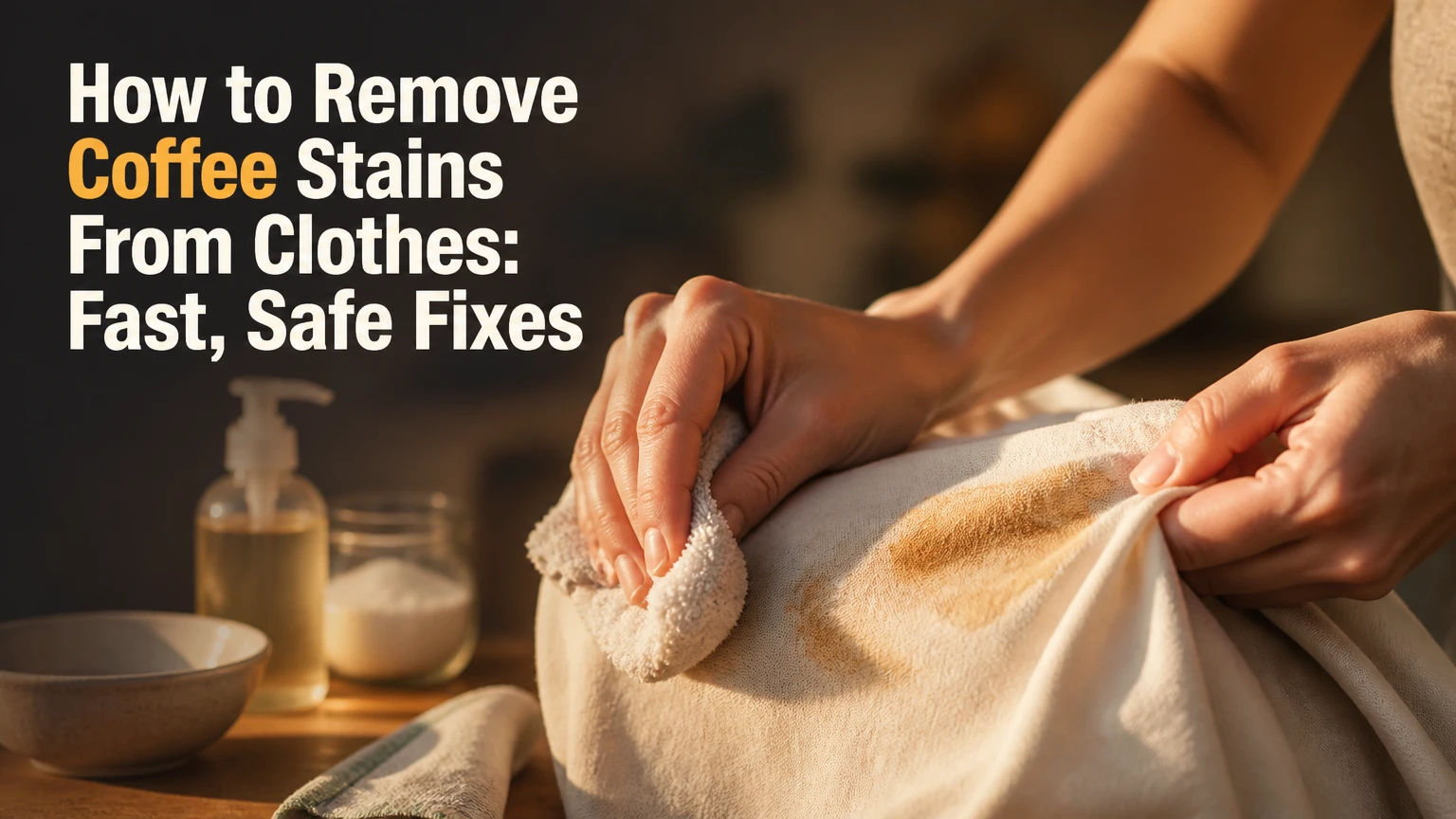
To remove coffee stains from clothes, blot the spill, rinse cold water through the back of the fabric, apply liquid laundry detergent, wait 5-15 minutes, and wash using the warmest care-label-safe cycle. Inspect the garment before drying, because dryer or iron heat can permanently set any remaining coffee pigment.
Key Facts at a Glance
- Fresh coffee stains usually respond to cold-water rinsing and liquid detergent within 15 minutes.
- Coffee tannins create the brown color; milk and cream add proteins and oils that need surfactants or enzymes.
- Rubbing spreads liquid coffee across fibers and can force pigment deeper into the weave.
- Oxygen bleach can treat many white and colorfast garments, but the product label controls the dose and soaking time.
- Wool, silk, rayon, acetate, and dry-clean-only garments need a fiber-safe approach rather than an aggressive soak.
- A garment is not ready for the dryer until the stain has disappeared under bright light.
Why Coffee Stains Hold to Fabric
Coffee stains are mainly plant-based tannin deposits held in water-soluble residue, while milk, cream, sugar, and flavored syrups add fats, proteins, and sticky solids. Black coffee generally needs rinsing and surfactant cleaning; a latte or sweetened coffee needs extra attention because its non-coffee ingredients can leave a ring after the brown color fades.
Coffee is a liquid, so the first spill often penetrates along the yarn rather than sitting on top. Cotton and linen absorb it quickly through their cellulose fibers. Polyester absorbs less water but can retain oily cream residues on its surface. Wool and silk are protein fibers, so strong alkaline products, enzymes, prolonged soaking, and oxidizers can damage them even when they remove the stain.
Water removes the mobile portion of the spill. A detergent surfactant then surrounds oily particles and helps carry them away during rinsing and washing. Enzymatic products are relevant when milk or cream proteins remain, while oxygen bleach can oxidize residual brown color on suitable fabrics.
What determines the difficulty?
| Stain condition | Main residue | Typical first treatment | Typical total time |
|---|---|---|---|
| Fresh black coffee | Tannins and water-soluble solids | Cold reverse-side rinse plus detergent | 5-20 minutes |
| Fresh coffee with milk | Tannins, proteins, and fats | Rinse plus liquid detergent | 15-30 minutes |
| Coffee with heavy cream | Tannins and concentrated oils | Detergent or tiny dish-soap application | 20-40 minutes |
| Dried black coffee | Oxidized tannin residue | Detergent pre-treatment and repeat wash | 30-90 minutes |
| Dried milk coffee | Tannins, proteins, and fats | Enzyme-compatible detergent or remover | 30 minutes to overnight |
| Heat-set coffee mark | Chemically altered pigment | Oxygen bleach if fiber and color permit | 1-6 hours |
Before You Start
Prepare the garment according to its care label, because the label sets the safe washing temperature, bleaching options, and drying method. You need absorbent towels, cold running water, liquid laundry detergent, and a soft toothbrush or clean cloth; oxygen bleach is an optional escalation product for compatible items.
Before-treatment checklist
| Item | Typical amount | Purpose | Important limit |
|---|---|---|---|
| Paper towel or white cloth | 2-4 pieces | Blot excess coffee | Avoid colored towels that can transfer dye |
| Cold tap water | 250-500 milliliters | Flush soluble residue | Use gentle flow on fragile fabric |
| Liquid laundry detergent | 1-2 teaspoons | Lift tannins, oils, and soil | Use less on a small spot |
| Soft toothbrush | 1 | Gentle fiber agitation | Do not scrub silk, wool, or loose knits |
| Oxygen bleach | Label dose | Oxidize persistent color | Test colorfastness first |
| Clean white towel | 1 | Place beneath the stain | Prevents transfer to the garment underside |
Check the fiber content before applying anything. A washable cotton T-shirt can tolerate more manipulation than a silk blouse, wool sweater, acetate lining, or garment marked “dry clean only.”
How to Remove Coffee Stains From Clothes
The safest general method has seven actions: blot, flush from behind, apply detergent, work gently, wait, wash, and inspect before drying. Treating a fresh coffee spill takes about 5 minutes of active work and 15-30 minutes including dwell time, while dried or cream-heavy marks may require two treatment cycles.
Step 1: Blot the fresh spill
Press a white paper towel or cloth onto the coffee stain for 10-20 seconds, lift it, and repeat with a clean section until little liquid transfers. Do not rub, because lateral friction expands the wet boundary and pushes coffee between the fibers.
If coffee has soaked through the garment, place a dry towel beneath the mark. Replace the towel when it becomes damp so the coffee does not wick back into the fabric.
You will know it worked when: the stain looks lighter and the towel picks up moisture without creating a larger wet ring.
Common mistake: rubbing from the outside toward the center. That motion spreads the stain and can roughen cotton, wool, or brushed fabric.
Step 2: Flush cold water through the back
Hold the stained area face down under a gentle stream of cold or cool tap water for 30-60 seconds. Back-side flushing pushes coffee out of the fabric instead of driving it farther through the garment.
Avoid a powerful jet on silk, lace, open knits, or loosely woven linen. Use a cup of cool water and repeated pours when the fabric is fragile or the stain sits near a seam.
You will know it worked when: the runoff becomes nearly clear and the brown edge stops expanding.
Common mistake: rinsing from the front first. Front-side pressure can move the pigment toward the visible surface and surrounding fibers.
Step 3: Apply liquid laundry detergent
Place 1-2 teaspoons of liquid laundry detergent on a stain approximately the size of a coin. For a larger shirt-front spill, use enough detergent to cover the mark in a thin film rather than pouring a large puddle onto the fabric.
Liquid detergent contains surfactants that help suspend coffee oils and loosen pigment-bearing soil. A detergent labeled for colors is usually the safer choice for dyed clothing than a whitening formula.
You will know it worked when: the detergent wets the entire mark without leaving dry brown islands.
Common mistake: using powdered detergent directly on a small wet stain. Undissolved powder can leave a pale residue and requires more rinsing.
Step 4: Agitate the fibers gently
Massage the detergent from the outer edge toward the center with clean fingers for 15-30 seconds. On sturdy cotton or polyester, use a soft toothbrush with short strokes; avoid vigorous brushing, especially on wool, silk, rayon, velvet, and printed surfaces.
A small stain benefits from controlled agitation, not force. Excess pressure can spread dissolved coffee and produce a fuzzy patch that remains visible after the color is gone.
You will know it worked when: the brown color breaks into a lighter, diffuse area and the fabric texture remains unchanged.
Common mistake: combining several cleaners during agitation. Multiple products increase residue and can create unwanted chemical reactions.
Step 5: Let the detergent work
Leave the pre-treatment on the stain for 5-15 minutes. Use up to 30 minutes for a dried mark if the care label permits, but do not allow detergent to dry hard on the fabric.
For milk, cream, or protein-rich coffee, an enzyme-containing laundry detergent may improve soil removal. Enzymes work under the temperature and time conditions stated on the product label; prolonged exposure is not automatically more effective.
You will know it worked when: the stain remains moist and visibly lighter before washing.
Common mistake: leaving a product overnight without checking its instructions. Extended contact can alter dyes, finishes, or delicate fibers.
Step 6: Wash on the warmest safe cycle
Wash the garment according to its care label, using the warmest permitted water that will not shrink, bleed, or damage the fabric. For cotton, the label may permit warm water; for wool, silk, and many synthetics, a cool delicate cycle is safer.
Use the normal detergent dose for the load. Adding extra detergent does not guarantee better stain removal, and excess product can trap soil in fabric or leave a stiff residue.
You will know it worked when: the garment looks clean while still wet, with no brown halo under strong light.
Common mistake: washing a single coffee-stained garment with a load of heavily dyed items before checking colorfastness.
Step 7: Inspect before drying
Hold the damp garment near a window or bright white light and inspect both sides, seams, cuffs, and the area beyond the original spill. If any beige or brown shadow remains, repeat the detergent treatment before using a dryer, iron, radiator, or heated drying rack.
Dry heat can make residual organic color more difficult to remove. One unsuccessful wash does not mean the garment is ruined, but repeated heat exposure reduces the chance of complete removal.
You will know it worked when: no visible color remains after the fabric dries naturally.
Common mistake: relying on the dim light of a laundry room. Wet fabric can hide a faint ring that becomes obvious after drying.
Which Treatment Works Best for Each Coffee Stain?
Liquid laundry detergent is the best default for most washable clothing because it addresses both soluble coffee residue and oily additions without the risks of strong bleach. Vinegar can help with odor and mineral residue, but it is not a replacement for detergent; oxygen bleach is the stronger option for persistent color on white or colorfast washable fabric.
| Treatment | Best use | Typical cost per use | Contact time | Main restriction |
|---|---|---|---|---|
| Cold water | Fresh black coffee | $0 | 30-60 seconds | May not remove dried or oily residue |
| Liquid laundry detergent | Most washable garments | $0.05-$0.30 | 5-15 minutes | Rinse excess product thoroughly |
| Enzyme detergent or spray | Milk, cream, and dried protein residue | $0.20-$1.50 | 10-30 minutes | Check wool, silk, and fiber warnings |
| Diluted white vinegar | Odor or mineral residue after washing | $0.05-$0.25 | 5-10 minutes | Do not mix with chlorine bleach |
| Oxygen bleach | Persistent marks on white or colorfast fabric | $0.25-$1.00 | 1-6 hours | Follow label; avoid wool and silk |
| Chlorine bleach | Some white cotton garments only | $0.10-$0.50 | Product-specific | Can yellow, weaken, or discolor fabric |
Is vinegar better than detergent?
Vinegar is not generally better than liquid laundry detergent for coffee stains. White vinegar contains acetic acid, which may reduce odor and help with mineral deposits, but it does not provide the same surfactant action as detergent against cream oils and embedded soil.
If you use vinegar, dilute it according to a conservative household-cleaning ratio, apply it briefly after a water rinse, and rinse again before washing. Never combine vinegar with chlorine bleach because the mixture can release irritating chlorine gas.
Should you use baking soda?
Baking soda can provide mild alkalinity and odor control, but dry baking soda is not a dependable primary treatment for a coffee mark. Mixing baking soda with vinegar mostly produces carbon dioxide, water, and a diluted salt solution, so the visible fizz does not indicate superior stain removal.
For a washable garment, detergent is the more targeted first choice. Baking soda may be added to a full wash only if the clothing label and detergent instructions permit it, but it should not replace stain pre-treatment.
How Do You Remove Dried Coffee Stains?
Dried coffee stains need rehydration before cleaning, so soak the mark in cool water for 10-20 minutes, apply liquid detergent for 15-30 minutes, and wash without heat drying. Repeat once if necessary; use oxygen bleach only after checking the fiber, dye, and product label.
Gently loosen a dried crust with the edge of a spoon or a soft cloth. Do not scrape aggressively, since abrasion can create a permanent shiny patch on smooth fabric.
After soaking, press out excess water and apply detergent to both sides if the stain has penetrated the garment. A soft toothbrush is appropriate for sturdy cotton or polyester, while fingers are safer for delicate weaves.
A dried milk-coffee stain may respond better to an enzyme detergent because proteins can remain attached after the water evaporates. Enzyme products are not interchangeable with bleach, and the label may prohibit use on wool, silk, leather, or certain finishes.
How Do You Remove Coffee With Milk, Cream, or Sugar?
Coffee with milk or cream needs detergent that can lift fats, while milk proteins may respond to an enzyme detergent. Sugar usually dissolves during rinsing, but syrup-based flavorings can leave a sticky residue that requires a second detergent application.
For a fresh oily ring, rinse from behind, apply liquid laundry detergent, and wait 10-15 minutes. A drop of grease-cutting dish soap can help on sturdy, washable polyester or cotton, but test it first because some dish soaps contain dyes, fragrances, or additives that leave a halo.
Do not use dish soap as a routine substitute for laundry detergent in the washing machine. Excess suds can overflow, and the formula may not rinse cleanly from clothing.
| Coffee addition | Residue to target | Preferred product | Extra precaution |
|---|---|---|---|
| Whole milk | Protein and moderate fat | Enzyme laundry detergent | Avoid high heat before treatment |
| Heavy cream | Concentrated fat | Liquid detergent, then tiny dish-soap spot treatment | Rinse thoroughly |
| Sugar | Soluble sticky solids | Cool water plus laundry detergent | Check for a remaining tacky feel |
| Flavored syrup | Sugar, oils, and coloring | Detergent pre-treatment | Repeat if colored syrup remains |
| Plant milk | Variable oils and proteins | Liquid detergent | Read the product ingredients when choosing enzymes |
How Do You Treat White and Colored Clothes?
White cotton can tolerate oxygen-bleach treatment when the care label permits it, while colored clothing requires a hidden-area colorfastness test before any oxidizer is used. Dark dyes, unstable prints, and garment finishes can fade even when the base fabric appears washable.
Mix oxygen bleach only at the package-specified concentration. A universal instruction such as “one cup in a bucket” is unsafe because products vary substantially in strength, and excess oxidizer can damage fibers or finishes.
Dissolve the product fully before adding the garment. Soak for the label’s stated duration, commonly 1-6 hours, then rinse and wash. Do not combine oxygen bleach with chlorine bleach, ammonia, vinegar, or other cleaners unless the manufacturer explicitly says the combination is safe.
For colored garments, use a hidden hem test for 5-10 minutes, rinse, and blot the test area with a white cloth. Color transfer indicates that the garment should not receive the proposed treatment.
What Changes for Wool, Silk, and Dry-Clean-Only Clothing?
Wool, silk, acetate, and dry-clean-only clothing should receive minimal water and friction, with professional cleaning preferred when the stain is large, old, or close to a structured seam. Avoid oxygen bleach, chlorine bleach, strong alkaline powders, enzyme products, and prolonged soaking unless the care label specifically permits them.
For a small fresh mark on washable silk, blot immediately and dab with cool water from the outside inward using a white cloth. Stop if the fabric develops a water ring, color change, stiffness, or surface distortion.
Wool can felt when exposed to heat, agitation, and moisture together. Blotting and careful local rinsing may be safer than brushing, but a tailored coat, lined jacket, or valuable sweater should go to a cleaner.
Dry-clean-only clothing should not be machine washed after a coffee spill. Blot the liquid, identify the stain as coffee and disclose any milk, cream, sugar, or cleaning product used when taking the garment to a professional.
What If the Coffee Stain Was Heated?
A heat-set coffee stain can still improve, but the garment may need repeated detergent treatment or a carefully controlled oxygen-bleach soak. Do not apply more heat to “dry the treatment,” because heat does not remove the pigment and may increase its bond to the fibers.
First, identify the fiber and care label. For washable cotton or colorfast polyester, apply detergent for 20-30 minutes, wash, and inspect. If the mark remains, use label-approved oxygen bleach at the stated concentration.
A yellow-brown mark after washing often means residual coffee pigment remains, not that the garment needs chlorine bleach. Oxygen bleach is generally the more appropriate escalation for compatible whites and colors, while chlorine bleach can yellow some fabrics and weaken cellulose fibers.
Common Mistakes and How to Fix Them
| Mistake | Why it fails | Recovery action | Safe limit |
|---|---|---|---|
| Rubbing immediately | Spreads coffee and roughens fibers | Rinse from the back, then apply detergent | Use gentle fingertip pressure |
| Using hot water first | Can make milk protein residue harder to remove | Cool-rinse, detergent-treat, then label-safe wash | Avoid heat until inspection |
| Drying before inspection | Heat can set remaining pigment | Re-wet and retreat before further drying | Air-dry during repeated attempts |
| Pouring bleach directly on fabric | Creates concentrated fading or fiber damage | Rinse immediately with abundant water | Use only diluted label directions |
| Mixing vinegar and bleach | Can release chlorine gas | Leave the area and ventilate if mixed | Never combine them |
| Overusing dish soap | Leaves suds and residue | Rinse thoroughly, then wash normally | Reserve for small oily spots |
| Scrubbing delicate fabric | Causes distortion or felting | Stop agitation and blot gently | Professional cleaning may be needed |
One practitioner rule is especially reliable: remove moisture first, chemistry second, heat last. A dry towel can remove more stain mass before treatment than an aggressive cleaner can remove after the coffee has spread.
Another useful rule is to treat the visible halo, not only the darkest center. Coffee travels outward through capillary action, so detergent applied only to the center can leave a circular edge after drying.
A third rule concerns repetition. Two mild treatment cycles are usually safer than one aggressive cycle because fading, abrasion, and chemical damage become more likely as product strength and contact time increase.
How Much Time and Money Does Removal Take?
Fresh coffee removal usually costs less than $0.30 in detergent and takes 5-20 minutes, while a commercial enzyme spray or oxygen-bleach soak can cost $0.25-$1.50 per treatment and take 1-6 hours. Professional dry cleaning commonly costs more and varies by garment, city, lining, and stain complexity.
| Scenario | Active work | Waiting or soaking | Typical household cost |
|---|---|---|---|
| Fresh black coffee | 3-5 minutes | 5-15 minutes | $0-$0.30 |
| Fresh latte on cotton | 5-8 minutes | 10-30 minutes | $0.10-$0.50 |
| Dried coffee on a shirt | 8-12 minutes | 20-60 minutes | $0.10-$1.50 |
| White cotton after heat exposure | 10-15 minutes | 1-6 hours | $0.25-$1.00 |
| Silk blouse, professional cleaning | 2-5 minutes blotting | Cleaner schedule | Typically $8-$30 |
| Wool coat, professional cleaning | 2-5 minutes blotting | Cleaner schedule | Typically $15-$50 |
These are typical household ranges, not fixed retail prices. Local currency, detergent concentration, garment size, and product packaging change the per-use cost.
What Should You Carry for Coffee Spills on the Go?
A portable kit should contain two white absorbent tissues, a small water bottle, and a stain pen labeled for the garment type. On the move, blot first, dilute the edge with a few drops of water, and apply the pen sparingly according to its instructions.
A stain pen is useful for reducing a fresh mark until the garment can be washed. It is not a complete substitute for laundering, and some pens can leave a visible ring or affect unstable dyes.
Do not saturate a suit jacket, silk blouse, leather trim, or structured garment in a public restroom. Blot excess coffee, record what spilled, and tell the cleaner exactly which product touched the fabric.
The Bottom Line
To remove coffee stains from clothes, blot immediately, flush cool water through the back, apply liquid laundry detergent for 5-15 minutes, wash on the warmest safe cycle, and inspect before drying. Use enzyme detergent for milk or cream residue, oxygen bleach for persistent marks on compatible fabric, and professional cleaning for delicate or dry-clean-only garments.
Frequently Asked Questions
Can cold water remove a coffee stain completely?
Cold water can remove much of a fresh black coffee spill, especially when the garment is rinsed from the reverse side within several minutes. Cold water alone is less reliable for dried coffee, cream oils, or stains that have already been machine washed, so liquid detergent usually provides the necessary second stage.
Does salt remove coffee stains from clothing?
Salt is not a dependable coffee-stain remover because it does not provide the surfactants needed to suspend oils or the oxidizing action needed for persistent pigment. Blotting, reverse-side rinsing, and liquid laundry detergent are more targeted and less likely to leave gritty residue in the fabric.
Can hydrogen peroxide remove coffee from a white shirt?
Hydrogen peroxide can lighten some organic stains on white fabric, but it may damage dyes, finishes, and fibers when used at excessive strength or for too long. Oxygen bleach formulated for laundry offers clearer dosage instructions; always test a hidden area and follow the garment and product labels.
How do you remove coffee from jeans?
Blot the jeans, rinse the stain from the back with cool water, apply liquid detergent for 10-15 minutes, and wash inside out according to the denim care label. Avoid chlorine bleach, which can create a pale patch, and inspect the jeans before tumble drying.
Will coffee stains come out of polyester?
Most fresh coffee stains come out of polyester with cool water and liquid laundry detergent because polyester does not absorb water as readily as cotton. Cream or flavored syrup may leave an oily ring, which needs longer detergent contact or a carefully tested small amount of dish soap.
When should a coffee-stained garment go to a cleaner?
Use a professional cleaner when the garment is labeled dry clean only, contains silk or wool, has a lining or tailored structure, carries a valuable finish, or developed a large stain after heat exposure. Report the coffee ingredients and every product already applied so the cleaner can choose a compatible process.