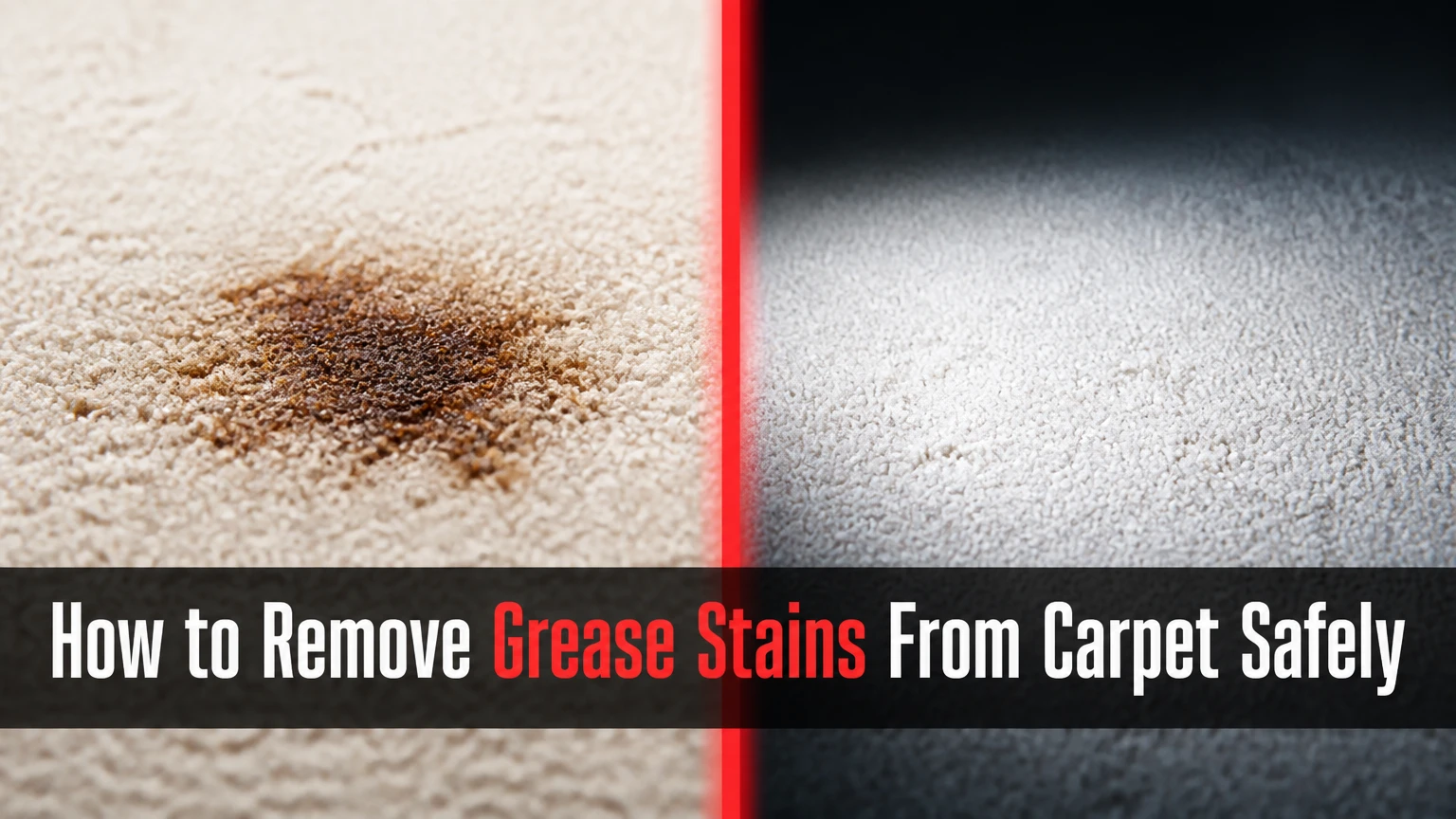
To remove grease stains from carpet, first lift excess oil without rubbing, then cover the spot with an absorbent powder and vacuum it. Follow with a small amount of clear dish soap diluted in warm water, blotting from the outside inward, rinsing lightly, and drying completely. Fresh stains usually respond best.
Key Facts at a Glance
- Grease stains need absorption and emulsification because water alone does not dissolve oil.
- A fresh cooking-oil spot often takes 20-40 minutes of active treatment and 4-12 hours to dry.
- Clear dish soap is usually safer for synthetic carpet than rubbing alcohol, acetone, or strong degreasers.
- Wool carpet, viscose, silk, and antique rugs require gentler treatment and often professional cleaning.
- Enzyme cleaners are designed mainly for protein and organic residues, so they are not automatically the best choice for grease.
- The most important rule is the Carpet and Rug Institute’s consumer guidance: “Blot, don’t rub.”
Which Method Should You Use?
The best method depends on the grease type, carpet fiber, stain age, and whether the spot has reached the backing. Use absorbent powder followed by diluted dish soap for fresh food grease, a labeled carpet degreaser for stubborn petroleum residue, and professional extraction for large, old, or deeply saturated stains.
Grease is an oil-based soil. Cooking oil, butter, salad dressing, automotive lubricant, cosmetic balm, and petroleum jelly can all cling to carpet fibers, but they do not respond identically. Polyester and nylon attract oily materials more readily than wool, while natural fibers can be damaged by excessive water, alkaline cleaners, or solvents.
Do not begin with a large volume of water. Water can move loose grease sideways and leave a wide, pale ring after drying. The safest sequence is controlled removal: scrape solids, absorb liquid oil, dissolve the remaining film, transfer it into a white cloth, rinse away cleaner, and dry the carpet rapidly.
| Stain situation | First-choice treatment | Typical active time | Main limitation |
|---|---|---|---|
| Fresh cooking oil, under 2 hours old | Cornstarch or baking soda, then dish soap | 20-40 minutes | May need a second cycle |
| Butter or margarine | Scrape, absorbent powder, dish soap | 30-60 minutes | Solid fat can reach the backing |
| Motor oil or chain lubricant | Carpet-safe solvent or degreaser | 30-90 minutes | Solvent can affect dyes or backing |
| Candle wax or crayon | Low-temperature transfer method | 10-25 minutes | Heat can melt synthetic fibers |
| Old, dark, set-in grease | Repeated low-moisture treatment or extraction | 1-3 hours | Complete removal is less predictable |
| Wool or viscose rug | Label-approved cleaner or rug specialist | Varies | Fiber damage can be permanent |
What Should You Do Before Cleaning?
Before cleaning a carpet grease stain, remove solid material, identify the fiber if possible, and test every cleaner in a hidden area. Gather two white absorbent cloths, a spoon or dull knife, a vacuum, cornstarch or baking soda, clear dish soap, lukewarm water, and a small bowl.
Before You Start
| Requirement | Recommended value |
|---|---|
| Active treatment time | 20-60 minutes for a small fresh spot |
| Drying time | 4-12 hours, longer in humid rooms |
| Difficulty | Moderate |
| Typical household cost | $1-$8 or local equivalent |
| Dish-soap mixture | 1 teaspoon in 2 cups of lukewarm water |
| Powder quantity | 1-2 tablespoons per 10-centimeter spot |
| Cloth type | White cotton or microfiber, no printed dye |
| Test area | Hidden carpet edge, 5-minute observation |
Ventilate the room, keep children and pets away from wet carpet, and read the carpet manufacturer’s care instructions. If the carpet is wool, viscose, silk, seagrass, or an expensive hand-tufted rug, stop at dry absorption unless the label specifically permits water-based spot cleaning.
How Do You Remove Fresh Grease Step by Step?
Fresh grease comes out most reliably when the cleaner removes oil in stages rather than flooding the carpet. Complete the following six steps, using minimal moisture and changing to a clean cloth section whenever oil transfers onto the fabric.
Step 1: Scrape Away Solid Grease
Lift butter, shortening, wax, or hardened food grease with a spoon or dull butter knife. Hold the tool nearly parallel to the carpet and push toward the center so the solid does not spread across adjacent tufts.
Do not use a sharp blade. A blade can cut pile yarn and expose a lighter backing line.
You will know this step worked when no raised chunks remain and the carpet pile still lies in its original direction. The common mistake is pressing downward while scraping, which drives softened fat toward the backing.
Step 2: Blot Liquid Oil
Place a white paper towel or folded white cloth over the spot and press straight down for 5-10 seconds. Lift, move to a clean section, and repeat until the towel stops picking up a translucent oil mark.
Never scrub in circles. Scrubbing bends the pile, spreads the stain, and can push oil below the visible surface.
You will know the blotting stage is complete when the surface looks matte rather than glossy. The common mistake is using a colored kitchen towel, because solvent and detergent can transfer its dye into pale carpet.
Step 3: Apply an Absorbent Powder
Cover the stain with 1-2 tablespoons of cornstarch, baking soda, or unscented talc for a spot about 10 centimeters wide. Use enough powder to form a visible, dry layer without burying surrounding carpet.
Cornstarch is generally the better oil absorbent. Baking soda can help with odor and surface oil, but it does not chemically dissolve grease and should not be treated as a complete cleaner.
Leave the powder for 15-30 minutes. For a larger or wetter spot, use a second application rather than a thick mound that becomes difficult to vacuum.
You will know the powder has worked when it forms slightly darker or clumped areas. Vacuum slowly in two directions, keeping the vacuum nozzle from grinding powder into the pile. The common mistake is leaving powder under the carpet fibers, where moisture can create a paste.
Step 4: Emulsify the Remaining Film
Mix 1 teaspoon of clear, grease-cutting dish soap with 2 cups of lukewarm water. Dip a white cloth into the solution, wring it almost dry, and dab the stain from the outer edge toward the center.
Dish soap contains surfactants that surround oil droplets and help suspend them in water. The solution must be dilute because excess detergent leaves a sticky film that attracts soil.
Work in 5-centimeter sections. Press the cloth down for several seconds, lift, inspect the cloth, and rotate to a clean area. Do not pour the mixture directly onto carpet.
You will know the emulsification stage is working when the cloth shows a faint tan or oily transfer and the carpet loses its dark sheen. The common mistake is applying more soap when the real problem is incomplete transfer to the cloth.
Step 5: Rinse Without Flooding
Dampen a second white cloth with plain water and wring it thoroughly. Press the cloth over the treated area twice, using a dry section after each pass, to remove detergent residue without saturating the backing.
A clean-water rinse matters because leftover surfactant can cause rapid resoiling. It can also create a stiff patch that looks like a returning stain.
You will know the rinse is sufficient when the carpet feels neither slippery nor tacky and the cloth no longer picks up visible suds. The common mistake is rinsing with a cup of water, which can carry dissolved grease into the underlay.
Step 6: Dry and Inspect
Fold several dry towels over the spot and press for 30-60 seconds. Replace wet towels, then leave a fresh towel over the area with a light, flat weight for 1-2 hours.
Increase airflow with a fan positioned nearby, not directly against the carpet pile. Keep the area uncovered afterward until fully dry, which typically takes 4-12 hours.
You will know the treatment succeeded when the dried pile matches the surrounding color and no oily odor remains. Inspect in daylight, because wet carpet often appears darker than it will after drying.
Which Grease Removal Methods Compare Best?
Dish soap is the safest first-line method for fresh household grease on most synthetic carpet. Solvents work faster on some petroleum stains but carry greater risks, while heat transfer is appropriate mainly for solid wax-like residue and commercial products vary greatly by formulation.
| Method | Best material | Typical quantity or setting | Main risk |
|---|---|---|---|
| Cornstarch absorption | Fresh cooking oil | 1-2 tablespoons, 15-30 minutes | Does not remove bonded residue |
| Diluted dish soap | Food grease on nylon or polyester | 1 teaspoon in 2 cups water | Resoiling if not rinsed |
| Isopropyl alcohol | Small petroleum or cosmetic spot | Cloth dampened with 70% alcohol | Dye loss or backing damage |
| Carpet degreaser | Old automotive or industrial oil | Label-directed application | Strong odor or residue |
| Brown paper and iron | Candle wax or crayon | Low heat, 5-second presses | Melted synthetic fibers |
| Hot-water extraction | Deep, broad contamination | Professional machine | Overwetting and wicking |
When Is Rubbing Alcohol Appropriate?
Rubbing alcohol is a secondary option for a small, stubborn petroleum or cosmetic stain on colorfast synthetic carpet, not a universal grease remover. Apply 70% isopropyl alcohol to a white cloth, never directly to the floor, and dab until the oily transfer stops.
Patch-test first and ventilate the room. Avoid alcohol on wool, viscose, acetate, unknown fibers, latex-backed rugs, and carpet with loose or deteriorated backing.
Alcohol can dissolve or mobilize some oils, but it may also affect carpet dye, adhesive, latex, or backing materials. The area should remain only lightly damp. If the carpet backing feels loose, the color changes, or the solvent smell persists, stop and use a professional cleaner.
Should You Use an Iron and Brown Paper?
Use the brown-paper method only for wax, crayon, or a solid grease deposit that can be transferred with low heat. Place plain unprinted brown paper or a white cotton towel over the spot, set the iron to its lowest dry setting, and press for about 5 seconds at a time.
Check the paper after every press and move to a clean section as oil transfers. Never leave the iron stationary.
This method is unsafe for many synthetic carpets because nylon and polyester can soften, flatten, or melt under heat. A household iron can also create a permanent shiny patch. For valuable rugs or unknown fibers, scrape and absorb instead.
How Do You Treat Old or Set-In Grease?
Old grease stains need repeated small applications, not one aggressive soaking. Remove surface soil, apply an absorbent powder, use a carpet-labeled degreaser according to its label, blot or extract the dissolved oil, and allow complete drying before deciding whether another cycle is necessary.
An old stain may have migrated into the carpet backing or pad. A visible dark spot can therefore persist even after the surface fibers are clean. A rental extractor may improve the result, but excessive water can create wicking and leave the pad damp for more than 24 hours.
Enzyme cleaners deserve a specific qualification. Enzymes target materials such as proteins, starches, and other biological residues; they are not automatically effective against pure cooking oil or petroleum lubricant. Choose a product labeled for grease, oil, or carpet spot removal rather than relying on the word “enzyme.”
| Stain age and depth | Recommended sequence | Expected result |
|---|---|---|
| Under 15 minutes, surface-only | Blot, powder, dish soap, rinse | Often substantial removal in one cycle |
| 15 minutes to 24 hours | Two powder cycles, then detergent | Usually requires 30-90 minutes |
| More than 24 hours | Product test, degreaser, extraction | Partial to strong improvement |
| Dark spot across multiple tufts | Professional inspection | Backing or pad may be contaminated |
| Repeated spot after drying | Re-treatment plus deeper extraction | Residue or wicking likely |
No responsible cleaner can guarantee complete removal from an unknown carpet. Heat, age, previous bleach exposure, and permanent dye alteration may make the discoloration irreversible even when the grease itself is gone.
How Does Carpet Fiber Change the Treatment?
Carpet fiber determines which chemicals and moisture levels are acceptable. Nylon and polyester usually tolerate cautious water-based spot cleaning, while wool needs a near-neutral, wool-approved product and viscose can distort or brown when wetted.
| Carpet type | Safer first action | Avoid | Professional threshold |
|---|---|---|---|
| Nylon | Powder, dilute dish soap, blot rinse | High heat and bleach | Stain reaches backing |
| Polyester | Powder, dilute detergent | Strong solvents and heat | Color changes during test |
| Wool | Dry absorbent powder, WoolSafe product | Alkaline degreasers and flooding | Any large or dark oil stain |
| Viscose or rayon | Dry blotting only | Water, scrubbing, steam | Almost any visible liquid stain |
| Olefin | Powder and controlled detergent | Heat and oily residue left behind | Broad greasy traffic area |
| Silk or antique rug | Isolate and call a specialist | DIY solvent or water | Immediate professional advice |
Wool fibers can hold oil while retaining a natural surface feel, so aggressive degreasing may remove protective finish or alter texture. Viscose is especially unforgiving: water can cause rings, distortion, color migration, or browning.
Always locate a flooring sample, manufacturer label, or spare offcut if available. A hidden test should dry fully before approval, because color change may appear only after evaporation.
What Alternatives Can Replace Dish Soap?
A labeled carpet spot cleaner or low-residue carpet degreaser can replace dish soap when the product specifically identifies oil or grease as a target soil. Cornstarch can replace baking soda for absorption, but no dry powder alone reliably removes old grease bound to carpet fibers.
Avoid ammonia, chlorine bleach, acetone, paint thinner, gasoline, and undiluted household degreasers. These products can damage dyes, dissolve backing adhesives, create hazardous vapors, or leave residues that are difficult to extract.
White vinegar is also a poor first choice for grease. Vinegar is acidic and useful for some mineral or odor problems, but it does not provide the same oil-emulsifying action as a suitable surfactant. Mixing cleaning chemicals creates additional risk without improving grease removal.
What Mistakes Make Grease Stains Worse?
The most damaging mistakes are aggressive scrubbing, excessive water, repeated soap application, and untested solvents. Correct the process by reducing moisture, increasing transfer into clean cloths, and allowing the carpet to dry before judging the result.
- Scrubbing spreads the oil. Stop rubbing, scrape remaining solids, and restart with dry blotting.
- Flooding creates a larger ring. Press with dry towels, improve airflow, and avoid another wet treatment until the area dries.
- Soap residue causes rapid resoiling. Rinse with a barely damp cloth, then absorb the rinse water.
- A colored cloth transfers dye. Stop immediately and blot with plain water if the transferred color is still mobile.
- A solvent changes the color. Do not add another chemical. Dry the area and contact a carpet technician.
- Powder remains in the pile. Vacuum in multiple directions, then use a soft brush to release trapped granules.
A counterintuitive practitioner rule is that a slightly under-treated grease spot is safer than an over-wet carpet. A second controlled cycle can remove more oil, but drying damage, backing delamination, or dye loss may be permanent.
Why Did the Stain Come Back After Drying?
A grease stain that reappears after drying usually indicates wicking, residual detergent, or oil remaining in the backing and pad. As moisture evaporates, dissolved soil can travel upward through carpet fibers and recreate the visible mark.
Wait until the carpet is fully dry, then vacuum and inspect the perimeter. If the center remains oily, repeat the powder stage before using any additional liquid. If the entire spot returns as a broad ring, the contamination probably extends below the pile.
Weighted towels can improve surface transfer, but they cannot extract a saturated pad. Professional hot-water extraction or controlled low-moisture cleaning may be needed for a large spill, especially when the carpet has a glued secondary backing.
How Much Time and Money Does Treatment Require?
A small fresh grease stain typically costs $1-$8 to treat at home and takes 20-60 minutes of active work, followed by 4-12 hours of drying. Professional room or spot cleaning commonly costs about $30-$100 or more, depending on region, access, room size, fiber, and contamination depth.
These are typical planning ranges, not fixed prices. A technician may charge a minimum service call, while a localized stain may be included in whole-room cleaning.
| Treatment option | Typical cost | Active time | Drying or return time |
|---|---|---|---|
| Household powder and dish soap | $1-$8 | 20-60 minutes | 4-12 hours |
| Consumer carpet spray | $5-$20 | 20-45 minutes | 2-8 hours |
| Rental extractor | $30-$60 per day | 1-3 hours | 8-24 hours |
| Professional spot treatment | $50-$150 typical minimum | 30-90 minutes | 4-12 hours |
| Professional room cleaning | $30-$100+ per room | 1-3 hours | 6-24 hours |
| Rug specialist for wool or viscose | $75-$250+ | Not applicable | Several days |
The largest cost variable is not stain age alone. Fiber type, backing construction, affected area, and whether oil reached the pad usually determine the required service.
When Should You Call a Professional?
Call a professional carpet cleaner when grease covers more than about 0.1 square meter, has soaked through to the pad, involves wool or viscose, came from machinery, or remains after two careful treatment cycles. Professional equipment can recover dissolved oil more effectively than repeated household wetting.
Choose a technician who identifies the fiber, tests for dye stability, explains the cleaning method, and uses appropriate extraction or low-moisture equipment. For rugs, look for a specialist familiar with WoolSafe procedures or the rug’s specific construction.
Do not delay when motor oil, hydraulic fluid, or unknown industrial chemicals are involved. Petroleum products can carry additives that leave odor and may damage backing materials beyond the visible stain.
How Do You Prevent Another Carpet Grease Stain?
Prevent grease stains by placing washable mats near cooking and maintenance areas, keeping oily containers off carpet, and cleaning spills before they migrate into the pile. A carpet protector may improve future spot release, but it will not prevent oil from soaking into an unprotected spill area.
Use a tray under indoor automotive work, remove greasy shoes before crossing carpet, and keep food preparation away from carpeted floors. Vacuuming removes dry soil, not bonded oil, so prevention must address the spill source.
Do not apply a carpet protector over an existing grease stain. Residual oil can become harder to remove and may interfere with product bonding.
Frequently Asked Questions
Can baking soda remove a grease stain from carpet overnight?
Baking soda can absorb some surface oil when left for 15-30 minutes, but overnight exposure does not turn it into a solvent. Vacuum the powder thoroughly, then use a dilute surfactant solution if the carpet fiber and manufacturer instructions permit wet cleaning.
Is Dawn safe for every carpet?
Clear dish soap is often suitable for small spots on colorfast nylon or polyester when diluted to about 1 teaspoon in 2 cups of water. Dawn or another detergent is not automatically safe for wool, viscose, silk, antique rugs, or carpets with unstable dyes, so test first and rinse residue away.
How do you remove grease from carpet without water?
Blot the oil, cover it with cornstarch or another suitable absorbent powder for 15-30 minutes, then vacuum slowly. Dry-cleaning compounds or a labeled dry carpet product can help, but old grease bonded to the backing usually needs controlled solvent or professional extraction.
Can steam cleaning remove grease from carpet?
Steam or hot-water extraction can remove grease after a suitable pre-treatment, but heat and water alone may spread oil or drive it into the pad. Professional extraction is safer for broad contamination because the operator can control detergent, pressure, recovery, and drying.
How do you remove a greasy smell after cleaning?
Remove remaining oil and detergent first, because fragrance only masks the source. After the carpet dries completely, vacuum it and ventilate the room; persistent odor usually means grease remains in the backing or pad and needs deeper extraction.
Will carpet insurance or a rental deposit cover grease damage?
Coverage depends on the policy, lease, and whether the damage is classified as accidental or maintenance-related. Photograph the stain before treatment, keep receipts, and avoid aggressive chemicals that could make the original damage worse or complicate a landlord’s inspection.
The Bottom Line
How to remove grease stains from carpet safely is a controlled sequence: scrape solids, blot excess oil, absorb the surface residue, emulsify with a small amount of diluted dish soap, rinse lightly, and dry completely. Use solvents only after a colorfastness test, avoid heat on synthetic fibers, and call a professional when oil reaches the backing, pad, wool, viscose, or a large area.