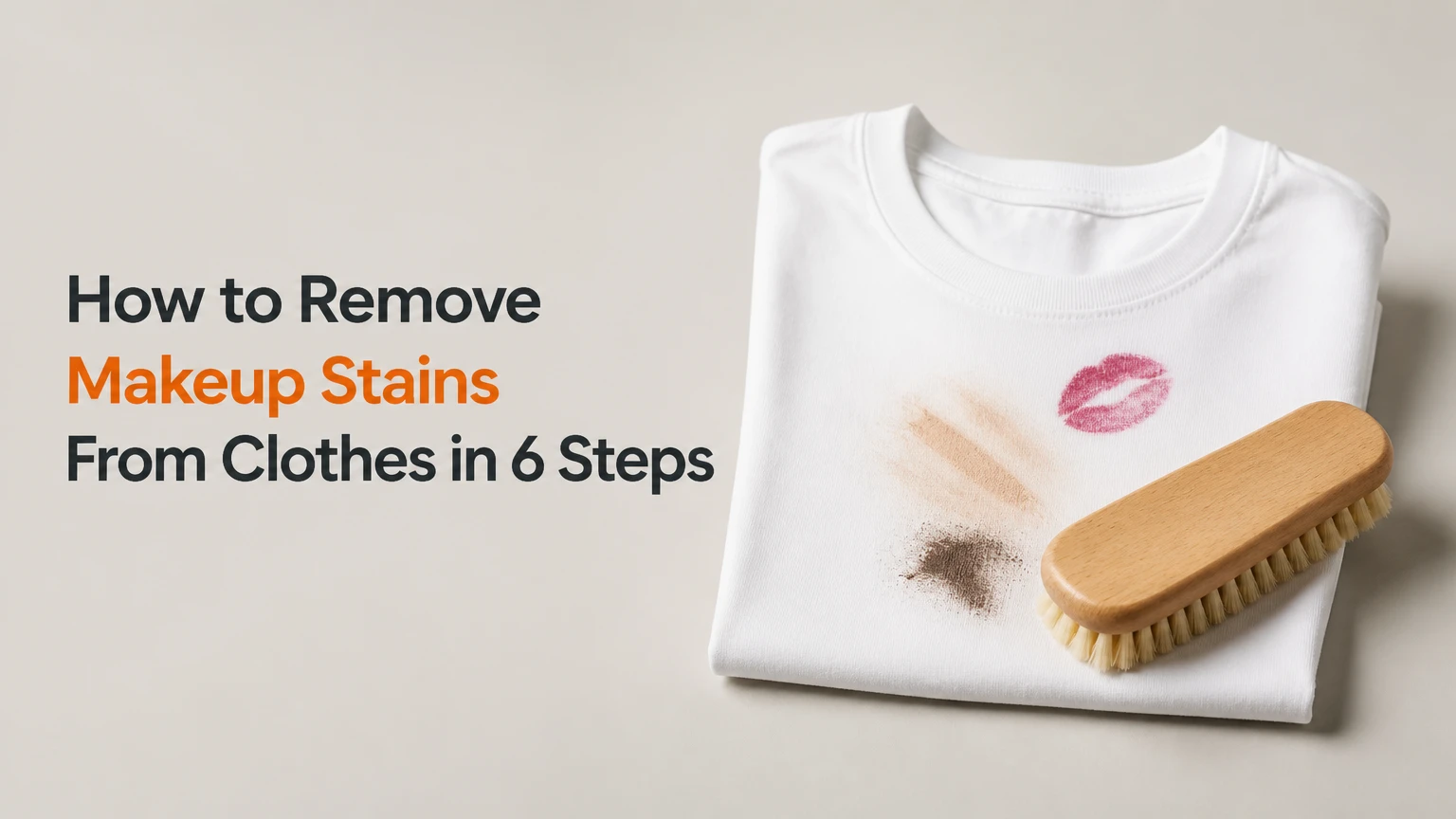
To remove makeup stains from clothes, lift excess product, identify whether the formula is oily, powdery, or waterproof, then pre-treat before washing. Use liquid laundry detergent for foundation and concealer, alcohol cautiously for lipstick, and dry removal for loose powder. Keep the garment out of the dryer until the stain disappears.
Key Facts at a Glance
- Liquid foundation and concealer usually respond best to a small amount of liquid laundry detergent or grease-cutting dish soap.
- Loose powder should be brushed or blown off before water touches the fabric.
- Rubbing alcohol can remove waxy lipstick, but it may strip dye from acetate, rayon, silk, wool, and brightly colored synthetics.
- A care label determines whether a garment can be washed, bleached, tumble-dried, or treated at home.
- Heat from a dryer can make remaining oil and pigment harder to remove, so air-dry after every treatment attempt.
- Typical treatment time is 10-30 minutes, while typical household cost is less than $1 per stain when detergent is already available.
Before You Start
Makeup stain removal is safest when the garment is washable, the stain has not been heat-dried, and the cleaning agent is tested on a hidden area first. Read the care label before applying any solvent, especially on silk, wool, acetate, rayon, leather, embellished clothing, or garments marked dry clean only.
| Requirement | Typical specification | Why it matters |
|---|---|---|
| Treatment time | 10-30 minutes | Allows detergent or solvent to loosen residue |
| Difficulty | Low for washable cotton and polyester | Delicate fibers need professional handling |
| Water temperature | Cold to lukewarm, 20-30°C | Reduces the chance of setting oils and dyes |
| Detergent amount | 3-5 drops on a small spot | More product creates residue and excess suds |
| Blotting material | 2-4 white towels or paper layers | Prevents pigment transfer back into fabric |
| Typical cost | $0-$5 per treatment | Depends on whether detergent or alcohol is available |
Gather a dull spoon or plastic card, a soft toothbrush, white paper towels, liquid laundry detergent, and cool running water. Keep 70% isopropyl alcohol, micellar water, and 3% hydrogen peroxide for cases where their specific benefits outweigh their fabric risks.
How to Remove Makeup Stains From Clothes
The reliable process has six steps and usually takes 15-30 minutes before laundering. The factor that most affects success is treating the cosmetic before a tumble dryer applies heat, because dried foundation oils and lipstick wax become more difficult to disperse after heating.
Step 1: Read the Care Label and Remove Heat
Check the garment’s fiber content, washing symbol, bleaching instructions, and drying instructions before treatment. If the clothing has already been through a dryer, use the heat-set procedure later in this guide rather than assuming a normal wash will remove the mark.
Lay the garment flat with the stained area facing upward. Place a white towel beneath thin or lightweight fabric so dissolved pigment has somewhere clean to transfer.
You will know this step worked when: the care label confirms that home washing is permitted and the garment is cool and dry.
Common mistake: starting with hot water or placing the garment in a dryer after an incomplete wash.
Step 2: Lift Excess Makeup Without Rubbing
Remove loose powder with a soft clothes brush, a clean makeup brush, or short bursts from a cool hair dryer held several inches away. Lift thick liquid or cream makeup with the edge of a spoon or plastic card, moving from the outside toward the center.
Do not scrub a powder stain. Water combines with powder pigment and binders to create a wet paste that can spread across the weave. For a raised cream deposit, use several light lifts instead of one forceful scrape.
You will know this step worked when: the remaining mark is flat and localized rather than a mound of product or a wider dusty area.
Common mistake: wiping a powder blush or eyeshadow with a wet tissue, which pushes particles between the fibers.
Step 3: Apply the Correct Pre-Treatment
Choose the cleaning agent according to the makeup formula, not simply the color of the stain. Apply 3-5 drops of liquid laundry detergent to foundation, concealer, tinted moisturizer, cream blush, and most liquid face products. Use 70% isopropyl alcohol for waxy lipstick only after a hidden patch test.
For detergent treatment, place the stained side against a white towel, apply the product, and gently work it through the fabric with a fingertip or soft toothbrush. Leave it for 10-15 minutes. For alcohol, put the stain face down and dab the reverse side so pigment transfers into the towel rather than spreading across the surface.
Replace the towel when it becomes visibly colored. A saturated towel can redeposit makeup.
You will know this step worked when: the stain becomes lighter at the edges and the towel receives beige, red, brown, or black transfer.
Common mistake: pouring a large amount of cleaner onto the garment, which enlarges the wet ring and makes rinsing more difficult.
Step 4: Blot From the Outside Toward the Center
Blot with a clean white cloth or paper towel, working from the perimeter inward. Press and lift; do not rub back and forth. Continue for 30-60 seconds, then inspect the towel and repeat with a clean section.
The outside-in direction limits the spread of dissolved pigment. White material provides a visible transfer checkpoint, while colored cloth can conceal dye movement and make it harder to tell whether the product is lifting.
You will know this step worked when: the towel shows less pigment after each pass and the garment’s fibers retain their original texture.
Common mistake: using a circular scrubbing motion on a thin shirt, which roughens fibers and creates a larger cosmetic halo.
Step 5: Flush the Reverse Side With Cool Water
Turn the garment inside out and run cool water through the back of the stain. Back-flushing pushes loosened makeup away from the fabric instead of driving it deeper from the front.
Rinse until the water no longer carries visible color or feels slick. Avoid soaking an entire structured garment when only a small section is stained, because unnecessary saturation can create water marks or distort interfacing.
You will know this step worked when: the fabric no longer feels greasy and the rinse water is substantially clearer.
Common mistake: rinsing from the front with strong pressure, which can force residue further into the weave.
Step 6: Wash, Inspect, and Air-Dry
Wash the garment according to its care label, using the warmest permitted setting only after pre-treatment and only when the label allows it. Use the normal recommended detergent dose, not a double dose intended to compensate for a stain.
Inspect the clothing under bright light while it is still damp. If any beige, red, gray, or oily shadow remains, repeat Steps 3-5. Air-dry the garment until the area is completely clear.
You will know this step worked when: the fabric looks uniform from several angles after drying naturally.
Common mistake: checking only when the garment is wet, then discovering a faint ring after tumble-drying.
Which Makeup Stain Remover Should You Use?
Liquid laundry detergent is the best first choice for most washable foundation and concealer stains because it addresses both oily carriers and pigment. Rubbing alcohol is more targeted for lipstick, while dry brushing is the correct first treatment for loose powder. No single product is safest for every cosmetic or fabric.
| Cleaner or method | Best match | Quantity and contact time | Main risk |
|---|---|---|---|
| Liquid laundry detergent | Foundation, concealer, cream blush | 3-5 drops, 10-15 minutes | Residue if poorly rinsed |
| Grease-cutting dish soap | Oily foundation, lip gloss | 2-4 drops, 5-10 minutes | Excess suds and possible fabric finish changes |
| 70% isopropyl alcohol | Lipstick, waxy lip stain, some eyeliner | Dab, 3-5 minutes | Color loss on dyes and acetate |
| Micellar water | Light transfer, delicate washable synthetics | Saturated cotton round, 5 minutes | Often leaves oily residue or fails on long-wear makeup |
| Foam shaving cream | Small fresh foundation mark | Pea-sized amount, 5 minutes | Fragrance, conditioners, and incomplete rinsing |
| 3% hydrogen peroxide | Residual pigment on white, bleach-safe cotton | Small dab, up to 5 minutes | Bleaching or yellowing colored fabric |
The American Cleaning Institute advises checking the care label and pre-treating stains before laundering. Product-specific instructions from Tide and OxiClean also place stain treatment before washing and require checking the stain before drying. Those recommendations support the central rule: remove residue first, wash second, apply heat last.
Why Is Detergent Usually Better Than Makeup Remover?
Detergent is usually better than a cosmetic remover for clothing because laundry surfactants are designed to suspend oil and soil in rinse water. Many makeup wipes and cleansing balms contain oils, emollients, or conditioners that can remove facial makeup while adding a second greasy mark to fabric.
Use a fragrance-free liquid detergent when possible. Dish soap can work on a small washable area, but rinse it thoroughly and never pour concentrated dish soap into a washing machine.
Is Rubbing Alcohol Safe on Colored Clothing?
Rubbing alcohol is conditionally safe on some colorfast clothing, but it is not universally safe. Test one drop on an inside seam, wait five minutes, and press the area with a white towel; visible dye transfer means alcohol should not be used.
Avoid alcohol on silk, wool, acetate, leather, and garments with unstable dyes. Even when the color survives, alcohol can affect printed finishes, coatings, and some synthetic fibers.
Match the Method to the Makeup
Makeup formulas differ in their carriers and binders. Foundation often combines pigment with oils, silicones, waxes, or water-based emulsions, whereas powder blush relies on dry particles and pressed binders. Waterproof mascara and long-wear eyeliner add film-forming polymers that resist ordinary water.
| Makeup type | Typical residue | First choice | Avoid first |
|---|---|---|---|
| Liquid foundation | Oil, silicone, beige pigment | Liquid laundry detergent | Hot dryer |
| Concealer | Cream oils, wax, dense pigment | Detergent and soft brush | Vigorous scrubbing |
| Red lipstick | Wax, oil, strong dye | Patch-tested alcohol, then detergent | Chlorine bleach |
| Powder blush or eyeshadow | Loose mineral or synthetic pigment | Dry brush or tape lift | Water before excess removal |
| Waterproof mascara | Film-former, wax, black pigment | Detergent, then cautious solvent testing | Rubbing across the surface |
| Liquid eyeliner | Pigment, resin, film-former | Detergent, targeted alcohol if safe | Acetone |
| Cream bronzer | Oil, wax, brown pigment | Grease-cutting detergent | Makeup wipes |
| Shimmer or highlighter | Mica, binder, oil | Dry lift, then detergent | Rough towel rubbing |
How Do You Remove Liquid Foundation?
Apply liquid laundry detergent directly to the foundation mark, wait 10-15 minutes, and blot before back-flushing with cool water. Foundation often leaves an oily beige ring, so repeat the detergent treatment if the color disappears but the fabric still looks darker.
For a collar transfer, work from both sides only after placing a towel beneath the garment. A soft toothbrush can reach textured cotton, but finger pressure is safer for knitwear and lightweight polyester.
How Do You Get Lipstick Out of Clothes?
Place the lipstick stain face down on a white towel and dab 70% isopropyl alcohol onto the reverse side if a patch test confirms colorfastness. Follow with liquid detergent to remove the loosened wax and oil, then rinse from the back and launder according to the label.
Lipstick can contain persistent red dyes, so one pass may remove grease while leaving pink pigment. Do not use chlorine bleach on a colored garment, and do not substitute acetone unless a textile professional confirms compatibility.
How Do You Remove Powder Eyeshadow or Blush?
Remove powder eyeshadow or blush while the fabric is dry. Shake the garment gently, lift remaining particles with a soft brush or low-tack tape, then use a small amount of detergent only after the loose pigment has gone.
Pressed powder may contain oils that require a second detergent treatment. Tape should be pressed and lifted rather than dragged, especially on velvet, brushed fleece, or loosely woven fabric.
How Do You Remove Waterproof Mascara?
Treat waterproof mascara as an oil-and-polymer stain: lift any dried flakes, apply liquid detergent, blot from the reverse, and rinse thoroughly. If a black film remains, use a patch-tested solvent only on a washable, colorfast garment.
Mascara can leave a gray shadow after the oily carrier is gone. Keep each blotting layer clean, because black pigment transfers easily from a saturated towel back onto white fabric.
Fabric and Color Safety Guide
Fabric construction changes the risk of shrinking, dye loss, water marks, and surface damage. Cotton and polyester generally tolerate careful home treatment, while silk, wool, acetate, and dry-clean-only garments require a lower-risk approach.
| Fabric or garment | Safer home approach | Solvent position | Professional threshold |
|---|---|---|---|
| White cotton | Detergent, oxygen bleach if label permits | Alcohol after patch test | Large or old set-in stain |
| Colored cotton | Detergent and cool rinse | Alcohol only after color test | Dye bleeding or spreading |
| Polyester | Detergent, controlled blotting | Alcohol may be suitable after test | Coated or pleated item |
| Denim | Detergent from reverse side | Alcohol can create a pale spot | Transfer across a large panel |
| Silk | Blot and stop, no aggressive soaking | Avoid alcohol and peroxide | Any visible oil or red dye |
| Wool | Minimal moisture, gentle blotting | Avoid alcohol and alkaline cleaners | Any persistent cosmetic mark |
| Rayon or acetate | Follow label exactly | Avoid alcohol and acetone | Dry-clean-only or shaped garment |
| Sequined or embellished | Local blot only | Avoid solvents near adhesive | Any solvent-sensitive decoration |
When Should You Use Hydrogen Peroxide?
Use 3% hydrogen peroxide only for a small residual mark on white, bleach-safe fabric after detergent treatment has failed. Test an inner seam, apply a few drops for up to five minutes, rinse completely, and stop if the fabric changes color.
Hydrogen peroxide is an oxidizer, not a universal makeup solvent. It can lighten colored dyes and may weaken some fibers with repeated use. Never mix it with chlorine bleach, ammonia, or other cleaners.
Should You Take Silk or Wool to a Dry Cleaner?
Take silk, wool, acetate, rayon, tailored clothing, and dry-clean-only garments to a professional cleaner when the stain is visible or oil-heavy. Tell the cleaner whether the product was lipstick, waterproof mascara, foundation, self-tanner, or glitter, because the formula affects solvent selection.
Do not saturate a silk blouse with micellar water simply because the product feels gentle on skin. Water can create tide marks, and rubbing can permanently alter the sheen.
Common Mistakes and How to Fix Them
Rubbing the stain immediately
Rubbing spreads liquid foundation and forces powder into the weave. Stop, lift surface material, place a towel beneath the mark, and restart with controlled blotting.
Applying hot water first
Hot water is not automatically destructive, but it can make oily cosmetic residue more difficult to disperse and can accelerate dye setting in some formulas. Use cool or lukewarm water during the first rinse, then follow the care label.
Using a makeup wipe
A makeup wipe can transfer pigment while leaving oils, moisturizers, and fragrance behind. If a wipe caused the mark to spread, use liquid detergent on the entire affected halo rather than treating only the original center.
Using too much cleaner
Excess detergent leaves a pale or stiff residue ring. Rinse from the reverse side, blot away water, and launder normally without adding more chemicals.
Applying chlorine bleach to lipstick
Chlorine bleach can react unpredictably with cosmetic dyes and yellow the surrounding fabric. Use oxygen bleach only when the care label permits it, or use a professional cleaner for colored and delicate clothing.
Using WD-40 after a dryer cycle
WD-40 is a petroleum-based product, not a preferred clothing stain remover. It can create a larger oil stain, leave odor, damage finishes, and introduce a flammability risk in a dryer. Use repeated detergent treatment or a professional cleaner instead.
What If the Stain Has Already Been Washed or Dried?
A washed but undried garment can usually be treated again with liquid detergent and a longer 20-30 minute contact time. A dryer-treated stain is harder because heat can consolidate oils, waxes, and binders, but repeated controlled treatment may still reduce the mark.
| Situation | Recommended response | Expected effort | Stop point |
|---|---|---|---|
| Washed, still damp | Detergent, blot, rinse, rewash | 10-20 minutes | Repeat once if fading |
| Washed, air-dried | Detergent soak, gentle wash | 20-40 minutes | Cleaner for delicate fabric |
| Dryer-dried cotton | Detergent treatment, air-dry inspection | 2-3 cycles may be needed | Persistent shadow after two attempts |
| Dryer-dried silk | Do not experiment with solvents | Professional service | Immediate cleaner referral |
| Oily ring remains | Absorbent powder, then detergent | 30-60 minutes | Ring spreads or fabric lightens |
For an oily ring, apply cornstarch or plain talcum powder to dry fabric for 30 minutes, brush it away, and then use detergent. Baking soda is less reliable for oil than an absorbent powder and can leave alkaline residue if overused.
Fast Treatments for Work, Travel, and Shared Laundry
For an office collar mark, remove excess makeup, place a dry paper towel behind the fabric, dab a small amount of liquid detergent or foam shaving cream, and blot with a damp white towel. The garment may look improved within five minutes, but wash it fully before wearing it again.
For a household laundry kit, keep liquid detergent, white towels, a plastic card, a soft toothbrush, and a small spray bottle of water together. A stain pen can help with fresh marks, but it may not dissolve waxy lipstick or waterproof mascara.
For expensive clothing, the cheapest safe choice is often professional cleaning. A $10-$30 cleaning charge is typically less costly than replacing a silk blouse, tailored jacket, wedding garment, or embellished dress damaged by alcohol or bleach.
Time, Cost, and Method Selection
The fastest method is not always the safest method. Alcohol may lift lipstick quickly from colorfast polyester, while detergent takes longer but has a wider safety margin for ordinary cotton clothing.
| Scenario | First method | Typical time | Typical household cost |
|---|---|---|---|
| Fresh foundation on cotton | Liquid detergent | 15-25 minutes | $0.10-$0.50 |
| Lipstick on polyester | Alcohol test, then detergent | 10-20 minutes | $0.25-$1.00 |
| Powder blush on a T-shirt | Dry lift, then wash | 5-15 minutes | $0-$0.25 |
| Waterproof mascara on white cotton | Detergent, repeat if needed | 20-40 minutes | $0.25-$1.50 |
| Dried stain after washing | Detergent soak and rewash | 30-60 minutes | $0.25-$2.00 |
| Silk or wool stain | Professional dry cleaning | 1-5 days | Typically $10-$30 |
These are typical household ranges, not fixed prices. Local cleaner rates, garment size, stain area, and urgency can change the total substantially.
FAQ
Can toothpaste remove makeup stains from clothes?
Toothpaste is not a dependable clothing stain remover. Whitening toothpaste may contain abrasives, colorants, or ingredients that leave a pale residue, and scrubbing can damage fibers. Use liquid laundry detergent for foundation or concealer, then rinse from the garment’s reverse side.
Does vinegar remove foundation from clothing?
White vinegar is not the first choice for oily foundation because acid does not reliably dissolve cosmetic oils and waxes. Vinegar can also create odor or interact poorly with other products. Treat foundation with detergent, rinse thoroughly, and never mix vinegar with chlorine bleach.
Can makeup stains come out of white clothes?
Most fresh makeup stains can come out of white cotton or polyester when treated before drying. Start with detergent, then consider 3% hydrogen peroxide or oxygen bleach only after checking the care label and testing the fabric. Red lipstick may need several controlled treatments.
How do you remove makeup from black clothes without bleaching them?
Use liquid detergent first and rinse from the reverse side. Avoid peroxide and chlorine bleach, while alcohol should be used only after a hidden colorfastness test because it can create a lighter patch on black dye.
Does dry cleaning remove lipstick and foundation?
Professional dry cleaning can remove many lipstick, foundation, and waterproof cosmetic stains, particularly from silk, wool, rayon, acetate, tailoring, and embellished clothing. Identify the exact makeup product when handing over the garment so the cleaner can choose an appropriate treatment.
Should you wash a makeup-stained garment separately?
Wash a heavily stained garment separately or with similar dark colors after pre-treatment. Loose pigment and dissolved oils can transfer to other clothing, especially during a long wash cycle. Inspect the garment before using the dryer.
The Bottom Line
The safest way to remove makeup stains from clothes is to match the treatment to the formula, remove excess without rubbing, pre-treat, back-flush, wash, and air-dry. Use detergent for most foundation, alcohol cautiously for lipstick, dry lifting for powder, and professional cleaning for silk, wool, dry-clean-only, or high-value garments. Do not put the clothing in a dryer until the makeup stain is completely gone.