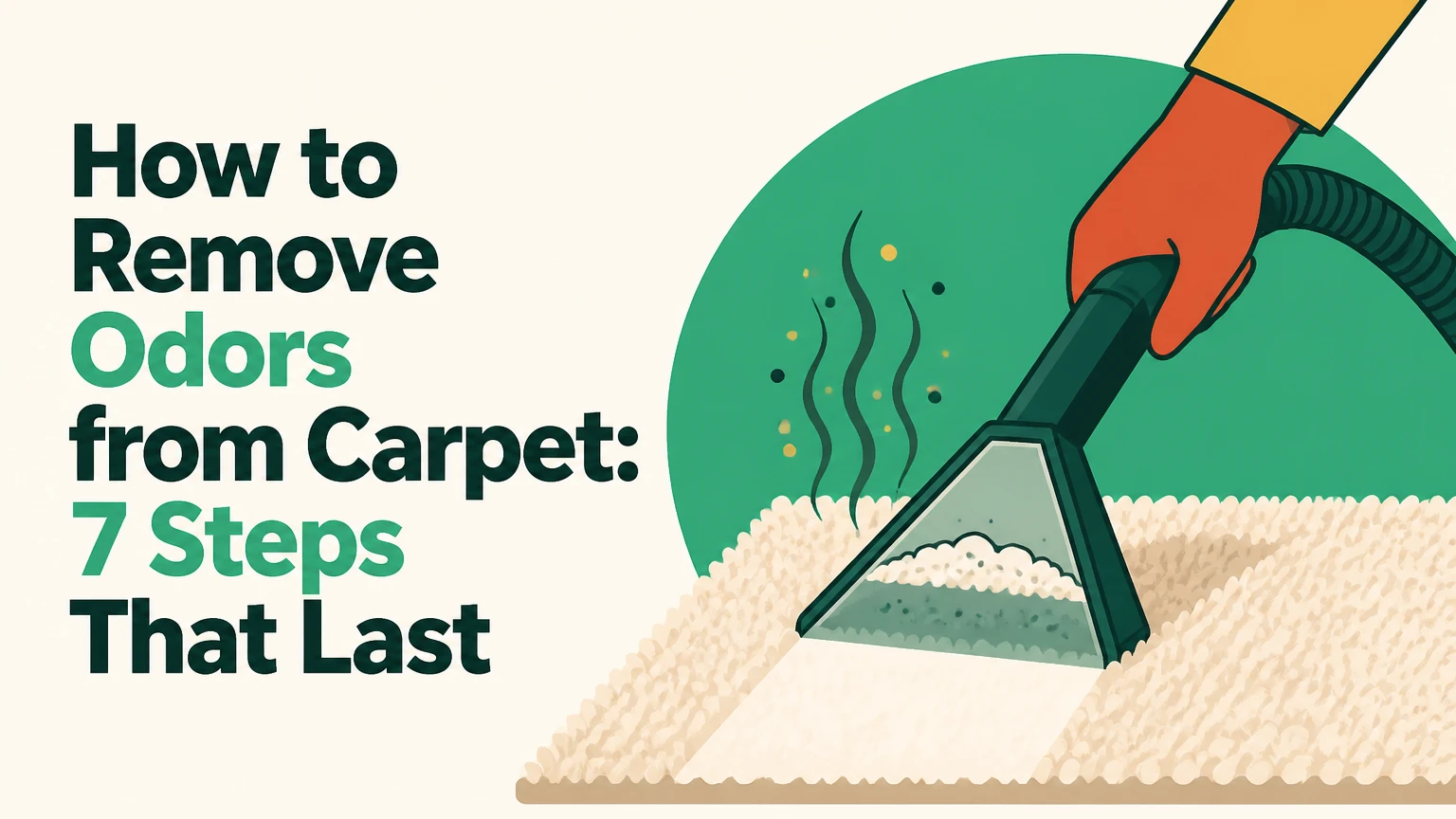
To remove odors from carpet, identify and remove the odor source, treat the affected fibers and backing with a compatible cleaner, extract residue, and dry the carpet completely. Baking soda helps with mild surface smells, while enzymatic cleaners work better for organic pet accidents and professional extraction is often needed when odor reaches the pad or subfloor.
Key Facts at a Glance
- Carpet odor usually comes from residue in the pile, backing, underlay, or subfloor, not from the room air alone.
- Enzymatic carpet cleaners are the most suitable DIY option for fresh urine, vomit, feces, and other protein-based organic contamination.
- Baking soda can reduce mild surface odor, but it cannot neutralize deeply absorbed urine salts, mold growth, or smoke residue.
- Carpet should dry fully, preferably within 24 hours, after wet cleaning to limit microbial growth and prevent a sour damp smell.
- Never mix bleach, ammonia, vinegar, hydrogen peroxide, or commercial cleaners in the same application.
- Ozone generators should not run in occupied rooms because ozone irritates the lungs and can damage rubber, plastics, dyes, and finishes.
What Causes Carpet Odors?
Carpet odors come from volatile compounds released by moisture, oils, microorganisms, urine salts, smoke particles, food residue, or contaminated padding. Odor molecules can remain in carpet yarn, latex backing, cushion, tack strips, and wood subfloors, so surface spraying often produces only temporary improvement.
A useful diagnosis starts with the odor character and its timing. Sour or earthy smells usually point to trapped moisture or microbial growth. Ammonia-like pet odor often indicates urine residue, while greasy, acrid, or stale smells can indicate cooking oil or tobacco smoke. A sweet, fermented smell may come from milk, juice, or food trapped below the pile.
Carpet fibers also change the treatment decision. Nylon and polyester generally tolerate more water than wool, viscose, sisal, or cotton rugs, but the manufacturer’s care label takes priority. Natural fibers can shrink, bleed, brown, or develop texture changes when they receive excess moisture or alkaline products.
How Do Odor Removers Work?
Carpet odor removers use absorption, enzymatic breakdown, oxidation, surfactant cleaning, or physical extraction. Absorbent powders hold some surface moisture and odor compounds; enzymes break down organic residues; oxidizers alter certain odor molecules; surfactants loosen oily soil; and extraction physically removes dissolved contamination.
The chemistry has limits. An enzyme product cannot remove cigarette tar, while baking soda cannot digest urine proteins. A fragrance deodorizer can reduce perceived odor without reducing the contamination load, which explains why the smell often returns when humidity rises.
Which Method Fits the Odor?
The best carpet odor treatment depends on the contaminant, its depth, the carpet fiber, and the amount of moisture involved. Use an enzymatic cleaner for organic pet accidents, extraction for broad or embedded soil, and controlled drying whenever the carpet has become wet.
| Odor source | Best first treatment | Typical dwell time | Escalation point |
|---|---|---|---|
| Fresh dog or cat urine | Enzymatic cleaner | 10-24 hours | Odor returns after drying |
| Vomit, feces, or blood | Enzymatic cleaner after removal | 10-30 minutes | Residue reaches pad |
| Cigarette smoke | Low-moisture or hot-water extraction | 5-15 minutes | Smoke remains after two cleanings |
| Mildew or damp carpet | Moisture removal and drying | 4-24 hours | Visible mold or wet pad |
| Milk, juice, or food | Extraction with neutral detergent | 5-10 minutes | Sour odor persists |
| General stale odor | Vacuuming, ventilation, light powder | 4-12 hours | Smell has a defined source |
Do not select a method solely because it is labeled natural. Vinegar, essential oils, and baking soda may be less useful than a properly formulated carpet-safe product, and natural products can still damage dyes, backing, or indoor air quality.
How to Remove Odors from Carpet in 7 Steps
The complete process usually takes 2-24 hours for a localized odor and 24-72 hours for severe contamination, with moderate difficulty and a typical DIY cost of $10-$60. The factor that most determines success is source removal at the same depth as the contamination, especially when urine has reached the pad.
Before You Start
| Requirement | Typical specification |
|---|---|
| Time | 30-60 minutes of work, 2-24 hours of treatment and drying |
| Difficulty | Moderate for a spot, high for a room or contaminated pad |
| DIY cost | $10-$60 for cleaner, towels, gloves, and extraction |
| Tools | White towels, gloves, vacuum, spray bottle, fan, optional wet vacuum |
| Cleaner | Enzyme product for organic residue, neutral carpet detergent for soil |
| Safety check | Patch-test a hidden area and read the carpet manufacturer’s label |
Keep children and pets away from treated carpet until the product label permits contact and the area is dry. Open windows when outdoor conditions allow, but do not use ventilation as a substitute for removing the source.
Step 1: Locate and Remove the Odor Source
Find the source before applying deodorizer. Inspect nearby upholstery, walls, baseboards, pet bedding, floor vents, trash containers, and the underside of the carpet where accessible, because an apparently localized smell can originate outside the visible spot.
For pet urine, a UV flashlight can reveal some dried deposits in a dark room, although detergents and optical brighteners can also fluoresce. Mark the boundaries with painter’s tape. If the smell covers a large area, lift one carpet edge carefully and inspect the pad and subfloor rather than saturating the entire room blindly.
You’ll know it worked when: the suspected source is identified and the treatment area extends beyond the visible stain by 2-6 inches.
Common mistake: treating the strongest-smelling spot without checking the pad, baseboard, or nearby fabric.
Step 2: Blot Liquid Contamination
Press white absorbent towels into fresh liquid, replacing them as they become wet. Apply body weight through a clean towel for 30-60 seconds at a time, but do not scrub, twist, or brush the pile because agitation spreads liquid and damages yarn.
A wet-dry vacuum can remove more liquid than towels. Make slow passes in two directions, emptying the recovery tank before it becomes full. Do not use a household vacuum on wet carpet unless the manufacturer explicitly identifies it as a wet-capable machine.
You’ll know it worked when: a fresh towel remains nearly dry after firm pressure and no liquid transfers to the towel.
Common mistake: rubbing outward from the stain, which enlarges the contaminated zone and pushes liquid toward the backing.
Step 3: Vacuum Dry Soil and Apply a Controlled Absorbent
Vacuum loose particles before applying a powder. Use a thin, even layer of baking soda, approximately 1/4-1/2 cup per square yard, and leave it for 4-12 hours rather than creating a thick mound that settles into the backing.
Baking soda is appropriate for mild stale odor and limited surface moisture. It is not a reliable treatment for urine crystals, mold, smoke tar, or contamination beneath the carpet. Fine powder can also burden some vacuum filters, so use a clean bag or filter and make several slow passes.
You’ll know it worked when: the powder is fully removed and the carpet feels dry, loose, and free of gritty residue.
Common mistake: leaving baking soda on damp carpet. Moisture turns the powder into a paste that is harder to extract and can leave alkaline residue.
Step 4: Apply the Correct Odor Neutralizer
Choose an enzyme cleaner for urine, vomit, feces, or other organic residues, and choose a carpet detergent or extraction rinse for general soil, food, and smoke film. Apply enough enzyme solution to reach the contaminated depth, but follow the product label because formulas vary in concentration and required saturation.
Enzymes need contact time and usually perform poorly when immediately rinsed away. Keep the treated zone damp for the labeled dwell period, commonly 10-24 hours, while preventing runoff into wood flooring. Do not apply vinegar, bleach, ammonia, peroxide, or another cleaner over the enzyme product unless the manufacturer permits that sequence.
Patch-test every cleaner. Wool, viscose, silk, and plant-fiber carpets need specialized products and often professional cleaning because dye bleeding and fiber distortion can occur.
You’ll know it worked when: the odor decreases after the area dries, not merely while the product’s fragrance is present.
Common mistake: using a small mist of enzyme cleaner on a deep urine spot. The liquid must contact the contaminated fibers and backing, or the untreated residue remains active.
Step 5: Extract Dissolved Residue
Extract the treated carpet with a water-extraction machine when the product directions call for rinsing or when dissolved soil remains. Make one controlled wet pass followed by two or three slow dry passes, and use the least water that removes the cleaner effectively.
Hot-water extraction can remove soil from the pile and backing, but household machines do not automatically sanitize carpet. Water temperature, pressure, chemical concentration, contact time, and extraction performance all affect the result, and excessive heat or moisture can damage some fibers and carpet adhesives.
For a small spot, a wet-dry vacuum may provide better control than a rented upright machine. For a whole room, professional extraction is more consistent when odor has reached the pad or when furniture prevents adequate drying.
You’ll know it worked when: the recovered water becomes lighter and the carpet feels damp rather than saturated.
Common mistake: adding extra detergent to improve cleaning. Excess surfactant leaves sticky residue that attracts soil and can create a new odor.
Step 6: Dry the Carpet Within 24 Hours
Increase airflow immediately with floor fans, open windows, and a dehumidifier. Lift furniture legs with foil or plastic blocks if the manufacturer permits, and keep foot traffic off the carpet until the pile and backing are dry.
A typical residential carpet should dry within 6-24 hours after controlled extraction. Drying beyond 24-48 hours indicates excessive water, poor airflow, high indoor humidity, or wet padding. The Environmental Protection Agency recommends prompt drying after water intrusion because moisture control is the main way to limit mold growth.
You’ll know it worked when: the carpet feels the same temperature as adjacent dry flooring, has no cool damp backing, and produces no sour smell after several hours.
Common mistake: closing the room after cleaning. A closed, humid room slows evaporation and can make a neutral odor turn musty.
Step 7: Recheck After Complete Drying
Evaluate the carpet after it has dried for at least 12 hours. Compare the treated zone with an untreated nearby area, and check the smell at carpet level rather than standing height because odor concentration is greatest near the source.
If the odor is gone, vacuum once to restore the pile. If the odor returns only during humid weather, contamination may remain in the backing, pad, or subfloor. If the carpet smells clean but the room still smells, inspect air vents, walls, curtains, furniture, and pet bedding.
You’ll know it worked when: the odor remains absent after normal room humidity returns and after the carpet receives ordinary foot traffic.
Common mistake: repeating stronger chemical applications without locating the remaining reservoir.
What Are the Costs and Timeframes?
DIY carpet odor treatment typically costs $10-$60 for a localized problem, while rental extraction commonly costs $40-$100 per day before cleaning solution and professional services often cost $120-$400 for one room or a small area. Replacing contaminated padding can add $1-$3 per square foot, excluding carpet installation.
| Approach | Typical cost | Active work | Total time | Best use |
|---|---|---|---|---|
| Baking soda and vacuum | $3-$15 | 15-30 minutes | 4-12 hours | Mild surface odor |
| Enzyme spot treatment | $10-$30 | 20-45 minutes | 10-24 hours | Fresh or localized pet odor |
| Rental extractor | $40-$100 | 1-3 hours | 6-24 hours | Large soiled room |
| Professional extraction | $120-$400 | 1-3 hours | 6-24 hours | Embedded soil or repeated failure |
| Pad replacement | $1-$3 per sq. ft. | 2-6 hours | 1-2 days | Persistent contamination below carpet |
| Carpet replacement | $2-$8 per sq. ft. | 4-12 hours | 1-3 days | Irreversible smoke, mold, or urine damage |
Prices vary by region, room size, furniture movement, access, and restoration severity. Ask whether the quote includes odor treatment, pad inspection, extraction, drying equipment, and subfloor sealing.
Which Carpet Odor Methods Work Best?
Enzymatic cleaners are the strongest DIY choice for organic pet accidents, while extraction is more effective for broad soil and smoke film. Baking soda is the lowest-cost option for mild surface odor, but it has the narrowest ability to remove contamination.
| Method | Mechanism | Useful for | Main limitation |
|---|---|---|---|
| Baking soda | Absorption and pH buffering | Light stale odor | Does not reach deep residues |
| Enzyme cleaner | Organic-residue digestion | Urine, vomit, feces | Requires correct dwell and coverage |
| Neutral detergent | Surfactant soil removal | Food, oils, tracked soil | Needs thorough extraction |
| Hydrogen-peroxide product | Oxidation | Some organic stains and odors | Can lighten dyes |
| Hot-water extraction | Rinsing and physical removal | Room-scale soil and smoke | Over-wetting can damage pad |
| Ozone generator | Oxidation in unoccupied space | Specialized restoration | Unsafe for occupied rooms |
Hydrogen peroxide should be used only in a carpet-formulated product or after a careful hidden-area test. Household peroxide can bleach dyes and damage natural fibers.
Is Vinegar Safe for Carpet Odors?
Diluted white vinegar can reduce some alkaline or stale smells, but vinegar is not a dependable treatment for deep urine, mold, or smoke contamination. A light application may be suitable for some synthetic carpets, yet acidic liquid can affect dyes, backing adhesives, and natural fibers.
Never combine vinegar with bleach, ammonia, hydrogen peroxide, or an unknown commercial cleaner. Vinegar and baking soda largely neutralize each other, producing carbon dioxide, water, and sodium acetate rather than a stronger carpet deodorizer. For residue, dry vacuuming followed by labeled extraction is safer than adding another household chemical.
How Do You Remove Pet Urine Odor Permanently?
Remove pet urine odor by treating the full contaminated depth with an enzyme cleaner, maintaining the labeled dwell time, extracting excess liquid, and drying the carpet and pad. If odor returns after drying, the urine likely reached the cushion or subfloor, where surface treatment cannot fully reach it.
Use a UV flashlight only as a locating aid, not as proof that every fluorescent mark is urine. Treat an area larger than the visible discoloration because urine spreads laterally through the backing and pad. For repeated accidents, identify the animal’s access route and clean nearby vertical surfaces as well.
For severe contamination, a technician may lift the carpet, replace the pad, clean the subfloor, and apply an odor-blocking sealer before reinstalling the carpet. Sealing a dirty or damp subfloor traps the problem rather than solving it.
How Do You Remove Cigarette Smoke Odor?
Remove cigarette smoke odor with thorough vacuuming, alkaline-sensitive professional or rental extraction, and cleaning of walls, baseboards, curtains, upholstery, and HVAC components. Smoke residue is oily and adheres to multiple surfaces, so carpet deodorizer alone rarely removes the room-wide source.
Use a carpet-safe detergent designed for oily soil, then extract with controlled moisture. Smoke odor that persists after two properly dried cleanings often indicates contaminated pad, tack strips, drywall, or subfloor. In rental housing, document the condition before treatment and check whether the landlord requires approved restoration methods.
Ozone is not a casual DIY shortcut. The EPA warns that ozone generators can produce concentrations harmful to human health, and rooms must be vacant during treatment and adequately ventilated afterward. Never use ozone around people, pets, plants, or occupied medical equipment.
Can Mildew-Smelling Carpet Be Saved?
Mildew-smelling carpet can sometimes be saved when the carpet is only damp and has no visible mold, but carpet with established mold, wet padding, or prolonged water exposure needs professional assessment. Drying the source of moisture is more important than applying fragrance or deodorizer.
Remove standing water, run fans and a dehumidifier, and inspect the pad and subfloor. Do not seal, shampoo, or heavily spray carpet that remains wet. The Institute of Inspection Cleaning and Restoration Certification uses water-damage categories and drying principles because contamination level and material exposure affect the safe restoration method.
Discard porous padding when it remains contaminated, compressed, visibly affected, or odorous after drying. Carpet may be salvageable after pad replacement if the carpet backing is intact and the subfloor can be cleaned and dried.
Common Mistakes and How to Fix Them
Using ammonia on pet stains
Ammonia can resemble urine to animals and may encourage repeat marking. Blot the area, rinse and extract compatible residue, then use an enzyme product after checking the label.
Scrubbing the carpet
Scrubbing frays or distorts carpet yarn and spreads liquid into the backing. Use pressing, blotting, and slow extraction instead.
Over-wetting the pad
Saturated pad dries slowly and can release a sour odor. Stop adding liquid, extract repeatedly, increase airflow, and lift the carpet if the backing remains wet.
Masking odor with perfume
Fragrance changes perception while contamination remains. Identify the source and remove residue before using any optional fragrance product.
Mixing cleaning chemicals
Chemical combinations can create irritating vapors, bleaching, heat, or dangerous reactions. Use one product at a time, follow its label, and rinse or extract only when directed.
Applying powder to wet carpet
Powder binds with moisture and forms residue. Dry-extract liquid first, then use a small amount of powder only on fully dry carpet.
When Should You Call a Professional?
Call a carpet or water-restoration professional when odor covers an entire room, returns after two complete treatments, follows sewage or flood water, involves visible mold, or persists beneath the carpet. Professional equipment can measure moisture, inspect the pad, lift carpet edges, and extract more effectively than a household machine.
A professional is also the safer choice for wool, viscose, antique rugs, glued-down carpet, and smoke damage across walls and ventilation systems. Ask for the proposed chemistry, drying plan, moisture readings, pad-inspection process, and whether replacement is recommended before work begins.
Carpet replacement becomes more rational when urine has repeatedly saturated the pad, mold has damaged the backing, smoke odor remains after coordinated cleaning, or the subfloor cannot be cleaned without removing the carpet. Replacement is not the first option for every stain, but repeated wet treatment can cost more than a controlled rebuild.
FAQ
Does coffee grounds remove odor from carpet?
Coffee grounds do not remove the contamination causing carpet odor and can add organic residue, color, and fine particles. Vacuum the area, clean the spill with a carpet-safe detergent, extract dissolved residue, and dry the carpet completely.
How long should baking soda stay on carpet?
Leave baking soda on fully dry carpet for approximately 4-12 hours for a mild odor, then vacuum slowly in several directions. Do not use baking soda as a substitute for enzyme treatment when urine, vomit, or other organic material has entered the backing.
Why does carpet smell worse when humid?
Humidity increases the release of odor compounds from residues in carpet fibers, backing, and padding. Humid air also slows evaporation, so a previously hidden source becomes noticeable. A returning odor usually requires source removal or pad inspection rather than another surface deodorizer.
Can a carpet cleaner remove all odors?
A carpet cleaner can remove many odors when the contaminant is in the pile and the machine extracts enough soil and solution. A carpet cleaner cannot guarantee removal when urine, smoke, mold, or sewage has contaminated the pad, subfloor, walls, or ventilation system.
Is baking soda safe for every carpet?
Baking soda is generally compatible with many synthetic carpets when used sparingly and vacuumed completely, but delicate rugs, wool, viscose, and handmade textiles need label-specific care. Powder residue can remain in deep pile and may increase wear if repeatedly ground into the fibers.
The Bottom Line
How to remove odors from carpet depends on treating the actual source, not covering the smell. Blot fresh liquid, select an odor-specific cleaner, respect dwell time, extract residue, and dry the carpet within 24 hours. Use enzyme treatment for organic pet accidents, controlled extraction for smoke and broad soil, and professional inspection when odor returns after drying.