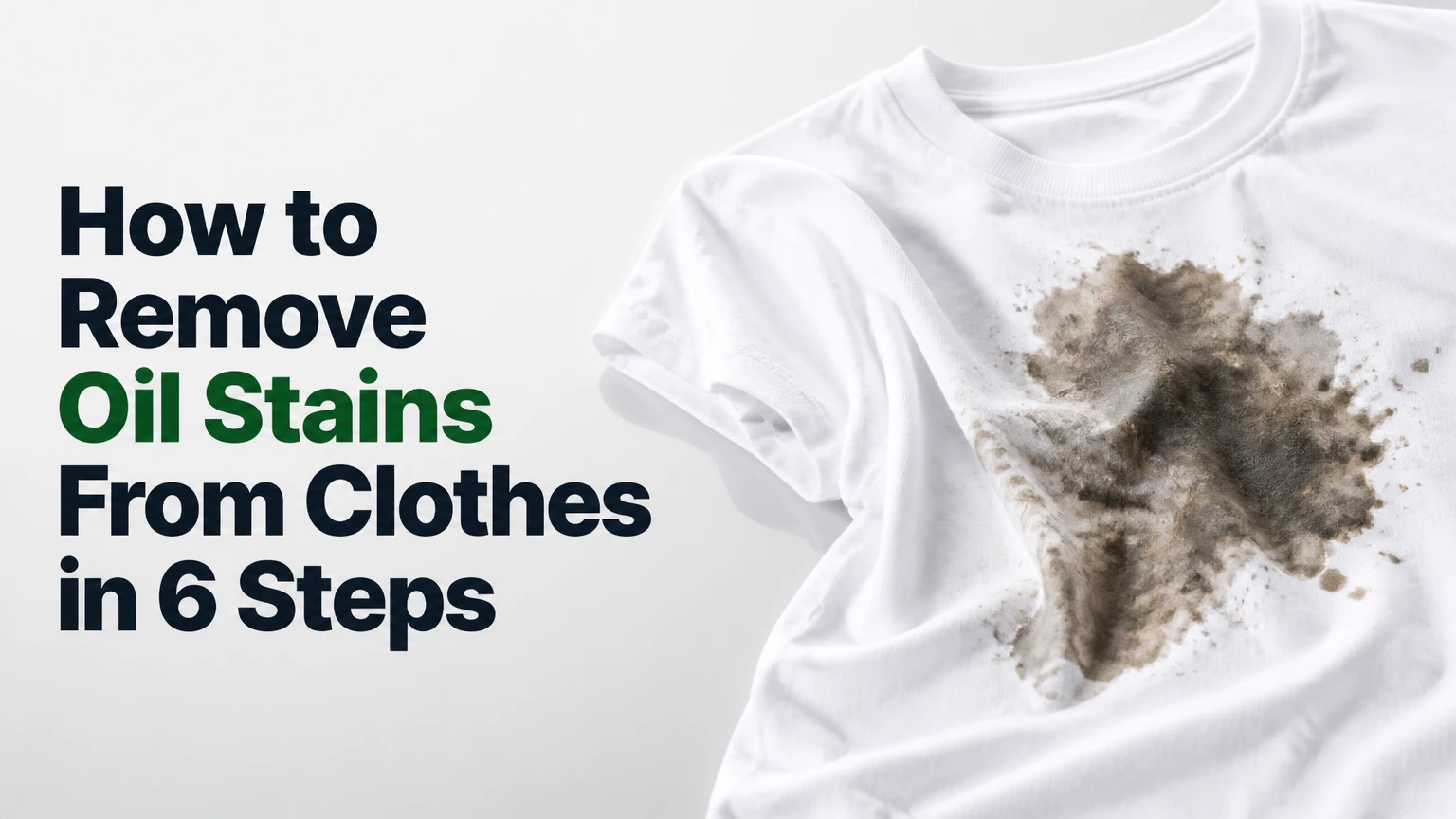
To remove an oil stain from washable clothes, blot excess oil, cover it with an absorbent powder, work in liquid dish soap or laundry detergent, rinse, and wash at the hottest temperature allowed by the care label. Air-dry the garment and inspect it before using a dryer. Fresh stains usually respond fastest.
Key Facts at a Glance
- Liquid dish soap or laundry detergent is needed because water does not dissolve oil.
- Baking soda and cornstarch absorb surface oil but do not replace a surfactant wash.
- Dryer heat can make a remaining oil mark much harder to remove.
- The care label controls the maximum safe water temperature and washing method.
- Silk, suede, leather, and dry-clean-only garments require a different treatment pathway.
- A typical fresh stain takes 20-40 minutes to pretreat, excluding the wash cycle.
Before You Start
A fresh oil stain on a washable cotton, linen, denim, or polyester garment usually needs 5-10 minutes of active work, 15-30 minutes of pretreatment, and one wash cycle. The main success factor is preventing heat from reaching the garment before you confirm that the mark has disappeared.
Materials and Settings
| Item | Typical amount or setting | Purpose |
|---|---|---|
| White paper towel or cloth | 2-4 pieces | Blot excess oil without dye transfer |
| Cornstarch or baking soda | 1-2 teaspoons for a small spot | Absorb surface oil |
| Clear liquid dish soap | 1 teaspoon for a palm-sized mark | Dissolve and suspend grease |
| Soft toothbrush | 1 brush, 2-3 cm bristles | Work cleaner through fibers gently |
| Liquid laundry detergent | Label dose for one load | Complete removal during washing |
| Washing machine | Care-label temperature | Rinse away suspended oil safely |
Check the garment label before adding water. “Dry clean only,” silk, wool, suede, leather, acetate, rayon with a structured finish, and garments with unstable dyes should not automatically receive the standard home method.
Test any soap on an inside seam. Apply one drop, wait five minutes, blot with a white cloth, and stop if the color transfers or the fabric changes texture.
Why Oil Stains Resist Water
Oil stains resist plain water because oil is nonpolar and water is polar, so the two liquids do not mix into a washable solution. Surfactants in dish soap and laundry detergent have an oil-attracting end and a water-attracting end; they surround loosened oil in micelles that can be carried away during rinsing.
Fabric type changes the difficulty. Cotton and linen absorb oil into their cellulose structure, while polyester and other synthetics can hold a thin oily film across a relatively hydrophobic surface. A stain that looks lighter after washing may still contain oil, detergent residue, or pigment from the original food.
Absorbent powder works only on the oil that remains near the surface. It cannot pull out all material from the fiber, which is why powder should be followed by a surfactant treatment.
Fresh Oil Versus Set-In Oil
Fresh oil is easier to remove because less time has passed for the liquid to spread and bind within the fabric. A dried mark can still improve after several treatment cycles, but the result depends on the oil type, fabric, dye, and whether a dryer or iron has already applied heat.
A practical rule is simple: treat the garment before laundering whenever possible. Do not put an oily garment directly into a hot dryer, even if the mark appears faint.
How to Remove Oil Stains From Clothes
The standard method has six steps: blot, absorb, pretreat, gently agitate, wash, and inspect. For a fresh stain, expect 20-40 minutes of pretreatment and one normal wash cycle; repeat the process once if a pale shadow remains, but do not increase scrubbing force.
Step 1: Blot the Excess Oil
Place a folded white paper towel under and over the stain, then press from the outside edge toward the center. Replace the towel as it becomes translucent or greasy, and continue for 30-60 seconds without rubbing.
You will know this step worked when the towel picks up visible oil and the fabric no longer feels wet at the surface. Do not use a colored cloth because dye can transfer to damp fibers.
Common mistake: rubbing outward from the spot. Rubbing increases the treated area and can drive oil deeper into a knitted or loosely woven fabric.
Step 2: Cover the Mark With Absorbent Powder
Spread 1-2 teaspoons of cornstarch or baking soda over a small stain, using enough to cover the oily area completely. Leave the powder for 15-30 minutes, then brush it off over a bin or sink before applying liquid cleaner.
Cornstarch is often the cleaner choice for dark garments because baking soda can leave a visible pale residue in textured fabric. Powder is most useful when the stain contains a pool of liquid oil, such as cooking oil spilled from a pan.
You will know this step worked when the powder forms slightly darker clumps or the original mark looks less glossy. Powder alone is not a complete stain remover.
Common mistake: adding water to the powder immediately. A wet paste can spread the oil before the surfactant reaches the fibers.
Step 3: Apply a Small Amount of Dish Soap
Put approximately 1 teaspoon of clear liquid dish soap on a palm-sized stain, or use enough to make a thin film over the mark. Work from the outside toward the center, keeping the treatment localized rather than soaking the entire garment.
Liquid dish soap is effective because its surfactants are designed to disperse food grease. Laundry detergent can also work, particularly when it contains surfactants, builders, and enzymes suited to oily soils.
Let the soap sit for 5-10 minutes. Do not allow it to dry completely, because dried soap is harder to rinse and can create a new ring.
Common mistake: using a large amount of dish soap. Excess soap creates foam and residue, overloads a washing machine, and does not necessarily increase oil removal.
Step 4: Agitate the Fibers Gently
Use your fingers or a soft toothbrush to work the soap through the front and back of the stained fabric for 30-60 seconds. Use light strokes on cotton and denim, fingertip pressure on polyester, and no home scrubbing on silk, suede, or leather.
The treatment should produce a thin, slippery film rather than a heavily foamed lather. If the garment has a printed graphic, brush from the reverse side when possible to reduce abrasion on the print.
You will know the step worked when the dark translucent patch becomes less defined and the fabric feels evenly coated. Complete removal may not occur until the wash cycle.
Common mistake: using a stiff brush or aggressive circular motion. Mechanical abrasion can roughen fibers, fade dyes, and make a small stain appear larger.
Step 5: Wash at the Highest Safe Temperature
Rinse the treated area from the reverse side with warm water if the care label permits, then wash the garment with the normal dose of liquid laundry detergent. Select the hottest temperature allowed by the label, not automatically the hottest setting on the machine.
Warm or hot water can improve the movement of many cooking oils, but heat can shrink wool or cotton, damage elastic, bleed unstable dyes, or set some accompanying food pigments. Detergent concentration, wash time, and mechanical action also affect the result.
Use a normal or heavy-soil cycle for a substantial grease mark. Wash the garment separately or with similar items if the stain is large enough to contaminate other clothing.
Common mistake: assuming cold water permanently solidifies every oil. Cold water can reduce cleaning efficiency for some greasy soils, but oil does not behave like wax in every garment; the care label and detergent chemistry matter more than a blanket hot-versus-cold rule.
Step 6: Air-Dry and Inspect the Garment
Hang or lay the garment flat to dry, then inspect it in bright, indirect light from several angles. Run clean fingers over the area because a remaining oil film may feel slick even when the visual mark is faint.
If any yellow, gray, or translucent shadow remains, repeat the dish-soap pretreatment and wash before using a tumble dryer or iron. Dryer heat is not guaranteed to make every oil stain permanent, but it can oxidize, spread, or fix residual oily material and makes later treatment less predictable.
You will know the job is complete when the fabric looks uniform, feels dry rather than slick, and has no odor or halo after drying.
Common mistake: checking only while the fabric is wet. Water temporarily darkens many textiles and can hide a small residual grease mark.
Which Treatment Works Best?
Dish soap is the best first choice for fresh cooking oil on washable everyday fabrics, while a heavy-duty liquid laundry detergent is usually better for repeated laundering or larger workwear loads. Absorbent powder is a useful first step, not a replacement for a surfactant.
| Method | Best use | Typical time | Main limitation |
|---|---|---|---|
| Clear dish soap | Fresh food grease on cotton or polyester | 15-25 minutes | Must be rinsed thoroughly |
| Liquid laundry detergent | Large stains and washable workwear | 30-60 minutes | May need a second cycle |
| Cornstarch | Wet surface oil before washing | 15-30 minutes | Cannot remove embedded oil alone |
| Enzyme stain product | Mixed food stains with protein or starch | 5-15 minutes | Formula must suit the fabric |
| Professional dry cleaning | Silk, wool tailoring, leather, and special finishes | 1-5 days | Typical cost is $8-$35 per garment |
| Petroleum solvent | Industrial contamination under controlled use | 10-30 minutes | Fire, toxicity, dye, and fabric risks |
Commercial stain sprays vary substantially. An enzyme product can help with a meal stain that includes egg, milk, or starch, but enzymes do not replace surfactants for pure motor oil or cooking oil.
Why Solvents Are Usually a Poor Home Choice
WD-40, lighter fluid, gasoline, paint thinner, and products such as Goof Off are not routine clothing treatments. They can introduce a new petroleum stain, damage acetate or some synthetic coatings, weaken dyes, create harmful vapors, and remain flammable in fabric or washer components.
The safer household sequence is detergent-based. If motor oil or hydraulic fluid remains after two careful wash treatments, use a commercial product whose label specifically permits clothing, follow its ventilation and disposal instructions, and contact a professional cleaner when the garment matters.
Match the Treatment to the Oil
Cooking oil and butter usually respond to dish soap followed by detergent. Lotion, sunscreen, and hair oil may also need a second treatment because they combine oils with waxes, pigments, polymers, or mineral particles.
Motor oil, chain lubricant, hydraulic fluid, and automotive grease are more complex. These materials can contain petroleum fractions, carbon particles, metal residue, and additives that ordinary dish soap may not fully remove.
| Oil source | Typical appearance | First treatment | Escalation point |
|---|---|---|---|
| Olive or vegetable oil | Yellow or translucent wet patch | Dish soap, then detergent | Repeat once after air-drying |
| Butter or mayonnaise | Greasy patch with food pigment | Dish soap and enzyme detergent | Treat pigment separately if needed |
| Sunscreen or lotion | White-yellow oily film | Liquid detergent pretreatment | Professional cleaning for delicate fabric |
| Motor oil | Black or brown slick mark | Clothing-safe degreaser and detergent | Escalate after two cycles |
| Hydraulic fluid | Amber or red oily patch | Product-label-approved degreaser | Professional cleaner for uniforms |
| Essential oil | Oily spot with strong odor | Detergent after blotting | Check dye stability and odor persistence |
Never mix an oil stain with chlorine bleach as a first response. Bleach does not dissolve grease and may permanently alter the dye while leaving the oily component behind.
Fabric-Specific Instructions
Cotton, linen, denim, and most washable polyester can usually receive the six-step method after a hidden-area color test. Delicate, coated, elasticized, and dry-clean-only garments need a narrower treatment because cleaning damage can exceed the stain damage.
Cotton, Linen, and Denim
Use 1 teaspoon of dish soap for a palm-sized mark, 15-30 minutes of contact time, and the hottest label-approved wash. Denim may require two cycles because its dense twill can retain grease beneath the surface.
Linen wrinkles easily, so avoid twisting the treated area. Press water out with a towel and air-dry flat if the garment label recommends gentle handling.
Polyester and Nylon
Synthetic fibers often release surface oil well after pretreatment, but they can retain a slippery film if too much soap is used. Choose a warm wash when permitted, rinse thoroughly, and inspect the fabric under angled light.
Avoid ironing polyester until the stain is gone. Heat from an iron can flatten the finish and make a shadow more difficult to distinguish from permanent fabric damage.
Silk, Wool, Suede, and Leather
Do not scrub silk, suede, or leather with dish soap and a toothbrush. Blot the oil, keep the garment away from heat, identify the stain source, and take the item to a cleaner experienced with that material.
For wool tailoring, a professional can judge whether localized treatment will create a water ring or alter the nap. Home powder can be used only as a temporary absorption measure when the care instructions and fabric finish permit it.
How to Treat a Dried or Heat-Set Stain
A dried oil stain can often be reduced by applying liquid laundry detergent or a clothing-safe degreaser for 10-20 minutes, gently working the product into the fabric, and washing at the highest label-approved temperature. Air-dry after every attempt so the result remains visible.
Start with a hidden-area test, then place a clean towel behind the stain to prevent transfer to the opposite side. Apply a small amount of cleaner, wait 10 minutes, rinse from the back, and wash with detergent.
Repeat once if the mark is lighter but still visible. If the stain has survived several dryer cycles, complete removal may be impossible because oxidized oil can chemically discolor fibers rather than remain as removable surface soil.
Do not use WD-40 or lighter fluid as a default recovery method. The solvent may reactivate oily material, but it also adds petroleum residue and creates fire and fabric-safety hazards that outweigh its uncertain benefit in ordinary home laundry.
Fix a Dark Ring or Shadow
A dark ring usually forms when dissolved oil or detergent migrates to the edge of a wet area and dries there. Re-wet the entire affected panel, apply a thin, even layer of detergent across the full panel rather than only the ring, rinse thoroughly, and wash again.
Treating only the visible boundary can create a second boundary. This is particularly common on cotton jersey, fleece, and dark polyester, where uneven drying makes a clean spot look lighter or darker than the surrounding fabric.
If the ring remains after one controlled rewash, stop adding products. Residual dye transfer, fiber abrasion, or permanent discoloration may now be contributing to the appearance.
Common Mistakes and How to Fix Them
| Mistake | What happens | Better correction |
|---|---|---|
| Rubbing immediately | Oil spreads into surrounding fibers | Blot from edge toward center |
| Using powder alone | Surface oil absorbs, embedded oil remains | Follow with dish soap or detergent |
| Overloading with soap | Foam and residue remain | Use about 1 teaspoon on a palm-sized spot |
| Drying too soon | Residual oil becomes harder to remove | Air-dry until inspection is complete |
| Applying chlorine bleach | Dye changes without dissolving grease | Remove oil first, then assess discoloration |
| Using a colored cloth | Towel dye transfers to the garment | Use white paper or white cotton |
| Ignoring the label | Shrinkage, bleeding, or finish damage occurs | Follow the lowest-risk care pathway |
One practitioner rule matters most: never escalate chemical strength before confirming that the first treatment was rinsed completely. Residual dish soap can attract soil and mimic a persistent oil mark.
Another counterintuitive point is that more heat is not always more cleaning. A hot cycle can improve grease mobility, but a temperature beyond the label limit can shrink the garment or fix accompanying dyes before the stain is gone.
Time, Cost, and Escalation
A household treatment usually costs less than $1 per garment when existing dish soap and detergent are available. Professional cleaning costs more but is often cheaper than replacing silk, tailored wool, leather, or a uniform with a specialized finish.
| Treatment pathway | Typical out-of-pocket cost | Active time | Expected attempts |
|---|---|---|---|
| Dish soap and home laundry | $0.25-$1.50 | 10-15 minutes | 1-2 washes |
| Commercial degreaser | $5-$15 per bottle | 10-20 minutes | 1-2 washes |
| Enzyme stain spray | $6-$18 per bottle | 5-15 minutes | 1-2 washes |
| Shirt or trouser dry cleaning | $8-$20 per piece | 5 minutes to drop off | 1 service |
| Coat, silk, or leather cleaning | $20-$75 per piece | 5 minutes to drop off | 1 service |
Prices are typical US consumer ranges and vary by region, garment construction, and cleaner. A professional cleaner should be told whether the stain came from cooking oil, cosmetics, motor oil, or a solvent because the source changes the treatment choice.
Take the garment directly to a cleaner when the label says dry clean only, the fabric is silk or leather, the stain covers a large panel, the item is expensive, or two label-safe home treatments have failed.
What to Do After a Successful Treatment
Wash the garment according to its label, dry it completely, and store it only when the fabric has no oily feel or odor. For work clothes, pre-treat visible grease before placing them in a hamper because several days of contact can spread oil to other garments.
Keep clear dish soap, cornstarch, white paper towels, and a soft toothbrush together in a laundry area. A small kit reduces the delay between a spill and the first blotting step, which improves the odds of complete removal.
Do not pour concentrated grease into a washing machine without treating it first. A heavily soiled item can transfer oil to the drum, rubber seal, or other garments.
FAQ
Can baking soda remove an oil stain without dish soap?
Baking soda can absorb some surface oil, especially when the stain is fresh and still wet, but it cannot reliably remove oil embedded in fabric fibers. Leave the powder for 15-30 minutes, brush it away, then use liquid dish soap or laundry detergent and wash according to the care label.
How do you remove cooking oil from black clothes?
Blot the black garment, cover the spot with cornstarch for 15-30 minutes, and apply a small amount of clear dish soap after testing an inside seam. Wash at the highest permitted temperature, then air-dry. Avoid bleach, colored cloths, and excess powder, which can leave visible residue.
Can toothpaste or shampoo remove grease from clothing?
Toothpaste is a poor choice because abrasives, whitening agents, and pigments can alter fabric color. Shampoo may contain surfactants, but its conditioning ingredients can leave residue. Clear dish soap or liquid laundry detergent is more predictable for a washable oil stain.
How many times should you wash an oily garment?
Wash an oily garment once after pretreatment, inspect it while air-drying, and repeat the treatment once if the mark has lightened. After two unsuccessful cycles, identify the oil source and fabric, then use a clothing-safe specialist product or professional cleaner instead of adding stronger household chemicals.
Should you use hot or cold water for an oil stain?
Use the hottest water temperature allowed by the garment care label, not a universal hot setting. Warm or hot water can help remove some cooking oils, while cold water protects shrink-prone or dye-sensitive fabrics. Detergent pretreatment is more important than temperature alone.
Can a dry cleaner remove motor oil from clothes?
A dry cleaner can often reduce or remove motor oil, particularly when the garment is handled before washing and drying. Identify the exact oil source and point to the stain at drop-off. Heat-set discoloration, carbon residue, or damaged fibers may remain even after professional cleaning.
The Bottom Line
To remove oil stains from clothes, blot first, absorb surface oil, pretreat with a small amount of surfactant, agitate gently, wash within the care-label limits, and air-dry for inspection. Avoid early dryer heat, harsh solvents, and aggressive scrubbing. Fresh washable stains are usually a home-laundry problem; delicate or heat-set stains deserve professional evaluation.