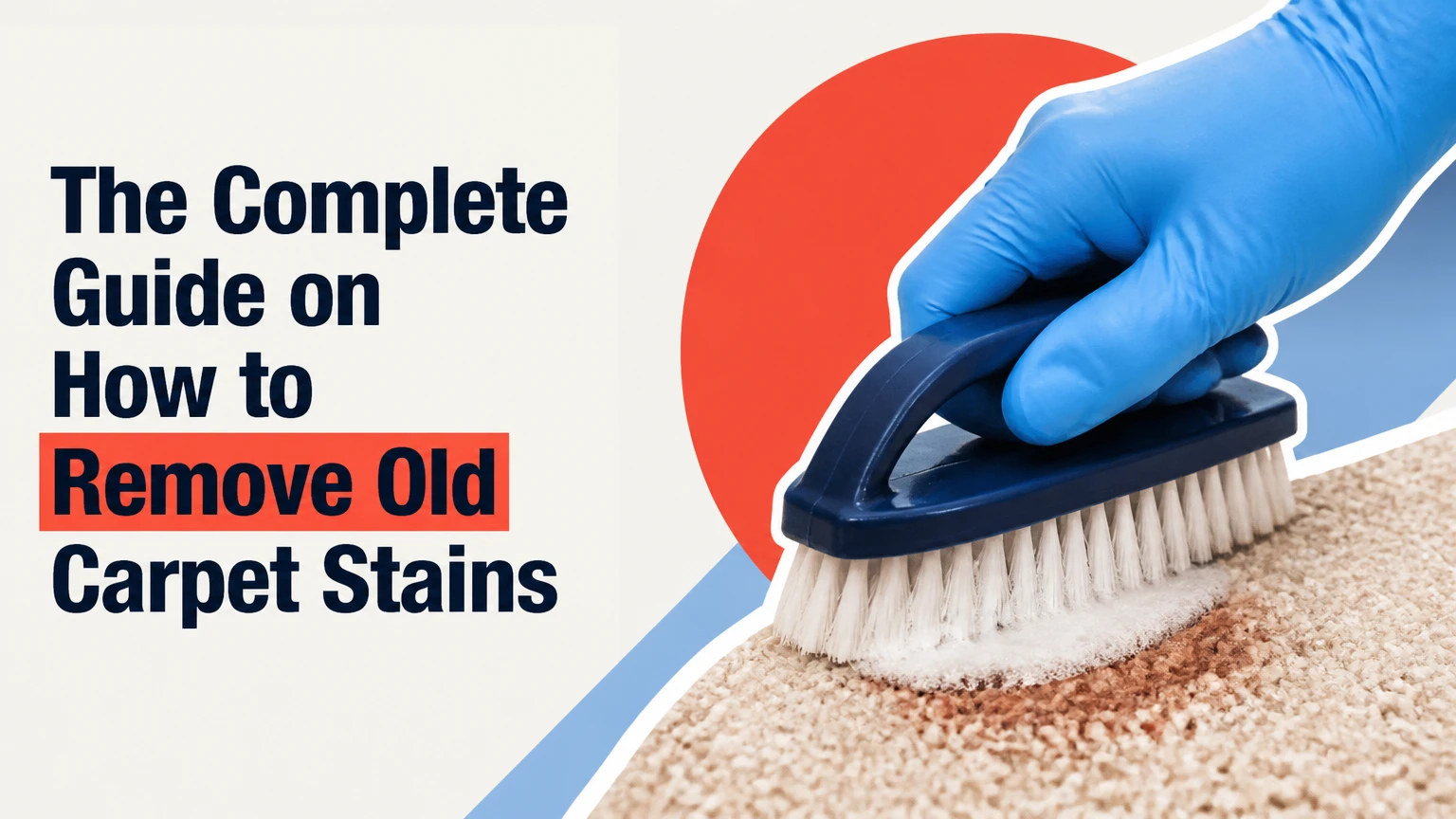
Knowing exactly how to remove old carpet stains can save you thousands of dollars in premature flooring replacement. This seven-step deep-cleaning restoration process breaks down hardened residues, lifts embedded pigments, and completely stops subsurface wicking. The entire process requires roughly 45 minutes of active labor. Your success depends entirely on one vital factor: practicing patient, repetitive moisture extraction rather than aggressive scrubbing.
Before You Start
Do not rush into applying liquids to an unidentified blemish. Gathering the exact materials prevents chemical damage to your flooring.
- Active Time Required: 45 minutes.
- Total Drying Time: 12 to 24 hours.
- Difficulty Level: Intermediate.
- Typical Cost: $15 to $45 for household supplies (excluding vacuum hardware).
- Prerequisite Skills: Ability to safely operate a wet/dry vacuum and correctly measure liquid dilutions.
Essential Tools and Materials
| Item | Quantity or Specification | Typical Cost | Purpose |
| White Microfiber Cloths | 4 to 6 clean cloths | $8 to $12 | Absorbs pigment without transferring dye to the carpet. |
| Wet/Dry Vacuum | Minimum 3 Peak HP (or extractor) | $50 to $150 | Pulls contaminated liquid from the deep padding. |
| Clear Liquid Dish Soap | 1 tablespoon (Dawn preferred) | $4 to $6 | Acts as a surfactant to break down surface oils. |
| White Distilled Vinegar | 1/4 cup (strictly 5% acidity) | $3 to $5 | Dissolves alkaline salts and neutralizes odors. |
| Baking Soda | 1/4 cup per 6-inch stain | $2 to $4 | Absorbs deep odors and provides mild dry abrasion. |
| Hydrogen Peroxide | 2 tablespoons (3% concentration) | $3 to $5 | Oxidizes stubborn organic pigments (light carpets only). |
| Tap Water | 2 cups (100°F to 120°F maximum) | Free | Dilutes chemicals and rinses the carpet fibers. |
Understanding Carpet Fiber Types and Stain Bonding
Before applying any chemistry, you must understand what you are cleaning. According to guidelines published by the Carpet and Rug Institute (CRI), different fibers react violently to incorrect chemical applications.
Nylon is the most common residential carpet material. It is highly durable but acts like a sponge for acid-based dyes. If you spill red wine on nylon and wait a year, the dye physically bonds to the fiber’s receptor sites. Polyester, conversely, resists liquid dyes but bonds instantly with oils. An old grease spot on polyester requires more dish soap and less vinegar. Wool is a natural protein fiber. It is highly sensitive to alkaline solutions. Applying high-pH chemicals to wool will cause permanent yellowing and structural brittleness.
You must also establish water temperature limits. The Institute of Inspection, Cleaning and Restoration Certification (IICRC) S100 standard dictates specific thermal boundaries for carpet care. Using boiling water on a synthetic carpet melts the fibers. Using hot water (above 140°F) on a protein stain, such as old blood or dairy, permanently cooks the protein into the yarn bundle. Always use warm water between 100°F and 120°F.
Process Summary
| Step | Action | Active Time | Most Common Mistake |
| 1 | Identify and Patch Test | 10 minutes | Skipping the test and bleaching the carpet. |
| 2 | Dry Extract the Debris | 15 minutes | Wetting the stain before vacuuming dry chunks. |
| 3 | Apply Cleaning Solution | 5 minutes | Drenching the carpet pad with excess liquid. |
| 4 | Blot the Perimeter | 10 minutes | Scrubbing back and forth, which frays yarn. |
| 5 | Rinse and Machine Extract | 5 minutes | Leaving soapy residue behind to attract new dirt. |
| 6 | Force-Dry the Subsurface | 5 minutes | Letting it air dry, causing the stain to wick back up. |
| 7 | Fluff and Restore | 2 minutes | Leaving the fibers crushed and matted. |
Step-by-Step Cleaning Process
Step 1: Perform a Colorfastness Patch Test
Test your cleaning solution on a hidden area of the carpet before touching the actual stain.
Mix your intended cleaning solution (1 tablespoon of clear dish soap, 1/4 cup of white vinegar, and 1 cup of warm water) in a spray bottle. Find an inconspicuous area of your carpet, such as inside a closet or under a heavy piece of furniture. Spray a small amount of the solution onto this hidden spot. Press a damp white cloth firmly against the wet fibers for 30 seconds. Lift the cloth and inspect it under bright lighting.
You will know this step worked when the white cloth remains completely free of carpet dye, and the test patch shows no signs of bleaching or discoloration.
If you see carpet color transferring onto your white towel, stop immediately. Your carpet is not colorfast, and you must hire a professional dry-cleaning service.
Step 2: Dry Extract and Loosen the Debris
Remove all dry, crusty, and loose particulate matter from the carpet fibers before introducing any water.
Sprinkle a generous, opaque layer of dry baking soda directly over the old stain. Use roughly 1/4 cup of baking soda for every 6 inches of stain diameter. Take a soft-bristled brush or a clean old toothbrush and gently work the powder into the fibers using a tapping motion. Set a timer and let the powder sit undisturbed for exactly 15 minutes. Once the timer expires, attach a narrow crevice tool to your vacuum cleaner. Turn the machine to its maximum suction setting and thoroughly vacuum the white powder out of the carpet.
You will know this step worked when the carpet feels entirely dry to the touch and the crusty surface tension of the old stain is broken.
The most common mistake at this stage is adding water immediately. If you add liquid to dried mud or old food spills before vacuuming, you simply create a larger pool of liquid dye that sinks deeper into the carpet pad.
Step 3: Apply the Targeted Cleaning Solution
Saturate the stained fibers with your chemical mixture without penetrating the underlying carpet pad.
Ensure your spray bottle contains the mixture of 1 tablespoon clear dish soap, 1/4 cup 5% white vinegar, and 1 cup of warm water (100°F to 120°F). Hold the spray nozzle approximately 4 inches above the carpet surface. Mist the solution evenly over the stain, starting slightly outside the visible edge and working your way toward the center. Apply just enough liquid to dampen the yarn down to its base. Do not pour the liquid directly from a cup. Let the solution dwell on the stain for exactly 5 minutes to break down the hardened chemical bonds.
You will know this step worked when the hardened edges of the old stain begin to blur and soften into the surrounding liquid.
Do not drench the carpet. Soaking the carpet pad dissolves the latex adhesive holding the carpet backing together and triggers deep, hidden mold growth under your floorboards.
Step 4: Blot from the Perimeter Inward
Transfer the dissolved pigment from the carpet fibers into your towel using downward pressure.
Fold a clean, damp white microfiber cloth into a thick square. Press the cloth firmly directly onto the outer edge of the stain. Apply moderate body weight downward using the heel of your hand. Hold the pressure for 5 seconds, then lift the towel straight up. Check the bottom of the towel for transferred color. Rotate the towel to a completely clean, white section and press down on the next section of the stain, slowly moving toward the center. Continue this rhythmic blotting for 5 to 10 minutes.
You will know this step worked when the stain visibly lightens on the floor, and your towel is heavily soiled with the extracted pigment.
Never scrub the carpet back and forth. Scrubbing untwists the delicate yarn bundles. Once you fray synthetic or wool fibers, the texture changes permanently, leaving a fuzzy patch that looks like a permanent shadow.
Step 5: Rinse and Machine Extract
Flush the sticky soap residue out of the carpet and pull the suspended liquids into your vacuum.
Pour exactly 1/4 cup of clean, warm water directly over the treatment zone to dilute the remaining soap and vinegar. Immediately place the nozzle of your wet/dry vacuum or carpet extractor directly against the wet carpet. Drag the nozzle slowly across the damp area, applying firm downward pressure to create a tight suction seal. Run the vacuum nozzle over the exact same spot 4 to 5 times. Continue extracting until you look through the clear plastic nozzle head and see absolutely no more liquid passing into the machine.
You will know this step worked when the carpet feels only slightly damp to the touch, and there are no suds visible when you press your finger into the fibers.
Leaving soapy residue in the carpet is a catastrophic error. Dried dish soap acts as a dirt magnet, pulling dust from the air and from your shoes, causing a dark brown patch to appear in the exact same spot two weeks later.
Step 6: Force-Dry the Subsurface
Wick the final microscopic drops of moisture out of the deep carpet padding to prevent the stain from returning.
Place a fresh, bone-dry white towel directly over the slightly damp zone. Place a heavy, water-resistant object on top of the towel. A heavy frying pan, a sealed gallon jug of water, or a stack of thick books wrapped in a plastic garbage bag works perfectly. Leave this heavy weight in place for 6 to 12 hours (ideally overnight). The heavy object forces the dry towel tightly against the base of the fibers, creating a stronger capillary draw than the carpet itself.
You will know this step worked when you remove the weight the next morning and find the bottom of the towel slightly damp, while the carpet beneath it is entirely dry and stain-free.
If you skip this step and let the carpet air dry normally, the evaporation process at the surface pulls hidden liquids up from the deep padding. This phenomenon, known as wicking, causes old stains to magically reappear 24 hours after you finish cleaning.
Step 7: Fluff and Restore the Fibers
Reset the carpet pile to match the texture of the surrounding room.
Remove the heavy weight and the wet towel. Run your fingers briskly back and forth across the dried cleaning zone to separate the compressed yarn bundles. If the carpet feels slightly stiff, take your vacuum cleaner (switched back to its standard dry mode) and run the beater bar over the area for 30 seconds.
You will know this step worked when the treated area visually blends into the rest of the room and feels soft underfoot.
Common Mistakes and How to Fix Them
Even careful practitioners occasionally encounter setbacks when dealing with aged, chemically set blemishes. If your first attempt yields poor results, identify the failure mode below and execute the exact recovery procedure.
The Stain Returns After 24 Hours (Wicking)
The Cause: Liquid penetrated past the carpet backing into the foam underpad. As the surface of the carpet dried, it acted like a wick in a kerosene lamp, pulling the trapped, dirty liquid upward from the pad to the surface.
The Fix: You do not need soap for this recovery. Mist the surface lightly with clean, warm water to reactivate the mobility of the dye. Immediately place a thick, dry white towel over the spot. Weigh it down with 10 to 15 pounds of weight. Leave it undisturbed for a full 12 hours to physically pull the deep dye into the towel.
The Carpet Feels Crunchy or Sticky
The Cause: You failed to extract all the cleaning agents. A film of dried dish soap or baking soda remains coated on the fibers.
The Fix: Mix a 50/50 solution of warm water and white vinegar. The acid in the vinegar will neutralize the alkaline soap and dissolve the salt crystals. Spray the area generously, let it sit for 2 minutes, and extract it completely with your wet vacuum. Perform 5 to 6 dry vacuum passes to ensure zero moisture remains.
The Stain Did Not Budge (Organic Pigmentation)
The Cause: The spill contained strong organic dyes (like aged red wine, mustard, or old pet urine) that have chemically bonded with the fiber. Mild surfactants like dish soap cannot break this bond.
The Fix (Light Carpets Only): Mix 2 tablespoons of 3% hydrogen peroxide with a single drop of clear dish soap. Apply this directly to the stubborn spot. Let it sit for 30 minutes in direct ambient light (light accelerates the oxidation process). Blot the area firmly, rinse with clean water, and extract. Do not use this method on dark carpets, as peroxide will cause permanent bleaching.
A Foul, Musty Odor Develops
The Cause: Water reached the wooden subfloor or deep pad and failed to dry quickly enough, allowing anaerobic bacteria to multiply.
The Fix: You must force-dry the layers immediately. Rent or purchase a high-velocity portable floor fan or a compressor-based dehumidifier. Aim the airflow directly at the damp spot on maximum speed for 24 to 48 continuous hours. If the smell persists after two days, the carpet pad is permanently compromised and must be physically cut out and replaced.
Variations for Specific Situations
The standard extraction method requires adjustment based on the tools you own and the specific origin of the blemish.
How to Remove Stains Without a Wet Vacuum
If you do not own a machine extractor, you must rely entirely on gravity and mass. Follow the standard steps up to the extraction phase. Instead of using a machine, fold a highly absorbent cotton bath towel into a thick square and place it over the wet zone. Stand directly on top of the towel with your bare feet or clean shoes. Your full body weight will force the moisture up into the cotton. Step off, rotate to a dry section of the towel, and stand on it again. Repeat this until the towel comes away dry.
How to Treat Old Pet Urine
Standard dish soap and vinegar will clean the visible yellow mark of pet urine, but they cannot destroy the uric acid crystals trapped deep in the pad. When humidity rises, these crystals release ammonia gas. For this variation, replace the vinegar and soap mixture entirely with a commercial enzymatic cleaner. Enzymes are biological proteins that literally eat the uric acid crystals. Pour the enzyme cleaner heavily over the spot, cover it with a plastic tarp to prevent premature evaporation, and let it digest the organic material for 24 hours before extracting.
How to Clean Natural Wool Carpets
Wool is highly reactive to heat and alkalinity. If you are cleaning a genuine wool rug, you must drop the water temperature down to 70°F (room temperature). Furthermore, you must reduce the dish soap to 1/2 teaspoon per cup of water to keep the pH level strictly below 8.0. Never use hydrogen peroxide or ammonia on wool, as these chemicals dissolve the natural proteins and destroy the rug.
Time and Cost Expectations
Understanding the true investment of this project helps you decide whether to attempt it yourself or hire a professional.
- Time Investment: Setting up equipment and mixing chemicals takes 10 minutes. The physical labor of scrubbing, blotting, and vacuuming takes 20 to 30 minutes. The passive drying process takes 12 to 24 hours.
- Material Costs: If you already own a wet/dry vacuum, the chemical supplies (baking soda, vinegar, Dawn dish soap, peroxide) cost under $15.
- Professional Comparison: Hiring a certified carpet technician to remove a set-in stain typically costs between $100 and $150 for a minimum service call. If your carpet is made of sensitive materials like silk or hand-tufted wool, spending $150 for professional extraction is heavily advised to avoid ruining a $2,000 rug.
Frequently Asked Questions
Will baking soda and vinegar bleach my carpet?
No. Neither baking soda nor white vinegar contains bleaching agents. Vinegar is a mild acetic acid, and baking soda is a mild alkaline salt. When combined, they release carbon dioxide gas and create a neutral saltwater solution that will not remove commercial carpet dye.
How do you lift dried paint out of carpet fibers?
Latex paint requires a different chemical approach. Apply a citrus-based solvent (like Goof Off or rubbing alcohol) directly to the dried paint to soften the acrylic polymers. Let it sit for 10 minutes, then gently scrape the softened paint away with a dull butter knife before vacuuming.
Can I use a steam mop to remove old stains?
You should never use a hard-floor steam mop on carpets. Steam mops operate at 212°F (100°C), which will melt synthetic nylon or polyester fibers. Furthermore, the extreme heat permanently cooks protein-based soils into the yarn, making the stain impossible to remove.
Why does the carpet look darker after I clean it?
A dark shadow indicates cellulosic browning or soap residue. If you left soap in the fibers, it attracts dirt. If the carpet stayed wet too long, the jute backing released natural brown dyes that wicked to the surface. Both issues require a thorough rinse and rapid force-drying.
Final Thoughts
Learning how to remove old carpet stains is a mechanical skill that relies on patience rather than harsh chemicals. By identifying your fiber type, strictly controlling your water temperatures, and obsessively extracting every drop of moisture, you can reverse years of neglect. Remember to always work from the outside of the perimeter inward, avoid aggressive friction, and utilize heavy weights overnight to stop wicking in its tracks. Armed with these techniques, you can safely restore the appearance of your flooring without relying on expensive professional interventions.