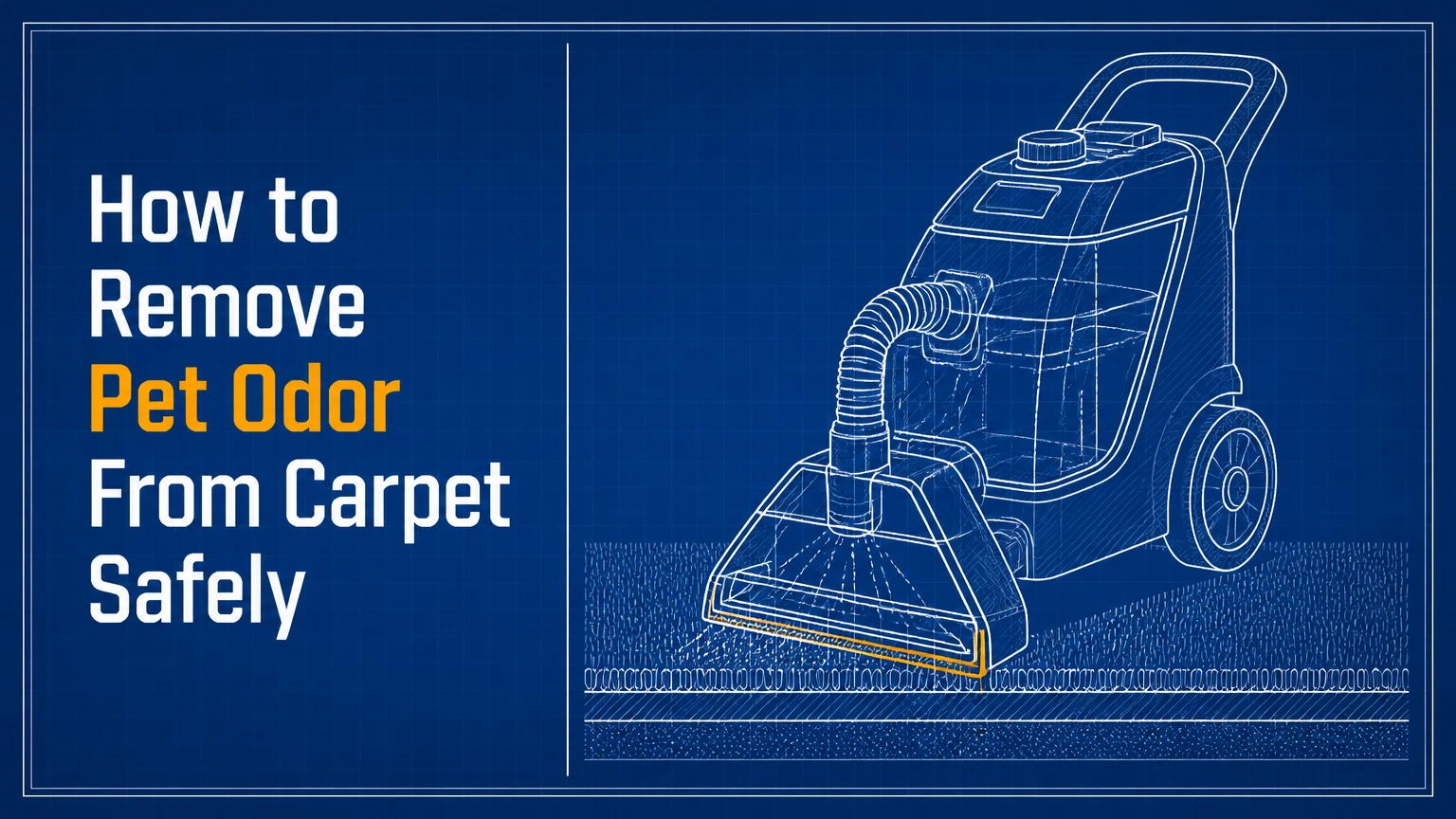
To remove pet odor from carpet, first absorb fresh moisture, then apply a carpet-safe enzymatic cleaner deeply enough to reach the backing and pad, allow the labeled dwell time, extract excess liquid, and dry the area completely. Old or recurring odors may require sub-surface extraction, pad replacement, or professional remediation rather than repeated surface spraying.
Key facts at a glance
- Pet urine odor returns when dried residue remains in carpet backing, padding, or subfloor cracks.
- Enzymatic cleaners work best on urine, feces, vomit, and other protein-containing organic soils when the area stays damp for the labeled dwell time.
- A visible urine mark can underestimate the contaminated area because liquid spreads sideways through the backing and pad.
- Baking soda absorbs some surface odor but does not reliably remove urine residue below the carpet face.
- Steam is not automatically unsafe, but heat and moisture can spread contamination or delay drying when used before proper extraction.
- Wool, silk, viscose, jute-backed, and hand-dyed carpets need fiber-specific products or professional cleaning.
What Causes Pet Odor in Carpet?
Pet odor comes from organic residue trapped in carpet fibers, backing, padding, or the subfloor. Urine contributes urea, salts, uric-acid residues, proteins, and odor-producing compounds; feces and vomit add proteins, fats, digestive material, and bacteria; dander contributes skin oils and proteins.
Fresh urine smells because volatile compounds are present in the liquid. As urine dries, water evaporates while less-volatile salts and uric-acid residues remain. Humidity can dissolve or reactivate those residues, which explains why a carpet may smell again on rainy days or after steam cleaning.
The carpet face is only one layer. A urine puddle can penetrate the primary backing, adhesive, cushion, and floor beneath. Cat urine often creates a stronger, more persistent odor because cats produce concentrated urine and may return to the same scent-marked location.
Why does carpet smell worse after it dries?
Carpet can smell worse after drying when cleaning has dissolved odor compounds without removing them, or when moisture has reactivated residue in the pad. A temporary increase during enzyme treatment can be normal, but a strong odor that remains after 24-48 hours usually indicates incomplete extraction, deeper contamination, or a second untreated spot.
How Does Pet Odor Removal Work?
Pet odor removal combines chemical breakdown with physical removal. An enzyme product changes or digests organic residues, while blotting and water extraction physically remove the dissolved material from carpet and padding.
Enzymatic cleaners target biological soils such as urine proteins, feces, and vomit. The formulation may contain enzymes, microorganisms, surfactants, or odor counteractants, so the word “enzyme” alone does not establish performance. The product label should identify the intended soil and carpet materials.
Oxidizing cleaners use ingredients such as hydrogen peroxide or percarbonate to alter odor and stain molecules. They can work quickly on some synthetic carpets, but they may lighten dyes or damage wool, silk, viscose, and unstable natural fibers.
Encapsulation products surround soil in a polymer film that dries into removable particles. Encapsulation is useful for routine carpet maintenance, but it is poorly suited to a urine pool that has soaked through the pad. Surfactants loosen oils and soil; extraction then carries the loosened material away.
Which method works best for pet odor?
For a localized urine accident on synthetic carpet, a properly applied enzymatic cleaner followed by extraction is usually the best first method. For contamination throughout the pad, mechanical extraction or carpet removal is more effective. Oxidizers suit some severe synthetic-fiber stains, while encapsulation and baking soda mainly address surface soil.
| Method | Best use | Typical dwell or process time | Main limitation |
|---|---|---|---|
| Enzymatic cleaner | Fresh or old urine, feces, vomit | 15 minutes to 24 hours | Needs sustained moisture and correct coverage |
| Oxygen-based oxidizer | Stained synthetic carpet | 5-60 minutes | Can alter dyes and damage sensitive fibers |
| Portable extractor | Dissolved residue and excess liquid | 15-45 minutes per spot | Does not chemically break down dry crystals alone |
| Encapsulation cleaner | Routine surface soil and mild odor | 10-30 minutes drying | Usually cannot reach a saturated pad |
| Professional remediation | Multiple rooms or subfloor contamination | 3-8 hours onsite | Higher cost and scheduling required |
What Do You Need Before Cleaning?
A typical single-spot treatment takes 30-60 minutes of active work and 8-24 hours of drying. The largest success factor is treatment depth: the cleaner must reach every layer that received urine, while the carpet must still dry quickly enough to avoid mildew or backing damage.
Before you start
| Item | Typical amount or specification | Purpose |
|---|---|---|
| White absorbent towels | 6-12 towels | Blotting without transferring dye |
| Enzymatic carpet cleaner | 250-1,000 milliliters per spot | Treating organic residue |
| Wet-dry vacuum or extractor | 1 machine with upholstery or floor tool | Removing dissolved contamination |
| UV flashlight | 365-395 nanometers | Locating suspected urine deposits |
| Nitrile gloves | 1 pair per cleaning session | Skin protection |
| Fan or air mover | 1 unit per 10-20 square meters | Faster drying |
| Plastic or washable barrier | 1 laundry basket or gate | Preventing re-soiling |
Check the carpet manufacturer’s care instructions before applying liquid. Test the cleaner in a hidden area, such as inside a closet, and wait until it dries before judging color stability. Keep pets and children away until the treated carpet is dry and the product label permits access.
How to Remove Pet Odor From Carpet Step by Step
The following process is for a localized accident on a reasonably colorfast synthetic carpet. It is not a substitute for a professional assessment when urine has soaked through the pad or reached wood flooring.
Step 1: Locate and assess the contamination
Find the visible mark, then inspect a wider area with a UV flashlight in a dark room. A 365-395 nm light may reveal yellow-green fluorescence, but optical brighteners, detergents, food, and some fibers can also fluoresce, so confirm suspected urine by odor and location.
Mark the perimeter with removable painter’s tape. Inspect around furniture legs, room edges, rugs, and previous accident sites because animals often re-mark locations humans cannot smell easily.
Estimate depth before adding liquid. A small fresh spot on the carpet face needs less treatment than a large, repeated puddle that has reached the pad. Do not assume a bright UV patch shows the entire contaminated area.
Success checkpoint: The suspected area is mapped at least 5-10 centimeters beyond the visible mark, and furniture that may conceal additional spots has been moved.
Common mistake: Treating only the brightest UV patch can leave the odor source at its edges.
Step 2: Absorb fresh moisture
Put on gloves and press folded white towels firmly into a fresh accident. Replace saturated towels and continue applying pressure until a new towel absorbs little or no liquid.
Do not scrub. Rubbing spreads urine sideways, damages carpet pile, and forces liquid into the backing. If the accident is large, use a wet-dry vacuum or extractor without detergent first, moving slowly enough to remove liquid rather than merely spreading it.
Success checkpoint: The carpet feels damp rather than wet, and towels no longer become visibly saturated under firm pressure.
Common mistake: Using colored towels can transfer dye, while a household vacuum that is not designed for liquids can create an electrical hazard.
Step 3: Apply enough enzyme cleaner
Choose an enzymatic product whose label specifically permits use on your carpet fiber. Apply enough liquid to reach the depth of the original contamination, extending 5-10 centimeters beyond the visible perimeter. A light mist is suitable for a surface smear, not a urine puddle.
For a spot approximately 30 by 30 centimeters, a typical starting volume is 250-500 milliliters on synthetic carpet, but the manufacturer’s directions control because formulas differ. If the pad is saturated, professional injection or controlled sub-surface extraction may be necessary.
Keep the area damp for the labeled dwell time, commonly 15-30 minutes for fresh surface soil and several hours for dried urine. Some biological products specify 8-24 hours. Do not combine enzyme cleaner with bleach, ammonia, peroxide, vinegar, disinfectant, or another cleaner because the second product may deactivate the formulation or create hazardous fumes.
Success checkpoint: The cleaner has visibly wetted the affected carpet depth, reached beyond the stain edge, and remained damp for the full label period.
Common mistake: Applying a few sprays to a deep stain gives the product no contact with the dried residue in the backing or pad.
Step 4: Extract dissolved residue
Blot with clean towels or use a wet-dry vacuum designed for liquid recovery. A portable carpet extractor can remove more liquid than towels, especially from dense pile, but make slow passes and empty the recovery tank when dirty water accumulates.
If the product label permits rinsing, use a small amount of clean, lukewarm water and extract again. Excessive rinsing can spread contamination and soak the pad. The goal is removal, not flooding.
Success checkpoint: Extracted liquid becomes clearer, the treated area no longer feels squishy, and no liquid transfers when a dry towel is pressed onto the carpet.
Common mistake: Leaving detergent and dissolved urine in the carpet can create sticky residue that attracts new soil and odor.
Step 5: Dry the carpet and pad completely
Place a fan so air moves across the carpet surface, not directly downward into the pad. Increase ventilation, operate a dehumidifier when indoor humidity is high, and lift furniture legs if they sit over the damp area.
Drying may take 8-24 hours for a surface treatment and 24-48 hours when the pad was wetted. Avoid covering the carpet with plastic because trapped humidity slows evaporation. A ventilated laundry basket can keep pets away while allowing airflow.
Success checkpoint: The carpet feels dry at the surface and backing, has no cool dampness after several hours, and produces no odor when the room is closed overnight.
Common mistake: Releasing the pet before the carpet dries can cause re-marking and make it impossible to determine whether the original odor was removed.
Which Carpet Cleaner Should You Choose?
The best cleaner depends on the contaminant, carpet fiber, stain age, and contamination depth. Product brands matter less than a label that identifies the correct soil, discloses precautions, supports the carpet fiber, and gives a measurable dwell time.
| Cleaner category | Suitable carpet | Typical use | Avoid or verify first |
|---|---|---|---|
| Biological enzyme formula | Nylon, polyester, olefin | Urine, feces, vomit | Wool, silk, and unknown dye stability |
| Hydrogen-peroxide formula | Colorfast nylon or polyester | Severe stains and odor | Dark dyes, wool, silk, viscose |
| Neutral extraction detergent | Most manufacturer-approved synthetics | Rinsing and soil removal | Overuse on absorbent pad |
| Wool-safe acidic formula | Wool when label-approved | Natural-fiber spot treatment | Generic high-pH enzyme products |
| Baking soda | Dry surface odor only | Short-term absorption | Deep urine and wet carpet |
| Vinegar solution | Limited surface odor reduction | Small non-urine residues | Mixing with peroxide or bleach |
Which home remedies help?
Baking soda can reduce a mild, dry surface smell after the carpet is completely dry, but it does not dissolve or extract uric-acid residue in the pad. Sprinkle a thin layer, leave it for several hours, and vacuum thoroughly; do not use it on wet carpet because paste can enter the pile and leave residue.
Vinegar can reduce some alkaline surface odors through acid-base chemistry, but vinegar is not a reliable substitute for an enzyme treatment on old urine. Never mix vinegar with bleach, peroxide, or commercial cleaners unless the label explicitly permits the combination.
Dish soap creates foam and residue that can be difficult to rinse from carpet. Hydrogen peroxide may lighten dye. Home remedies therefore suit small, confirmed surface residues, not repeated accidents or saturated padding.
How Long Does Pet Odor Removal Take and Cost?
A fresh, localized accident usually takes 30-60 minutes of active work and 8-24 hours to dry. Typical professional costs range from about $100-$300 per room in the United States, while pad replacement, subfloor treatment, or carpet removal can raise the project total substantially.
| Situation | DIY active time | Typical drying time | Typical cost range |
|---|---|---|---|
| Fresh 30 cm spot | 20-40 minutes | 8-16 hours | $10-$30 in supplies |
| Old localized urine spot | 45-90 minutes | 12-36 hours | $15-$60 in supplies |
| Portable extractor treatment | 1-3 hours per room | 12-36 hours | $30-$80 rental |
| Multiple contaminated rooms | 3-8 hours | 24-48 hours | $100-$300 per room professionally |
| Pad and subfloor remediation | 1-2 days | 24-72 hours | $300-$1,500 or more |
Prices vary by country, access, room size, equipment, and whether the carpet pad must be removed. A low advertised cleaning price may exclude urine treatment, odor inspection, subfloor sealing, or disposal.
What Changes for Cat Urine, Vomit, and Feces?
Cat urine needs deeper inspection because concentrated salts and repeated marking can contaminate the pad and subfloor. Dog urine can create the same structural problem when accidents are large or frequent, so pet species alone should not determine treatment volume.
Vomit should be removed quickly with a scraper or spoon, then blotted and treated with a suitable enzyme or protein-soil product. Feces require solid removal, detergent cleaning, controlled disinfection where the label allows, and complete drying. Wear gloves and wash hands after handling either material.
How do you handle old urine in carpet padding?
Old urine in carpet padding usually requires enough controlled treatment to reach the pad, followed by extraction and rapid drying. If odor returns after two complete treatments, lift a carpet edge and inspect the pad, tack strip, and subfloor rather than repeatedly spraying the carpet face.
Porous wood subfloors may absorb urine and need cleaning, drying, and a compatible odor-sealing coating. Concrete can retain odor in pores and joints. Carpet pad that is visibly discolored, brittle, or strongly odorous often needs replacement because cleaning cannot reliably remove every contaminated pocket.
Is Steam Cleaning Safe for Pet Odor?
Steam cleaning is not automatically harmful, but it is a poor first response to a heavily saturated urine spot. Heat and added moisture can redistribute residue, delay drying, and drive odor through the room, while some dyes and adhesives are heat-sensitive.
Professional hot-water extraction can remove substantial soil when the technician uses the correct prespray, temperature, rinse, vacuum recovery, and drying controls. The problem is usually uncontrolled household steaming before the contamination has been chemically treated and physically extracted.
For home treatment, use an enzyme product first, follow its label, and use a liquid extractor with lukewarm or manufacturer-approved water. Always follow the carpet warranty and care instructions.
Common Mistakes and How to Fix Them
| Mistake | Why it fails | Recovery |
|---|---|---|
| Spraying only the carpet surface | The pad remains contaminated | Reassess depth and use controlled saturation or extraction |
| Using ammonia cleaner | Ammonia resembles a urine odor cue | Rinse and extract, then use a compatible enzyme product |
| Mixing cleaning chemicals | Reactions can create fumes or deactivate products | Stop, ventilate, and follow the most restrictive label |
| Adding too much soap | Residue attracts soil and holds odor | Rinse lightly if permitted, then extract thoroughly |
| Covering wet carpet | Trapped humidity slows drying | Remove cover, add airflow, and monitor the pad |
| Repeating treatments indefinitely | The source may be below the carpet | Inspect pad, tack strip, and subfloor |
One counterintuitive rule matters: more cleaner is not always better. More liquid helps only when the product reaches the contamination and can later be extracted; otherwise, extra moisture increases wicking, browning, adhesive damage, and drying time.
Another practitioner rule is to judge success after the carpet dries, not while the product is wet. Fragrance can temporarily mask odor, and enzyme activity can release volatile compounds before extraction and drying finish.
What If the Odor Keeps Coming Back?
A returned odor identifies a location or process problem, not necessarily a defective cleaner. Diagnose the failure in order: untreated perimeter, contaminated pad, subfloor absorption, damp carpet, residue, or a new accident.
- Close the room overnight and check whether odor increases with humidity.
- Scan a wider area with a UV light and inspect adjacent rugs and furniture.
- Press a dry towel into the carpet to detect residual moisture.
- Review the product label, dwell time, treatment volume, and extraction method.
- Lift a carpet edge if safe and inspect the pad and flooring.
- Call a professional when odor spans multiple rooms or follows floor seams.
Renters should photograph the affected area, report recurring moisture promptly, and ask the landlord before lifting carpet or applying a sealer. Unauthorized pad replacement or chemical treatment can affect a security deposit.
How Can You Prevent Future Carpet Odor?
Prevention starts with removing the scent cue quickly and addressing why the accident occurred. Block access until the carpet is dry, clean washable bedding and nearby soft furnishings, and use an enzymatic product on every confirmed marking site.
For multi-pet homes, inspect high-risk areas monthly with a UV light, especially near doors, litter boxes, feeding areas, and corners. Place washable runners over repeat pathways, keep litter boxes clean, and use gates during unsupervised periods.
A sudden increase in urination, defecation, or marking can indicate illness, stress, mobility problems, or litter-box aversion. A veterinarian should assess a new or persistent pattern instead of treating the carpet as the only problem.
When Should You Call a Professional?
Professional remediation is appropriate when odor covers multiple rooms, the pad is saturated, the subfloor smells, the carpet is wool or silk, or two correctly performed treatments fail. A qualified technician should inspect with moisture measurement, identify carpet and pad construction, and explain whether treatment, pad replacement, subfloor sealing, or carpet removal is necessary.
Ask for a written scope that separates cleaning, odor treatment, extraction, pad replacement, sealing, furniture movement, and disposal. Confirm the products are approved for the fiber and request the expected drying time. The cheapest quote may omit the layer holding the odor.
FAQ
Can I remove pet odor without replacing the carpet?
You can often remove a localized odor without replacing carpet when contamination is fresh, the pad is not saturated, and the carpet is colorfast. Deep or repeated urine can permanently contaminate padding and subfloor materials, making pad replacement or carpet removal more reliable than repeated surface treatments.
How do I remove pet odor from a carpet without a machine?
Blot fresh liquid with white towels, apply a label-approved enzymatic cleaner, maintain the required dwell time, and extract by pressing dry towels repeatedly. A machine improves recovery, but towel extraction can work for a small spot if you prevent over-wetting and dry the area with strong airflow.
Will carpet powder remove dog or cat urine smell?
Carpet powder may absorb surface moisture and loosen dry soil, but it rarely removes urine odor from backing or padding. Vacuum powder thoroughly after use, and choose an enzyme treatment or extraction process when the smell returns after humidity rises or the carpet dries.
Why does my carpet smell like wet dog after cleaning?
A wet-dog smell after cleaning usually comes from damp backing, retained pet oils, detergent residue, or insufficient drying. Increase airflow, extract compatible rinse water, and check moisture below the pile. If the odor persists after complete drying, inspect the pad and subfloor for older contamination.
Can pet odor damage carpet?
Pet urine can stain carpet, weaken some backings, corrode metal components, and damage wood subfloors when exposure is repeated. Odor itself does not always mean structural damage, but recurring wetness, browning, delamination, or a soft floor warrants professional inspection.
Is enzyme cleaner safe around pets?
An enzyme cleaner is safe around pets only when the specific product label permits it and the treated carpet is dry. Keep animals away during application and dwell time, provide ventilation, and never allow a pet to lick wet cleaning solution or contaminated carpet.
The Bottom Line
The reliable way to remove pet odor from carpet is to identify the full contaminated area, absorb fresh liquid, apply a compatible enzymatic cleaner deeply enough to contact the residue, extract the dissolved material, and dry every layer completely. Baking soda may help a mild surface smell, but recurring urine odor usually requires pad or subfloor assessment. Use the exact product label, avoid chemical mixing, and choose professional remediation when contamination is deep, widespread, or associated with delicate carpet.