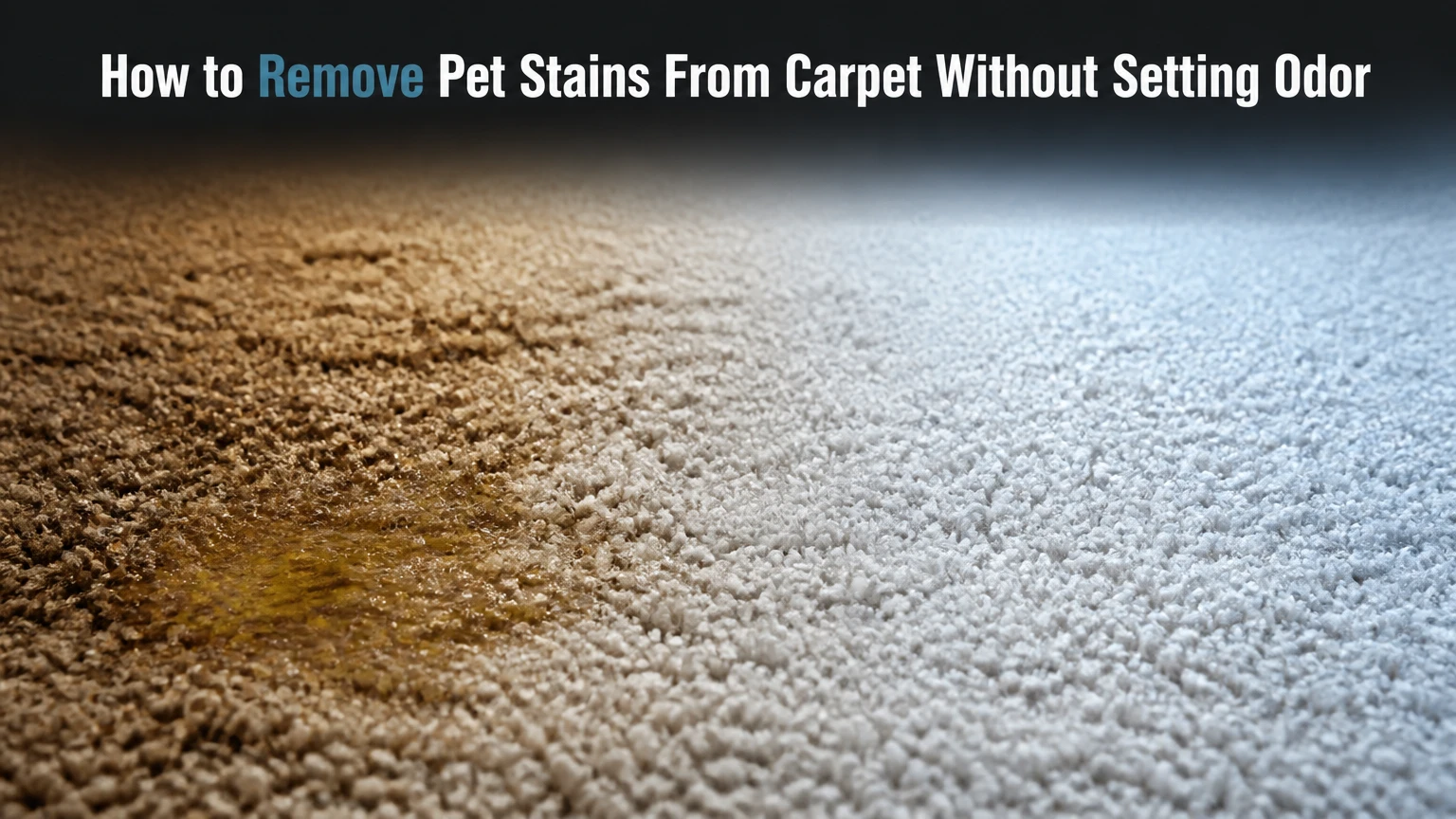
Pet stains come out of carpet most reliably when you remove solids, blot liquid, apply a carpet-labeled enzymatic cleaner to the full contaminated area, and extract moisture without heat. Fresh accidents often take 15-30 minutes to treat and 12-24 hours to dry; old urine may require repeated treatment or professional extraction because odor can remain in the pad or subfloor.
Key Facts at a Glance
- Enzymatic cleaners are the first choice for fresh dog or cat urine because they target organic urine residues rather than merely masking odor.
- Blotting removes liquid; scrubbing spreads contamination through carpet yarn, backing, and padding.
- A visible stain can be smaller than the contaminated area, especially after urine wicks sideways through the pad.
- Hydrogen peroxide can lighten dyes, so test a hidden area and avoid it on wool, silk, dark fibers, or unstable dyes.
- Heat does not reliably remove urine odor and can damage fibers, set some colorants, or create excessive moisture.
- Returning odor usually indicates remaining contamination or wicking, not that the carpet has become permanently smelly.
What Counts as a Pet Stain?
A pet stain is organic contamination from urine, feces, vomit, saliva, or a regurgitated food mixture embedded in carpet fibers or carpet construction. Urine is primarily an odor and re-marking problem, while feces and vomit usually create visible protein, pigment, and lipid residues.
Carpet has several layers that affect the result: face yarn, primary backing, adhesive, secondary backing, pad, and sometimes a wood or concrete subfloor. A surface spray may remove discoloration from the face yarn while leaving urine salts below it. That is why a clean-looking patch can smell again when humidity rises.
The Carpet and Rug Institute’s consumer guidance uses the practical rule, “Blot, don’t rub,” because rubbing forces wet contamination into the pile and can distort the yarn. Follow the carpet manufacturer’s care instructions first, particularly for wool, viscose, antique rugs, and carpets with natural dyes.
Why Does Urine Smell Worse After It Dries?
Dried urine smells worse after moisture reactivates concentrated urine salts and releases odor compounds from the carpet backing or pad. Uric acid deposits can remain below the visible fibers, so ordinary detergent may improve appearance without removing the odor source.
Cat urine often needs more intensive treatment than a small dog accident because cats may repeatedly use one location and urine can penetrate deeply. A black light can help locate some dried residues, but it is not a chemical test: optical brighteners, cleaners, and fibers can also fluoresce.
How to Remove Pet Stains From Carpet Safely
To remove a fresh pet stain, contain the pet, lift solid material, blot from the outside inward, apply a carpet-safe enzyme product to the contaminated zone, allow the label-specified dwell time, then absorb and air-dry the area. The decisive factor is reaching all affected layers without damaging the carpet fiber or backing.
Before You Start
| Requirement | Typical specification | Why it matters |
|---|---|---|
| Initial response time | Within 5 minutes | Limits sideways wicking and fiber discoloration |
| Household treatment time | 15-30 minutes | Covers removal, application, and first extraction |
| Drying time | 12-24 hours | Allows odor assessment after moisture leaves |
| Enzymatic cleaner | 250-500 mL | Provides enough product for a 30-60 cm spot |
| White towels | 6-10 pieces | Prevents dye transfer and permits repeated blotting |
| Disposable gloves | 1 pair, nitrile | Limits contact with biological waste |
| Absorbent scraper | 1 plastic card or spoon | Lifts solids without cutting carpet yarn |
| Air movement | 1 fan, 30-60 cm away | Reduces drying time and wicking |
Never combine enzyme products with bleach, ammonia, peroxide, vinegar, or another disinfectant unless the product label specifically permits the combination. Chemical mixing can deactivate the cleaner or release irritating vapors.
Step 1: Remove Solids and Protect the Area
Put on gloves, keep children and animals away, and lift feces or vomit with a plastic scraper, spoon, or several folded towels. Work from the outside edge toward the center so the waste does not spread across clean carpet.
Place solids in a sealed bag. Do not press a dry towel onto a large solid mass because pressure can drive protein and fat into the pile. If the material has dried, place a barely damp white towel over it for 5-10 minutes, then lift it gently.
You’ll know this step worked when: no bulk material remains and the surrounding carpet is still dry.
Common mistake: using a metal knife or stiff brush, which can cut loops or pull tufts from the backing.
Step 2: Blot Liquid From the Outside Inward
Fold a white towel into a thick pad and press it firmly over the stain for 10-15 seconds. Replace the towel as soon as it becomes wet, then repeat until little liquid transfers.
For a urine puddle larger than 30 cm across, stand on a towel-covered area for 10 seconds if the carpet construction is sound and the manufacturer allows it. Do not twist, scrub, or rub. Pressure extracts liquid; lateral movement spreads it.
| Stain condition | First blotting target | Typical towel quantity | Immediate checkpoint |
|---|---|---|---|
| Fresh cat urine, 15 cm spot | 2-4 minutes | 4-6 towels | Towel shows pale moisture, not a wet patch |
| Fresh dog urine, 30 cm spot | 5-8 minutes | 6-10 towels | No liquid beads appear after pressure |
| Watery vomit, 20 cm spot | 3-5 minutes | 4-8 towels | Solids are removed before cleaner |
| Loose feces residue, 10 cm spot | 1-3 minutes | 2-4 towels | No brown transfer remains on a dry towel |
You’ll know this step worked when: the towel absorbs moisture without spreading the stain’s edge.
Common mistake: using colored paper towels. Dyes can transfer into light carpet when the area becomes wet.
Step 3: Test the Cleaner on a Hidden Section
Apply one teaspoon of the selected product to an inconspicuous area, such as beneath furniture, and wait 10 minutes. Blot it dry, then compare color, texture, and backing adhesion with an untreated section.
Use a product labeled for carpet and appropriate for the fiber. Wool and plant-based fibers need extra caution because alkaline formulas, oxidizers, and prolonged moisture can cause color change, browning, shrinkage, or texture distortion.
You’ll know this step worked when: the test area has no color transfer, lightening, sticky residue, or altered texture.
Common mistake: testing only for bleaching while ignoring residue. A sticky patch can attract soil even when its color remains unchanged.
Step 4: Apply Enzymatic Cleaner Across the Full Contamination Zone
Choose a biological or enzymatic carpet cleaner for urine and other organic residues. Apply enough product to reach the depth of the accident, extending approximately 5-10 cm beyond the visible edge when the spill is fresh and farther when urine has soaked into the pad.
Do not rely on a light mist for a saturated accident. A spray bottle may wet only the yarn tips, while the odor source remains in the backing. Conversely, flooding a large area can create delamination, prolonged drying, or wicking. Match the quantity to the product label and carpet construction.
Most enzyme products need a damp dwell period of 10-30 minutes, but label directions control because formulations differ. Enzymes do not literally “consume ammonia” in every product; microorganisms or enzymes target particular organic residues, and odor reduction depends on contact, temperature, moisture, and adequate coverage.
You’ll know this step worked when: the cleaner has contacted the entire affected zone and remains damp for the labeled dwell time.
Common mistake: neutralizing or rinsing the enzyme immediately. Early removal shortens contact time and leaves residues untreated.
Step 5: Extract Cleaner and Contamination With Towels
Cover the treated area with clean white towels and press downward. For a small spot, place a waterproof plastic layer over the towels and add a flat, weighted object for 30-60 minutes, checking that the carpet is not being crushed or kept wet unnecessarily.
Remove the weight, replace saturated towels, and repeat until the towels are only slightly damp. A wet vacuum can improve extraction if it is designed for carpet and used according to its instructions. Avoid repeatedly soaking the area with clean water, because rinsing can move dissolved urine into the pad.
You’ll know this step worked when: a fresh towel remains nearly dry after firm pressure and no cleaner pools around the spot.
Common mistake: using a heavy object directly on wet carpet. Unprotected weight can transfer dye, flatten pile, or damage backing.
Step 6: Dry the Carpet Completely
Open windows when outdoor humidity is reasonable, run a fan across the surface, and keep pets away until the carpet is dry. Do not use a steam mop, hair dryer, iron, or high-temperature blower on an untreated urine stain.
Drying commonly takes 12-24 hours for a small treated area and longer when the pad was saturated. Check the surface, backing edge, and nearby floor with a dry hand or towel. Odor evaluation before complete drying is unreliable because moisture temporarily changes the odor profile.
You’ll know this step worked when: the carpet feels the same temperature and texture as the surrounding area, a dry towel stays dry, and odor does not return after several hours.
Common mistake: replacing furniture before drying. Furniture blocks airflow and can trap moisture against the backing.
Which Pet-Stain Cleaner Should You Use?
Enzymatic cleaners are the best first option for urine, while oxygen-based products can help with some color residues from vomit or feces after a patch test. Professional hot-water extraction is the better choice when contamination has reached the pad, subfloor, or a large area.
| Method | Active mechanism | Typical contact or service time | Main risk | Best application |
|---|---|---|---|---|
| Enzymatic cleaner | Enzymes or microbial action on organic residues | 10-30 minutes contact; 12-24 hours drying | Incomplete results if the area is under-wetted | Fresh urine and organic odor |
| Oxygen-based cleaner | Oxidation of some colored residues | 5-30 minutes, label dependent | Dye loss on dark or natural fibers | Light synthetic carpet with vomit residue |
| Neutral detergent | Surfactants lift soil and fats | 5-10 minutes | Residue can attract soil | Surface residue after solids removal |
| Portable extractor | Vacuum removal of dissolved soil and liquid | 15-45 minutes per spot | Over-wetting and slow drying | Medium accidents on synthetic carpet |
| Professional extraction | Pressurized rinse plus high-volume vacuum | 1-3 hours per room | Poor technique can leave moisture | Deep, repeated, or widespread contamination |
“Steam cleaning” is commonly used for professional carpet cleaning, but many systems primarily use hot-water extraction. A truck-mounted unit may heat its solution substantially, yet the actual temperature at the carpet and the suitability of heat depend on equipment, fiber, backing, and chemical formulation. The 100-120°C figures sometimes quoted for equipment do not mean the carpet itself should receive that temperature.
Can Vinegar, Baking Soda, or Dish Soap Remove Pet Odor?
Vinegar, baking soda, and dish soap are limited alternatives rather than reliable cures for urine in carpet padding. Vinegar can alter odor temporarily, baking soda can absorb some surface odor, and dish soap can lift fats, but none reliably digests or extracts uric residues deep in the carpet system.
If no enzyme product is available, blot thoroughly with water only, extract the moisture, and dry the carpet rather than layering household chemicals. A small amount of unscented detergent may help with surface vomit residue, but excess soap creates residue that attracts soil and complicates later professional cleaning.
How Do Urine, Vomit, and Feces Differ?
Urine requires odor-source removal, vomit requires rapid solid and protein removal, and feces requires hygienic removal followed by targeted cleaning. Treating every accident with the same product increases the risk of residue, color damage, or incomplete extraction.
| Pet waste | Primary residue | Preferred first treatment | Avoid first | Typical escalation |
|---|---|---|---|---|
| Urine | Urea, salts, odor compounds | Carpet-labeled enzyme cleaner | Ammonia and heat | Pad inspection after 2 failed treatments |
| Vomit | Protein, food pigments, stomach acid | Lift solids, blot, mild labeled cleaner | Rubbing colored solids deeper | Oxidizer patch test on synthetic fiber |
| Feces | Protein, fats, microorganisms, pigments | Lift solids, blot, disinfect only as labeled | Bleach on carpet | Professional sanitation for large contamination |
| Diarrhea | Liquid organic contamination | Remove bulk, blot, enzyme treatment | Repeated surface misting | Extraction when backing is wet |
| Pet saliva | Protein and soil | Mild detergent, blot, rinse minimally | Strong oxidizer on dyed fibers | Fiber inspection for persistent discoloration |
What Changes for Old or Dried Pet Stains?
Old pet stains require locating the full contaminated footprint, rehydrating residues with a compatible product, and allowing longer drying and extraction time. A dried urine spot may take 24-48 hours to evaluate and can require two or more treatment cycles when the pad or subfloor is involved.
Start with a dry inspection and use a UV flashlight only as a locating aid. Mark several inches around the suspected area, then test the carpet fiber and backing before applying cleaner. For a large or repeated cat-urine area, lift a carpet edge if practical and inspect the pad; surface treatment cannot remove contamination that never becomes wet enough to reach.
Do not saturate hardwood subfloors, particleboard, or carpet tack strips. Wood can absorb urine and retain odor, while excessive moisture can swell engineered wood or loosen adhesives. Professionals may use subfloor cleaning, sealing, pad replacement, or localized carpet replacement when the odor source lies beneath the textile.
How Can You Clean Wool or Delicate Carpet?
Wool, viscose, silk, antique, and hand-dyed rugs should receive a fiber-specific test before treatment, and severe urine contamination should go to a rug specialist. These materials can bleed, shrink, brown, fuzz, or lose texture after alkaline, oxidizing, or prolonged wet cleaning.
For a minor fresh spot, remove solids, blot, and use only a product whose label and manufacturer guidance permit the fiber. Keep dwell time short, use minimal moisture, avoid aggressive pressure, and dry with airflow. Do not assume that a product marketed as “pet safe” is safe for every fiber; pet safety and textile compatibility are separate claims.
Synthetic nylon, polyester, and polypropylene carpets generally tolerate a wider range of labeled spot products, although dyes, backings, and stain-resistant treatments still vary. Always follow the carpet warranty and care instructions.
What Mistakes Make Pet Stains Return?
Returning stains and odor usually result from contamination below the carpet face, excessive cleaning water, or residue left in the yarn. The correct fix depends on whether the problem is wicking, untreated padding, chemical residue, or repeated pet behavior.
Wicking After the Carpet Dries
Wicking occurs when dissolved soil or urine moves from backing toward carpet tips during evaporation. A ring or returning brown mark often indicates that the original liquid reached deeper than the first treatment.
Allow the area to dry fully, then re-treat the affected footprint rather than only the ring. Use controlled moisture, towel extraction, and stronger airflow. If the ring returns after two careful cycles, inspect the pad or hire a technician.
Odor Returns in Humid Weather
Humidity can make residual urine salts smell again because moisture mobilizes odor compounds. If odor appears only during humid conditions, use a UV inspection and compare the carpet surface with the pad and nearby baseboard.
Do not cover the area with fragrance, deodorizer, or carpet powder. Masking makes diagnosis harder and leaves the source intact.
The Pet Keeps Re-Marking
Pets may return because residual odor remains below the human detection threshold. Veterinary behavior guidance also matters, because urinary infection, pain, diabetes, kidney disease, anxiety, territorial conflict, and litter-box aversion can cause new accidents.
Clean the full area, block access during drying, and use an enzymatic product that does not contain ammonia. Arrange veterinary assessment when a previously house-trained animal begins urinating repeatedly, strains, produces blood, or changes drinking behavior.
The Carpet Feels Sticky
Sticky carpet usually contains excess detergent, deodorizer, or incomplete extraction. Rinse and extract only if the carpet manufacturer permits it, using the minimum water needed, then dry rapidly.
Do not add more cleaner to solve stickiness. More product usually increases residue.
When Should You Hire a Professional?
Hire a professional carpet or rug cleaner when urine has soaked through the pad, the affected area exceeds roughly 1 square metre, odor returns after two complete treatments, or the carpet is wool, antique, glued, or visibly delaminating. Professional cleaning cannot guarantee removal when the subfloor is contaminated, so ask whether the technician will inspect below the carpet.
Typical costs vary by country, city, room size, access, and contamination depth. The following ranges are practical household estimates, not fixed prices.
| Service or material | Typical quantity or scope | Typical time | Typical cost in US dollars |
|---|---|---|---|
| Enzymatic spot cleaner | 500-750 mL bottle | 15-30 minutes application | $10-$25 |
| Portable extractor rental | 24-hour rental | 1-3 hours per room | $30-$70 |
| Professional spot treatment | 1-3 small areas | 30-90 minutes | $75-$200 |
| Professional room extraction | 12-25 square metres | 1-3 hours | $100-$250 |
| Pad replacement | 1-10 square metres | 2-6 hours | $100-$400 |
| Carpet section replacement | 0.5-3 square metres | 2-5 hours | $150-$600 |
A rental machine is useful for widespread synthetic-carpet contamination when the operator can perform enough vacuum passes to remove moisture. It is a poor choice for a small spot, delicate rug, saturated pad, or user who cannot ventilate the room.
Can Carpet Padding Be Saved?
Carpet padding can sometimes be saved after a small, promptly extracted accident, but saturated or repeatedly contaminated pad often needs replacement. Foam and felt can retain urine beyond the reach of surface spraying, particularly when the liquid has spread beneath the carpet.
A practical escalation rule is two complete enzyme-and-extraction cycles, followed by a dry odor check. If the smell remains, stop adding chemicals and inspect the pad. Replacing a contaminated section is often more reliable than repeatedly wetting the carpet face.
How Can You Prevent Future Carpet Accidents?
Prevent recurrence by removing residual odor, limiting access during drying, improving toilet access, and investigating sudden behavior changes. Cleaning alone cannot prevent new accidents caused by illness, stress, territorial marking, or an unsuitable litter-box setup.
Use an enzymatic cleaner rather than ammonia-based cleaner for urine. Place washable mats in high-risk areas, keep litter boxes clean and accessible, and use gates or closed doors while training or during recovery from illness. A pet camera can reveal whether accidents follow absence, conflict, nighttime movement, or access problems.
Do not punish an animal after an accident. Delayed punishment does not connect reliably to the earlier behavior and can increase fear without removing the odor cue.
Frequently Asked Questions
Does hydrogen peroxide remove dog urine from carpet?
Hydrogen peroxide may lighten some organic discoloration, but it is not the first choice for dog urine odor and can bleach carpet dyes. A 3% household solution still requires a hidden-area test, label compatibility, and careful extraction. Use an enzyme product for urine unless the carpet manufacturer or a professional recommends another treatment.
How long should enzyme cleaner sit on carpet?
Most carpet enzyme products need approximately 10-30 minutes of damp contact, but the product label controls the correct dwell time. Dried urine may need a longer, repeated treatment rather than one prolonged soak. Keep the area damp during the specified contact period, then extract and dry it completely.
Will a carpet cleaner remove cat urine?
A carpet cleaner can remove cat urine when the machine reaches the contaminated layer and extracts enough liquid, but surface-only cleaning may leave urine in the pad. Use a carpet-safe enzyme pre-treatment, follow the machine’s dilution instructions, perform slow vacuum passes, and inspect below the carpet if odor returns.
Is it safe to use bleach on pet stains?
Bleach is generally unsuitable for carpet because it can destroy dyes, weaken fibers, damage backing, and create hazardous reactions with other cleaners. Never mix bleach with ammonia, vinegar, urine, or an unknown product. Use a labeled carpet cleaner and consult a professional for significant biological contamination.
Why does my carpet smell after professional cleaning?
Carpet can smell after professional cleaning when moisture reactivates residues, the pad remains contaminated, cleaning chemicals leave residue, or drying is incomplete. Ventilate and use fans until the carpet is fully dry. If odor remains after 24-48 hours, request an inspection of the pad, backing, and subfloor rather than another surface deodorizer.
The Bottom Line
How to remove pet stains from carpet depends on the waste type, carpet fiber, and contamination depth. Lift solids, blot without scrubbing, patch-test a carpet-labeled enzyme cleaner, apply it across the entire affected zone, extract moisture, and dry the carpet completely. If odor returns after two treatments, investigate the pad or subfloor instead of adding stronger chemicals.