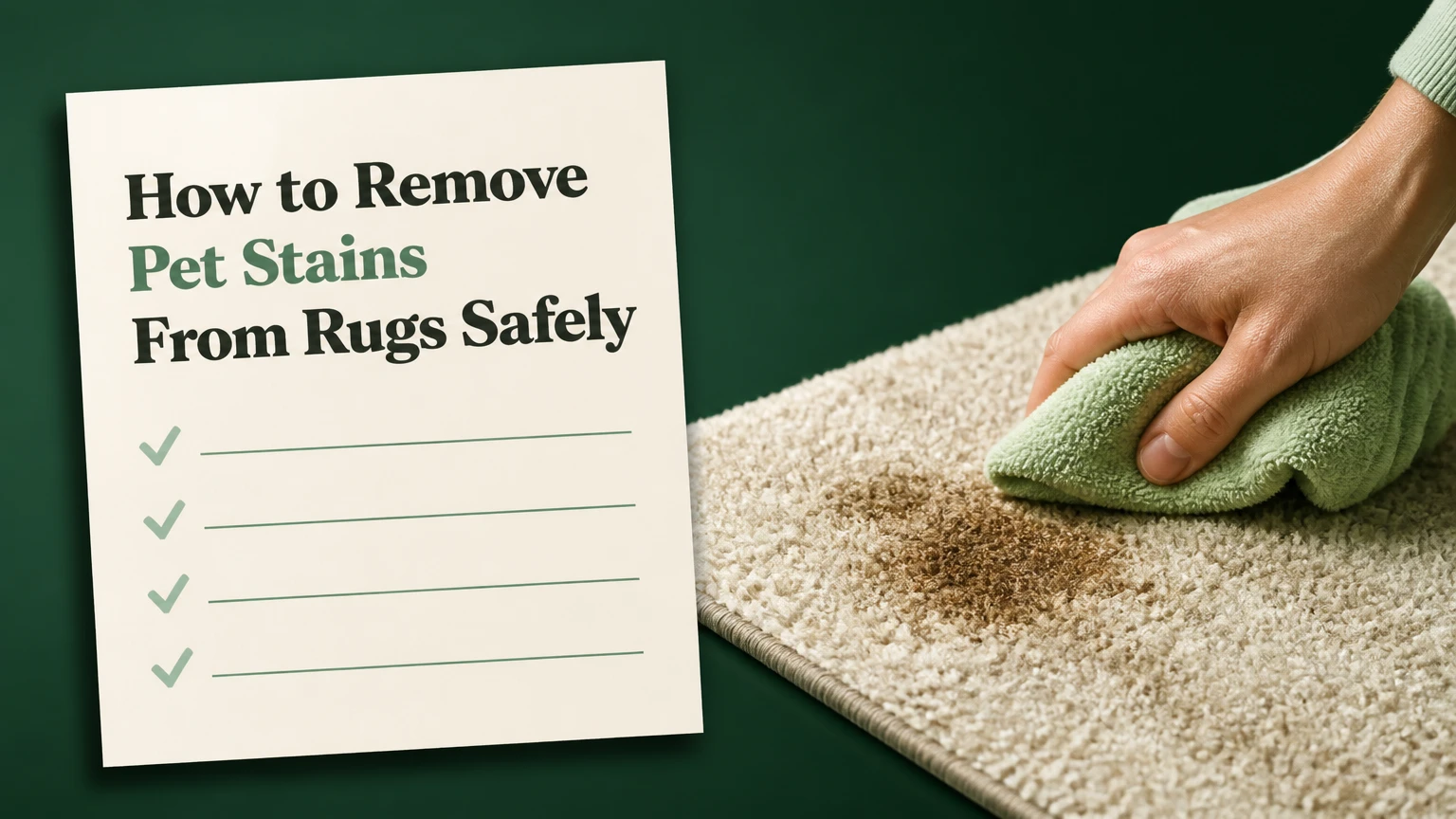
To remove pet stains from rugs, lift solids, blot liquids, apply a compatible enzymatic or detergent cleaner, extract the residue, and dry the rug completely. Fresh urine usually takes 20-40 minutes to treat, while old urine that reached the backing or floor may require repeated extraction or professional rug washing.
Key Facts at a Glance
- Enzymatic cleaners work on urine and other protein-rich organic soils only when the product reaches the full contaminated depth.
- Blotting removes liquid; scrubbing spreads soil, damages pile, and can drive contamination into the backing.
- Vinegar and baking soda fizz, but their reaction neutralizes much of each ingredient and can leave residue without reliably removing uric salts.
- Wool, silk, viscose, antique, and hand-knotted rugs need a hidden-area dye test and often require a rug-cleaning specialist.
- A rug should dry fully within 24-48 hours; wet backing against a floor can cause mildew, dye migration, or floor damage.
- Recurring odor usually means urine remains in the backing, rug pad, or subfloor rather than that the surface stain was missed.
What Counts as a Pet Stain?
Pet stains include urine, feces, vomit, saliva, muddy paw soil, and oily body residue deposited on rug fibers. Urine is the most difficult because water evaporates while less-volatile salts and odor compounds remain in the pile, backing, pad, or flooring below.
Fresh urine is mostly liquid and can often be removed before it spreads. Dried urine is different: uric-acid-related residue can recrystallize when humidity rises, which explains why an apparently clean rug may smell again on a damp day.
The stain category changes the treatment. Urine needs absorption and odor breakdown, feces needs safe solid removal followed by detergent or enzyme treatment, and vomit may need a mild acidic rinse after solid removal because stomach acid and food pigments can discolor fibers.
How Do Pet-Stain Cleaners Work?
Pet-stain cleaners use different mechanisms, and the label matters more than the word “pet” on the bottle. Enzymatic formulas use enzymes, and some also contain bacterial cultures that produce enzymes; not every enzyme cleaner contains live bacteria, and neither type sterilizes a rug.
Surfactants loosen oily and particulate soil by helping water spread and suspend dirt. Oxidizing products alter some color-causing compounds, but they can also lighten dyes. A cleaner can remove visible color while leaving urine salts or backing contamination behind.
Cleaner types and best uses
| Cleaner type | Main target | Typical dwell time | Main risk |
|---|---|---|---|
| Enzymatic formula | Urine proteins, feces residue | 10-30 minutes or label time | Dye change or prolonged moisture |
| Neutral detergent | Surface soil, vomit, feces | 3-10 minutes | Residue if poorly rinsed |
| Oxygen oxidizer | Some organic discoloration | 5-15 minutes | Bleaching natural or unstable dyes |
| Vinegar solution | Mild odor and mineral residue | 5 minutes | Limited stain removal and acidic dye risk |
| Ammonia cleaner | General alkaline soil | Not recommended for urine | Odor, residue, and repeat-soiling risk |
| Chlorine bleach | Hard nonporous surfaces only | Not for rugs | Fiber damage and permanent color loss |
Use an enzymatic product when the rug label permits water-based spot cleaning and the contamination is organic. Follow the product’s stated dilution, dwell time, and extraction instructions because stronger is not automatically more effective.
Before You Start: Tools, Time, and Safety
A fresh spot generally requires white towels, a spoon or scraper, cool water, a compatible cleaner, gloves, and airflow. A portable extractor is useful for synthetic rugs, but it is not automatically safe for wool, viscose, jute, antique rugs, or rugs with unstable dyes.
Preparation checklist
| Item | Typical amount or setting | Purpose |
|---|---|---|
| White absorbent towels | 10-20 towels | Blotting without dye transfer |
| Disposable gloves | 1 pair | Handling feces and contaminated materials |
| Enzyme cleaner | Enough to wet the affected depth | Breaking down organic residue |
| Distilled or clean tap water | 250-500 milliliters for a spot | Controlled rinsing |
| Fan | Low or medium speed | Faster, more even drying |
| Wet vacuum or extractor | 1 pass per rinse cycle | Removing dissolved residue |
| Plastic sheet | Larger than the rug spot | Protecting wood or laminate flooring |
Move the rug away from furniture legs and inspect the underside before applying liquid. Place plastic beneath the affected area if the rug is on wood, laminate, or a floor that can absorb moisture.
Test every cleaner on a hidden edge. Wait until the test area dries, because some dye bleeding and color change appear only after evaporation.
How to Remove Pet Stains From Rugs: Seven Steps
Step 1: Remove Solids and Blot Immediately
Lift feces or vomit with a spoon, dull scraper, or folded cardboard, then press white towels into liquid without rubbing. Start at the outside edge and work toward the center so the stain does not spread.
For a urine puddle, place several folded towels over the area and apply firm vertical pressure. Replace wet towels until they come away nearly dry. A 30-60 second compression period per towel section removes more liquid than quick surface dabbing.
Success checkpoint: The towel shows only a faint damp mark after firm pressure.
Common mistake: Scrubbing before absorption, which pushes liquid into the pile and enlarges the affected area.
Step 2: Identify the Rug Fiber and Check the Backing
Read the care label and determine whether the rug is synthetic, wool, cotton, viscose, jute, silk, antique, or hand-knotted. Examine whether the stain passed through the backing or rug pad.
Synthetic polypropylene and nylon rugs usually tolerate controlled water extraction better than viscose or silk. Wool can tolerate professional wet cleaning, but alkaline products, high heat, aggressive agitation, and prolonged soaking can cause felting, shrinkage, or dye bleeding.
Success checkpoint: You know the fiber, backing type, and floor surface before applying treatment.
Common mistake: Treating an expensive wool or viscose rug like wall-to-wall synthetic carpet.
Step 3: Perform a Colorfastness Test
Apply one teaspoon of diluted cleaner to a hidden corner, then press a white towel onto it for 10 seconds. Check the towel and rug after the area dries for transferred dye, fading, texture change, or a stiff residue.
A failed colorfastness test means home spot treatment is unsafe. Do not assume that a clear liquid is harmless; acidic, alkaline, oxidizing, and solvent-based products can all affect dyes or coatings.
Success checkpoint: No color transfers and the dry texture matches the surrounding rug.
Common mistake: Testing only while the rug is wet and missing delayed dye migration.
Step 4: Treat the Full Contaminated Area
Apply the compatible cleaner to the visible stain and extend treatment approximately 2-5 centimeters beyond its edge. For urine, the solution must reach the depth reached by the liquid, but the rug should not be flooded unless you can extract and dry it safely.
Enzyme products need moisture and contact time. Leave the cleaner for the label period, commonly 10-30 minutes, and keep pets away while it works. A dried urine mark may need two or three controlled treatments rather than one heavily saturated application.
Success checkpoint: The treatment covers the visible edge and the likely contamination depth.
Common mistake: Spraying only the center, leaving an odor ring in the surrounding pile or backing.
Step 5: Extract Dissolved Soil and Cleaner
Blot with clean towels or use a wet vacuum designed for rugs. On a washable synthetic rug, make slow extraction passes in one direction, then a second pass across the first direction; avoid repeatedly injecting liquid when the rug is already wet.
Extraction is especially important for enzyme residue, dissolved urine salts, detergent, and fecal soil. Residue left behind can attract new dirt and create a stiff or dark patch after drying.
Success checkpoint: The rug feels damp rather than saturated, and the extractor removes little additional liquid on the final pass.
Common mistake: Adding more cleaner because the first pass looks darker while wet.
Step 6: Rinse Carefully
Mist the treated area with a small amount of clean water, then extract or blot again. Rinsing is most useful when the cleaner instructions permit it and when visible residue remains; repeated rinsing is risky on rugs whose backing or dyes are water-sensitive.
Do not mix vinegar, ammonia, bleach, peroxide, or commercial cleaners in the same treatment. Chemical incompatibility can create irritating vapors, damage fibers, or make a later professional treatment harder to assess.
Success checkpoint: The area has no slippery or powdery feel after drying.
Common mistake: Pouring rinse water onto the rug without a way to remove it.
Step 7: Dry the Rug Completely
Lift the rug edge, place spacers beneath it, and aim a fan across both surfaces. Turn the rug only when the face is stable enough to handle without stretching, and keep foot traffic and pets away until the backing is dry.
A small spot may dry in 6-12 hours in a ventilated room. Dense wool, thick cotton, and layered rugs commonly need 24-48 hours. If the underside or floor remains damp after 48 hours, increase airflow and inspect for odor, discoloration, or swelling.
Success checkpoint: The pile, backing, and floor beneath the rug are dry and odor-free.
Common mistake: Judging dryness from the surface while the pad or backing remains wet.
Are Vinegar and Baking Soda Safe for Pet Stains?
Vinegar and baking soda are not a reliable primary treatment for urine embedded in a rug. Mixing acidic vinegar with alkaline baking soda creates carbon dioxide, water, and a salt solution; the fizz provides agitation but does not specifically digest urine residue, and remaining powder can attract soil.
A diluted vinegar rinse may reduce some surface odor on a colorfast synthetic rug, but it cannot replace extraction when urine has reached the backing. Never use vinegar on an untested natural-fiber or antique rug, and never combine it with bleach.
For a low-risk home alternative, use a small amount of neutral detergent followed by controlled rinsing and extraction. For persistent urine odor, a rug-compatible enzyme product is generally more targeted.
Which Method Should You Choose?
The best method depends on fiber, stain age, contamination depth, and whether you can remove moisture. Fresh stains on washable synthetic rugs suit controlled enzyme treatment, while silk, viscose, antique, and unstable-dye rugs need professional evaluation before wet cleaning.
| Method | Typical cost | Typical time | Best match | Main limitation |
|---|---|---|---|---|
| Towels and neutral detergent | $2-$10 | 20-45 minutes | Fresh surface soil | Weak on dried urine salts |
| Commercial enzyme spray | $8-$25 | 30 minutes plus drying | Fresh or moderate organic stains | Must contact full contamination |
| Portable extractor | $100-$250 purchase | 30-60 minutes | Washable synthetic rugs | Over-wetting and residue |
| Professional rug washing | $3-$12 per square foot | 3-10 days | Wool, silk, antique, severe odor | Higher cost and turnaround |
| Rug replacement | $50-$1,000 or more | 1-3 days | Irreversible backing or floor damage | Loses the original rug |
Prices are typical United States consumer ranges and vary by region, rug size, fiber, and service level. A professional quote may include dusting, dye testing, washing, deodorizing, controlled drying, and delivery rather than stain treatment alone.
What Each Cleaning Method Can and Cannot Do
| Option | Removes surface stain | Reaches backing | Protects delicate dyes | Odor control |
|---|---|---|---|---|
| Hand blotting | Yes, if fresh | No | Usually high | Low |
| Enzyme spot treatment | Often | Sometimes | Product and fiber dependent | Moderate to high |
| Portable extraction | Yes | Limited by suction and access | Low to moderate | Moderate |
| Off-site rug wash | Yes | Usually | High when performed correctly | High |
| Oxidizing treatment | Often changes color | No | Low on unstable dyes | Low to moderate |
A portable machine is not a substitute for off-site washing when urine has soaked through the rug. Machine suction can remove liquid from the face while leaving contamination trapped beneath a latex backing or in the pad.
When Should You Use a Professional Rug Cleaner?
Use a professional rug cleaner when the rug is silk, viscose, antique, hand-knotted, heavily fringed, structurally damaged, or visibly bleeding dye. Professional cleaning is also the safer choice when urine reaches the backing, pad, wood floor, or a large portion of the rug.
Ask the cleaner whether the rug will be inspected, dusted, dye-tested, washed with a method suited to its fiber, and dried in a controlled environment. Ask specifically whether odor treatment includes the backing and pad, because surface deodorizing alone may fail.
Professional cleaning cannot guarantee removal of every dark urine shadow. Urine can permanently alter dyes, weaken fibers, create cellulosic browning, or damage floor finishes. Cleaning removes remaining soil; it cannot always reverse chemical damage.
How Do You Handle Specific Pet Stains?
Dog Feces and Cat Feces
Remove solid waste first, then blot moisture and lift remaining particles from the pile. Apply a rug-safe neutral detergent or enzyme cleaner, extract the area, and dry it promptly.
Do not grind feces into the rug with a brush. Use gloves, wash hands, and discard contaminated towels. If fecal material reached the backing or the rug has a long pile, professional cleaning reduces the chance of retained residue.
Vomit and Food Residue
Scoop solids, blot liquid, and remove food particles before applying a small amount of neutral detergent. Rinse and extract because vomit can contain acids, fats, pigments, and partially digested food that leave both odor and color.
Avoid scrubbing dried vomit aggressively. Soften the residue with a damp towel for several minutes, lift it gradually, and test any oxidizer before use.
Muddy Paw Prints
Allow thick mud to dry, vacuum loose particles, and then treat the remaining mark with neutral detergent and water. Wet mud spreads easily, so dry removal should happen before any spray is applied.
What If Urine Reached the Rug Pad or Floor?
When the rug pad or floor is contaminated, surface treatment alone usually cannot eliminate odor. Lift the rug, inspect the pad and underside, and clean or replace the affected pad if urine has soaked through it.
Hard flooring needs a separate compatible treatment. Wood can absorb urine through seams and may require professional floor refinishing if darkening or persistent odor remains. Never saturate wood while treating the rug above it.
For a removable synthetic rug, clean both sides and dry the rug elevated. For a fixed carpet or a rug bonded to a pad, use a professional extraction service that can assess the subfloor.
Can a UV Light Find Old Urine?
A 395-nanometer UV flashlight can reveal some dried urine deposits in a dark room, but fluorescence is not proof of urine. Detergent residue, optical brighteners, fibers, and other organic materials can also glow.
Turn off normal lights, let your eyes adjust, and mark suspected areas with removable tape. Compare several locations instead of treating every glowing patch. A UV light identifies areas for inspection; it does not measure contamination depth or replace moisture testing.
Why Did the Odor Return After Cleaning?
Odor returns when moisture reactivates urine residue left in the backing, pad, floor, or deep pile. The fix is to identify the contaminated layer, treat it with a compatible method, extract dissolved residue, and dry every layer completely.
A dark ring after drying is often wicking. As moisture evaporates, soil from deeper layers can move toward the surface. Lightly re-moisten the entire affected patch with compatible solution, extract evenly beyond the original edge, and dry with airflow rather than treating only the ring.
Common Mistakes and How to Fix Them
| Mistake | What it causes | Recovery action |
|---|---|---|
| Scrubbing urine | Spread, frayed pile, deeper contamination | Stop rubbing and blot from the edge inward |
| Using ammonia | Strong odor and possible repeat marking | Rinse and extract if the fiber permits |
| Applying steam or high heat | Dye movement, shrinkage, odor fixation risk | Stop heat and dry with cool airflow |
| Over-saturating the rug | Wet backing, floor damage, mildew risk | Extract immediately and elevate the rug |
| Skipping the dye test | Bleeding or permanent fading | Stop treatment and flush only if label permits |
| Cleaning only the visible spot | Returning odor and wicking | Treat the full dampened footprint |
A common practitioner rule is to use the least wet method that can reach the contamination. More liquid helps only when the operator can remove that liquid afterward.
Another rule is to judge success after complete drying, not while the rug is wet. Wet fibers can temporarily hide discoloration, odor, stiffness, and dye migration.
How Can You Prevent Repeat Pet Stains?
Block access until the rug is dry and the odor has disappeared. Pets may return to a location that still contains odor compounds even when humans cannot detect them.
Use a washable rug pad, place waterproof protection beneath rugs during house-training, and clean accidents immediately. For repeated accidents, consult a veterinarian or qualified behavior professional because urinary disease, stress, mobility problems, and litter-box issues can all contribute.
Replace a damaged pad rather than repeatedly perfuming it. Fragrance masks odor for people but does not remove the contamination that guides repeat marking.
FAQ
Will hydrogen peroxide remove pet urine from a rug?
Hydrogen peroxide can lighten some organic discoloration, but it may bleach dyes and weaken natural fibers. Use it only when the rug manufacturer or a qualified cleaner confirms compatibility, and test a hidden area until fully dry. Peroxide also does not guarantee removal of urine salts in the backing.
How long can urine sit before it permanently stains a rug?
Permanent discoloration can begin as urine dries, but the result depends on dye stability, acidity, fiber, moisture, and exposure time. A fresh accident should be blotted within minutes. Old stains may remain as chemical dye damage even after odor and residue are removed.
Should I use a carpet cleaner on an area rug?
Use a carpet cleaner only when the rug care label permits water extraction and the dyes are colorfast. Portable machines are most suitable for washable synthetic rugs. Avoid them on silk, viscose, antique, hand-knotted, or structurally weakened rugs unless a professional directs the process.
Can pet stains be removed without leaving a ring?
A ring is less likely when the cleaner is applied beyond the visible edge, extracted evenly, and dried quickly with airflow. Treating only the center allows soil to wick outward during evaporation. On absorbent rugs, professional cleaning may be needed to correct an existing ring.
Is a pet-stained rug safe after cleaning?
A rug is generally ready for use when the pile, backing, pad, and floor are fully dry, no cleaner residue remains, and no strong odor persists. Cleaning reduces contamination but does not guarantee sterilization. Keep children and pets away during treatment and follow the product’s safety label.
The Bottom Line
To remove pet stains from rugs, blot first, identify the fiber, test the cleaner, treat the entire contaminated footprint, extract residue, and dry every layer completely. Use an enzyme product for compatible washable rugs, avoid ammonia and uncontrolled heat, and choose professional rug washing when urine reaches delicate fibers, backing, padding, or flooring.