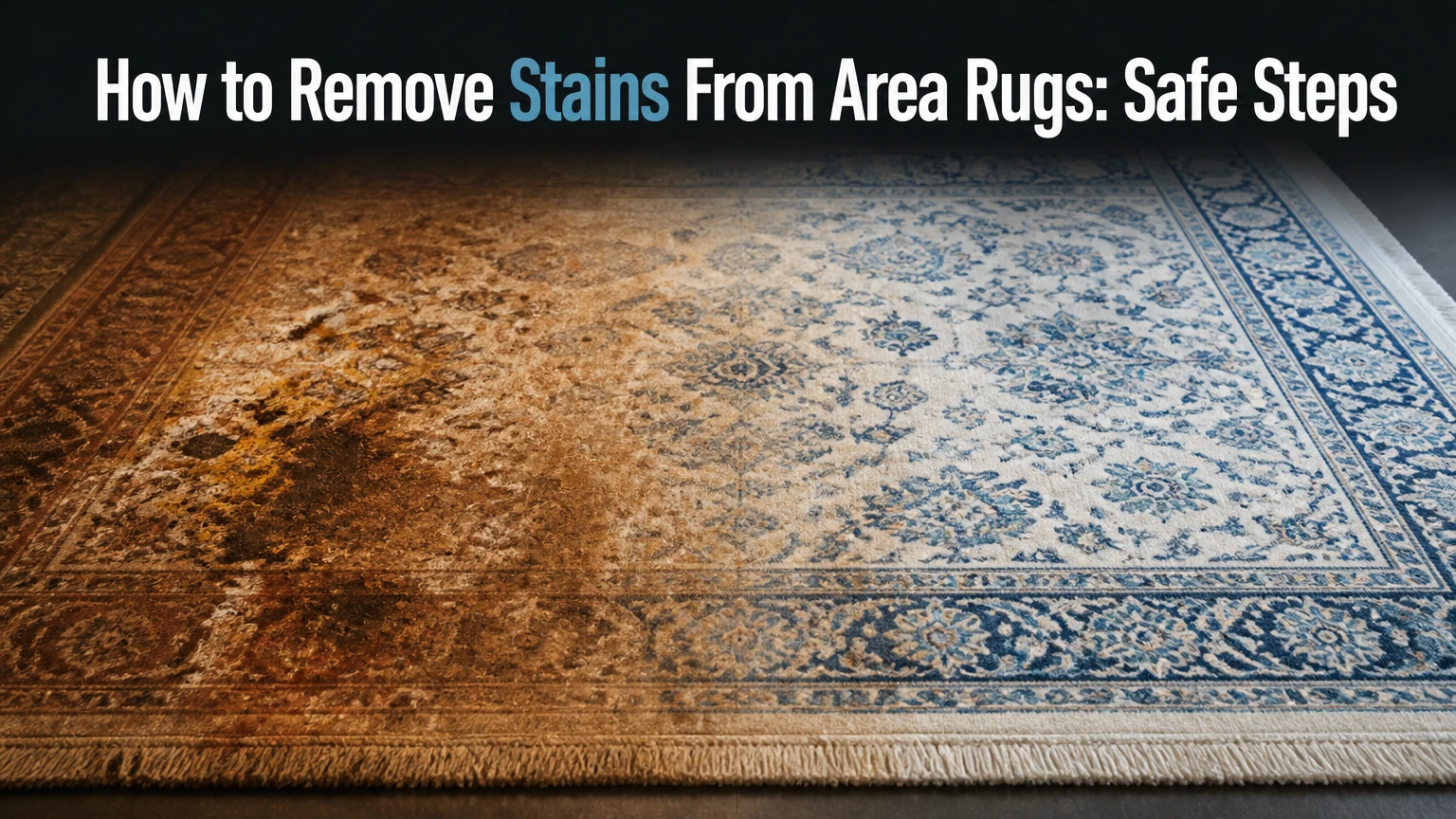
To remove stains from area rugs, first identify the rug fiber and stain type, then blot the spill, test a compatible cleaner, treat from the outside inward, rinse away residue, and dry the backing completely. Fresh water-based stains often respond in 5-15 minutes, while pet urine, oil, wool, silk, viscose, and old stains require more controlled treatment.
Key Facts at a Glance
- Blotting removes liquid while rubbing spreads pigment and damages pile.
- A clean white cloth and a small amount of solution are safer than pouring cleaner directly onto a rug.
- Synthetic fibers tolerate more moisture than wool, silk, viscose, jute, sisal, and seagrass.
- Enzyme cleaners address organic residue and odor, but they do not automatically remove every visible dye stain.
- A stain that returns after drying usually indicates wicking from the backing or underlay.
- Complete drying matters because trapped moisture can cause odor, browning, adhesive failure, or mold.
What Determines Successful Rug Stain Removal?
Successful rug stain removal depends on four variables: the stain’s chemistry, the fiber’s moisture tolerance, the dye’s colorfastness, and how long the spill has remained in the pile. Water-based food spills usually respond to diluted surfactant; grease needs a solvent; protein residue needs an enzyme; wax and gum need mechanical hardening.
Area rugs are layered textiles, not single surfaces. A spill can move through the face yarn, primary backing, secondary backing, adhesive, and underlay. The visible spot may therefore be smaller than the contaminated area underneath.
Why should you blot instead of scrub?
Blotting transfers liquid from the rug into an absorbent towel, while scrubbing pushes liquid sideways and downward. Capillary action then pulls the dissolved stain through adjacent fibers as the rug dries, creating a larger halo or a recurring mark.
Use firm, vertical pressure for 10-15 seconds, lift the towel, and inspect the transfer. Replace the towel when it becomes damp or colored. Work from the outer edge toward the center, because the edge contains the least concentrated stain and is easiest to control.
Which cleaner matches the stain?
The correct cleaner matches the substance that must be dissolved or suspended. A neutral detergent helps with water-soluble particles, an appropriate solvent helps dissolve oils, and an enzyme formula breaks down selected biological residues.
| Stain category | Typical examples | First-choice treatment | Main limitation |
|---|---|---|---|
| Water-soluble | Coffee, tea, juice, soda, mud | 1/4 teaspoon clear dish detergent in 1 cup lukewarm water | Excess detergent leaves sticky residue |
| Acidic or tannin-rich | Red wine, coffee, tea, fruit | Neutral detergent, then limited vinegar only if fiber-safe | Vinegar can alter dyes and damage some natural fibers |
| Oil-based | Butter, cooking oil, makeup, lotion | Rug-approved solvent on a white cloth | Solvent can dissolve backing adhesive or bleed dye |
| Protein or biological | Urine, vomit, feces, blood | Product-labeled enzyme cleaner or professional treatment | Enzymes need suitable temperature and dwell time |
| Solid or thermoplastic | Gum, candle wax, crayon | Ice hardening, lifting, then residue treatment | Heat can drive wax deeper into pile |
Do not mix cleaners. In particular, never combine bleach with ammonia, acids, or unknown commercial products because dangerous vapors or uncontrolled bleaching can result.
Before You Start: Materials, Time, and Risk
Prepare the work area before applying liquid. A typical fresh spot takes 5-20 minutes of active work and 2-12 hours to dry, but dense wool rugs, thick pads, and large spills may need 24-48 hours.
| Item | Typical quantity or specification | Purpose | Avoid |
|---|---|---|---|
| White cotton towels | 6-10 pieces, 30 x 30 cm | Blotting and rinsing | Colored or printed towels |
| Clear dish detergent | 1/4 teaspoon per 1 cup water | Water-soluble food stains | Opaque lotion-style soap |
| Lukewarm water | 1 cup, approximately 30-38°C | Dilution and rinsing | Hot or boiling water |
| Soft brush | 1 brush with soft nylon bristles | Limited synthetic-pile agitation | Stiff wire or hard bristles |
| Plastic sheet | 1 piece larger than the spot | Protecting floor and backing | Bare wood or unprotected laminate |
| Fan | 1 floor fan, low or medium setting | Accelerating evaporation | High heat on wool or delicate fibers |
Check the care label, manufacturer instructions, and rug construction. Photograph the stain before treatment if the rug is valuable, rented, insured, antique, or subject to a damage claim.
How to Remove Stains From Area Rugs Safely
A safe six-step process is: remove solids, blot liquid, test colorfastness, apply a small amount of matched cleaner, rinse residue, and dry both sides. The most important success factor is controlling moisture, because a clean surface with a wet backing can develop a larger problem.
Step 1: Remove solids without spreading them
Lift food, soil, feces, or other solids with a spoon or dull plastic edge. Hold the tool almost parallel to the pile and move toward the center, rather than pressing downward.
You will know this step worked when no loose material remains on the surface and the stain edge has not expanded. Scraping aggressively is the common mistake; it twists pile tufts and forces particles into the backing.
Step 2: Blot the spill with white towels
Place a folded white towel over the liquid and apply firm hand pressure for 10-15 seconds. Repeat with dry sections until the towel shows little or no transfer, then place a dry towel beneath the rug if the spill reached the underside.
The success checkpoint is a towel that feels only slightly damp after pressing. Rubbing, using a hairdryer immediately, or pouring water onto the spot can spread dye and lock residue into lower layers.
Step 3: Test colorfastness and fiber reaction
Mix the intended solution and test it on a hidden corner, underside edge, or spare rug sample. Press a damp white cloth against the test area for 10 seconds, then check the cloth and rug for transferred dye, texture change, yellowing, or a lightened patch.
Proceed only when the test remains stable after five minutes. A test is not proof that the entire rug is safe, because an exposed stain may contain different dyes, repairs, or backing materials.
Step 4: Apply the smallest effective amount
Put the cleaner on a white cloth rather than spraying or pouring it directly onto the rug. Dab from the outside toward the center, using one teaspoon at a time for a spot up to 10 cm across; increase the amount only when the cloth cannot contact the stain.
Allow a product-labeled dwell time, commonly 3-10 minutes for detergent spotters and 10-30 minutes for many enzyme products. You will know the treatment is working when color transfers to the towel without a spreading wet edge.
Step 5: Rinse away dissolved residue
Use a separate cloth dampened with clean water and press it repeatedly over the treated area. Follow with a dry towel until the cloth no longer feels slippery and the rug no longer produces visible foam.
Residue attracts dry soil and can create a darker patch within days. The common mistake is treating rinsing as optional, especially after dish soap or a concentrated commercial spray.
Step 6: Dry the rug completely on both sides
Raise the rug so air can reach the face and backing, or place it over a clean drying rack if its construction permits. Use a fan, change wet towels after 30-60 minutes, and avoid replacing furniture until the pile, backing, and underlay are fully dry.
A small synthetic spot may dry in 2-6 hours; a wool rug may require 12-24 hours. Complete drying means no cool, damp sensation underneath and no musty odor when the rug is folded back.
Which Treatment Works for Each Common Stain?
Stain-specific treatment works better than a universal homemade spray because coffee tannins, cooking oil, pet urine salts, and wax do not respond to the same chemistry. Treat fresh stains promptly, but use gentler methods on wool and natural plant fibers than on solution-dyed polypropylene.
| Stain | Treatment sequence | Typical dwell | Special warning |
|---|---|---|---|
| Coffee or tea | Blot, detergent solution, water rinse | 3-5 minutes | Tannin rings may remain on pale wool |
| Red wine | Blot, detergent solution, careful rinse | 5 minutes | Do not flood the rug or add salt |
| Grease or makeup | Lift excess, solvent on cloth, rinse sparingly | 1-3 minutes | Test solvent for dye bleed |
| Pet urine | Blot, enzyme cleaner to contaminated depth, air-dry | 10-30 minutes or label time | Odor can remain in pad or floor |
| Blood | Cold water blot, fiber-safe protein treatment | 5-10 minutes | Heat can set protein stains |
| Gum | Ice in plastic bag, lift fragments, spot clean residue | 5-15 minutes | Do not use an iron directly |
| Candle wax | Harden, lift flakes, solvent only after testing | 1-3 minutes | Heat may damage backing and dyes |
How do you remove coffee, tea, wine, and mud?
For a fresh water-soluble stain, blot first, then dab a solution of 1/4 teaspoon clear dish detergent in 1 cup lukewarm water. Rinse with a separate water-dampened cloth and dry quickly; use white vinegar only after a hidden colorfastness test and only when the rug manufacturer permits it.
Coffee and tea contain tannins that can leave yellow-brown discoloration even after the liquid is removed. Red wine contains water, sugars, acids, and pigment, so flooding it with plain water can enlarge the mark without removing the color.
Mud should dry before vacuuming when possible. Wet mud becomes a suspension that spreads through pile; once dry, loosen it with a vacuum and treat the remaining brown residue with diluted detergent.
How do you remove grease, makeup, and lotion?
For oil-based stains, lift excess material with a spoon, apply a rug-approved solvent to a white cloth, and blot from the perimeter inward. Rinse with a barely damp cloth and dry immediately, because solvent and moisture can travel into latex, adhesive, or backing layers.
Isopropyl alcohol is not universally safe for area rugs. It may affect dyes, latex, acetate, viscose, or printed surfaces, and its use can void a manufacturer’s warranty. A professional dry-cleaning solvent is safer only when the label specifically allows it and ventilation is adequate.
How do you remove pet urine, vomit, and feces?
For pet urine, remove liquid, apply an enzyme cleaner that reaches the contaminated depth, and keep the area damp for the label-specified dwell period. Enzyme products target organic residue, but a rug pad, floorboard, or subfloor may also hold odor and require separate cleaning.
Vomit combines acid, food particles, and protein. Remove solids, blot, use a compatible enzyme or protein-stain product, then rinse carefully. Feces require gloves, solid removal, detergent treatment, and disinfection of tools, but do not saturate a rug that cannot dry rapidly.
Blood should receive cold water only at first. Hot water can coagulate proteins and make the mark more difficult to remove. Large blood stains, unknown biological material, or contamination that reached the backing justify professional handling.
What Changes by Rug Fiber?
Rug fiber determines how much water, heat, solvent, and agitation the material can tolerate. Synthetic polypropylene and polyester usually offer the widest DIY margin, while viscose, silk, antique wool, jute, sisal, and seagrass can suffer permanent texture or color damage from one wet treatment.
| Rug material | Moisture tolerance | Safer home approach | Stop and call a professional when |
|---|---|---|---|
| Polypropylene | High, if backing dries | Diluted detergent, low agitation | Dye transfer or large saturated area appears |
| Polyester | Moderate to high | Mild detergent, controlled rinse | Oil remains after one treatment |
| Nylon | Moderate | Synthetic-safe spotter, blotting | Heat or solvent causes texture change |
| Wool | Low to moderate | Wool-safe, pH-neutral product, minimal water | Stain exceeds 10 cm or color bleeds |
| Silk or viscose | Very low | Dry blotting only unless label permits | Any liquid reaches the pile or backing |
| Jute, sisal, seagrass | Low | Vacuum and very low-moisture foam if approved | Brown ring, damp odor, or stiffening develops |
WoolSafe recommends wool-specific cleaning products because wool can react poorly to high-alkaline formulas and excessive agitation. Wool also contains natural oils and scales that can felt under heat, friction, and moisture.
Viscose is especially hazardous to spot clean. Wet viscose loses strength, develops pile distortion, and can form permanent water marks, so a professional familiar with cellulosic fibers should handle liquid stains.
Jute, sisal, and seagrass are plant fibers that can brown, swell, or mildew when wet. Do not apply the standard one-cup water recipe automatically to these rugs.
Which Cleaning Option Should You Choose?
DIY spot cleaning is the right first response for a small, fresh spill on a colorfast synthetic rug. Commercial products offer better targeting for odor or oil, rental extraction suits washable synthetic rugs with broad contamination, and professional cleaning is the safest decision for delicate, valuable, oversized, or deeply saturated rugs.
| Option | Typical cost | Active time | Drying time | Best fit | Main risk |
|---|---|---|---|---|---|
| DIY spot treatment | $2-$10 | 5-20 minutes | 2-12 hours | Fresh small stain on synthetic rug | Residue or dye bleed |
| Commercial spotter | $8-$25 | 10-30 minutes | 4-24 hours | Enzyme, grease, or odor problem | Wrong chemistry |
| Rental extractor | $35-$90 per day | 1-3 hours | 12-48 hours | Washable synthetic rug, broad soil | Overwetting and backing damage |
| Professional rug cleaner | $75-$400 typical | 15-30 minutes onsite | 1-3 days | Wool, silk, antique, large, severe stain | Cost and transport time |
Extraction machines are not automatically superior. A machine can remove more dissolved soil only when the rug tolerates water, the operator controls the solution volume, and the backing dries quickly.
When should you stop DIY treatment?
Stop after one or two controlled attempts if color transfers, the stain spreads, the backing becomes wet, the pile changes direction, or a brown ring appears. Repeated chemical applications rarely improve a stain once dye migration or backing contamination has begun.
Professional cleaning is especially appropriate for hand-knotted wool, silk, viscose, antique rugs, rugs with fringe, and rugs with unknown dyes. Ask the cleaner how the rug will be dusted, tested, washed, dried, and protected from browning.
How Do You Remove Dried or Returning Stains?
Dried stains need rehydration in small sections, not aggressive scrubbing or repeated full-rug saturation. A returning mark usually results from wicking, where dissolved soil in the backing travels upward as surface moisture evaporates.
Lightly dampen a cloth, press it onto the spot for 30-60 seconds, and blot toward the center. Apply a matched cleaner only after testing, then extract moisture with layered towels and weight the stack with a plastic-wrapped book for 2-4 hours.
The stain may return if the towel never contacts the backing-side contamination. A larger professional flush or controlled immersion wash may be necessary, particularly when urine, milk, sugary drinks, or muddy water entered the pad.
Why does a clean spot look brighter than the rug?
A bright patch often means the spot treatment removed surface soil while surrounding fibers remain generally dirty. Spot cleaning can therefore create visual contrast even when the treated area is technically clean.
Do not repeatedly darken the clean patch with more detergent. Vacuum the whole rug, compare the color in daylight, and arrange uniform low-moisture or professional cleaning when the contrast remains visible.
How do you fix a yellow or brown ring?
A yellow or brown ring often indicates over-wetting, suspended soil, or cellulosic browning from the backing. First dry the rug completely, then vacuum gently; do not add vinegar or another chemical until the fiber and dye have been identified.
Some synthetic rugs tolerate a carefully tested acidic rinse, but wool, viscose, jute, and unknown natural fibers may worsen. A professional can identify whether the ring is browning, dye migration, residue, or actual fiber discoloration before choosing a correction.
Common Mistakes and Safer Fixes
Avoiding damage is part of stain removal. The following errors account for many failed home treatments.
- Pouring solution onto the rug: Apply cleaner to a cloth so the dose stays near the surface.
- Using hot water on blood or wool: Choose cold water for blood and lukewarm water for approved detergent treatments.
- Adding baking soda to every stain: Baking soda absorbs some surface odor but does not extract urine from backing and can leave powder in dense pile.
- Using bleach or ammonia: These can remove dye, weaken fibers, and create hazardous fumes when mixed.
- Ignoring the underlay: A stained pad can wick contamination back into a clean rug.
- Replacing furniture too early: Furniture traps moisture and can transfer rust, wood dye, or pressure marks into damp fibers.
One practitioner rule is to use the least aggressive method that can plausibly dissolve the stain. Stronger chemicals do not compensate for incorrect stain identification.
How Can You Prevent New Area Rug Stains?
Preventive maintenance reduces the amount of soil available to bond with fibers. Vacuum high-traffic rugs twice weekly, place absorbent mats at entrances, use a washable pad under the rug, and keep food and drinks away from delicate fibers.
Treat spills while they remain liquid. A rug protector can slow absorption, but it does not make silk, viscose, wool, or jute waterproof. Rotate an area rug every 3-6 months to distribute traffic and expose hidden color or wear before a spot treatment produces visible contrast.
FAQ
Can I use dish soap on every area rug?
No. Clear dish soap is generally suitable for a small, colorfast synthetic spot when highly diluted, but it is not a universal rug cleaner. Wool, silk, viscose, jute, sisal, and rugs with unstable dyes need a manufacturer-approved product or professional treatment.
Is baking soda safe for pet urine on an area rug?
Baking soda can reduce a limited surface odor after the rug is dry, but it does not reliably remove urine salts from the backing or pad. Vacuum thoroughly after use, and choose an enzyme cleaner when the label and fiber permit controlled moisture.
How long should an area rug stay wet after cleaning?
The surface should begin drying immediately, and a small synthetic spot typically dries within 2-6 hours. Dense wool, thick backing, or a wet underlay may require 12-48 hours. Persistent dampness, coolness, or odor signals incomplete drying.
Can I use a carpet shampooer on an area rug?
Use a carpet shampooer only when the rug label permits water extraction and the backing is stable. Avoid machines on silk, viscose, jute, antique rugs, loosely constructed rugs, and any rug that cannot be lifted and dried on both sides.
Should I remove an area rug before treating a stain?
Remove or raise the rug when liquid may reach the floor, pad, or backing. Protect wood, laminate, and finished floors with plastic beneath the rug, but never leave a wet rug trapped on plastic because evaporation will slow.
What is the safest way to remove an old stain?
Identify the fiber, vacuum loose soil, test a compatible product, and rehydrate only a small area before blotting. If the old stain has changed dye, reached the backing, or covers more than approximately 10 cm, professional cleaning offers a better risk-to-cost balance.
The Bottom Line
The safest answer to how to remove stains from area rugs is to blot immediately, match the treatment to the stain, test colorfastness, apply minimal moisture, rinse residue, and dry the backing completely. Synthetic rugs allow the broadest DIY treatment range, while wool, silk, viscose, jute, antique, and heavily saturated rugs should receive conservative or professional care.