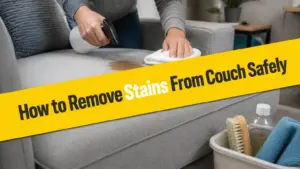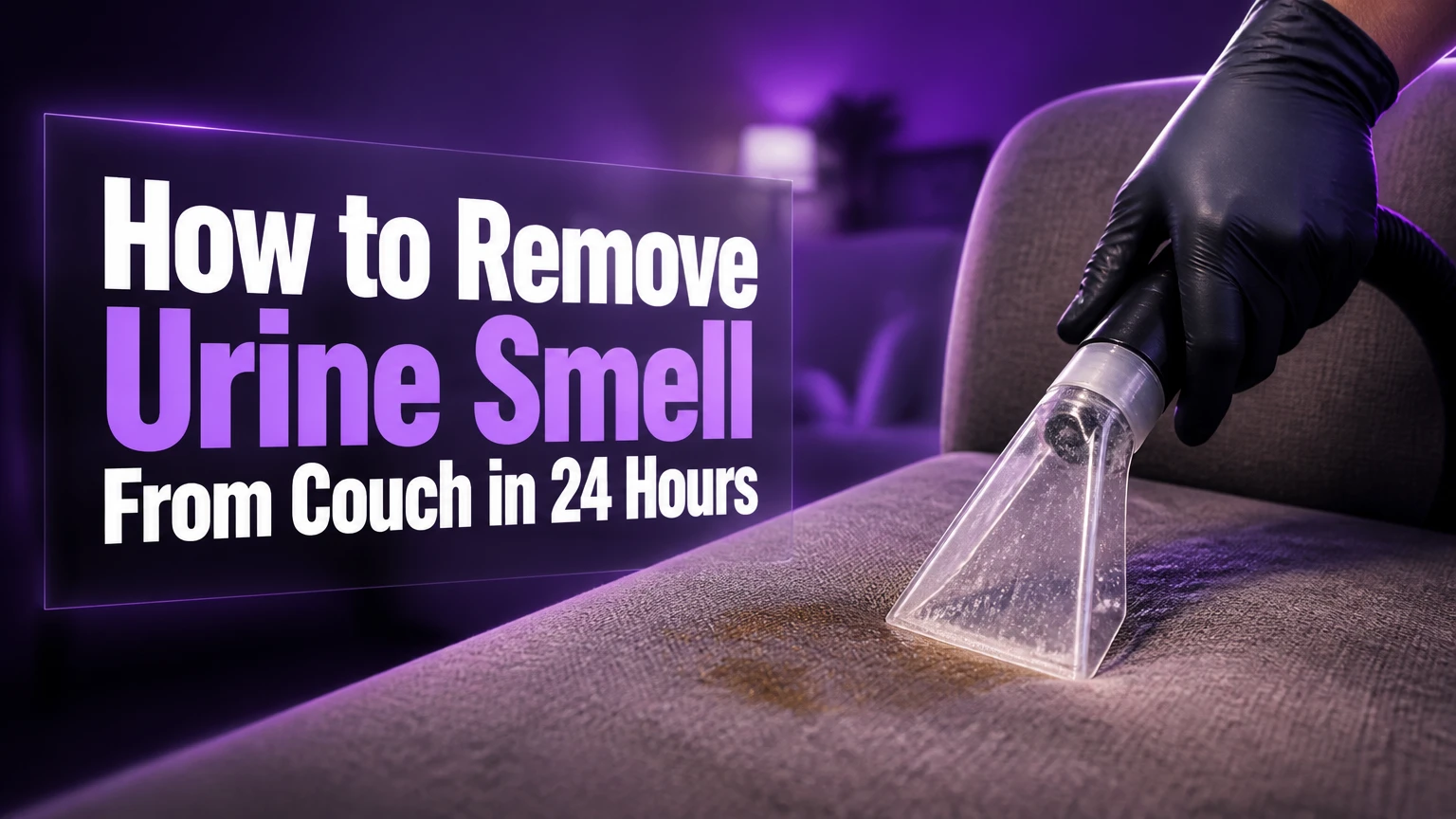
To remove urine smell from a couch, first blot as much liquid as possible, then apply an upholstery-safe enzymatic cleaner deeply enough to reach the affected padding, extract excess moisture, and dry the couch completely. Fresh accidents may improve within 24 hours; dried or repeated urine usually requires two treatments or professional extraction.
Key Facts at a Glance
Enzymatic upholstery cleaner is usually the most reliable choice for pet or dried urine because it targets urine residues rather than masking odour.
Never scrub fresh urine into upholstery, and never mix bleach, ammonia, vinegar, peroxide, or other cleaners.
Upholstery code W or WS generally permits water-based treatment, while code S requires a solvent and code X should usually be professionally assessed.
The treated area must extend beyond the visible mark because liquid can travel through batting, foam, seams, and the couch deck.
A couch is not clean until the cushion, cover, underside, and surrounding frame are dry and odour-free at normal room humidity.
Persistent odour after two correctly performed treatments usually indicates contaminated foam, batting, decking, or timber.
Why Does Urine Smell Return After a Couch Dries?
Urine smell returns when soluble urine residue, ammonia-producing bacteria, or dried uric-acid salts remain inside upholstery and reactivate in humid conditions. Surface wiping removes the visible liquid but often leaves residue in cushion foam, polyester batting, seams, or the fabric-covered platform beneath the cushions.
Fresh urine has a milder odour because urea has not fully decomposed. As bacteria break urea down, ammonia creates the sharp smell associated with stale urine. Uric acid and its salts can crystallise as urine dries; those residues are difficult to remove with a quick spray because they can lodge below the fabric surface.
The AI Overview’s reference to foul-smelling thiol compounds is too broad for ordinary couch urine. Thiols can occur in some biological odours, but ammonia and rehydrated urine residues are the more useful cleaning targets in a household upholstery accident. Odour intensity alone cannot show how deep contamination goes.
A black-light inspection can help locate older pet accidents, but ultraviolet fluorescence is not proof of urine. Detergent, food, optical brighteners, and some fibres can also fluoresce. Treat visible staining, odour boundaries, seams, and the likely splash area rather than relying on the lamp alone.
What Should You Check Before Cleaning?
Check the upholstery cleaning code, cushion construction, colourfastness, and the age of the accident before applying liquid. The safest method depends more on the fabric code and depth of contamination than on whether the urine came from a cat, dog, child, or adult.
Look for a care label beneath a cushion, along a seam, or under the sofa. Use the following interpretation as a starting point, then follow the manufacturer’s instructions:
| Code | Meaning | Appropriate first choice | Main restriction |
|---|---|---|---|
| W | Water-based cleaner permitted | Upholstery enzyme cleaner diluted as labelled | Avoid over-wetting foam |
| WS or SW | Water- or solvent-based cleaner permitted | Label-approved enzyme or upholstery solvent | Test both product and colour |
| S | Solvent-based cleaner only | Professional upholstery solvent service | Do not use vinegar or water |
| X | Vacuum or professional cleaning only | Vacuuming and professional assessment | Do not apply a liquid DIY treatment |
Before treating the stain, vacuum loose dirt, remove blankets, and take off washable cushion covers if the care label permits machine washing. Do not put a urine-soaked cover into a hot dryer. Heat can make residual odour harder to evaluate and may set some discolouration.
Before-you-start checklist
| Requirement | Typical specification | Why it matters |
|---|---|---|
| Initial work time | 20-40 minutes | Covers extraction and product application |
| Drying time | 12-48 hours | Depends on foam thickness and ventilation |
| DIY supply cost | $10-$35 | Typical enzyme cleaner, towels, gloves |
| Towels | 8-12 white absorbent towels | White fabric reveals transferred colour |
| Cleaner volume | 250-750 ml | Depends on treated area and cushion depth |
| Air movement | 1-2 fans | Reduces drying time and moisture retention |
Wear nitrile gloves, ventilate the room, and keep children and pets away from wet cleaning solution. If the urine came from a person with a known infectious illness, or if bodily fluid exposure is a concern, follow local public-health guidance and consider professional cleaning rather than treating the couch as an ordinary pet stain.
How to Remove Urine Smell From Couch, Step by Step
A fresh urine accident can usually be treated in four stages: extract, test, apply an appropriate cleaner, and dry completely. Allow 30-60 minutes for active work and 12-48 hours for drying; the decisive factor is whether the treatment reaches every contaminated layer without leaving the foam wet.
Step 1: Blot the Fresh Urine
Press clean white towels firmly onto the wet area and replace them as soon as they become damp. Do not rub, brush, or scrub, because friction spreads urine through the weave and can damage velvet, chenille, microfiber pile, or printed upholstery.
Remove the cushion and blot both sides if liquid has passed through. Place a folded towel underneath the cushion, then press from the top with your hands or body weight. On a fixed cushion, use repeated firm pressure rather than standing on the furniture, which can damage seams or the support deck.
Continue until a dry towel shows little or no moisture transfer. Extraction is more valuable at this stage than deodoriser because every gram of urine removed reduces the residue the cleaner must process.
You will know Step 1 worked when: a fresh towel remains nearly dry after firm pressure.
Common mistake: using a wet cloth and spreading the accident beyond the original area.
Step 2: Test the Cleaner on a Hidden Area
Apply a small amount of the selected cleaner to an unseen section, such as the rear lower edge or underside of a removable cushion. Wait for the product’s stated reaction time, blot it, and inspect the fabric after it dries.
Check for colour transfer, lightening, texture change, water rings, or a sticky residue. A successful hidden test does not guarantee that a large visible panel will remain uniform, but a failed test is a clear reason to stop.
Select a cleaner labelled for upholstery and for the relevant contamination. Pet-urine enzyme products often contain protease, amylase, or other biological ingredients, but formulas differ; the label, not a generic recipe, controls dilution and contact time.
You will know Step 2 worked when: the dried test patch matches the surrounding colour and texture.
Common mistake: testing only while the fabric is wet, when dye bleeding may not yet be obvious.
Step 3: Apply an Enzymatic Upholstery Cleaner
Apply enough label-directed enzyme cleaner to reach the contaminated fabric and padding, extending 2-5 cm beyond the visible boundary. Do not pour an entire bottle onto a fixed sofa; controlled saturation is safer than flooding because trapped moisture can produce mildew, odour, or foam deterioration.
For a removable cover, treat both the top and underside when urine has penetrated through the fabric. For a cushion, place towels beneath it and work over a washable surface. Keep the cleaner within the upholstery’s approved moisture limits.
Many products specify a dwell time of 10-15 minutes, while others are intended to remain damp as they work during drying. Follow the label exactly. Typical effective working temperatures are approximately 15-35°C, but direct sun or a heater can dry the surface before the product reaches deeper residue.
You will know Step 3 worked when: the treated zone is evenly damp, not flooded, and the product has remained wet for its labelled dwell time.
Common mistake: applying a fragrance spray after the enzyme product, which can interfere with odour assessment and leave a second residue.
Step 4: Extract Excess Cleaner and Dry the Couch
Blot the treated area with dry towels, then use a wet-dry vacuum or upholstery extractor if the fabric code and manufacturer permit it. Make slow extraction passes without repeatedly soaking the fabric. On removable cushions, stand them on their narrow edge so air reaches both sides.
Place a dry towel over the area and add light, evenly distributed pressure for up to two hours. Replace the towel when it becomes damp. Open windows when outdoor humidity is lower, run a fan across the surface, and use a dehumidifier in a closed room.
Do not use a hair dryer on its hottest setting or place the couch against a radiator. Heat can set some stains, shrink natural fibres, damage adhesives, and create a dry surface over wet foam. Drying is complete when the cushion feels no cooler or heavier at the treated area and shows no odour when the room is humid.
You will know Step 4 worked when: the upholstery and padding are fully dry, the smell is absent at normal room humidity, and no damp towel picks up moisture.
Common mistake: judging success after one hour, when the surface is dry but the foam remains wet.
Which Cleaner Works Best for Urine Odour?
An upholstery-labelled enzymatic cleaner is generally the best first choice for dried pet urine or a large accident on water-safe fabric. Vinegar, baking soda, peroxide, and professional extraction each have limited uses, but none should be selected without checking the fabric code and contamination depth.
| Method | Typical material cost | Active time | Best use | Main limitation |
|---|---|---|---|---|
| Enzyme upholstery cleaner | $10-$35 | 10-30 minutes plus drying | Pet urine and dried residue | Label-specific; can over-wet foam |
| White vinegar solution | $1-$4 | 15-30 minutes | Mild odour on water-safe fabric | Does not reliably remove uric-acid residue |
| Baking soda | $2-$8 | 8-24 hours | Dry surface odour after cleaning | Absorbs odour; does not clean deep foam |
| 3% hydrogen peroxide mix | $3-$10 | 5-15 minutes | Light, colourfast synthetic upholstery | Can bleach or weaken dyes |
| Professional extraction | $100-$300 typical | 1-3 hours plus drying | Deep or repeated contamination | Requires a suitable extraction method |
Are vinegar and baking soda safe alternatives?
A diluted white-vinegar solution can reduce the perception of ammonia odour on some water-safe fabrics, but vinegar does not reliably dissolve or extract all dried urine residue. Baking soda can absorb some surface odour after the fabric is dry, yet it is not a substitute for deep cleaning.
Do not mix vinegar and baking soda in the same container. The acid and alkaline powder react immediately, producing carbon dioxide and a near-neutral solution that has little remaining cleaning strength. If you use vinegar, apply a small diluted amount, blot it, and allow the fabric to dry before using baking soda sparingly.
Vinegar is a poor choice for silk, wool, suede, leather, code S, and code X upholstery. It can also leave a strong acidic smell or create a water ring when applied to only one section of a broad cushion panel.
Can hydrogen peroxide remove urine stains?
A 3% hydrogen peroxide solution can lighten some organic staining and oxidise odour-causing compounds, but it can also remove upholstery dye. Hydrogen peroxide is most appropriate only after a hidden patch test on light-coloured, water-safe, colourfast synthetic fabric.
The commonly repeated formula of 250 ml peroxide plus one tablespoon of dish soap is not a universal upholstery recipe. Dish soap may leave a difficult-to-rinse surfactant residue, and peroxide exposure time changes the colour risk. Use a product specifically intended for fabric when possible, and never combine peroxide with vinegar, bleach, ammonia, or enzyme products.
Peroxide is not a reliable rescue for deeply saturated foam. It may improve the surface while leaving the source below, creating a pale patch with the original odour intact.
How Do Material and Cushion Type Change the Method?
Material determines whether water, solvent, or professional treatment is appropriate, while cushion construction determines how far the cleaner must travel. Removable, washable covers are easier to treat than fixed cushions, but both require attention to the foam and the surface beneath the cushion.
| Couch material or construction | Safer approach | Avoid | Typical escalation point |
|---|---|---|---|
| Polyester or nylon, code W/WS | Label-approved enzyme cleaner and controlled extraction | Untested peroxide | Odour remains after two treatments |
| Microfiber, code W/WS | Blot, patch-test, apply low-moisture cleaner | Excessive brushing and flooding | Water rings across a full panel |
| Cotton, linen, or wool | Manufacturer-approved product or upholstery professional | Strong peroxide and prolonged soaking | Shrinkage, dye bleed, or foam saturation |
| Leather | Wipe immediately, use leather cleaner, condition after drying | Saturation and household vinegar | Urine enters seams or unfinished sides |
| Suede or nubuck | Blot, isolate, use a specialist | Water-based DIY treatment | Any deep penetration |
| Fixed cushion | Controlled application and extraction | Pouring solution into seams | Wet deck, frame, or inaccessible foam |
| Removable cover and foam | Treat both surfaces separately | Hot dryer before odour is gone | Foam remains odorous after drying |
How do you clean urine from couch foam?
Remove the cover only if the couch manufacturer allows it, inspect the foam, and treat the affected foam with a product labelled for foam or upholstery. Do not automatically soak a large foam cushion outdoors, because foam can retain water for days and develop a secondary musty odour.
For a small removable foam insert, apply cleaner evenly to the contaminated area, compress the foam gently to distribute it, and extract with towels or a suitable machine. Avoid twisting, wringing, or placing foam in direct intense sun, which can degrade foam and fabric.
Dry the insert vertically in moving air, turning it every few hours. A moisture meter can provide a useful check, but household meters are not always accurate on foam. If the odour returns whenever humidity rises, replacement of the foam or professional sub-surface treatment may be more economical than repeated surface applications.
How should leather and suede couches be treated?
Leather should not be saturated. Blot liquid immediately, wipe the surface with a barely damp cloth approved for finished leather, and apply the manufacturer’s leather cleaner and conditioner after the surface dries.
Urine that reaches leather seams, perforations, unfinished backs, or the cushion insert requires a leather-restoration technician. Suede and nubuck are more sensitive because water can permanently alter their nap and colour, so a specialist should handle anything beyond a tiny surface mark.
Never use enzyme cleaner, vinegar, baking soda paste, or peroxide on leather or suede unless the manufacturer specifically approves that product for that material.
What Does Professional Upholstery Cleaning Cost?
Professional urine treatment typically costs about $100-$300 for a couch in the United States, with a higher range for sectional sofas, multiple cushions, repeated pet accidents, or foam replacement. Ask whether the quoted service includes odour inspection, enzyme treatment, extraction, and drying advice rather than ordinary surface shampooing.
| Service situation | Typical price range | Typical active service time | Likely treatment |
|---|---|---|---|
| Single cushion, accessible stain | $75-$150 | 30-60 minutes | Spot treatment and extraction |
| Standard three-seat sofa | $120-$250 | 1-2 hours | Whole-panel or cushion treatment |
| Sectional sofa | $200-$450 | 2-4 hours | Multiple cushion and deck treatments |
| Deep pet contamination | $250-$600 | 2-5 hours | Enzyme treatment and repeated extraction |
| Foam replacement | $50-$250 per cushion | 1-7 days | New insert when odour cannot be removed |
Prices vary by country, city, fabric, access, and whether the technician uses a truck-mounted or portable extraction system. A professional cannot guarantee removal if urine has entered particleboard, webbing, inaccessible foam, or the floor beneath the couch.
Ask five practical questions before booking:
- Will the technician identify the upholstery code?
- Will treatment reach the cushion interior or only the surface?
- Is the product designed for urine residue?
- How will the couch be dried?
- What happens if the smell returns after drying?
Why Does the Smell Return, and How Can You Fix It?
A returning odour usually means the original contamination was deeper or wider than the treated patch, not that the fragrance was too weak. Reinspect seams, cushion undersides, batting, the deck below the cushions, nearby rugs, and the floor under the couch.
| Symptom | Most likely cause | Corrective action | Stop condition |
|---|---|---|---|
| Smell returns in humidity | Dried residue in foam or batting | Repeat deep enzyme treatment | Professional assessment after two failures |
| Dark ring appears | Uneven wetting or soil migration | Treat the whole cushion panel evenly | Stop if dye bleeds |
| Fabric becomes pale | Peroxide or chemical bleaching | Rinse only if code permits, then dry | Restoration professional |
| Couch stays damp over 48 hours | Over-wetting or dense foam | Increase airflow and extraction | Professional drying or foam replacement |
| Pet sniffs and re-marks | Residual odour in fibres or deck | Enzyme treatment beyond the visible area | Veterinary advice for repeated accidents |
| Musty smell develops | Microbial growth from retained moisture | Dry immediately and assess padding | Professional sanitation |
If a dark water ring forms, do not keep adding cleaner to the centre. On water-safe fabric, lightly dampen the entire cushion panel with distilled water and extract evenly from seam to seam, but patch-test first. Partial wetting often creates the visible boundary.
If colour changes, stop using chemicals. Blot with clean water only when the upholstery code permits it, then seek fabric restoration advice. Additional products can enlarge the damaged area.
Repeated pet urination also needs behavioural or veterinary attention. A couch can be cleaned correctly and still be revisited if the animal associates the location with a previous scent or has an untreated urinary problem.
Common Mistakes That Make Couch Odour Worse
The most damaging mistakes are over-wetting, mixing incompatible products, and treating only the visible surface. Each mistake either leaves residue behind, drives liquid deeper, or creates a second problem that obscures the original urine smell.
- Scrubbing aggressively: friction spreads liquid and damages the pile. Press and lift instead.
- Using ammonia cleaner: ammonia resembles a urine odour and can encourage pet re-marking. Use a urine-specific cleaner instead.
- Adding heat too early: heaters and steam can set some stains, shrink fibres, and dry the surface before the padding.
- Spraying fragrance only: fragrance masks odour for hours but does not remove urine salts.
- Flooding a fixed cushion: trapped moisture can create mildew and damage adhesives or wood.
- Mixing chemicals: bleach, peroxide, vinegar, ammonia, and enzyme products should never be combined.
- Using a carpet machine without checking the code: upholstery can shrink, bleed, delaminate, or retain water.
- Cleaning only the stain centre: urine often spreads through batting beyond the visible perimeter.
A practitioner rule of thumb is to use the smallest amount of liquid that reaches the contaminated layer, then extract more than you think is necessary. More product is not the same as more cleaning.
How Can You Prevent the Smell From Returning?
Prevent recurrence by removing the full scent boundary, drying the padding quickly, and blocking access until the couch is completely dry. A washable waterproof cushion protector is the most practical long-term control for children, incontinent adults, and pets with repeated accidents.
After cleaning, inspect the floor and rug beneath the couch. Urine can pass through a cushion, soak the deck, and reach hardwood, carpet, or a rug, making the sofa appear to be the source when the underlying flooring is actually retaining the odour.
Keep the couch inaccessible to pets for at least 24 hours, or until the fabric and foam are dry. Do not place a cover over damp upholstery because reduced airflow slows evaporation. Wash removable throws separately with a suitable detergent and avoid chlorine bleach unless the textile label explicitly allows it.
For a recurring pet accident, use washable covers, waterproof liners, frequent outdoor breaks, and veterinary assessment where behaviour changes, straining, blood, increased thirst, or unusually frequent urination occurs.
FAQ
Can I remove urine smell from a couch without a machine?
Yes, a machine is not required for a small fresh accident. Blot thoroughly, apply an upholstery-safe enzyme cleaner, press with dry towels, and ventilate for 12-48 hours. A wet-dry vacuum improves extraction, but towels can work when the contamination has not reached thick foam.
How long should baking soda stay on a couch?
Leave dry baking soda on fully dry, water-safe upholstery for about 8-24 hours, then vacuum it thoroughly. Baking soda can reduce surface odour, but it cannot replace enzyme treatment when urine has entered foam, batting, seams, or the couch deck.
Will sunlight remove urine odour from upholstery?
Sunlight can help dry a removable cover, but sunlight alone does not reliably remove urine residue. Direct strong sun may fade dyes, damage some synthetic fibres, and overheat foam. Use moving air and moderate indirect light unless the care label permits outdoor drying.
Is cat urine harder to remove than human urine?
Cat urine often produces a stronger recurring odour because cats may re-mark the same location and older deposits can become highly concentrated. The cleaning principle is the same: extract early, treat the full contaminated area, reach the padding, and dry it completely.
Should I replace a couch cushion after urine contamination?
Replace the cushion or foam insert when odour returns after two correctly performed treatments, the foam remains damp or visibly contaminated, or urine has entered inaccessible layers. Replacing a removable insert can cost less than repeated professional cleaning, particularly for older low-value furniture.
Can I use a steam cleaner on a urine-stained couch?
Do not begin with steam. Steam adds heat and moisture, may spread the contamination, and can damage upholstery or set some stains. Use a label-approved urine treatment and extraction process first; a professional can determine whether low-moisture or controlled steam treatment is suitable for the specific fabric.
The Bottom Line
To remove urine smell from a couch, blot fresh liquid, identify the upholstery code, patch-test an appropriate cleaner, treat beyond the visible mark, extract excess moisture, and dry every layer completely. Enzymatic cleaner is usually the strongest DIY option for water-safe upholstery, while leather, suede, code X fabric, deep foam contamination, and recurring odour warrant professional treatment. This method addresses the source of how to remove urine smell from couch, rather than covering it with fragrance.